What Students Learn in a Basic Esthetics Program
A Basic Esthetics program teaches you the science of skin, the art of facial treatments, and the professional skills to build a licensed career — all in as few as three to four months. If you’ve been thinking about a career in skincare but aren’t sure what actually happens inside an esthetics classroom, this guide walks you through everything: the curriculum, Virginia’s licensing requirements, the hands-on clinic experience, and the real job outcomes waiting on the other side of graduation.
At AVI Career Training in Vienna, Virginia, the Basic Esthetics program is designed to take you from curious beginner to State Board-ready professional. Whether you’re switching careers, returning to the workforce, or pursuing a passion you’ve had for years, here’s exactly what you can expect to learn.
Ready to get started? Apply to AVI’s Basic Esthetics program today and take the first step toward a licensed career in skincare.
—
Key Takeaways
- Virginia requires 450 hours of training to qualify for a Basic Esthetics license through the Virginia Board of Cosmetology (DPOR)
- AVI’s full-time students can typically complete the Basic Esthetics program in approximately 3–4 months
- The Virginia State Board exam includes both a written (theory) component and a practical (hands-on) component
- BLS data projects skincare specialist employment to grow approximately 17% through 2032 — faster than the national average for all occupations
- Virginia estheticians earn a median range of $38,000–$48,000 per year, with tip income in spa and salon settings pushing total earnings higher
- AVI is COE-accredited and SCHEV-certified, and financial aid — including the GI Bill® — is available for those who qualify
—
The Core Curriculum: Skills Covered in a Basic Esthetics Program
A basic esthetics program covers far more than facials. The curriculum is built around a combination of science, technique, and client communication — because a successful esthetician needs to understand why treatments work, not just how to perform them.
Here are the core subject areas you’ll study at AVI:
Skin Analysis and Anatomy
You’ll learn the structure of the skin — its layers, functions, and how it responds to different treatments, products, and environmental stressors. Understanding skin types (dry, oily, combination, sensitive) and conditions (acne, rosacea, hyperpigmentation) is foundational to everything else you do as a professional.
Facial Treatments
This is the heart of esthetics training. You’ll practice a full range of facial services: cleansing, exfoliation, extractions, masks, steam treatments, and massage techniques. You’ll learn to customize each service based on what a client’s skin actually needs — not just what they ask for.
Hair Removal
Waxing is one of the more established services in any spa or salon. The esthetics program curriculum covers both soft and hard wax techniques for facial and body hair removal, including proper skin prep, application, and post-treatment care.
Sanitation, Safety, and Infection Control
Every state board exam tests heavily on sanitation — and for good reason. You’ll learn OSHA standards, proper disinfection protocols, and how to maintain a clean, safe treatment environment. These aren’t optional extras. They’re the foundation of a professional practice.
Product Chemistry and Ingredient Knowledge
You’ll study the ingredients inside the products you’ll use every day: acids, humectants, antioxidants, SPF, and retinoids. Understanding how ingredients interact with skin — and with each other — helps you make smart treatment decisions and builds real credibility with clients.
Client Consultation and Professional Communication
Technical skill alone doesn’t build a loyal clientele. You’ll learn how to conduct thorough intake consultations, identify contraindications, set client expectations, and communicate clearly. These soft skills often separate thriving estheticians from struggling ones.
—
Virginia State Board Requirements: Hours, Exams, and Licensing
Before you can legally practice as an esthetician in Virginia, you need a license from the Virginia Department of Professional and Occupational Regulation (DPOR). Understanding those requirements upfront helps you choose a program that actually prepares you to meet them.
The 450-Hour Requirement
Virginia requires 450 hours of approved training to qualify for a Basic Esthetics license. That’s your minimum threshold — the program you choose must meet or exceed this requirement for you to sit for the State Board exam. AVI’s Basic Esthetics program is built to fulfill this requirement while also preparing you for real-world practice.
How Long Does That Take?
For full-time students, 450 hours typically translates to approximately three to four months of training. Part-time schedules take longer, but offer more flexibility for students balancing work or family obligations. AVI’s admissions team can walk you through current schedule options and help you map out a realistic timeline.
The Virginia State Board Exam
Once you’ve completed your program hours, you’ll sit for the Virginia State Board exam. The exam has two components:
- Written (Theory): Tests your knowledge of skin anatomy, sanitation, product chemistry, safety, and Virginia’s professional regulations
- Practical (Hands-On): Evaluates your ability to perform specific esthetics procedures correctly, safely, and efficiently
AVI’s curriculum is aligned with State Board standards throughout — so by the time you finish your hours, you’re not cramming for an exam. You’re ready for one.
What About SCHEV and COE Accreditation?
AVI is SCHEV-certified (School for Higher Education in Virginia) and COE-accredited (Council on Occupational Education). These credentials matter for two reasons: they signal program quality to employers and licensing boards, and they make AVI eligible to offer federal financial aid and the GI Bill® to qualifying students.
—
Hands-On Training: What the Student Clinic Experience Looks Like
Reading about facials and actually performing them are two very different things. That’s why AVI’s Basic Esthetics program integrates real clinic hours alongside classroom instruction.
From Classroom to Treatment Room
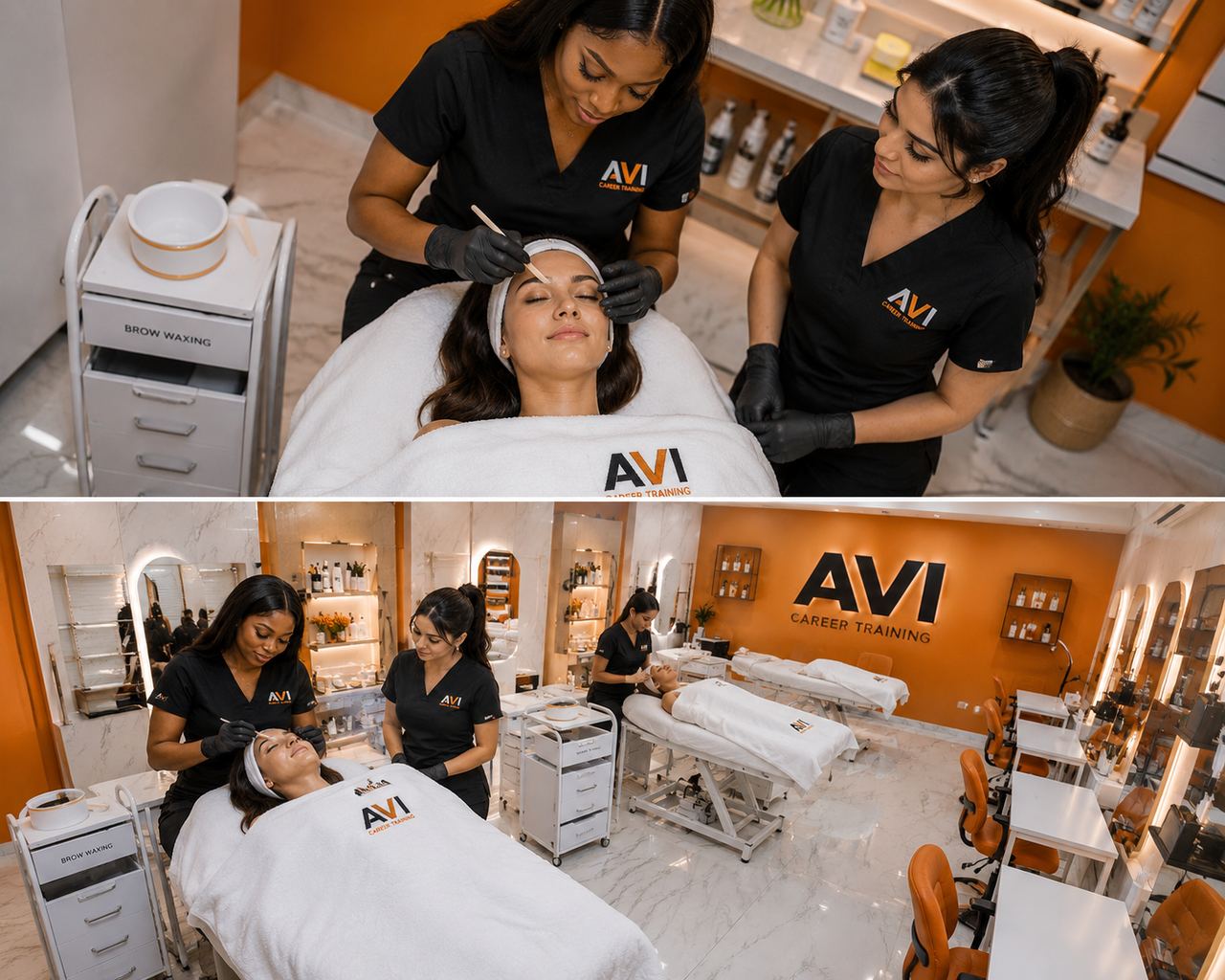
In the early weeks of the program, you’ll build foundational knowledge in the classroom — skin anatomy, product knowledge, sanitation protocols. As you advance, you’ll move into AVI’s student clinic, where you’ll perform services on real clients under the supervision of licensed instructors.
This matters more than most students initially realize. Working on actual people — not mannequins — forces you to adapt. Clients have different skin types, different sensitivities, and different comfort levels. Learning to read those variables and adjust your technique in real time is what separates a school-trained esthetician from a truly job-ready one.
Building Speed, Confidence, and Judgment
In a professional spa or clinic, you’ll often have 50 to 60 minutes for a facial service — including setup, consultation, treatment, and breakdown. AVI’s clinic hours are designed to build the speed and efficiency that real-world bookings demand.
You’ll also develop professional judgment: knowing when to modify a treatment, when to refer a client to a dermatologist, and how to handle challenging situations gracefully. These are the skills employers notice during interviews — and the ones clients remember.
—
Inclusive Esthetics: Learning to Work on Every Skin Tone
Here’s something that sets AVI Career Training apart from a lot of esthetics programs: the curriculum is explicitly built around diverse skin tones and culturally competent client care.
Why This Matters in Northern Virginia
The Northern Virginia and DC metro market is one of the most ethnically diverse regions in the country. Your future clients will have a wide range of skin tones, concerns, and backgrounds. If your training only prepared you for one type of skin, you’re not fully prepared for the market you’re entering.
The Fitzpatrick Scale in Practice
AVI’s esthetics program curriculum includes hands-on application of the Fitzpatrick Scale — a six-type classification system used to assess skin tone, UV response, and treatment risk. Understanding Fitzpatrick typing helps you customize treatments appropriately and avoid adverse outcomes from waxing, chemical exfoliation, and other services on deeper skin tones.
This isn’t just theory. You’ll practice these assessments during clinic hours, building real competency across the full range of skin types.
A Professional Advantage That Follows You
Estheticians who can confidently serve every client — regardless of ethnicity, skin tone, or hair texture — are simply more valuable in the marketplace. You can market yourself to a broader clientele. You can work in more settings. And you give clients who have historically felt underserved in the beauty industry a reason to become loyal, long-term customers.
—
Meet Two AVI Students: Real Stories, Real Outcomes
Story 1: From Retail to Treatment Room
Monique had spent eight years behind a department store beauty counter in Tysons Corner. She knew products inside and out, but she couldn’t perform treatments — and she watched estheticians in the store’s spa earn more per client than she made in a full shift. At 34, she enrolled in AVI’s Basic Esthetics program on a full-time schedule. Four months later, she passed her Virginia State Board exam on the first attempt. Within six weeks of graduating, she had a full-time position at a medical spa in McLean — a setting she’d been eyeing for years. Her retail knowledge gave her an edge in client consultations. Her AVI training gave her the license to act on it.
Story 2: A Career Change With a Clear Timeline
David had 12 years in IT before a layoff pushed him to reconsider everything. A friend who owned a spa in Reston suggested he look into esthetics — half as a joke, half seriously. David came to AVI for a tour, asked hard questions about licensing timelines and job outcomes, and enrolled two weeks later. He used the GI Bill® benefit he’d never touched to cover tuition. He completed the program in just over three months on a full-time schedule. Today he’s building a clientele in a salon suite and running his own books — a level of professional independence he never had in corporate life.
—
Career Paths After Completing Your Basic Esthetics Program
Finishing your Basic Esthetics program and passing the State Board exam opens more doors than most people expect. Here’s an honest look at where graduates go — and what they can earn.
Entry-Level Career Settings
Day Spa Esthetician: Performing facials, waxing, and body treatments in a spa setting. Often the most accessible first position for new graduates, with strong tip income potential on top of hourly wages.
Medical Spa Support: Working alongside nurses, nurse practitioners, and physicians in a medical aesthetic setting. Some medical spas hire newly licensed estheticians for pre- and post-procedure skin care, while others require additional specialized training.
Retail Beauty Educator: Positions with skincare brands in department stores, specialty retailers, or brand showrooms. Strong product knowledge from your esthetics training is a competitive advantage here.
Salon Suite Owner: Some graduates move directly toward entrepreneurship — renting a suite, building their own book, and running their own practice. The timeline varies, but it’s a realistic long-term path from day one.
What Can You Earn?
According to BLS and Virginia labor market data, Virginia estheticians earn a median range of $38,000–$48,000 per year. That figure reflects base wages — in spa and salon settings with active clientele, tip income can push total annual earnings meaningfully higher.
Earning potential in esthetics scales with experience, specialization, and the type of setting you work in. Medical spas and high-end resort spas typically pay more than budget chains.
Where Can You Go From Here?
A Basic Esthetics license is a starting point — not a ceiling. AVI offers advanced programs for graduates who want to specialize:
- Master Esthetics: Advanced skincare techniques and deeper clinical skills
- Cosmetic Laser Technician: Training in laser and light-based treatments, one of the fastest-growing segments in aesthetic medicine
- Electrolysis: Permanent hair removal — a niche skill with consistent demand
According to the U.S. Bureau of Labor Statistics, skincare specialist employment is projected to grow approximately 17% through 2032 — significantly faster than the average for all occupations. That growth is driven by increased consumer interest in professional skin care, the expansion of medical aesthetics, and an aging population seeking anti-aging treatments.
—
Take the Next Step at AVI Career Training in Vienna, VA
AVI Career Training’s Basic Esthetics program gives you 450 hours of hands-on, career-focused training — aligned with Virginia State Board requirements, grounded in inclusive technique, and taught by licensed industry professionals at our Vienna, Virginia campus.
You don’t need prior experience to start. You need the drive to learn, the willingness to practice, and a clear goal on the other side.
If you’re ready to find out whether this program is the right fit, apply to AVI Career Training today or call us directly at (703) 943-9841. Our admissions team can answer questions about scheduling, financial aid options — including the GI Bill® — and what your first day of training actually looks like.
Your career in esthetics starts with one decision. Make it today.