
What A Nail Tech Actually Does: Career Reality Check For Fairfax County
A nail technician shapes, colors, and maintains clients’ fingernails and toenails while building lasting relationships in one of the most social corners of the beauty industry. If you’ve been wondering whether a nail tech career is right for you, this guide breaks down exactly what the job looks like day to day, what training looks like in Virginia, and how AVI Career Training in Vienna can get you started fast.
Key Takeaways
- Nail technicians do far more than paint nails — they provide sanitation, nail health assessments, and full hand and foot care services.
- Virginia requires a state cosmetology board license to work as a nail technician professionally.
- AVI Career Training’s Nail Technology program is only 150 hours, one of the shortest paths to a new career in the beauty industry.
- The program is located at 112 Lawyers Rd NW Suite 3, Vienna, VA 22180 — conveniently accessible to Fairfax County residents.
- Finishing your training opens doors to salons, spas, medical aesthetics offices, and self-employment across Northern Virginia.
The Real Day-to-Day Life of a Nail Technician
Ask anyone who has never worked in a salon what a nail tech does, and they’ll probably say “paint nails.” That’s a bit like saying a chef “heats food.” The reality is layered, skilled, and genuinely interesting.
A working nail technician in Fairfax County typically arrives before their first client, sets up a sanitized workstation, checks their appointment book, and reviews any client notes from previous visits. From there, the day is a steady rhythm of consultations, services, and brief turnovers between clients.
Services You’ll Actually Provide
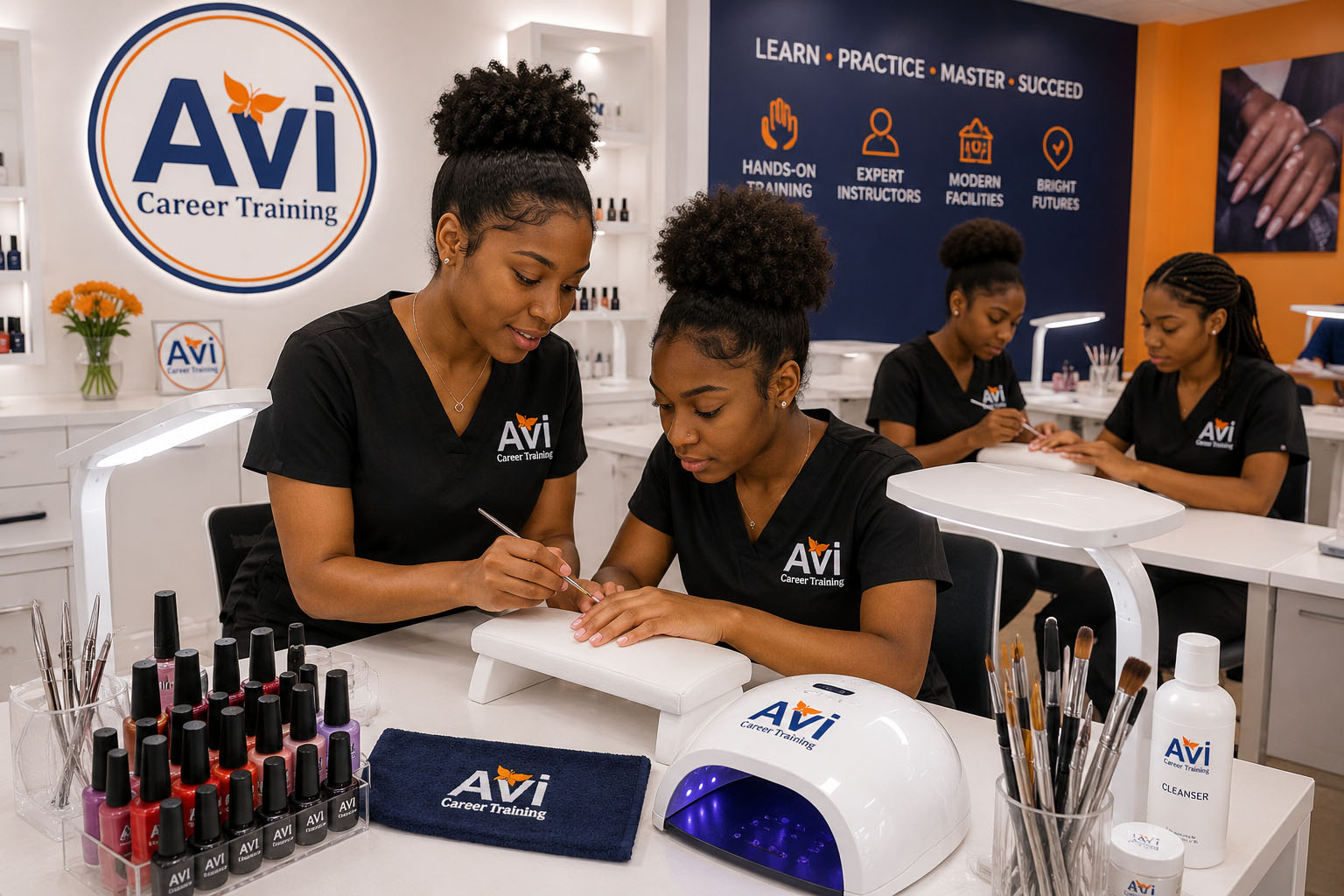
Nail technicians are trained to perform a wide range of hands-on services, including:
- Manicures and pedicures — classic, gel, shellac, and spa variations
- Acrylic and gel nail extensions — sculpting, filing, and finishing enhancements
- Nail art — hand-painted designs, stamping, foil, and 3D embellishments
- Nail repair — fixing breaks, cracks, and damaged nail beds
- Cuticle care — safe removal, moisturizing, and health maintenance
- Paraffin treatments — deep moisturizing for hands and feet
- Sanitation and infection control — a non-negotiable part of every single appointment
That last point is more significant than most people realize. Nail technicians are responsible for preventing the spread of fungal infections, bacteria, and other pathogens. Proper sanitation protocol isn’t background knowledge — it’s a core professional skill that your clients depend on every time they sit down at your station.
The Client Relationship Side of the Job
Unlike some healthcare or beauty roles, nail technicians often see the same clients every two to four weeks. Over months and years, those appointments become a genuine relationship. Clients talk about their lives, celebrate milestones, and trust their nail tech in a deeply personal way. If you enjoy connecting with people and making someone’s day brighter, this aspect of the career is genuinely rewarding.
Strong nail techs also know how to consult — asking about a client’s lifestyle, nail health history, and preferences before recommending products or services. Someone who types all day needs a different approach than someone who works outdoors or competes in sports.
Where Nail Technicians Work in Northern Virginia
Fairfax County is one of the most affluent and densely populated counties in the entire country, which means the demand for personal care services is consistently strong. Here’s where nail technicians typically find employment:
- Full-service salons — the most common setting, offering both nail and hair services under one roof
- Nail-only salons — high-volume environments with a specialized focus
- Day spas and resort spas — often found in the upscale communities throughout Fairfax County and neighboring Loudoun County
- Medical spas and dermatology offices — a growing niche that focuses on nail health alongside skincare
- Freelance and mobile services — serving clients at home, events, or bridal parties
- Self-employment — renting a booth or suite and building your own clientele
The variety of work environments means your career can evolve as your interests and goals change. Many nail techs start in a high-volume salon to build speed and skill, then transition to a spa or private studio as their reputation grows.
What Nail Tech Training Actually Looks Like at AVI
AVI Career Training’s Nail Technology program runs 150 hours. In the context of beauty school programs, that is a focused, efficient path to licensure. For comparison, AVI’s Cosmetology program is 1,000 hours, Basic Esthetics is 600 hours, and Master Esthetics is 750 hours. The Nail Technology program’s shorter duration is one reason it appeals to career changers, parents returning to work, or anyone who wants to move quickly into a new profession.
During those 150 hours, students at AVI learn the technical skills, sanitation standards, product knowledge, and Virginia state board requirements they need to pass their licensing exam and start working. AVI Career Training holds COE accreditation (Council on Occupational Education), which signals that the institution meets rigorous academic and professional standards.
The school is located at 112 Lawyers Rd NW Suite 3, Vienna, VA 22180, a convenient location for residents of Fairfax County, Loudoun County, and the surrounding communities. You can also reach the admissions team directly at (571) 520-4417.
Ready to get started? Apply to AVI Career Training’s Nail Technology program today.
Is a Nail Tech Career Right for You?
Let’s be honest about what this career requires, because a reality check cuts both ways — it should help you self-select in just as much as out.
You will likely thrive as a nail technician if you:
- Enjoy detailed, hands-on work that requires precision and patience
- Like talking with people and building ongoing relationships
- Appreciate variety — no two clients or sets of nails are identical
- Want flexibility in scheduling, including evenings and weekends if you prefer them
- Are interested in eventually working independently or owning your own space
You should think carefully if you:
- Struggle with standing or sitting in one position for extended periods (ergonomics matter in this job)
- Have sensitivities to chemical products, since nail products include acrylics, gels, and solvents
- Prefer a career with zero client-facing interaction
Neither list is a dealbreaker on its own, but going in with clear eyes means you’ll build a career you actually enjoy.
Beyond Nails: Growing Within the Beauty Industry
One advantage of starting with nail technology is that it gives you a foothold in a broader industry. Many nail techs eventually expand into esthetics, cosmetology, or wellness services. AVI offers programs in all of these areas — Basic Esthetics at 600 hours, Master Esthetics at 750 hours, Massage Therapy at 625 hours (with Title IV federal financial aid available), and Cosmetology at 1,000 hours — so continuing your education at the same COE-accredited school is a straightforward next step when you’re ready.
AVI also offers programs in Laser Technician (120 hours), Medical Assistant (600 hours), and ESL (1,200 hours), making it a genuinely full-spectrum career training center, not just a beauty school.
Frequently Asked Questions
How long does it take to become a nail technician in Virginia?
Virginia requires 150 hours of approved nail technology training before you can sit for the state licensing exam. AVI Career Training’s Nail Technology program meets exactly that requirement. The total time from enrollment to working in a salon depends on your schedule and how quickly you schedule your board exam after completing your hours, but many students are ready to work within a few months of starting the program.
Do I need a license to do nails professionally in Fairfax County?
Yes. In Virginia, performing nail services for compensation without a state-issued nail technician license is illegal. Licensing is handled through the Virginia Department of Professional and Occupational Regulation (DPOR). You must complete your required training hours at an approved school like AVI Career Training and pass both a written and practical exam to receive your license.
How much can a nail technician earn in Northern Virginia?
Earnings for nail technicians vary based on employment type, experience, clientele, and location. In a competitive market like Northern Virginia, experienced nail techs — especially those who have built a loyal client base or who work in higher-end spa environments — can earn meaningfully more than national averages. Booth renters and self-employed nail techs set their own pricing, which can significantly impact income. We encourage you to research current wage data through the Bureau of Labor Statistics and speak with working professionals in the area.
Does AVI Career Training offer financial aid for the Nail Technology program?
AVI Career Training offers Title IV federal financial aid for eligible programs, specifically Cosmetology, Basic Esthetics, Master Esthetics, and Massage Therapy. We never want to misrepresent what’s available, so we encourage you to contact AVI directly at (571) 520-4417 or visit the application page to discuss your specific situation and which financial resources may apply to your enrollment.
What’s the difference between a nail technician and an esthetician?
Nail technicians specialize in the care of fingernails and toenails, including manicures, pedicures, nail enhancements, and nail art. Estheticians focus on skincare — facials, waxing, chemical peels, and other treatments for the face and body. While there is some overlap in the wellness and spa world, they are separate licenses requiring separate training programs. AVI Career Training offers both, so if you’re interested in eventually doing both, you can plan your education accordingly.
Take the First Step Toward Your Nail Tech Career
A career as a nail technician is a real, skilled profession that offers genuine flexibility, consistent demand, and the kind of day-to-day human connection that many people find deeply satisfying. In Fairfax County’s thriving service economy, trained and licensed nail technicians have strong options for employment and entrepreneurship.
AVI Career Training has built its reputation in Vienna on giving students practical, focused education through a COE-accredited program that respects your time and prepares you for the board exam and the real working world. With a Nail Technology program that can be completed in 150 hours, there’s no reason to wait another season to start building the career you want.
Visit AVI Career Training’s application page to get started, or call us at (571) 520-4417 with any questions. We’re at 112 Lawyers Rd NW Suite 3, Vienna, VA 22180, and we’re happy to help you figure out whether nail technology — or any of our other beauty and wellness programs — is the right fit for your goals.