Continuing beauty education is defined as the post-licensure training beauty professionals complete to maintain active licenses and sharpen their skills. Known formally as Continuing Professional Development (CPD) in many industry contexts, this ongoing learning covers everything from state-mandated health and safety courses to elective advanced techniques in cosmetology, esthetics, and nail technology. Whether you are a licensed cosmetologist in Virginia or a newcomer mapping out your career path, understanding how this system works determines how far you go. Providers like Avi Career Training, Pivot Point International, and state boards such as Maryland’s Board of Cosmetologists all play roles in shaping what these requirements look like in practice.
What is continuing beauty education and why does it exist?
Continuing beauty education exists because beauty licenses do not grant permanent permission to practice. States require licensed professionals to prove they are staying current with health codes, safety protocols, and evolving techniques before renewing their credentials. Post-licensure learning requirements vary by state, with renewal cycles spanning 1–3 years and CE hours ranging from 4 to 16 or more. That range reflects how seriously different states treat public safety in service environments.
The system has two layers. The first is mandatory coursework, which typically covers sanitation, infection control, state laws, and client safety. The second is elective coursework, where professionals choose topics aligned with their career goals, such as advanced color techniques, lash extensions, or business management. Both layers count toward the total hours required for license renewal.

Experts at Pivot Point International describe continuing education as more than legal compliance. It functions as a protective measure for public safety and a standard-setter for the profession as a whole. That framing matters because it shifts the mindset from “checking a box” to genuinely investing in your practice.
What are the regulatory requirements and renewal cycles?
Every state sets its own rules, and the differences are significant. Renewal cycles run from one to three years depending on your state board. The required CE hours within each cycle typically fall in the 4–16 hour range, with core subjects like health, safety, sanitation, and state law forming the non-negotiable foundation.
Maryland offers a clear example of how specific these rules get. Maryland mandates 6 CE hours total as of 2026, split into 2 mandatory hours on health and safety and 4 elective hours covering business practices and advanced techniques. All courses must carry state board approval and be completed within the active renewal period to count. Completing a course one day after your renewal deadline means it does not count toward that cycle.
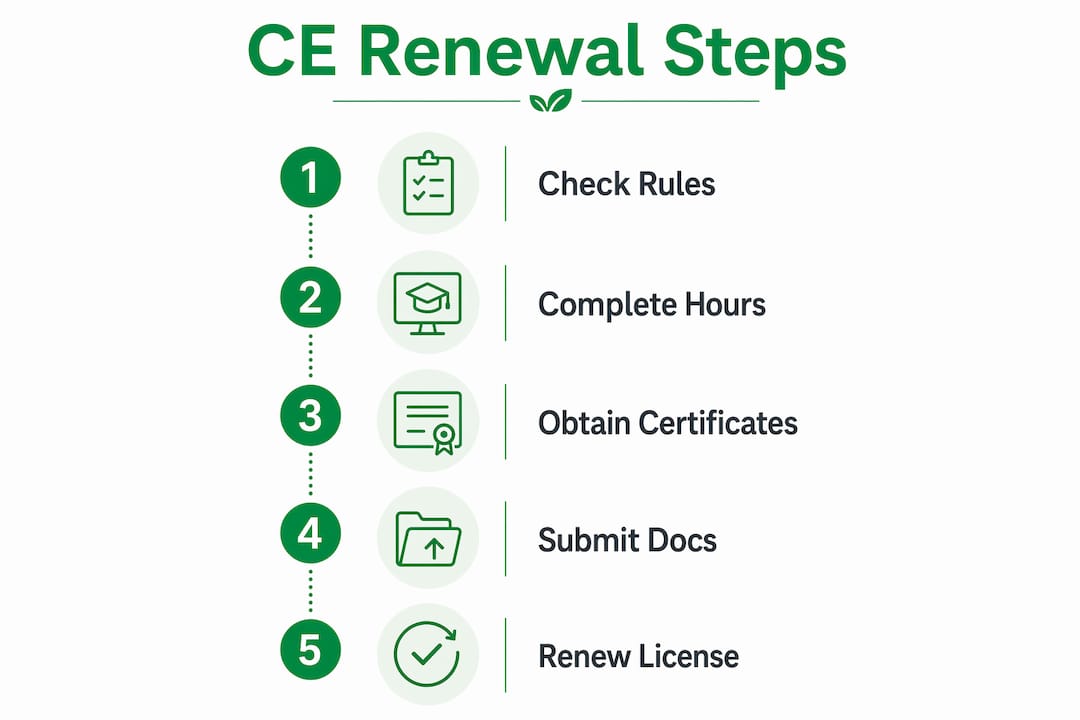
Documentation is where many professionals get tripped up. CE certificates must include the provider’s approval number, the course title, the licensee’s name, and the hours awarded. States conduct audits, and incomplete certificates get rejected. Keep every certificate in a dedicated folder, physical or digital, from the moment you receive it.
Pro Tip: Set a calendar reminder 90 days before your license renewal date. That window gives you enough time to complete remaining hours, gather certificates, and submit documentation without rushing.
| State Requirement | Details |
|---|---|
| Renewal cycle length | 1–3 years depending on state board rules |
| CE hours per cycle | 4–16 hours, split between mandatory and elective |
| Maryland 2026 mandate | 6 total hours: 2 mandatory (health/safety), 4 elective |
| Certificate requirements | Must include provider approval number, course title, licensee name, and hours |
| Non-compliance consequence | License suspension, reinstatement fees, possible re-examination |
What types of courses and formats are available?
Beauty industry training covers a wider range of topics than most people expect. The mandatory category includes health and safety, sanitation procedures, infection control, and state regulatory updates. These are non-negotiable and form the base of every renewal cycle. Elective courses are where the real career-building happens.
Elective topics available to licensed professionals include:
- Advanced hairstyling and color correction
- Esthetics specializations such as chemical peels and microdermabrasion
- Nail technology and nail art techniques
- Lash and brow services
- Business management, marketing, and salon ownership
- Client psychology and communication skills
Format options have expanded considerably. Many states now accept online CE courses with 24/7 access, though some still require in-person attendance for subjects like sanitation or state law updates. Hybrid options combining live streaming with in-person components address both flexibility and compliance needs.
Choosing between online and in-person formats depends on your learning style and your state’s rules. Online courses work well for business management or technique theory. In-person workshops are better for hands-on skills like advanced cutting or chemical services, where physical practice matters.
Pro Tip: Before enrolling in any course, verify the provider’s state board approval number on your state’s official licensing website. Completing an unapproved course means those hours will not count, regardless of how much you paid.
The comparison between beauty classes and online courses shows that neither format is universally superior. The right choice depends on the subject matter and your state’s specific attendance rules.
| Format | Best For | Limitation |
|---|---|---|
| Online self-paced | Business, theory, regulatory updates | Not accepted for all subjects in every state |
| Live virtual | Interactive learning, Q&A with instructors | Requires stable internet and scheduled time |
| In-person workshop | Hands-on technique practice | Less flexible scheduling |
| Hybrid | Balancing compliance and convenience | Varies by provider availability |
What are the benefits of continuing education beyond license renewal?
The most underestimated benefit of ongoing beauty education is financial. Ongoing training allows professionals to increase earnings by offering premium and specialized services that command higher prices. A cosmetologist who adds a certified color correction specialty can charge significantly more per appointment than one offering only standard services.
The benefits extend well beyond income:
- Client trust: Clients notice when their stylist or esthetician references current techniques and safety standards. CPD acts as a marketing tool that helps professionals justify premium pricing through demonstrated commitment to quality.
- Career advancement: Specialization opens doors to roles in education, product development, and salon management that generalist practitioners rarely access.
- Creative engagement: Learning new techniques directly combats the burnout that affects many beauty professionals after years of repetitive work.
- Business skills: Courses in marketing, client retention, and salon finance give professionals the tools to build or grow their own businesses.
A common misconception is that CE is only about technique updates. Impactful programs include business management and client psychology alongside technical skills. These complementary areas are key to long-term financial success and avoiding burnout. The professionals who thrive long-term treat their education as a business strategy, not just a compliance task.
Understanding the full scope of certification advantages helps you see why strategic course selection matters more than simply accumulating hours.
How to plan and manage your continuing beauty education
Managing CE effectively requires treating it like a business calendar item, not an afterthought. Here is a practical framework:
- Record your renewal date immediately. Write it in your phone, your calendar, and a physical planner. Missing CE deadlines can cause automatic license suspension, mandatory reinstatement fees, and potentially new exams. The cost of missing a deadline far exceeds the cost of a course.
- Identify your mandatory hours first. Know exactly which subjects your state requires before selecting electives. Complete mandatory courses early in the renewal cycle so elective hours can be chosen strategically.
- Select state-board approved providers only. Selecting approved providers and obtaining official certificates with proper approval numbers is non-negotiable. Simple course completion without correct credentials gets rejected during audits.
- Choose electives that build toward a specialty. Strategic CE course selection focused on specialization offers a competitive edge and allows premium service pricing rather than just fulfilling minimal legal requirements.
- Document everything immediately. Store certificates digitally and physically as soon as you receive them. Do not wait until renewal time to organize your records.
- Use your CE as a marketing asset. Post completed certifications on your social media profiles and salon bio. Clients respond to visible proof of professional development.
Pro Tip: Block out one weekend per quarter for CE coursework. Spreading hours across the year prevents the last-minute scramble that leads to choosing whatever is available rather than what actually advances your career.
The evolution of cosmetology education shows that professionals who plan their learning proactively consistently outperform those who treat CE as a last-minute obligation.
Key takeaways
Continuing beauty education is the structured system of post-licensure learning that keeps professionals compliant, competitive, and financially positioned to grow.
| Point | Details |
|---|---|
| Mandatory vs. elective hours | Every state requires core hours in health and safety, plus elective hours you choose strategically. |
| Documentation is non-negotiable | Certificates must include provider approval numbers and licensee names or states will reject them. |
| Financial upside is real | Specialization through CE directly enables premium pricing and higher earning potential. |
| Deadlines carry serious consequences | Missing renewal deadlines triggers suspension, reinstatement fees, and possible re-examination. |
| Business skills belong in your CE plan | Courses in management and client psychology are as career-defining as advanced technique training. |
Why i think most beauty professionals approach CE backwards
Most licensed professionals I have observed treat continuing education as a compliance sprint. They wait until 60 days before renewal, grab whatever approved courses are still available, and check the box. That approach keeps your license active. It does not keep your career moving.
The professionals I have seen build genuinely successful long-term careers treat their CE calendar the way a business owner treats a product roadmap. They identify one or two specializations they want to own, then build their elective hours around those areas over multiple renewal cycles. A cosmetologist who spends three consecutive renewal cycles deepening expertise in color correction becomes the go-to specialist in their market. That is not an accident. It is a plan.
The other thing most articles skip is the burnout factor. Beauty work is physically and emotionally demanding. The professionals who stay engaged and creative over 10 or 20 years are almost always the ones who kept learning. New techniques and new knowledge reset your enthusiasm for the work. That is not a soft benefit. It is a career survival strategy.
My honest recommendation: treat your next renewal cycle as a chance to pick one specialty and go deep. Skip the scattered approach of one course on color, one on nails, and one on business. Choose a direction and build toward it. The hands-on training foundation you build through focused CE is what separates professionals who plateau from those who keep growing.
— krishna
How Avi supports your beauty education goals
Avi Career Training in Fairfax County, VA, offers state-approved programs in cosmetology, esthetics, and massage therapy designed for both newcomers and licensed professionals seeking to advance their skills.
Avi’s programs combine hands-on training with personalized mentorship, giving students real-world experience through partnerships with leading spas and salons across Northern Virginia. Whether you are working toward your first license or building on an existing one, Avi’s cosmetology program options are structured to meet your goals at your pace. Financial aid options make quality training accessible regardless of your starting point. If you are ready to turn your CE hours into a genuine career advantage, Avi is the place to start.
FAQ
What is continuing beauty education exactly?
Continuing beauty education is post-licensure training that licensed beauty professionals complete to renew their credentials and update their skills. It includes both mandatory courses on health and safety and elective courses on advanced techniques or business management.
How many CE hours do beauty professionals need per renewal cycle?
CE hours range from 4 to 16 per renewal cycle depending on the state. Maryland, for example, requires 6 total hours as of 2026, split between mandatory and elective subjects.
What happens if you miss your CE deadline?
Missing a CE deadline can trigger automatic license suspension, reinstatement fees, and in some cases a requirement to retake licensing exams. Treating renewal dates as firm deadlines protects your ability to practice.
Can beauty CE courses be completed online?
Many states accept online CE courses for subjects like business management and regulatory updates. Some states still require in-person attendance for hands-on subjects like sanitation, so always verify your state board’s rules before enrolling.
Does continuing education in beauty actually increase earnings?
Yes. Professionals who complete specialized CE courses can offer premium services that command higher prices. Business and client psychology training also contributes directly to long-term financial success and career sustainability.