
Online Beauty Courses Vs Hands-On Training: Which Path Is Right for You?
For most beauty and wellness careers, hands-on training is essential and cannot be fully replaced by online coursework alone — but the best programs often blend both approaches to prepare you for real-world success. If you are weighing your options and trying to decide how to launch your career in cosmetology, esthetics, massage therapy, or nail technology, understanding the key differences between purely online beauty courses and structured hands-on training will help you make the smartest investment in your future.
Key Takeaways
- State licensing boards in Virginia — and across most of the US — require a minimum number of clock hours completed in an approved, hands-on training environment.
- Online-only beauty courses cannot satisfy Virginia’s practical hour requirements for licensed professions like cosmetology, esthetics, or massage therapy.
- Hybrid programs that combine theory delivered online or in the classroom with supervised practical training give students the best of both worlds.
- Accredited schools like AVI Career Training offer structured programs with defined hour requirements, financial aid eligibility, and career placement support.
- Choosing a COE-accredited institution protects your investment and ensures your credential is recognized by employers and licensing boards.
- Program length varies widely — from 120 hours for Laser Technician training to 1,200 hours for Cosmetology — so it pays to research exactly what your target career requires.
What Online Beauty Courses Can and Cannot Do
The internet has made it easier than ever to learn the theory behind beauty and wellness disciplines. You can watch tutorials on skin anatomy, study color theory, or read about the science of hair treatments — all from your couch. Online beauty courses have genuine value for supplementing your education, exploring a new interest, or refreshing your knowledge after you are already licensed.
However, there is a hard limit to what a screen can teach you. You cannot learn to perform a European facial, execute a precision haircut, or carry out a deep tissue massage by watching videos alone. Your hands, your muscle memory, and your ability to read a real client’s responses are all developed through direct practice — and that practice must be supervised by qualified instructors who can correct your technique in real time.
There is also a regulatory reality to consider. In Virginia, the Department of Professional and Occupational Regulation (DPOR) sets minimum clock-hour requirements for each licensed beauty profession. Those hours must be completed in an approved school setting. No online-only course can substitute for them. If your goal is to hold a Virginia cosmetology or esthetics license, you will need to enroll in an accredited, in-person program.
The Case for Hands-On, Accredited Training
Structured hands-on training at an accredited school does far more than check the regulatory box. It builds the clinical confidence that employers notice immediately during an interview or a working interview on the salon or spa floor. When you graduate from a program that required you to perform services on real clients under real conditions, you walk into your first job already knowing how to handle a nervous client, manage your time at a busy station, and troubleshoot when a treatment does not go exactly as planned.
Accreditation matters too. AVI Career Training holds accreditation from the Council on Occupational Education (COE), one of the most respected accrediting bodies for career schools in the United States. COE accreditation means the school’s programs, faculty qualifications, facilities, and student support services have all been independently reviewed and approved. It also means students may be eligible for Title IV federal financial aid — a benefit that online-only courses sold outside an accredited institution simply cannot offer.
AVI Career Training’s Program Lineup
At AVI Career Training in Vienna, Virginia, every program is designed to meet or exceed Virginia’s licensing requirements while giving students hands-on experience from day one. Here is a quick look at what is available and the clock hours involved:
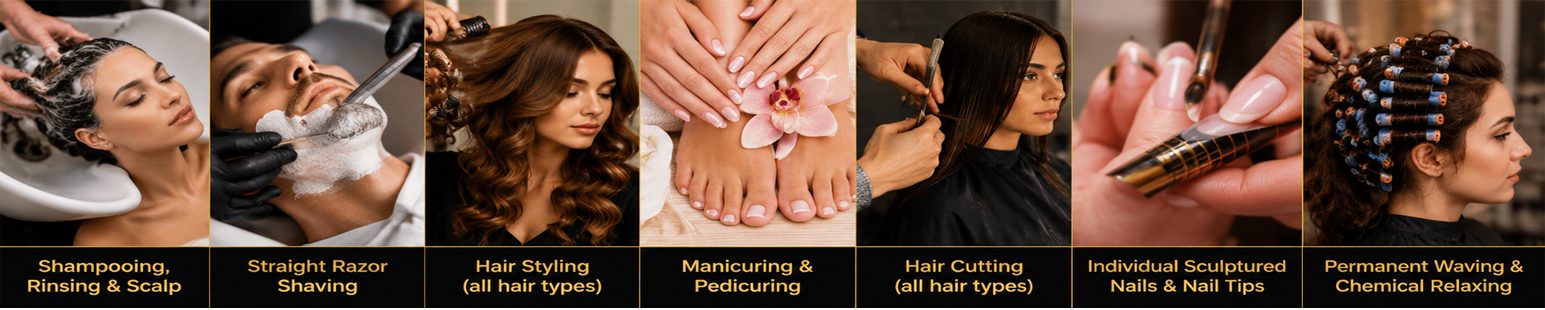
- Cosmetology — 1,000 hours. Covers cutting, coloring, chemical services, skin care basics, and salon business skills.
- Basic Esthetics — 600 hours. Focuses on facials, waxing, skin analysis, and client consultation.
- Master Esthetics — 750 hours. Builds on Basic Esthetics with advanced modalities and clinical skin care techniques.
- Massage Therapy — 625 hours. Includes anatomy, physiology, Swedish massage, deep tissue, and specialty techniques. Title IV federal financial aid is available for this program.
- Nail Technology — 150 hours. Covers manicuring, pedicuring, nail art, and product chemistry.
- Laser Technician — 120 hours. Introduces laser safety, skin typing, and common laser and light-based treatments.
- Medical Assistant — 600 hours. Prepares students for clinical and administrative roles in medical office settings.
- ESL (English as a Second Language) — 1,200 hours. Supports non-native English speakers in building language skills for professional environments.
Every one of these programs includes significant in-person, practical training components that an online course simply cannot replicate. Ready to take the first step? Apply to AVI Career Training today and speak with an admissions advisor about which program fits your goals.
Online Learning as a Complement, Not a Replacement
None of this means online learning is worthless — far from it. Many accredited career schools, including those in the beauty and wellness field, incorporate online or digital components into their curriculum for theory-based content like anatomy, sanitation standards, state law review, and business fundamentals. This blended approach lets students absorb background knowledge at a comfortable pace while reserving precious in-person time for skill-building practice.
The key distinction is that these online components are embedded within an accredited, clock-hour program — they are not a standalone substitute. If you see a beauty “certification” sold entirely online for a flat fee with no in-person requirements, it is worth asking hard questions: Is this recognized by Virginia’s licensing board? Does this meet DPOR’s clock-hour requirements? Will an employer treat this credential the same way they treat a license from a state-approved school? In most cases, the honest answers are no, no, and no.
Financial Aid and Return on Investment
One of the most practical reasons to choose an accredited, hands-on program over an online course is access to federal financial aid. Because AVI Career Training is COE-accredited, qualifying students may be eligible for Title IV federal financial aid to help cover the cost of their education. The Massage Therapy program, in particular, is Title IV eligible. This kind of support is simply not available for most standalone online beauty courses.
Beyond financing, consider the return on investment. A licensed cosmetologist, esthetician, or massage therapist can build a meaningful career with steady income, flexible scheduling, and real entrepreneurial potential. An unrecognized online certificate, on the other hand, may cost less upfront but deliver little career value in return. When you invest in a licensed profession through an accredited school, you are investing in a credential that opens doors.
How to Choose the Right Beauty School
If you are ready to move beyond browsing online courses and commit to a career in beauty and wellness, here are the most important factors to evaluate when choosing a school:
- Accreditation: Look for COE or NACCAS accreditation, which signals quality and federal aid eligibility.
- State approval: Confirm the school is approved by Virginia’s DPOR to train students for licensure.
- Clock hours: Verify that the program meets the minimum hours required for your target license.
- Facility and equipment: Tour the campus if possible. Modern equipment and a real working environment matter.
- Student support: Ask about job placement assistance, tutoring, and licensing exam preparation.
- Financial aid options: Find out which programs qualify for Title IV aid and what other funding options exist.
AVI Career Training checks every one of these boxes. Located at 112 Lawyers Rd NW Suite 3, Vienna, VA 22180, the school is easily accessible from across Northern Virginia and the broader DC metro area. You can reach the admissions team directly at (571) 520-4417 to ask questions or schedule a visit.
Frequently Asked Questions
Can I get a cosmetology license in Virginia by completing an online-only beauty course?
No. Virginia’s Department of Professional and Occupational Regulation requires cosmetology students to complete a minimum number of clock hours in an approved, in-person training program. Online-only courses do not satisfy this requirement. To sit for the Virginia cosmetology licensing exam, you must graduate from a state-approved school like AVI Career Training.
Are online beauty certifications recognized by salons and spas when hiring?
It depends heavily on the certification and the employer, but in general, licensed professionals — those who have completed an accredited clock-hour program and passed their state board exams — are far more competitive candidates than those holding only an online certificate. Most professional salons and medical spas specifically require state licensure for roles involving chemical services, advanced skin care, or massage therapy.
How long does it take to complete a beauty program at AVI Career Training?
Program length varies depending on the discipline. Nail Technology is the shortest at 150 hours, while Cosmetology requires 1,000 hours and ESL requires 1,200 hours. Basic Esthetics is 600 hours, Master Esthetics is 750 hours, Massage Therapy is 625 hours, Laser Technician is 120 hours, and Medical Assistant is 600 hours. Your admissions advisor can give you a realistic timeline based on your schedule and the program you choose.
Is financial aid available for beauty programs at AVI Career Training?
AVI Career Training is COE-accredited, which means qualifying students may be eligible for Title IV federal financial aid. The Massage Therapy program is specifically Title IV eligible. We encourage prospective students to contact the school directly at (571) 520-4417 or visit the admissions page to learn about all available funding options. We never publish tuition figures without a direct conversation, because your costs depend on program choice, schedule, and individual financial circumstances.
What is the advantage of attending a COE-accredited school versus enrolling in a popular online beauty course?
COE accreditation means the school has been independently evaluated for quality across curriculum, faculty, facilities, and student outcomes. It also unlocks access to federal financial aid and ensures your credential is recognized by licensing boards and employers. Popular online beauty courses can be great for hobbyists or for supplementing an existing license, but they cannot replace the structured, supervised clinical training that accreditation guarantees — and that a beauty career license requires.
Take the Next Step Toward Your Beauty Career
The bottom line is clear: if you want a real career in cosmetology, esthetics, massage therapy, nail technology, or any other licensed beauty profession, hands-on training at an accredited school is not optional — it is the foundation everything else is built on. Online beauty courses have their place as supplements and exploratory tools, but they cannot grant you a license, qualify you for federal financial aid, or give you the client-ready skills that employers demand.
AVI Career Training in Vienna, Virginia is ready to help you build that foundation the right way. With COE accreditation, a full range of programs, experienced instructors, and a supportive learning environment, we are committed to your success from your very first class to the day you pass your boards and start your career.
Apply to AVI Career Training now or call us at (571) 520-4417 to speak with an admissions advisor and find the program that is the perfect fit for your goals. Your future in beauty and wellness starts here.