
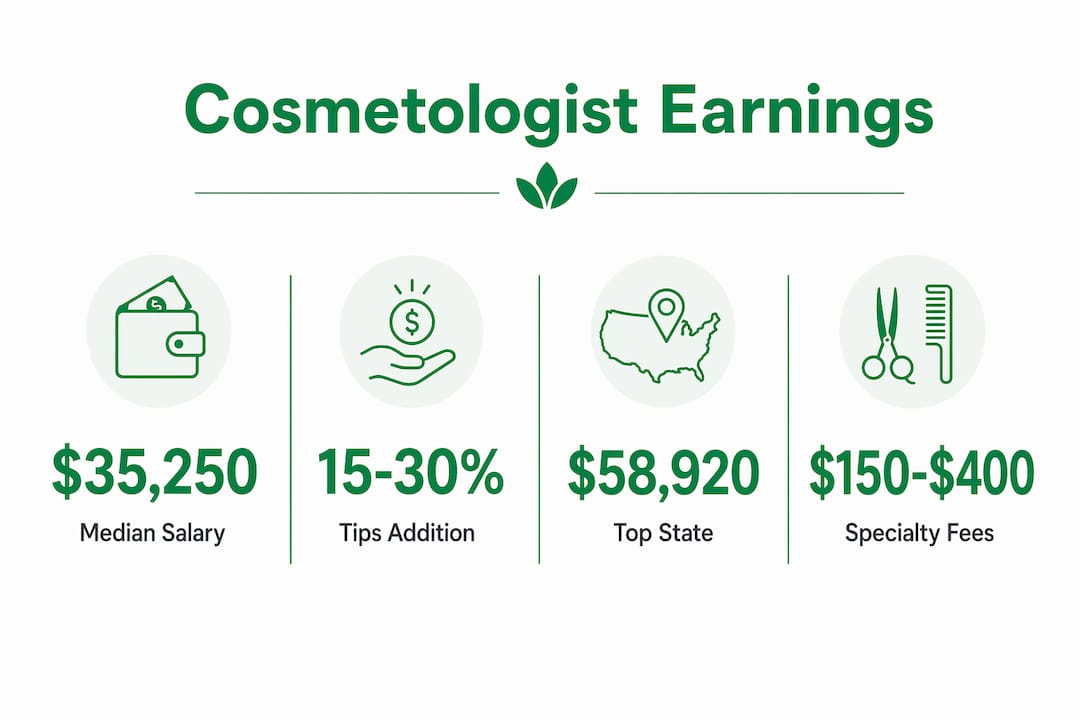
A cosmetologist’s base salary is defined by the U.S. Bureau of Labor Statistics as a national median of $35,250 annually, or roughly $17.00 per hour. That figure, however, tells only part of the story. What does a cosmetologist earn in real life? Significantly more. Tips, specialty services, and the right employment structure routinely push actual take-home pay well above what official data reports. Understanding those variables before you enter the field gives you a clear advantage in planning your cosmetology career earnings.
What does a cosmetologist earn across experience levels?
The $35,250 median is a starting point, not a ceiling. Entry-level cosmetologists earn near $24,000 annually while building their client base. Mid-career professionals typically land in the $29,000–$48,000 range. Top earners, often salon owners or specialists, clear $70,000 or more per year.
The middle 50% of cosmetologists earn between $46,980 and $73,080 annually. That range shows how much room exists between a new graduate and a seasoned professional with a loyal clientele. The gap is not luck. It reflects deliberate choices about specialization, location, and business structure.

One fact that surprises most career researchers: actual cosmetologist income runs 1.3 to 1.4 times higher than IRS-reported figures. Cash tips and non-W-2 income streams simply do not show up in government wage databases. This means the average income for cosmetologists is meaningfully higher than headlines suggest.
What determines how much a cosmetologist earns?
Four factors shape the cosmetologist pay scale more than any others: geography, experience, employment model, and specialty services. Each one operates independently, but they compound quickly when aligned.
Geography
Location is the single largest variable in cosmetologist salary. Washington State cosmetologists earn a median of $58,920, while Alabama and Arkansas cosmetologists earn $26,000–$29,000. That is more than a 100% difference for the same license. Higher cost-of-living states pay more, but urban markets within any state also outperform rural ones.
Experience and career stage
A new cosmetologist spends the first one to two years building a book of clients. Income grows as repeat bookings increase, because a full appointment book is the most direct path to higher earnings. Cosmetologists who actively seek continuing education and certifications move through career stages faster.
Specialty services
Color correction, extensions, and bridal styling command $150–$400 or more per session in higher-end markets. Cosmetologists who master these services attract clients willing to pay premium prices and tip generously. Specialty skills are the fastest route to the 75th percentile of earnings.
Employment model
Whether you work as a salaried employee, on commission, or as a booth renter determines your income structure as much as your skill level. Each model carries different risks and rewards, covered in detail in the next section.
Pro Tip: Research the going rate for specialty services in your target city before choosing where to work. A color correction that costs $180 in a mid-size city may cost $350 in a major metro, and that difference compounds across every client you serve.
How does employment structure affect cosmetologist pay?
The three main employment models in cosmetology produce very different financial outcomes. Choosing the right one for your career stage is one of the most consequential decisions you will make.
-
W-2 employee. You receive an hourly wage or salary, often with benefits like health insurance and paid time off. Income is predictable, but the ceiling is lower. This model suits new graduates who are still building skills and confidence.
-
Commission-based. You earn a percentage of the revenue you generate, typically 40%–60% of service fees. Income scales with performance, but a slow week means a smaller check. This model rewards cosmetologists who are good at upselling and client retention.
-
Booth or suite rental. You pay a flat weekly or monthly rent to use a station in a salon. Everything above that rent is yours. The IRS classifies booth renters as self-employed, which means you pay self-employment taxes and cover your own supplies and insurance. The gross revenue ceiling is the highest of the three models, but so are the responsibilities.
Tips add meaningfully to income across all three models. Tips add 15%–30% to base pay, and high-end salons see even larger gratuities. Because cash tips rarely appear in official wage data, government salary figures consistently understate what cosmetologists actually take home.
BLS salary data omits tips and non-W-2 income, underestimating real earnings by 30%–50% for experienced professionals. Tracking your total income, including cash tips and product commissions, gives you a far more accurate picture of your financial progress.
Pro Tip: If you are considering booth rental, spend at least six months as a commission employee first. Use that time to build a client list, learn your local market’s pricing, and save three months of rent as a financial buffer before you make the switch.
What is the impact of location and salon culture on cosmetologist salaries?
Geography shapes the cosmetologist pay scale in ways that go beyond state-level medians. The type of salon and its clientele matter just as much as the zip code.
| State / Market | Approximate Median Annual Salary |
|---|---|
| Washington | $58,920 |
| Hawaii | High cost-of-living premium |
| National median | $35,250 |
| Alabama | $26,000–$29,000 |
| Arkansas | $26,000–$29,000 |
Urban salons in affluent neighborhoods support premium service pricing and larger tips. A cosmetologist working in a high-end Washington, D.C. suburb earns more per client than the same professional working in a rural market, even within the same state. The regional salary variation between the highest and lowest paying states exceeds 100%.
Salon culture also affects income indirectly. A salon that invests in continuing education, encourages upselling, and maintains a premium brand attracts clients who spend more and tip better. Before accepting a position, research the salon’s average ticket price and client demographics. Those two data points predict your income potential more reliably than the posted hourly rate.
For readers in Northern Virginia, the Washington, D.C. metro market consistently ranks among the highest-paying regions in the country. Check cosmetology salaries in Virginia for a detailed regional breakdown.
What strategies can cosmetologists use to increase their income?
Earnings in cosmetology are not fixed. They respond directly to deliberate professional choices. The cosmetologists who reach the top of the pay scale treat their career as a business from day one.
-
Develop high-value specialties. Color correction, hair extensions, and bridal styling are services clients cannot easily find everywhere. Specialized services command $150–$400 or more per session, and clients who need them become loyal repeat customers.
-
Build a client retention system. A full appointment book beats any hourly rate increase. Send follow-up messages, offer loyalty incentives, and track client preferences. Repeat clients tip more and refer friends.
-
Market yourself actively. Social media, before-and-after photos, and Google reviews drive new client inquiries. Treating cosmetology as a business with real marketing effort separates six-figure earners from average ones.
-
Pursue continuing education. Advanced certifications in color theory, extensions, or scalp health justify higher service prices. They also signal professionalism to clients who are willing to pay for expertise.
-
Plan your path to booth rental or ownership. Salon ownership shifts your income model from wage to revenue, with average salon owner income around $69,530 annually. Booth rental is a natural intermediate step that builds the business skills ownership requires.
Mastering the business side of cosmetology is what separates professionals who plateau at the median from those who grow past it. Technical skill gets you licensed. Business acumen grows your income.
Key Takeaways
Cosmetologist earnings depend on employment model, location, specialization, and business skills far more than the national median of $35,250 suggests.
| Point | Details |
|---|---|
| Median salary understates real income | Tips and non-W-2 income push actual earnings 30%–50% above official BLS figures. |
| Location creates a 100% salary gap | Washington State cosmetologists earn more than double the salary of those in Alabama or Arkansas. |
| Employment model sets the income ceiling | Booth rental offers the highest gross revenue but requires self-employment tax management and overhead planning. |
| Specialization accelerates earnings | Color correction and extensions command $150–$400 per session, attracting loyal, high-spending clients. |
| Business skills drive long-term growth | Marketing, client retention, and pricing strategy matter more than technical skill alone for reaching top-tier income. |
The number that matters most is not the one in the headline
The $35,250 median gets cited constantly, and I understand why. It is official, it is clean, and it comes from the Bureau of Labor Statistics. But after years of watching cosmetologists build careers, I am convinced that number misleads more people than it helps.
The professionals I have seen reach $60,000, $80,000, or more did not do it by finding a higher-paying job listing. They did it by treating their chair like a small business. They tracked every dollar, including cash tips. They raised their prices when demand justified it. They invested in one or two specialty services that their local market underserved, then marketed those services relentlessly.
The uncomfortable truth is that cosmetology rewards entrepreneurial thinking more than almost any other licensed trade. A plumber or electrician earns a wage set largely by union contracts or regional rates. A cosmetologist’s income is far more elastic. That elasticity cuts both ways. It means a passive professional can stagnate at $28,000 for years. It also means a motivated one can double that within three years by making the right moves.
If you are considering this career, do not benchmark yourself against the median. Benchmark yourself against what a specialist with a full client book earns in your target market. That number is your real ceiling, and it is higher than most people expect.
— krishna
Start your cosmetology career with the right foundation at Avi
Knowing what cosmetologists earn is only useful if you have the training to compete at the top of that range. Avi Career Training in Fairfax County, VA, prepares students with hands-on cosmetology education, personalized mentorship, and direct connections to leading spas and salons in Northern Virginia.

Avi’s cosmetology school program covers technical skills alongside the business and client management knowledge that drives real income growth. Students graduate with externship experience, career placement support, and financial aid options that make quality training accessible. If you are ready to enter the field prepared to earn at the top of the pay scale, explore the Avi beauty school program nearest you and take the first step toward a career built on solid professional ground.
FAQ
What is the average income for cosmetologists in the U.S.?
The national median cosmetologist salary is approximately $35,250 per year, or $17.00 per hour. Actual take-home pay is typically 30%–50% higher when tips and non-W-2 income are included.
How much do cosmetologists make with tips included?
Tips add 15%–30% to base pay, and high-end salons see larger gratuities. Because cash tips are rarely captured in government wage data, official salary figures consistently understate real earnings.
Which states pay cosmetologists the most?
Washington State leads with a median salary of $58,920. Hawaii also ranks among the highest-paying states. Alabama and Arkansas sit at the lower end, with medians of $26,000–$29,000.
Does booth rental pay more than working as a salon employee?
Booth rental offers the highest gross revenue ceiling because you keep all service fees above your rent. The tradeoff is that you pay self-employment taxes, cover your own supplies, and manage your own client marketing.
How can a cosmetologist reach six-figure income?
Six-figure earnings in cosmetology come from combining high-value specialty services, a full client book, active marketing, and eventually transitioning to booth rental or salon ownership. Skill development and business acumen both contribute equally to reaching that level.