Nail Technician School in Virginia: Your Career Starts Here
AVI Career Training’s Nail Technician program in Vienna, Virginia gives you the hands-on skills, State Board preparation, and professional credentials you need to launch a nail technology career — in as few as 8 weeks.
That’s not years of schooling. It’s not a four-year degree. It’s a focused, career-ready program designed to get you licensed and earning as quickly as possible.
Northern Virginia’s beauty and wellness market is thriving. From Tysons and Fairfax to Arlington and Reston, nail salons and day spas are in constant demand for skilled, licensed technicians. The question isn’t whether there’s a career here — it’s whether you’re ready to start building it.
If you’re serious about becoming a nail technician, apply to AVI Career Training today and take the first step toward a career that fits your life.
—
Key Takeaways
—
What Does a Nail Technology Program Actually Teach You?
A quality nail technology program covers far more than polish colors and nail art. At AVI Career Training, your training starts on day one with the foundational knowledge and hands-on techniques that professional nail technicians use every day.
Core Curriculum Areas
Nail Anatomy and Physiology
Before you touch a client’s hand, you need to understand what’s underneath the surface. That means learning the structure of the nail plate, nail bed, matrix, cuticle, and surrounding skin — and recognizing the difference between normal nail conditions and those that require medical attention. This knowledge protects both you and your clients.
Manicures and Pedicures
You’ll master the full range of traditional nail services: hand and foot soaks, cuticle care, nail shaping, massage techniques, and polish application. These are the bread-and-butter services every nail technician performs daily, and doing them well builds the client loyalty that drives a sustainable career.
Gel and Acrylic Application
Gel and acrylic extensions are among the most requested — and highest-earning — nail services in the market. Your training includes application, fills, repairs, and safe removal techniques. Getting these right requires practice, and AVI’s hands-on structure means you’re building real skill, not just watching demonstrations.
Sanitation, Sterilization, and Infection Control
This is non-negotiable. Virginia State Board regulations require strict adherence to sanitation protocols, and your training reflects that standard. You’ll learn proper tool sterilization, surface disinfection, personal protective practices, and how to maintain a clean, professional workspace.
Client Consultation and Communication
Knowing how to read a client, understand their needs, and recommend the right services is a skill in itself. Your training includes professional communication, intake procedures, and how to build the kind of client-technician relationship that keeps people coming back — and referring their friends.
Inclusive Techniques — a Real Curriculum Differentiator
AVI’s curriculum is built to serve every client who walks through the door. That means explicit training in techniques that work beautifully across all skin tones — from gel application on deeper complexions to cuticle care that respects diverse skin types. This is a genuine differentiator. Many beauty programs default to techniques designed for a narrow range of clients. AVI doesn’t.
If you’re going to work in Northern Virginia — one of the most racially and ethnically diverse regions in the country — knowing how to serve every client isn’t optional. It’s the standard.
—
Virginia Nail Technician Licensing Requirements
Yes, Virginia requires a license to do nails professionally. This isn’t a formality — it’s a legally enforced requirement governed by the Virginia Department of Professional and Occupational Regulation (DPOR) and the Virginia Board of Cosmetology.
Here’s exactly what you need to know.
The 150-Hour Requirement
Virginia requires 150 clock hours of nail technology training from a state-approved school before you’re eligible to sit for the State Board licensing exam. Those hours must be completed at an approved institution — which is why choosing the right school matters from the start.
> ⚠️ Always verify current clock-hour requirements directly with the Virginia DPOR before enrolling, as regulations can change. Visit Virginia DPOR’s official website for the most current requirements.
AVI Career Training’s Nail Technician program is structured to meet and fulfill Virginia’s educational requirements, so graduates exit the program fully prepared to apply for licensure.
The Two-Part State Board Exam
Once you’ve completed your training hours, you’ll sit for the Virginia State Board exam — which has two distinct components:
Written (Theory) Exam
The written exam tests your knowledge of nail anatomy, product chemistry, sanitation standards, and Virginia state laws and regulations. AVI’s curriculum directly prepares you for this test, integrating theory throughout your hands-on training rather than treating it as an afterthought.
Practical (Skills) Exam
The practical exam requires you to demonstrate actual nail technology skills in a controlled, evaluated setting. You’ll be assessed on your technique, sanitation practices, and professional protocol. The repetitive hands-on training you complete at AVI is specifically designed to make this exam feel familiar — not frightening.
What Happens After You Pass?
Once you pass both components of the Virginia State Board exam, you receive your nail technician license and you’re legally eligible to work as a nail technician anywhere in Virginia. From that point, you can pursue employment at a salon or spa, or begin building toward independent work through booth rental.
—
How Long Does Nail Tech School Take — and What Happens After?
This is one of the most common questions prospective students ask — and the answer is more encouraging than most people expect.
The 8-Week Timeline
AVI’s Nail Technician program can be completed in as few as 8 weeks. That’s the time it takes to fulfill Virginia’s 150 clock-hour requirement and prepare for your State Board exam — not months, not semesters, not years.
For anyone who’s been putting off a career change because they assumed beauty school meant a long, drawn-out commitment, that timeline changes the math entirely.
A Real Student Scenario
Consider someone like Maya — a 29-year-old receptionist from Herndon who spent years doing intricate nail art on her friends and family but never pursued it professionally. She assumed becoming a licensed nail technician would take too long and cost too much. When she learned AVI’s program could be completed in 8 weeks and that financial aid was available, she enrolled. Eight weeks later, she sat for her Virginia State Board exam. She passed. Within a month of licensing, she was working at a salon in Fairfax County and building a client list.
Maya’s story isn’t unusual. It’s what AVI’s program is designed to produce.
After Graduation: Your Career Options
Completing your training and passing the State Board exam opens three primary career paths:
Salon or Spa Employment
This is the most common entry point. You join an established salon or spa as an employee or booth renter, build your client base, and develop your professional identity. The Northern Virginia market — with its density of upscale nail bars, day spas, and med spas — offers strong entry-level opportunities.
Booth Rental / Self-Employment
Many experienced nail technicians eventually transition to booth rental, where they operate essentially as independent contractors within a salon space. This model offers higher earning potential and greater schedule flexibility — two things that make nail technology appealing as a long-term career.
Specialty Services and Continuing Education
Licensed nail technicians can pursue advanced certifications in nail art, extensions, gel systems, and other specialty services — adding income streams and differentiating themselves in a competitive market.
—
Nail Technician Salaries and Career Outlook in Northern Virginia
Salary is a fair question to ask before you invest in any training program. Here’s an honest picture of what nail technicians earn — and why Northern Virginia is a particularly strong market.
National vs. Northern Virginia Context
According to the U.S. Bureau of Labor Statistics, the national median annual wage for nail technicians is approximately $31,000–$38,000 — but that figure includes lower-cost markets across the country.
Northern Virginia is not a low-cost market.
The DC metro area’s higher cost of living drives service prices — and technician earnings — meaningfully above the national median. Nail technicians in the Fairfax, Arlington, and Tysons corridor who build strong client bases often earn well above that range, particularly those who work in booth rental situations where they capture a larger share of service revenue.
> ⚠️ Salary figures vary based on experience, employment type, location, and service specialization. Review current data at BLS.gov before making financial decisions.
What Drives Higher Earning Potential
Several factors allow nail technicians to increase their income over time:
Specialization: Gel extensions, nail art, and advanced pedicure treatments command premium pricing. The more specialized your skills, the higher your service tickets.
Clientele retention: Nail care is a repeat service. Clients return every two to four weeks. A technician with 30–40 loyal clients has a predictable, recurring income base.
Self-employment flexibility: Booth rental allows you to set your own prices and hours. It requires building a client base first, but it’s a realistic path for technicians with two to three years of experience.
Geographic advantage: Being located near Tysons, Reston, or Arlington means your clients have real discretionary income and expect — and pay for — quality services.
Career Stability
The Bureau of Labor Statistics projects steady demand for nail technicians, driven by consistent consumer spending on personal care services. Unlike industries vulnerable to automation, nail technology requires skilled human hands — a stable foundation for a long career.
—
Why Choose AVI Career Training for Nail Technology in Virginia?
There are other schools in Virginia. Here’s why AVI Career Training specifically is worth your consideration.
COE Accreditation and SCHEV Certification
AVI is accredited by the Council on Occupational Education (COE) — a federally recognized accrediting body. AVI is also certified by the State Council of Higher Education for Virginia (SCHEV). These aren’t marketing claims. They’re verifiable credentials that signal educational quality, institutional accountability, and eligibility for federal financial aid.
When you’re choosing a nail technician school, accreditation matters. It affects your access to financial aid, your credential’s professional standing, and the school’s commitment to maintaining program quality.
Financial Aid — Including the GI Bill®
AVI offers financial aid to eligible students, including federal aid programs. And for the large veteran and military-connected community in Northern Virginia — one of the highest-density military populations in the country — AVI accepts the GI Bill®.
If you’ve served, your education benefits can apply here. That’s a meaningful differentiator in a market full of beauty schools that don’t.
Northern Virginia Location — Vienna/Tysons
AVI is located at 1595 Spring Hill Rd #720, Vienna, VA 22182 — right in the heart of Northern Virginia, minutes from Tysons Corner and accessible from Fairfax, McLean, Reston, and Arlington. You’re not training in the abstract. You’re training in the same market where you’ll build your career.
That proximity matters. The clients you’ll eventually serve, the salons you’ll eventually work in, the reputation you’ll eventually build — all of it exists within the same community where you’re learning.
A Second Student Story
Consider Derek — a 34-year-old Army veteran from Woodbridge who separated from service after 10 years and wanted a portable, hands-on career that he could eventually run independently. He’d heard about nail technology from a former colleague who had made a strong income doing it, but he didn’t know where to start. When he found out that AVI accepted the GI Bill® and that the program could be completed in 8 weeks, he enrolled. He passed his State Board exam on the first attempt. Today, he’s working at a salon in Alexandria and actively building the client base he needs to move into booth rental within the next year.
His path isn’t unusual for career changers. AVI’s program is built for people who want a real outcome — not just a certificate.
Hands-On Training from Day One
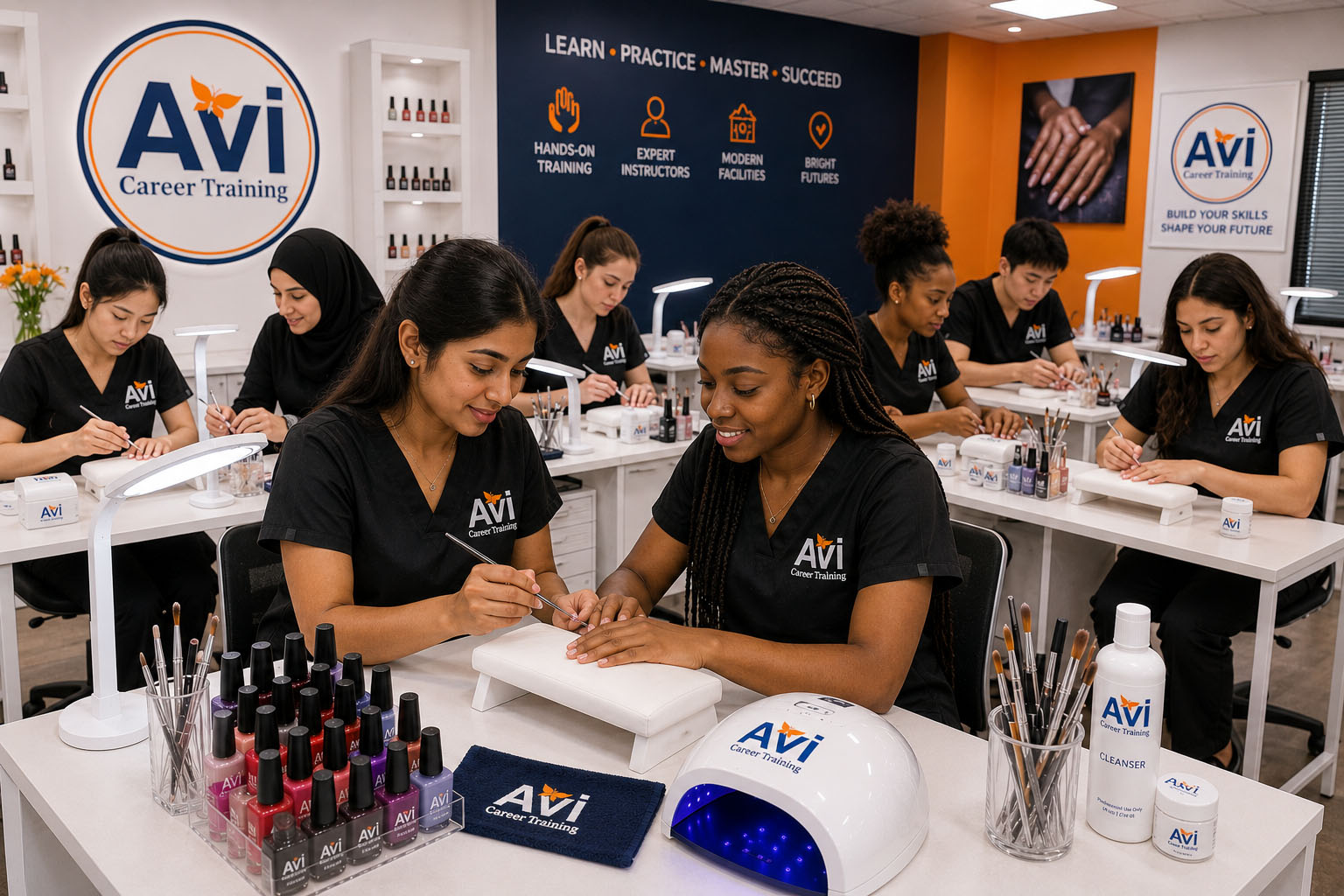
Nail technology is a skill-based profession. Reading about acrylics doesn’t make you good at applying them. At AVI, hands-on training starts immediately — not after weeks of classroom theory. You’ll work on real clients in a professional environment, building the muscle memory and client-facing confidence that employers and clients respond to.
Inclusive Curriculum Philosophy
AVI’s training reflects its commitment to inclusive beauty education. You’ll graduate knowing how to serve every client — across all skin tones, nail types, and service preferences. In Northern Virginia’s diverse market, that’s not just an ethical value. It’s a competitive advantage.
—
Ready to Become a Nail Technician in Virginia?
The path is shorter than you think. Virginia requires 150 clock hours of training. AVI’s program can be completed in as few as 8 weeks. After that, you sit for your State Board exam — and once you pass, you’re a licensed nail technician, ready to work.
AVI Career Training is a COE Accredited, SCHEV Certified school in Vienna, Virginia. Financial aid is available. The GI Bill® is accepted. And the Northern Virginia market you’ll graduate into is one of the strongest in the country for nail technology careers.
The only question left is whether you’re ready to start.
Apply to AVI Career Training today — or call us at (703) 943-9841 to speak with an admissions team member and get your questions answered.
Your career starts here.
—
Information in this article is provided for general guidance. Virginia licensing requirements are subject to change. Always verify current clock-hour requirements, exam procedures, and licensure details directly with the Virginia Department of Professional and Occupational Regulation (DPOR) before enrolling in any program or applying for licensure.