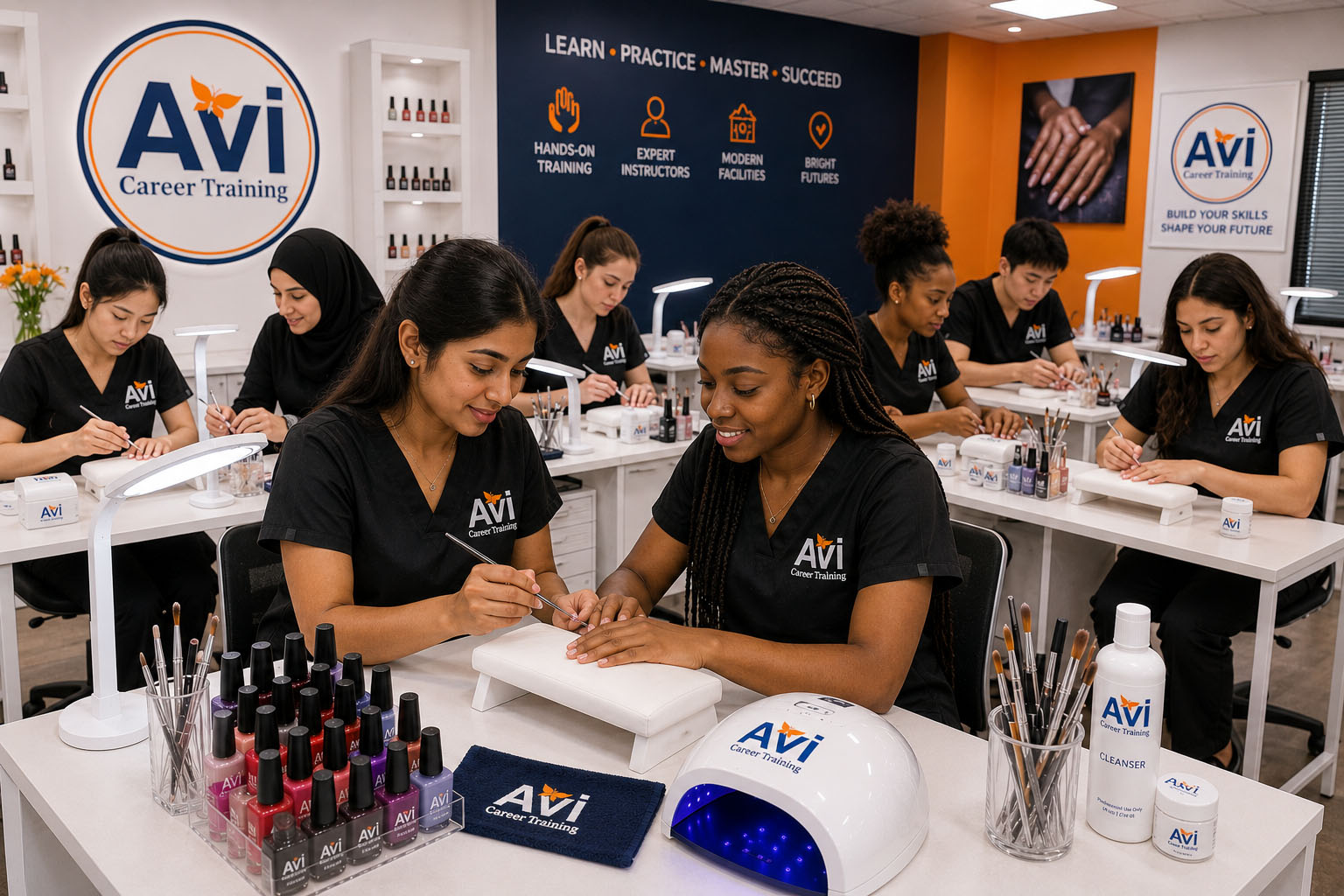
Nail Technician School in Virginia: Your Path to Licensure
To become a nail technician in Virginia, you need 150 hours of approved training, passing scores on two State Board exams, and a license from DPOR — and AVI Career Training (NO FINANCIAL AID FOR THIS PROGRAM) in Vienna, VA can get you there in approximately 8 weeks. If you’ve been thinking about this career, the path is shorter, more affordable, and more flexible than most people realize. This guide walks you through exactly what it takes to get licensed in Virginia, what to look for in a training program, and how AVI Career Training can get you started.
Key Takeaways
– Virginia requires 150 hours of training to sit for the nail technician licensing exam
– The State Board exam has two parts: a written (theory) test and a practical (skills) demonstration, both administered by PSI Exams
– AVI’s Nail Technology (NO FINANCIAL AID FOR THIS PROGRAM) program can be completed in approximately 8 weeks
– Licensed nail technicians in Virginia earn $34,000–$42,000/year in base wages — tips and independent bookings add significantly to take-home pay
– AVI Career Training is COE Accredited and SCHEV Certified, with flexible payment plans and private financing options available, and GI Bill® acceptance
If you’re ready to stop researching and start training, apply to AVI Career Training today and take the first step toward your nail tech career.
What Does a Nail Technician Actually Do?
Nail technicians (NO FINANCIAL AID FOR THIS PROGRAM) are licensed beauty professionals who specialize in the care, treatment, and artistry of fingernails and toenails. The work is hands-on, creative, and client-facing — and no two days look exactly the same.
Services and Specializations
As a licensed nail tech, your service menu can include:
- Manicures and pedicures — the core of most nail careers, from classic polish to spa-level treatments
- Nail enhancements — acrylics, gel extensions, dip powder, and builder gel systems
- Nail art — hand-painted designs, stamping, decals, and custom nail sculpting
- Nail health consultations — identifying issues like nail fungus, brittleness, and damage, and knowing when to refer clients to a medical provider
The breadth of what nail techs offer is part of what makes this career so sustainable. Clients return regularly — most every two to four weeks — which means consistent income once you build a loyal client base.
Where Nail Technicians Work
Your license opens doors across a range of settings:
- Nail salons — the most common entry point, offering steady hours and an immediate client flow
- Day spas and medical spas — higher-end clientele, often with a focus on nail health and relaxation services
- Hotel and resort spas — particularly strong in the DC metro area and Northern Virginia corridor
- Freelance and mobile nail services — serving clients in their homes, at events, or through private studios
- Salon ownership — many nail techs eventually build their own book of business and open independent studios
Earning Potential in Virginia
The professional nail care industry generates over $8 billion annually in the U.S. (IBISWorld), and demand for skilled nail technicians continues to grow. In Virginia, licensed nail technicians earn a median base salary of $34,000–$42,000 per year, according to BLS wage data for the region. That number doesn’t include tips — which, for a busy nail tech, can add thousands of dollars per year to take-home pay.
The earning arc is real: entry-level techs build their base, experienced techs build their book, and those who go independent or specialize in advanced techniques (nail extensions, nail art, spa pedicures) often earn significantly more.
Virginia Nail Technician License Requirements
To work legally as a nail technician in Virginia, you must be licensed through the Virginia Board of Barbering and Cosmetology, which is administered by the Department of Professional and Occupational Regulation (DPOR).
Here’s exactly what the process looks like.
Step 1: Complete 150 Hours of Approved Training
Virginia requires 150 hours of training at a state-approved nail technology (NO FINANCIAL AID FOR THIS PROGRAM) school before you can sit for the licensing exam. Those hours must be completed at an institution certified by the Virginia State Board.
Your training must cover:
- Nail anatomy and physiology
- Sanitation and infection control
- Manicure and pedicure techniques
- Nail enhancement systems (acrylics, gels, dip powder)
- Client consultation and safety
- Virginia state laws and regulations
This isn’t busy work. Each hour builds the technical knowledge and hands-on skill you’ll be tested on — and relied upon by real clients.
Step 2: Pass the Two-Part State Board Exam
The Virginia nail technician licensing exam is administered by PSI Exams and has two components:
- Written (Theory) Exam — Tests your knowledge of nail science, sanitation protocols, product chemistry, and Virginia state regulations
- Practical (Skills) Exam — Requires you to demonstrate hands-on techniques on a live model, including manicure services, sanitation procedures, and nail care protocols
Both parts must be passed to receive your license. Most students who complete a quality nail technology program sit for — and pass — both exams shortly after finishing their training hours.
Step 3: Submit Your License Application
After passing both exams, you submit your application and fees to the Virginia Board of Barbering and Cosmetology through DPOR. Once approved, you’