Medical estheticians focus on skin care and cosmetic treatments in clinical settings, while medical assistants provide healthcare support across clinical and administrative tasks — and the training paths, daily responsibilities, and long-term earning potential are very different. If you’re weighing these two careers, this guide breaks down exactly what each role involves, what it takes to get licensed or certified in Virginia, and why the Northern Virginia med spa market is creating steady work for skilled esthetic professionals right now.
—
> ## Key Takeaways
> – Virginia requires 600 clock hours of training to earn an esthetics license — a faster path than most medical assistant certificate programs, which typically run 9–12 months
> – Cosmetic laser technicians in Virginia can earn $45,000–$70,000+ depending on clinic and specialization
> – The DC metro area — including Tysons Corner, McLean, and Arlington — is one of the fastest-growing med spa markets in the country
> – Medical estheticians work in dermatology offices, plastic surgery clinics, and medical spas performing advanced treatments like chemical peels, laser therapy, and microneedling
> – AVI Career Training offers COE-accredited Esthetics, Cosmetic Laser Technician, and Electrolysis programs in Vienna, VA — all designed to prepare you for beauty careers in medical settings
—
What Does a Medical Assistant Actually Do?
Medical assistants are multi-role healthcare support professionals. They split their time between clinical tasks and administrative responsibilities, which makes the job versatile — but also demanding in a specific way.
On the clinical side, medical assistants take patient vital signs, prepare exam rooms, assist physicians during procedures, draw blood, administer injections, and collect lab specimens. On the administrative side, they schedule appointments, handle patient records, process insurance paperwork, and manage billing. In smaller practices, one person covers both.
Most medical assistants work in physician offices, outpatient clinics, urgent care centers, and hospital departments. The role is hands-on and fast-paced, and it requires comfort with both patient interaction and medical documentation software.
Training and certification for medical assistants typically looks like this:
- Certificate or diploma programs: 9–12 months at a community college or career school
- Associate degree programs: 18–24 months
- Certification exams: CMA (through AAMA) or RMA (through AMT) — voluntary in Virginia but increasingly required by employers
- Median salary in Virginia: approximately $38,000–$45,000 per year (BLS, 2023)
Medical assisting is a stable, career. But it’s firmly a healthcare support role — not a beauty or wellness path. If you’re drawn to skin care, cosmetic treatments, and working with clients on appearance-related goals, the role may not align with what you’re actually looking for.
—
What Is a Medical Esthetician — and How Is It Different?
A medical esthetician is a licensed skin care professional who works in clinical or medical-adjacent settings — think dermatology offices, plastic surgery practices, medical spas, and cosmetic wellness clinics. The role blends advanced skin care expertise with the clinical environment of a medical practice.
Unlike a traditional esthetician working in a day spa or salon, a medical esthetician performs treatments that require more technical training and often work alongside dermatologists, plastic surgeons, or nurse practitioners. Treatments commonly include:
- Chemical peels (superficial to medium-depth)
- Microneedling
- Microdermabrasion
- Pre- and post-surgical skin prep and recovery care
- Advanced extractions and acne treatments
- Laser-assisted skin treatments (in some states and settings, under medical supervision)
A medical esthetician is not a medical assistant . They don’t take vitals, draw blood, or handle administrative paperwork. Their focus is entirely on skin — assessing it, treating it, and educating clients about maintaining results between appointments.
This is also where cosmetic laser technicians enter the picture. Laser technicians specialize in energy-based skin treatments: laser hair removal, skin resurfacing, and photofacials. In Virginia, this specialty requires separate training and is often pursued alongside or after an esthetics license. Cosmetic laser technicians working in high-end med spas and dermatology practices in the DC metro area can earn $45,000–$70,000+ — a range that reflects both the technical skill involved and the affluence of the local client base.
If the idea of helping clients feel more confident in their skin — through science-backed, results-driven treatments — sounds more aligned with your goals than clinical healthcare support, the medical esthetician path is worth a serious look.
Ready to explore esthetics training in Northern Virginia? Apply to AVI Career Training and take the first step toward a career in medical esthetics.
—
Training Requirements and Time to Enter the Field in Virginia
This is where the comparison gets practical — and where the esthetics path often surprises people.
Becoming a Licensed Esthetician in Virginia
To earn an esthetics license in Virginia, you must complete 600 clock hours of approved training at a licensed school, then pass the Virginia State Board of Cosmetology exam (written and practical components) administered through PSI Exams.
The Virginia Department of Professional and Occupational Regulation (DPOR) oversees licensing requirements. Once licensed, you can work in salons, spas, dermatology offices, and medical spas as an esthetician.
For students pursuing a Master Esthetics path — which typically covers more advanced modalities — additional training hours may be required depending on the program.
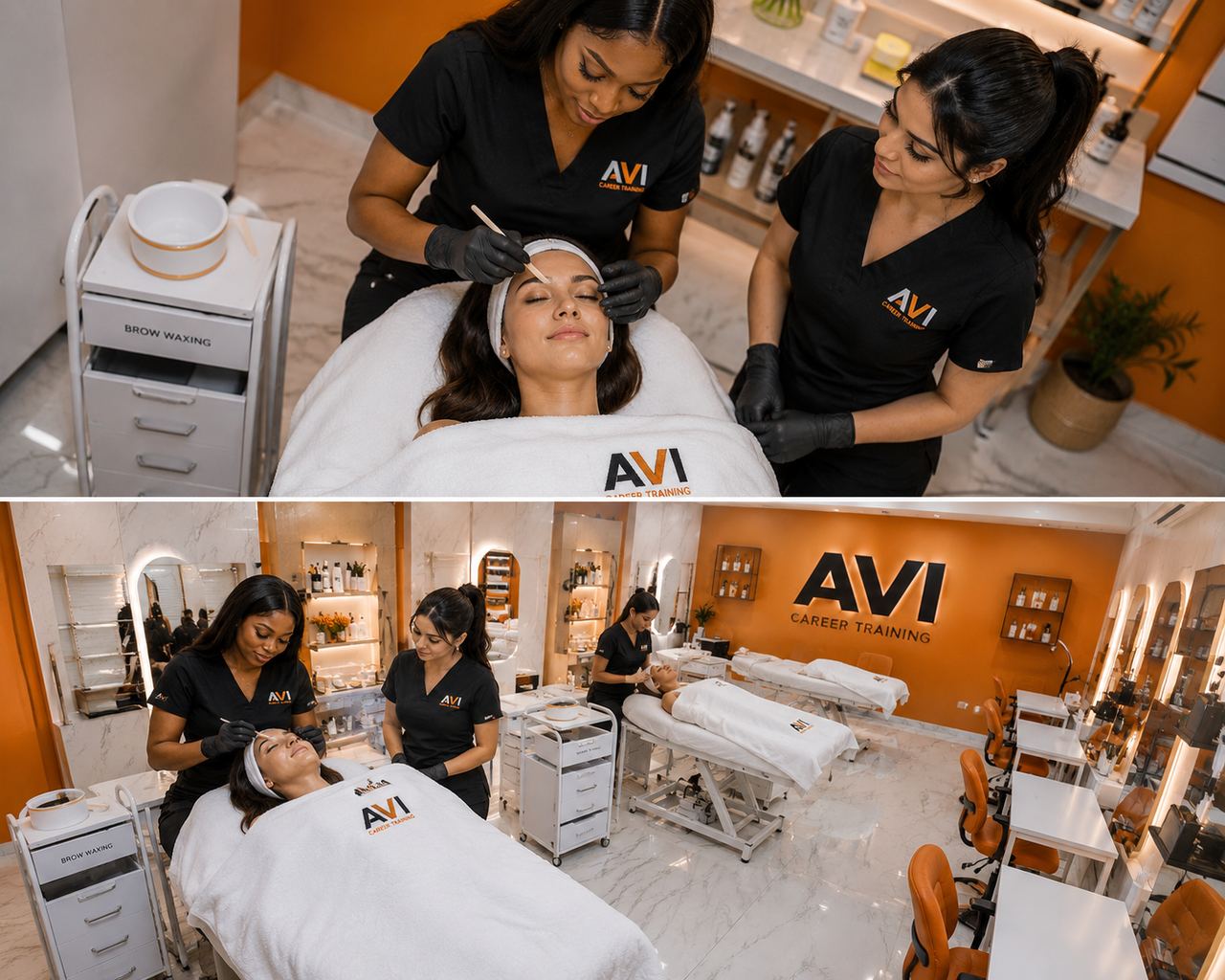
At AVI Career Training, the Esthetics program is structured to meet Virginia’s 600-hour requirement with hands-on clinical training built into the curriculum. Students work on real clients in AVI’s student clinic, gaining the practical experience that employers — especially medical spa employers — look for.
Adding Cosmetic Laser Technology
If you want to specialize in laser treatments, AVI also offers a Cosmetic Laser Technician program. This training covers the science of energy-based devices, skin typing, treatment protocols, and safety standards. It’s a direct path into one of the highest-paying specializations in the esthetics world.
Electrolysis: Another Medical-Adjacent Path
Electrolysis is the only FDA-recognized method of permanent hair removal. Electrologists work in medical spas, dermatology practices, and standalone studios. AVI’s Electrolysis program prepares students for Virginia licensure in this specialized field — and it’s a career with strong, steady demand in the DC metro area.
How Medical Assistant Training Compares
Medical assistant certificate programs at community colleges and career schools typically run 9–12 months for a diploma and up to 24 months for an associate degree. In Virginia, medical assistants are not required to be licensed by the state — but most employers now require national certification (CMA or RMA), which adds an exam step after graduation.
Side-by-side snapshot:
| | Medical Esthetician | Medical Assistant |
|—|—|—|
| Training Hours | 600 hours (esthetics license) | 9–24 months of coursework |
| Virginia Licensure | Required (DPOR) | Not required by state |
| National Certification | Optional (ASCP, etc.) | CMA or RMA recommended |
| Time to Entry | As few as 6–9 months | 9–24 months |
| Work Focus | Skin treatments, cosmetic care | Clinical support, administration |
The esthetics path can get you into the workforce faster — and into a specialty that has significant earning upside, particularly in a market like Northern Virginia.
—
Salary, Job Settings, and Career Growth in Northern Virginia
Northern Virginia is one of the wealthiest and most densely populated regions in the country. The DC metro area — including Tysons Corner, McLean, Reston, and Arlington — has a high concentration of medical spas, cosmetic dermatology practices, and luxury wellness clinics that specifically seek licensed esthetic professionals.
What Estheticians and Laser Technicians Earn in the DMV
Here’s how earnings break down for esthetic professionals in the Northern Virginia / DC metro market:
- Licensed esthetician (day spa or salon): approximately $38,000–$50,000/year, plus tips
- Medical esthetician (dermatology office or med spa): approximately $42,000–$58,000/year, with commission structures in many practices
- Cosmetic laser technician: approximately $45,000–$70,000+/year, depending on clinic volume and specialization
- Electrologist: earnings vary by setting; independent practitioners in active markets often exceed $50,000/year
(Salary data sourced from BLS Occupational Employment Statistics and current Northern Virginia job market listings. Verify figures against current data before making career decisions.)
For comparison, medical assistants in Virginia earn approximately $38,000–$45,000/year (BLS, 2023). That range is stable — but it doesn’t carry the same upward trajectory that a cosmetic laser specialization or a med spa commission structure can provide.
Where the Demand Is
The American Med Spa Association (AmSpa) projects continued growth in the medical spa industry through 2030 and beyond, driven by rising demand for non-surgical cosmetic treatments across all demographics. Locally, that growth is visible in real time: new med spas and cosmetic wellness centers are opening across the Tysons Corner corridor, in Old Town Alexandria, and throughout Arlington and Loudoun counties.
Medical estheticians and cosmetic laser technicians with solid training and Virginia licensure are exactly what these employers are looking for. The Northern Virginia market rewards specialization — and AVI students are positioned to deliver it.
—
A Career Changer Who Found Her Path
Consider someone like Danielle — a hypothetical but representative example of the students AVI serves. Danielle spent six years working as an administrative coordinator at a medical practice in Fairfax. She liked the clinical environment but felt disconnected from patient outcomes. When she started researching careers that combined her love of skincare with her comfort in a medical setting, she initially Googled “medical assistant vs esthetician.” She didn’t want to go back to school for two years. She wanted to be working — and earning — within a year.
After learning that Virginia’s esthetics license requires 600 hours of training, she enrolled at AVI Career Training. She completed her esthetics program, sat for the Virginia State Board exam, and within three months of graduation landed a position at a medical spa in McLean. Within her first year, she added commission on laser treatments to her base pay.
Her story isn’t unique. It’s the path the Northern Virginia market is built to support.
—
Can Estheticians Work in Medical Offices and Dermatology Clinics?
Yes — and it’s increasingly common. Here’s how it typically works.
Estheticians in Dermatology Offices
Dermatology practices hire licensed estheticians to handle cosmetic treatment appointments that fall outside the physician’s scope of day-to-day work: chemical peels, facials, microdermabrasion, pre-procedure skin prep, and post-treatment recovery care. The esthetician handles the cosmetic side; the physician or PA handles the medical side.
In this setting, an esthetician is not a medical assistant — but they work alongside MAs and medical staff regularly. Strong communication skills and comfort in a clinical environment matter.
Estheticians in Medical Spas
Medical spas (med spas) are the fastest-growing employer of licensed estheticians and laser technicians. A med spa operates under physician oversight but functions more like a luxury wellness clinic than a hospital. Services typically include:
- Laser hair removal and skin resurfacing
- Injectables (Botox, fillers — administered by medical providers, but estheticians often manage pre- and post-care)
- Chemical peels and advanced facials
- Body contouring treatments
- Microneedling and PRP facials
Licensed estheticians in med spas often have broader treatment menus and higher earning potential than those in traditional spas, because the clinical setting supports more advanced services.
Is a Cosmetic Laser Technician Considered a Medical Career?
This is a question that comes up often — and the honest answer is: it depends on the state and the setting.
In Virginia, cosmetic laser treatments are regulated and typically performed under the supervision or direction of a licensed medical professional (a physician or nurse practitioner). A cosmetic laser technician is not a medical provider — but they work within a medically supervised environment and must understand skin science, contraindications, and safety protocols at a clinical level.
So while it’s not a “medical career” in the way nursing or medical assisting is, cosmetic laser technology is absolutely a medical-adjacent career that requires rigorous training, continuing education, and professional standards. AVI’s Cosmetic Laser Technician program is designed to prepare students for exactly this environment.
—
How AVI Career Training Prepares You for Beauty Careers in Medical Settings
AVI Career Training is a COE-accredited, SCHEV-certified beauty and wellness school in Vienna, Virginia. The school offers programs in Esthetics, Cosmetic Laser Technology, Electrolysis, Cosmetology, Massage Therapy, and Nail Technology — all built around hands-on training, Virginia State Board preparation, and real career outcomes.
Programs That Lead to Medical-Adjacent Careers
Basic Esthetics and Master Esthetics
AVI’s Esthetics program meets Virginia’s 600-hour licensing requirement. Students train on real clients in AVI’s student clinic, building the practical skills that medical spas and dermatology offices expect from day one. The curriculum covers skin analysis, chemical exfoliation, advanced facial techniques, and client consultation — with inclusive techniques designed to work on every skin tone.
Cosmetic Laser Technician
AVI’s Cosmetic Laser Technician program prepares students to work with energy-based devices used in med spas and cosmetic clinics across Northern Virginia. Training covers laser physics, skin typing, treatment protocols, and safety standards — everything you need to step into a laser suite confidently.
Electrolysis
AVI’s Electrolysis program prepares students for Virginia licensure in permanent hair removal. Electrologists work in medical spas, dermatology practices, and private studios, often with a loyal and consistent clientele. It’s a specialized, recession-resistant skill with continuing work.
What Sets AVI Apart
- COE Accreditation and SCHEV Certification: AVI’s accreditation signals to employers — and to financial aid programs — that the training meets rigorous standards
- Inclusive Curriculum: AVI’s training is built to serve every client, across every skin tone. That’s not just a value — it’s a professional advantage in the diverse Northern Virginia market
- Hands-On Clinical Training: Students don’t just watch demonstrations. They perform treatments, build client hours, and graduate ready to work
- Financial Aid and GI Bill®: AVI accepts financial aid and the GI Bill® — making quality training accessible to more students, including military veterans and career changers
—
From Customer Service to the Cosmetic Clinic
Marcus, a career changer in his early 30s, had spent years in retail management in Tysons Corner. He was good with people, detail-oriented, and genuinely interested in skincare — his friends joked that he knew more about serums than most estheticians. When he started researching beauty careers in medical settings, he wasn’t sure if he needed to become a medical assistant to work in a clinic environment.
A conversation with AVI admissions helped him see the difference. He enrolled in the Esthetics program, completed his 600 hours, passed his Virginia State Board exam, and later added the Cosmetic Laser Technician certification. He now works at a med spa in Arlington, performing laser treatments and advanced facials — in a clinical setting, alongside medical professionals, doing work he genuinely loves.
His path took less than a year from enrollment to employment. And he never had to become a medical assistant to get there.
—
Your Next Step
If you’re researching the medical esthetician vs medical assistant comparison, you’re already asking the right questions. The career you choose should match what you actually want to do every day — not just where the building is located.
If you’re drawn to skin care, cosmetic treatments, and a career that blends artistry with science, the esthetics and cosmetic laser path is built for you. Northern Virginia’s med spa market is growing, the earning potential is real, and the training timeline is shorter than you might expect.
AVI Career Training is in Vienna, VA — minutes from Tysons Corner and the heart of the Northern Virginia med spa corridor. Financial aid is available, and the GI Bill® is accepted.
Apply to AVI Career Training today and find out which program is the right fit for your goals. You can also call us directly at (703) 943-9841 or reach out to our admissions team to schedule a tour of our Vienna, VA campus.
Your career in beauty and wellness — in the clinical settings where it’s growing fastest — starts here.