Licensed estheticians — not medical assistants — fill the majority of hands-on skincare roles in Virginia’s medical spa industry. If you want to perform chemical peels, laser treatments, or advanced skin therapies in a clinical setting, a licensed esthetics credential is the most direct route to get there. Medical esthetician training in Northern Virginia prepares you for exactly that career, and the DC metro medical spa market is actively hiring. Apply now at AVI Career Training to take the first step.
This guide breaks down what the role actually looks like day to day, what Virginia law requires, how the esthetician path compares to the medical assistant path, and what to look for in a training program — so you can make a confident, informed decision.
—
> ## Key Takeaways
> – Virginia requires 600 clock hours of esthetics training to sit for the Virginia State Board licensing exams
> – Licensed estheticians in the DC metro area earn $38,000–$55,000/year, with medical spa positions trending toward the top of that range
> – Cosmetic laser technicians in Northern Virginia clinical settings can earn $45,000–$65,000+
> – Cosmetic laser operation in Virginia requires separate documented training and certification beyond a basic esthetics license
> – Electrolysis requires its own licensed electrologist credential in Virginia — a standalone career path or powerful add-on
> – AVI Career Training is COE-accredited and offers Esthetics, Cosmetic Laser Technology, and Electrolysis programs in Vienna, VA
—
What Does a Medical Esthetician Actually Do?
A medical esthetician is a licensed skin care professional who works in clinical or medical spa environments rather than traditional day spas or salons. The scope of work is more advanced, the equipment is more powerful, and the clients often have specific skin health goals — not just relaxation.
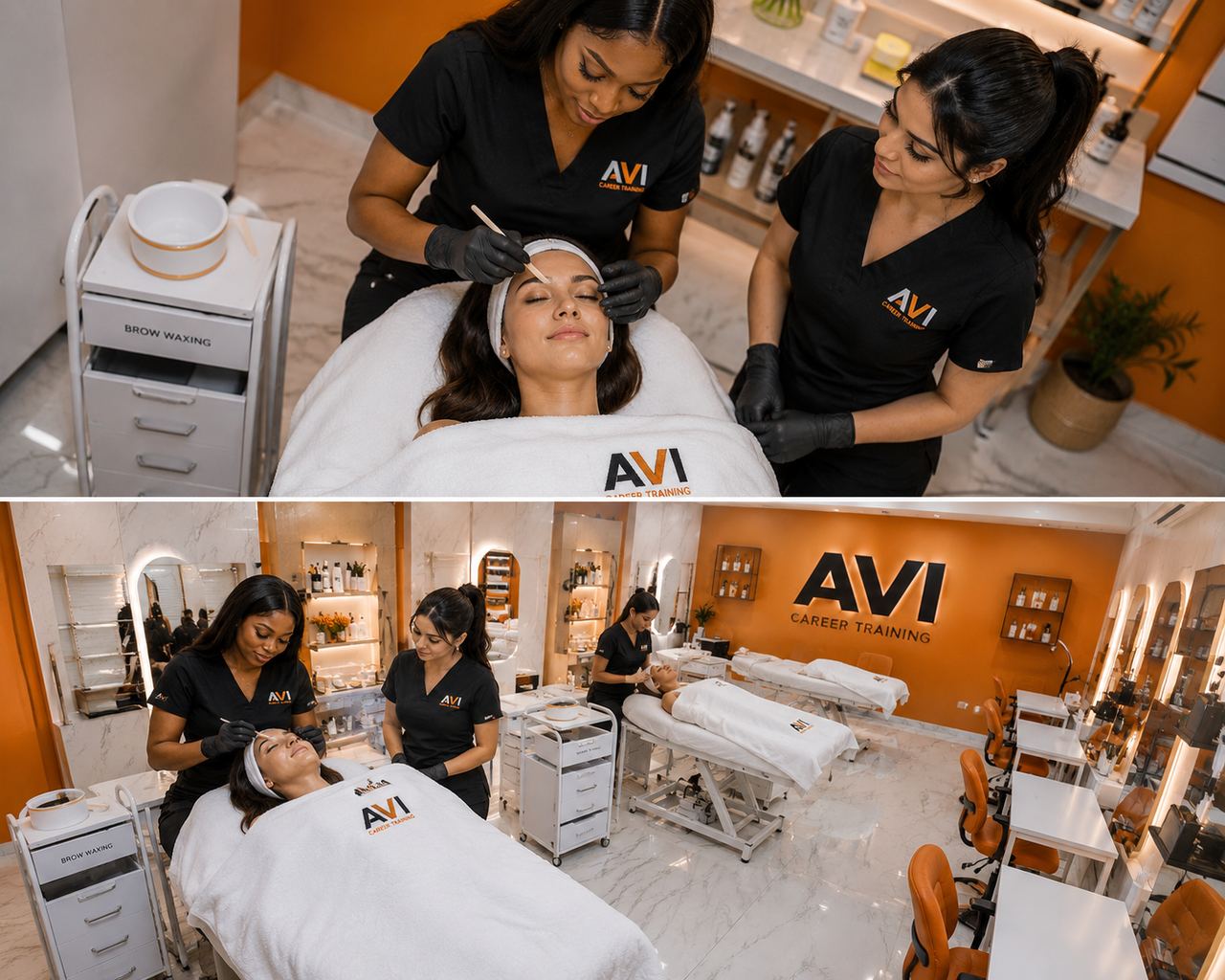
On any given day, a medical esthetician might perform chemical peels at varying strengths, prep clients for microneedling procedures, conduct detailed skin consultations, or operate laser and light-based devices for hair removal, pigmentation, and skin resurfacing. In some settings, they assist with pre- and post-treatment care for cosmetic procedures performed by physicians or nurse practitioners.
This is not the same role as a medical assistant . A general medical assistant typically handles administrative tasks, takes vital signs, prepares exam rooms, and assists physicians with clinical procedures — none of which are specific to esthetics or skin care. A medical esthetician, by contrast, is the licensed skincare specialist: the person clients book when they want a clinical-grade facial, a laser treatment series, or expert product recommendations backed by real skin science.
If you’re drawn to skincare, skin health, and helping people feel confident in their appearance — in a professional clinical environment — the medical esthetician path is designed for you. Explore AVI’s Esthetics programs to see how the training maps to real medical spa careers.
The Treatments Medical Estheticians Perform
The specific services vary by state law and the supervision model of the facility, but medical estheticians commonly:
- Perform chemical exfoliants and clinical-strength peels
- Operate laser and intense pulsed light (IPL) devices (with appropriate additional certification)
- Conduct microdermabrasion and dermaplaning
- Perform LED light therapy treatments
- Provide pre- and post-procedural skin care
- Conduct thorough skin analysis and consultation
- Recommend medical-grade skincare products and homecare routines
The more certifications and specialized training you hold — laser technology, electrolysis, advanced peels — the more valuable and versatile you become in a medical spa setting.
—
Virginia Licensing Requirements for Medical Spa Work
Working in a Virginia medical spa is not a gray area. The state has clear licensing requirements, and employers in professional clinical settings expect you to meet them.
Esthetics Licensure: The Foundation
To work as a licensed esthetician in Virginia, you must complete 600 clock hours of esthetics training at a state-approved school. After completing your program hours, you sit for the Virginia State Board written and practical exams, administered through the Department of Professional and Occupational Regulation (DPOR). Pass both, and you receive your Virginia esthetician license.
That license is your legal authorization to perform esthetic services — including in medical spa environments. Without it, you cannot legally perform esthetic treatments in Virginia, regardless of how much informal experience you have.
Cosmetic Laser Technology: A Separate Credential
Performing cosmetic laser treatments in Virginia is not covered by a standard esthetics license alone. Laser and light-based device operation is separately regulated, and operators are expected to hold documented training and certification specific to cosmetic laser technology.
This is one of the most important distinctions in medical spa hiring. Facilities operating laser equipment want credentialed technicians — both for client safety and liability reasons. Estheticians who pair their esthetics license with a Cosmetic Laser Technology certification are significantly more competitive candidates for medical spa positions.
Electrolysis: Its Own Licensed Profession
Electrolysis — the only FDA-recognized method of permanent hair removal — requires its own separate licensed electrologist credential in Virginia. If you’re interested in adding permanent hair removal services to your career portfolio, electrolysis training is a distinct program and a genuine differentiator in the job market.
What About Unlicensed Medical Assistants in Medical Spas?
Some medical spas do employ unlicensed medical assistants in supportive roles — but those roles are typically limited to non-esthetic tasks: patient intake, scheduling, vital signs, and general clinical support. An unlicensed assistant cannot legally perform the skincare and laser services that licensed estheticians perform. Clients booking skin treatments want and expect a licensed professional.
For the Virginia DPOR’s current guidance on esthetics licensure, visit the Virginia DPOR Cosmetology and Esthetics page.
—
Medical Esthetician vs. Medical Assistant — Which Path Is Right for You?
This is one of the most common questions career-changers ask, and it deserves a straight answer. Both are legitimate career paths. But they lead to very different daily work, and one is a much more direct route to hands-on medical spa employment.
Training Length and Cost
A medical assistant program at a community college or vocational school typically runs 9 to 24 months, depending on whether you pursue a certificate or associate degree. Costs vary widely — from roughly $5,000 for certificate programs to $15,000+ for degree-granting programs.
An esthetics program in Virginia requires 600 clock hours, which many students complete in under a year — sometimes in as few as six to nine months depending on full- or part-time enrollment. Program costs are generally lower than medical assistant degrees, and financial aid — including Pell Grants and the GI Bill® — can apply.
Scope of Practice
| | Licensed Esthetician | Medical Assistant |
|—|—|—|
| Facials & Skin Treatments | ✅ Yes | ❌ No |
| Chemical Peels | ✅ Yes (licensed) | ❌ No |
| Laser Treatments | ✅ With additional cert | ❌ Varies by state/supervision |
| Electrolysis | ✅ With separate license | ❌ No |
| Clinical Admin Support | ✅ Varies by setting | ✅ Yes |
| Vital Signs / Clinical Procedures | ❌ Not in scope | ✅ Yes |
| Assisting Physicians | Limited | ✅ Primary role |
If your goal is to perform skincare treatments on clients — to be the person who actually does the peels, runs the laser, and conducts consultations — a licensed esthetician credential is the right path. If your goal is clinical medical support work (charting, assisting physicians, patient intake), a medical assistant program better fits that intent.
Earning Potential in the Northern Virginia Market
Licensed estheticians in the DC metro area earn a median of approximately $38,000–$55,000 per year, with medical spa positions consistently landing at the higher end of that range. Cosmetic laser technicians in clinical settings can earn $45,000–$65,000+, reflecting the specialized nature of the credential.
The Northern Virginia and DC metro medical spa market — particularly in the Tysons Corner, Arlington, and Bethesda corridors — is one of the fastest-growing in the Mid-Atlantic. Demand for qualified clinical estheticians is strong and growing.
—
Meet Two Students Who Made the Switch
From Retail to the Treatment Room
Janelle spent six years in retail management before deciding she wanted a career that felt more personal — something where she could genuinely help people rather than just move products. She considered a medical assistant program but realized she had no interest in clinical paperwork or vital signs. What she wanted was to work with clients on skin health.
She enrolled in AVI Career Training’s Basic Esthetics program, completed her 600 hours, passed the Virginia State Board exams, and was hired at a medical spa in Tysons Corner within two months of graduation. Within her first year, she added AVI’s Cosmetic Laser Technology certification and took on laser hair removal and IPL treatments — increasing her earning potential significantly.
The Career Changer Who Needed Speed
Marcus was a veteran transitioning out of active duty and needed to start a second career quickly. He researched both medical assistant programs and esthetics, and what he found surprised him: esthetics training was faster, the Virginia licensure pathway was clear, and AVI accepted the GI Bill®.
He completed his esthetics training at AVI using his GI Bill® benefit, passed his Virginia State Board exams, and landed a position at a medical spa in the DC area. He later returned to AVI to complete the Electrolysis program — adding permanent hair removal services to his professional scope and setting himself apart from other candidates in his market.
—
What to Look for in a Medical Esthetics Training Program in Northern Virginia
Not all esthetics schools are the same. If your goal is medical spa employment, the program you choose matters — in ways that go beyond the brochure.
Accreditation Comes First
COE accreditation (Council on Occupational Education) is the benchmark for career-focused schools. It signals that the program has been independently evaluated for educational quality, student outcomes, and institutional integrity. COE accreditation is also required for students to access federal financial aid, including Pell Grants and GI Bill® benefits.
SCHEV certification (State Council of Higher Education for Virginia) is the additional Virginia-specific approval that confirms the school operates legally and meets state standards. Look for both credentials.
Schools without these accreditations may be cheaper — but they may also leave you unable to access financial aid and holding a credential that employers question.
Hands-On Clinical Hours
Medical spas hire people who can perform treatments confidently from day one. That means your training needs to include real hands-on practice — not just lectures and demonstrations. Ask any school you’re evaluating: how many of your 600 hours are spent on actual clients in a supervised clinic setting?
Inclusive Training Across All Skin Tones
Clinical esthetic work in Northern Virginia means serving a diverse, multicultural client base. Estheticians who have only trained on one skin type are underprepared for the real market. Your program should explicitly train you to assess, treat, and recommend for every skin tone — including deeper Fitzpatrick skin types that require modified approaches for laser treatments and chemical peels.
This is a non-negotiable for medical spa employment. Employers serving diverse communities need estheticians who can work confidently and safely across all skin tones.
Laser and Electrolysis Curriculum Integration
If medical spa work is your goal, proximity to laser and electrolysis training matters. Programs that allow you to stack credentials — completing esthetics and then adding Cosmetic Laser Technology or Electrolysis at the same school — give you a significant advantage. You build on existing relationships, stay in a familiar learning environment, and shorten your overall timeline to full clinical readiness.
Location and Job Market Access
For students targeting Northern Virginia medical spa employment, training in the DC metro area makes practical sense. You build local industry connections, complete clinic hours serving the local population, and have direct access to the Tysons Corner, Arlington, and Bethesda hiring markets — without relocating or adding a long commute on top of your training schedule.
—
How to Start Your Medical Esthetics Career at AVI Career Training
AVI Career Training is a COE-accredited, SCHEV-certified beauty and wellness school in Vienna, Virginia — located in the heart of the Northern Virginia / DC metro area. AVI offers three programs directly relevant to medical spa careers:
Programs at AVI
Basic Esthetics
The foundational 600-hour Virginia-required program covering skin analysis, facial treatments, chemical exfoliation, and client consultation. Prepares students to sit for the Virginia State Board exams and enter the workforce as licensed estheticians.
Cosmetic Laser Technology
AVI’s Cosmetic Laser Technology program trains students in the operation of laser and light-based devices used in medical and aesthetic settings — the certification that opens the door to laser treatment roles in clinical spas. This is the credential that separates candidates in competitive medical spa hiring.
Electrolysis
Virginia’s licensed electrologist credential program — the only training pathway to perform permanent hair removal legally in the state. A powerful standalone career or career-expanding add-on for licensed estheticians.
Financial Aid and the GI Bill®
AVI is an approved institution for federal financial aid, including Pell Grants. AVI also accepts the GI Bill® — making these programs accessible to veterans and active-duty service members transitioning into civilian careers. Speak with AVI admissions directly to understand which benefits apply to your situation.
Your Next Step
You don’t need a four-year degree to build a high-earning, clinically meaningful career in medical esthetics. What you need is the right license, the right additional credentials, and training at a school that prepares you for the actual job market — not just the state board exam.
AVI Career Training’s programs are built to do exactly that: get you licensed, credentialed, and job-ready for Virginia’s growing medical spa industry.
Ready to get started? Apply now at AVI Career Training or call (703) 943-9841 to speak with admissions and get your questions answered.
The Northern Virginia medical spa market is hiring. The path to get there is clear. The only question is when you start.
—
For current Virginia esthetics licensure requirements, visit the Virginia Department of Professional and Occupational Regulation (DPOR). For national salary and employment data on skincare specialists, visit the U.S. Bureau of Labor Statistics Occupational Outlook for Skincare Specialists.