A medical esthetician works directly with patients in clinical settings — performing advanced skin treatments, laser procedures, and pre- and post-surgical skin care — while a medical assistant handles patient intake, vitals, and administrative support in a physician’s office or clinic. Both careers touch healthcare. But the day-to-day work, the training path, and the earning potential look very different.
If you’re weighing these two options, you’re not alone. Thousands of people search this exact question every month — usually because they’re drawn to a clinical environment but aren’t sure which direction makes the most sense for their skills, interests, and goals. This guide breaks it down honestly so you can make the right call.
> Key Takeaways
> – Medical assistants in Virginia earn approximately $38,000–$48,000/year; medical estheticians in medspa or clinical settings can earn $35,000–$55,000+/year, with additional income from tips and commission
> – Virginia requires 600 clock hours of training to sit for the Esthetics licensure exam through the Virginia Board of Barbering and Cosmetology
> – Medical assistant certificate programs typically take 9–12 months at community colleges; AVI Career Training’s Esthetics program can prepare you for licensure on a comparable or faster timeline
> – Medical estheticians can work in medspas, dermatology clinics, plastic surgery offices, and laser centers — true clinical environments
> – AVI Career Training in Vienna, VA offers Esthetics and Cosmetic Laser Technology programs with financial aid available, including the GI Bill®
—
What Does a Medical Assistant Actually Do?
Medical assistants are the backbone of many outpatient clinics and physician offices. On any given day, a medical assistant might take a patient’s blood pressure, update electronic health records, prepare exam rooms, schedule follow-up appointments, draw blood, or assist a physician during a procedure.
The role blends clinical tasks with administrative responsibilities. That combination makes medical assistants incredibly versatile — and established. According to the U.S. Bureau of Labor Statistics (BLS), employment of medical assistants is projected to grow 14% through 2032, much faster than the national average for all occupations.
The Reality of the Day-to-Day Role
If you love the idea of being in a fast-paced clinic, working directly with patients from all walks of life, and handling a wide variety of tasks each shift, medical assisting can feel like a natural fit. You’ll need strong organizational skills, attention to detail, and genuine comfort with both clinical procedures and paperwork.
The tradeoff is that a significant portion of the job — especially at entry level — involves administrative work. Scheduling, insurance verification, and records management can take up as much time as hands-on patient care. If your draw to healthcare is primarily about the human connection and clinical results rather than the systems that support them, that balance might not feel right over the long term.
Medical assistant programs are typically offered at community colleges and vocational schools. Most certificate programs run 9 to 12 months. Associate degree programs take closer to two years. Neither path requires a four-year degree, which is one reason so many career changers find the field appealing.
—
What Is a Medical Esthetician — and How Is It Different?
A medical esthetician is a licensed skin care professional who works in clinical or medical settings rather than traditional day spas or salons. Think medspas, dermatology clinics, plastic surgery practices, and cosmetic laser centers. The work is hands-on, results-focused, and deeply rooted in skin science.
On a typical day, a medical esthetician might perform chemical peels, microneedling treatments, laser hair removal, photofacials, pre- and post-operative skin prep for surgical patients, or advanced acne treatments. The clinical environment means you’re often working alongside physicians, nurse practitioners, and physician assistants — a collaboration that many estheticians find energizing and professionally meaningful.
How the Medical Esthetician Role Differs from a Standard Esthetician
A standard esthetician — sometimes called a spa esthetician — typically works in a day spa or salon performing facials, waxing, and basic skin care services. A medical esthetician has the same foundational license but pursues additional clinical training, often in cosmetic laser technology, chemical exfoliation, or advanced treatment modalities.
The distinction matters for career trajectory. Medical estheticians can command higher service fees, work in more specialized environments, and build expertise that’s genuinely harder to replicate. If you’re considering a cosmetic laser technician vs medical assistant comparison, it’s worth knowing that laser technicians in clinical settings often work alongside the same medical teams as physician-employed medical assistants — but with a focused specialty that creates its own distinct career lane.
—
Salary, Job Outlook, and Career Growth — Side by Side
Let’s look at the numbers honestly. Both paths offer solid earning potential, but the structure of how you earn — and how much — differs in important ways.
Medical Assistant Salary in Virginia
According to BLS data, medical assistants in Virginia earn approximately $38,000–$48,000 per year at the median range. Entry-level positions in outpatient clinics and physician offices typically start at the lower end of that range. Growth tends to be steady but gradual, often tied to seniority, certifications (such as the CMA credential through AAMA), or moving into supervisory roles.
Medical assistants are salaried or hourly employees. There is generally no commission structure, no tips, and limited upside beyond annual raises or role changes. That stability is a feature for some people — and a ceiling for others.
Medical Esthetician Salary in Virginia
Medical estheticians in Virginia can earn $35,000–$55,000+ per year, with medspa and clinical settings representing the higher end of that range. What makes the financial picture more interesting is the income structure. Many clinical esthetics positions include:
- Commission on services and retail product sales
- Tips from satisfied clients
- Bonuses tied to client retention or treatment volume
- Opportunities for independent contracting as experience grows
That means a skilled, established medical esthetician in a busy Northern Virginia medspa can meaningfully out-earn the published median — something a salaried medical assistant role doesn’t typically allow.
Job Outlook: Both Are Growing
The BLS projects steady work for both roles. Demand for estheticians is driven by the booming medical spa industry and the continued growth of cosmetic dermatology. The American Med Spa Association reports that the medspa industry has grown into a multi-billion-dollar market, with no signs of slowing. For those pursuing clinical beauty careers in Northern Virginia — one of the most affluent and wellness-focused regions in the country — the local market is especially strong.
—
Training Requirements — Time, Cost, and Licensing in Virginia
This is where the comparison gets very practical. Both paths are accessible without a four-year degree, but the licensing requirements, training structures, and costs are distinct.
Becoming a Medical Assistant in Virginia
Virginia does not require a state license to work as a medical assistant , which is both a feature and a limitation. On the positive side, you can enter the workforce relatively quickly. On the other hand, most competitive employers prefer or require national certification — either the Certified Medical Assistant (CMA) credential from the American Association of Medical Assistants (AAMA) or the RMA credential from the American Medical Technologists (AMT).
Earning those credentials requires completing an accredited MA program (typically 9–12 months at a community college) and passing a national exam. Costs vary widely depending on the program and institution.
Becoming a Medical Esthetician in Virginia
In Virginia, the path to becoming a licensed esthetician is regulated by the Virginia Board of Barbering and Cosmetology, under the Virginia Department of Professional and Occupational Regulation (DPOR). The requirements are clear:
- Complete 600 clock hours of approved esthetics training
- Pass both the written and practical portions of the Virginia State Board exam
- Apply for licensure through DPOR
Once licensed, estheticians who want to specialize in clinical or medspa settings — including laser treatments — typically pursue additional training in cosmetic laser technology. In Virginia, there is no separate state license required specifically for laser operation, but medspas and clinical employers strongly prefer candidates with formal laser training and an active esthetics license.
For electrolysis, Virginia does regulate the practice. An Electrologist license through DPOR is required to provide electrolysis services commercially — a niche credential that sets practitioners apart in the permanent hair removal market.
How AVI Career Training Fits In
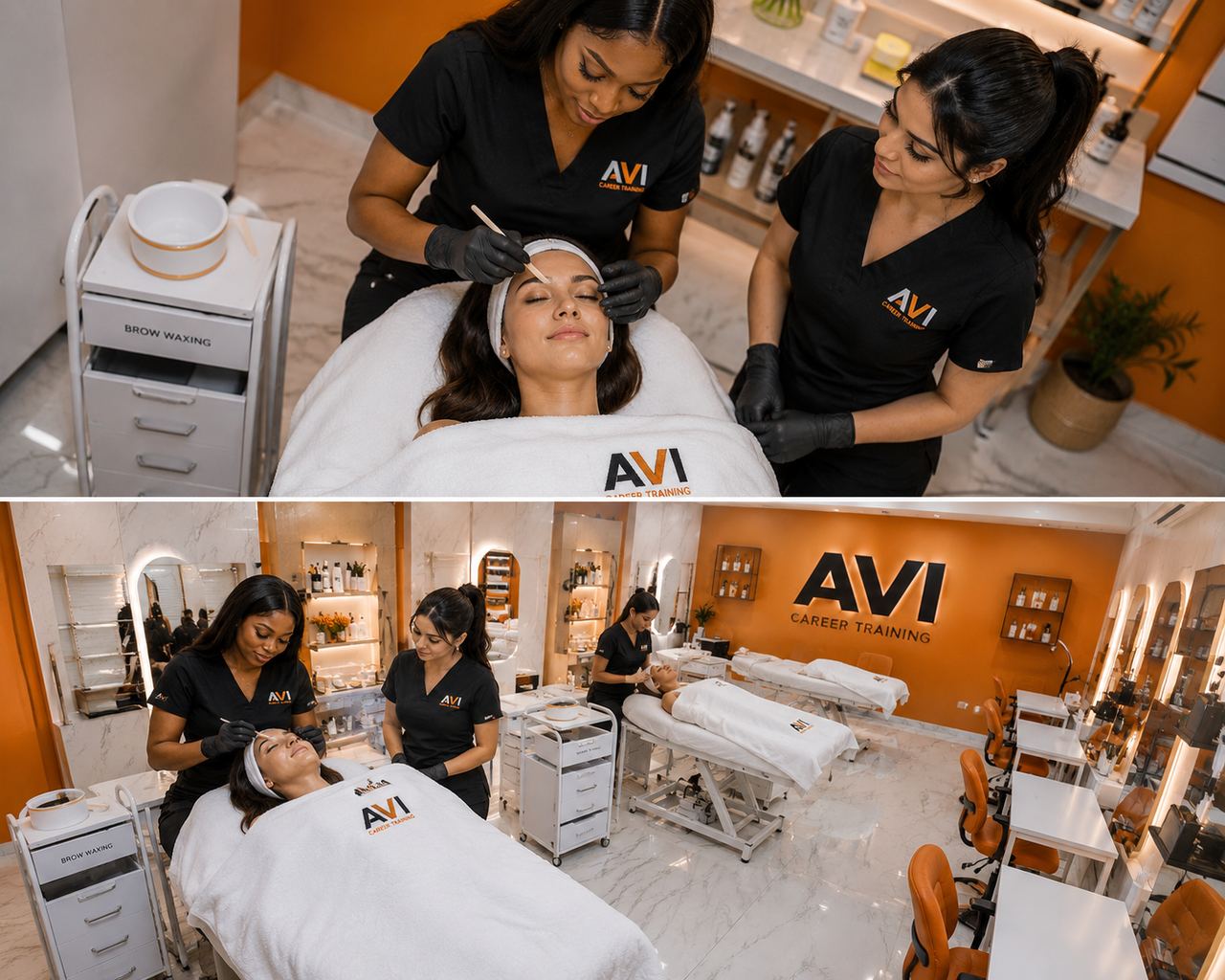
AVI Career Training, located in Vienna, VA, offers both an Esthetics program and a Cosmetic Laser Technology program designed to prepare graduates for exactly these clinical environments. The Esthetics program meets Virginia’s 600-hour requirement and prepares students for the Virginia State Board exam. The Cosmetic Laser Technology program builds on that foundation with hands-on training in the laser modalities used in medspas and clinical practices throughout the DC metro area.
Financial aid is available for eligible students, and AVI accepts the GI Bill® — making these programs accessible for veterans and military-connected students looking to transition into a civilian healthcare-adjacent career. If you’re ready to explore the path, apply now to get started.
—
Healthcare-Adjacent Careers Without a Degree: Why Clinical Beauty Makes Sense
One of the most common threads among people researching both medical assisting and medical esthetics is this: they want a career that feels meaningful, that connects them to health and wellness, and that doesn’t require spending four years and six figures on a traditional college degree.
Both paths deliver on that premise. But clinical beauty careers in esthetics and cosmetic laser technology offer something additional — they sit at the intersection of healthcare and personal transformation in a way that few other careers do.
Consider Amara, a career changer from Fairfax who spent eight years in retail management before deciding she wanted work that felt more purposeful. She’d looked at medical assistant programs at a local community college, but the curriculum felt heavily administrative. What she really wanted was to work with people on something that changed how they felt about themselves. She enrolled in AVI’s Esthetics program, completed her 600 hours, passed her Virginia State Board exam, and within six months of graduation was working as a lead esthetician at a medspa in Tysons Corner — performing chemical peels and laser treatments for clients managing acne scarring and hyperpigmentation.
Or think about Marcus, a former Army medic from Northern Virginia who understood clinical environments intimately but wanted a career path that gave him more autonomy and earning upside than a standard medical assistant role. His hands-on medical training translated naturally to the clinical precision required in esthetics. He added cosmetic laser certification to his esthetics license and now works at a dermatology practice in Reston, earning a base salary plus commission — and serving a diverse client base that includes veterans dealing with skin conditions related to sun exposure and service-related scarring.
These aren’t outlier stories. They reflect what’s possible when training meets a growing market.
—
Which Career Fits You? (And How AVI Can Help)
There’s no universally right answer here. The best path depends on what drives you, what kind of work environment you thrive in, and what you want your career to look like five years from now.
Medical Assisting May Be a Better Fit If You:
- Enjoy a high-volume, fast-paced clinical environment with varied daily tasks
- Are comfortable with a significant administrative component to your work
- Want a stable, salaried position with predictable hours
- Plan to use the role as a stepping stone toward nursing or another clinical credential
- Prefer a career that’s less tied to individual client relationships
Medical Esthetics or Cosmetic Laser May Be a Better Fit If You:
- Are passionate about skin health, cosmetic science, and visible results
- Want to work with clients on a deeper, ongoing basis — building relationships around transformation
- Are interested in the entrepreneurial upside of commission, tips, or eventually running your own practice
- Want to work in a clinical setting without the administrative burden common in physician offices
- Are drawn to the growing medspa and cosmetic dermatology industry, particularly in a market as strong as Northern Virginia
If you see yourself in that second column — or even if you’re still genuinely weighing both options — the medical esthetics school in Northern Virginia worth exploring first is AVI Career Training in Vienna, VA. AVI’s Esthetics and Cosmetic Laser Technology programs are built around hands-on, career-focused training that prepares graduates for real clinical roles in the DC metro market.
The school is COE Accredited and SCHEV Certified. Financial aid is available for those who qualify. And the team is ready to answer your questions about program schedules, licensing requirements, and what clinical esthetics work actually looks like day to day.
—
Ready to Take the Next Step?
If you’ve been exploring the difference between a medical assistant career and a medical esthetician career, you’re asking exactly the right question. The clinical beauty space is growing fast — and in Northern Virginia, the opportunity for skilled, licensed estheticians and laser technicians is genuine.
AVI Career Training offers the programs, the credentials, and the hands-on training environment to help you get there. Visit our campus in Vienna, VA, call us at (703) 943-9841, or apply now to start the conversation. Your next career is closer than you think.
—
Sources: U.S. Bureau of Labor Statistics (BLS.gov) — Occupational Outlook Handbook, Medical Assistants and Skincare Specialists; Virginia Department of Professional and Occupational Regulation (DPOR.Virginia.gov) — Cosmetology/Barbering Board Licensing Requirements.