If you’re choosing between a medical assistant and an esthetics career in Northern Virginia, the esthetics path typically offers higher earning potential, a state-issued Virginia license, and the option to eventually work for yourself — while medical assisting offers structure and stability inside the healthcare system. Both are legitimate, accessible without a four-year degree, and growing — but the day-to-day reality and long-term earning trajectory look very different.
Apply to AVI Career Training today to learn how AVI’s Esthetics and Cosmetic Laser Technician programs prepare you for the medical spa market in Northern Virginia.
—
Key Takeaways
- Medical assistants in Virginia earn a median salary of approximately $42,000–$48,000/year (BLS 2023 data)
- Estheticians in Virginia earn $38,000–$55,000+/year, with higher upside in self-employment and commission roles
- Cosmetic laser technicians working in medical spa settings can earn $45,000–$70,000+/year
- Virginia does not require state licensure for medical assistants — credentials are nationally certified but not state-regulated
- Virginia does require 1,500 clock hours for an esthetics license, with both written and practical State Board exams
- AVI Career Training’s Esthetics and Cosmetic Laser Technician programs in Vienna, VA prepare students for exactly this licensure pathway
—
What Does a Medical Assistant Actually Do?
Medical assistants are the connective tissue of outpatient healthcare. They work in physician offices, urgent care clinics, dermatology practices, and specialty medical settings — handling both clinical and administrative tasks throughout the day.
On the clinical side, that means taking patient vitals, drawing blood, administering injections, preparing exam rooms, and assisting physicians during procedures. On the administrative side, it means scheduling appointments, managing patient records, coding insurance forms, and handling billing. The split between these responsibilities depends heavily on the employer and setting.
Most medical assistant positions require a certificate or associate’s degree from an accredited program — typically one to two years of training. After completing a program, many MAs pursue national certification through the American Association of Medical Assistants (CMA credential) or the American Medical Technologists organization (RMA credential).
Here’s something that surprises many career seekers: Virginia does not require state licensure for medical assistants as of 2024. That means your credentials are nationally recognized but not regulated at the state level — which matters when you’re thinking about job security and career portability.
Work environments for MAs are almost entirely clinical. You’ll spend your days in a medical office or hospital setting, following physician protocols, managing patient flow, and adhering to strict HIPAA and clinical standards. For some people, that structure and environment is exactly what they want. For others, it’s a constraint that limits creativity and client-facing connection.
—
What Is a Medical Esthetician — and How Is It Different?
A medical esthetician is a licensed esthetician who works in a clinical or medical spa environment — providing advanced skin treatments in dermatology offices, plastic surgery practices, cosmetic laser clinics, and medical spas across Northern Virginia.
This is not a separate license in Virginia. It starts with the same Virginia State Board esthetics license that all estheticians hold. What makes the role “medical” is the environment, the training, and the advanced modalities involved — laser treatments, chemical peels, microneedling, and clinical-grade skin care protocols.
This is where the esthetician vs. medical assistant comparison gets genuinely interesting. On the surface, these careers look similar: both involve client care in a professional setting, both can work alongside physicians, and both are accessible without a four-year degree. But the day-to-day experience, the scope of practice, and the earning trajectory are meaningfully different.
An esthetician working in a medical spa setting has significant client-facing responsibility. You’re building relationships with your clients, customizing treatment plans, and directly influencing how someone feels about their skin and their confidence. That’s a different kind of work than clinical charting and administrative tasks.
The entrepreneurial upside is also substantially different. Licensed estheticians can rent booth space, launch independent practices, develop loyal client books, and build income streams that aren’t capped by an employer’s salary structure. Medical assistants, as employees in clinical settings, typically don’t have that flexibility.
If you’re considering a medical esthetics career, AVI Career Training offers both a Basic Esthetics program and advanced Cosmetic Laser Technician training — two programs that together build exactly the skill set medical spas are hiring for right now.
—
Salary & Job Outlook: Virginia Numbers Side by Side
Let’s put the numbers on the table clearly.
Medical Assistant Salary in Virginia
According to Bureau of Labor Statistics data, the medical assistant salary in Virginia falls in the range of approximately $42,000–$48,000 per year at the median. Entry-level positions often start lower, and experienced MAs in specialty practices can push toward the higher end of that range.
The BLS projects medical assisting as a field to grow faster than average — around 14–16% through 2032 — driven largely by an aging population and the expansion of outpatient healthcare settings. That’s a legitimate positive for the field.
Job stability is a real strength here. Medical offices hire consistently, benefits packages are typically solid, and the work is available across virtually every geographic area.
Esthetician & Laser Technician Salary in Virginia
The salary picture for estheticians is more variable — and that variability cuts both ways.
The median esthetician salary in Virginia lands in the range of $38,000–$55,000+/year. The lower end of that range reflects newer estheticians building their client base. The higher end — and beyond — reflects experienced estheticians in commission-based or self-employed structures where their income scales with their book.
Cosmetic laser technicians represent the higher-earning tier within the esthetics field. In medical spa settings across Northern Virginia, laser specialists can earn $45,000–$70,000+/year, with some experienced technicians earning more. The demand for laser services — from laser hair removal to skin resurfacing to body contouring — continues to grow as medical spas expand across the DC metro area.
The Growth Factor for Medical Esthetics
The medical spa industry is one of the fastest-growing segments in the entire beauty and wellness market. Northern Virginia, in particular, has seen significant expansion in medical spa locations over the past five years. Licensed estheticians with laser training are in genuine demand — and that demand is only increasing.
A Quick Side-by-Side
| | Medical Assistant | Esthetician | Cosmetic Laser Tech |
|—|—|—|—|
| Virginia Median Salary | $42,000–$48,000 | $38,000–$55,000+ | $45,000–$70,000+ |
| Self-Employment Option | No | Yes | Yes |
| State License Required | No | Yes (1,500 hours) | Yes (esthetics base) |
| Training Timeline | 1–2 years | ~12–14 months at AVI | Add-on to esthetics |
| Work Environment | Clinical/medical | Spa, medical spa, salon | Medical spa, clinic |
—
Licensing & Training Timelines in Virginia
This is where the paths diverge most clearly — and where your timeline matters.
Medical Assistant : No Virginia License Required
Virginia does not have a state licensure requirement for medical assistants. You complete an accredited certificate or associate’s degree program (typically one to two years), then pursue national certification through the AAMA or AMT. That certification is valuable and recognized by employers, but it’s not regulated by the state.
The lack of state regulation has a practical consequence: your credentials depend on your national certification status and your employer’s requirements. If your certification lapses or your employer’s requirements change, your standing can shift.
Esthetics in Virginia: Virginia State Board Pathway
To become a licensed esthetician in Virginia, you must complete 1,500 clock hours of training at a Board-approved school, then pass both the written and practical Virginia State Board exams administered through PSI.
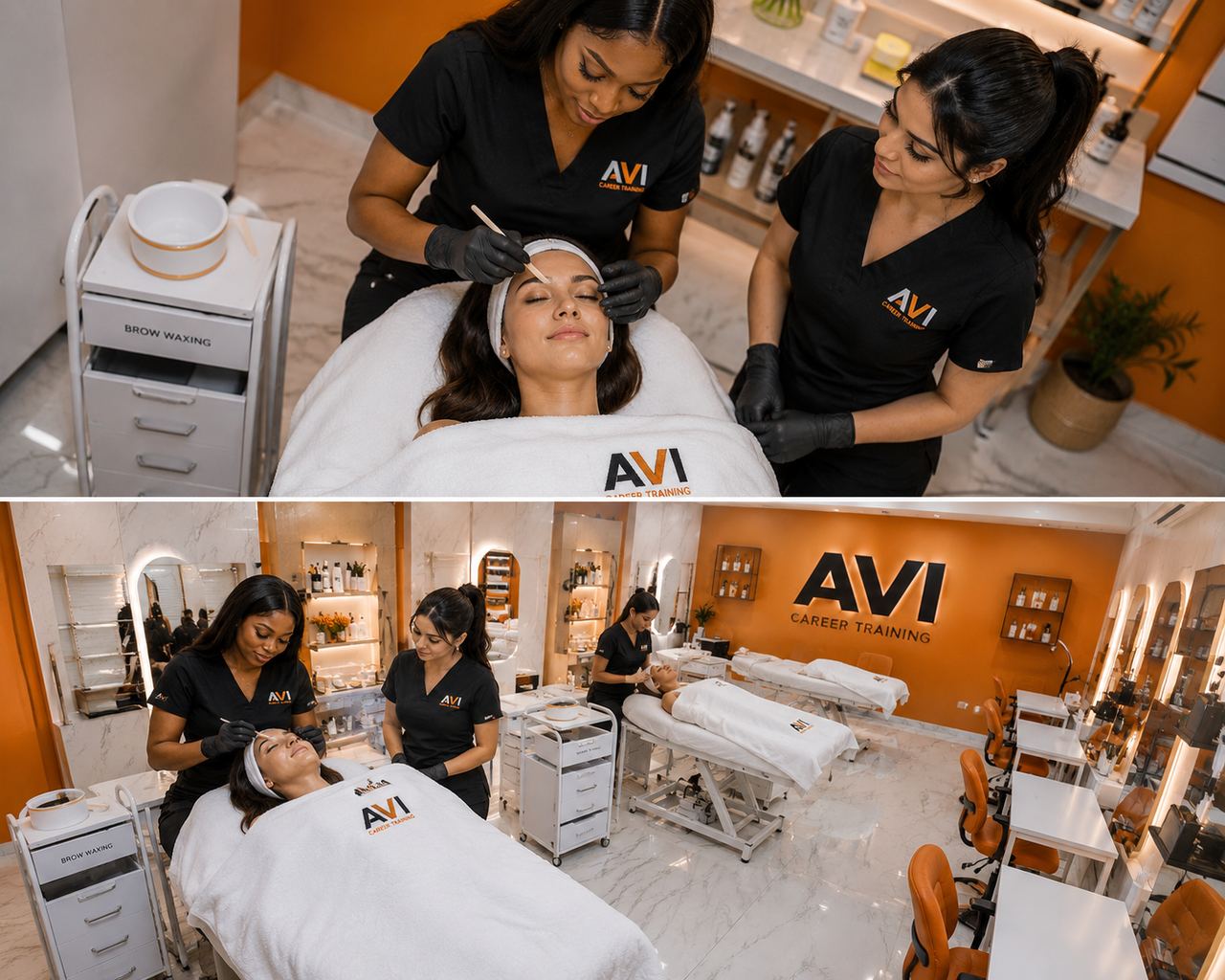
At AVI Career Training in Vienna, VA, the Esthetics program is structured to take students through those 1,500 hours with a strong emphasis on hands-on, clinical hours in AVI’s student salon. You work on real clients. You practice techniques across a range of skin tones and types. You graduate ready to sit for your State Board exams — not just ready to pass a written test.
The total timeline from enrollment to licensed esthetician is approximately 12–14 months for most AVI students, depending on schedule and program track.
Cosmetic Laser Technician Training at AVI
AVI also offers a Cosmetic Laser Technician program — an advanced training track that builds directly on esthetics fundamentals and prepares students for the laser-heavy medical spa environment. Virginia’s cosmetic laser regulations require practitioners to work under physician oversight or within specific supervised settings, and AVI’s program prepares students to understand and operate within those requirements.
For students who want to work in medical spas or clinical aesthetics settings, the combination of esthetics licensure plus laser technician training is a powerful credential package.
—
Meet Two Students Who Faced This Same Decision
Priya: From Hospital Admin to Licensed Esthetician
Priya had worked in hospital administration for six years when she started researching medical assisting as a way to move into a more hands-on clinical role. She liked the idea of direct patient contact — but when she dug into what MAs actually do day-to-day, she realized the clinical side wasn’t what drew her. What she wanted was the relationship with clients, the creative problem-solving of skincare, and a career where she controlled her own income.
She enrolled in AVI’s Basic Esthetics program at 34 years old, completed her 1,500 hours, passed her Virginia State Board exams on the first attempt, and took a position at a medical spa in McLean, Virginia. Within 18 months, she had built a loyal client base and was adding laser training to her credentials. Her income exceeded what she’d made in six years of hospital administration.
Marcus: Weighing Allied Health Careers in Northern Virginia
Marcus was 26 and working in retail when he started researching allied health careers in Northern Virginia. He had a strong interest in wellness and physical health, and medical assisting showed up in almost every list he found. He was drawn to the job stability and the clinical environment.
After talking with AVI’s admissions team, he learned that massage therapy — another AVI program — offered similar stability, a clear Virginia licensure pathway, and significantly more flexibility to build an independent practice over time. He wasn’t opposed to medical settings, but he wanted the option to eventually work for himself. He completed AVI’s Massage Therapy program, passed his MBLEx, and now works at a wellness practice in Tysons Corner with plans to open his own studio within two years.
Both Priya and Marcus started where you are — comparing options, looking for the path that fit their goals, not just a generic career recommendation.
—
Which Path Is Right for You?
The honest answer is that both careers are legitimate, both are growing, and both are accessible without a four-year degree. The question is which one fits how you want to work, what you want to earn, and where you want to go.
Choose Medical Assisting If You:
- Thrive in structured, clinical environments with clear protocols
- Want to support physicians and work directly within the healthcare system
- Prefer stable employment with benefits over entrepreneurial income potential
- Are comfortable with the administrative side of healthcare (charting, billing, scheduling)
Choose the Esthetics or Laser Path If You:
- Want a career that’s client-facing, creative, and relationship-driven
- Are drawn to skincare, cosmetic treatments, and helping people feel confident
- Want the option to work in a medical spa and eventually build your own practice
- Are interested in the growing medical esthetics market — lasers, advanced treatments, clinical aesthetics
- Want a clear Virginia state license that’s yours, not dependent on employer certification maintenance
Can You Work in Both Worlds?
Yes — and that’s actually one of the strongest arguments for the esthetics path. A licensed esthetician with cosmetic laser training can work in a dermatology office, a medical spa, or a day spa. They can transition between clinical and non-clinical settings. They can take their license to any employer in Virginia, start an independent practice, or combine employment with private clients.
Medical assistants are almost exclusively employed in clinical settings. The credential doesn’t translate to entrepreneurial models in the same way.
If you’re exploring beauty school in Northern Virginia and want to understand exactly what AVI’s programs look like — hours, costs, financial aid options, and scheduling — the best next step is to reach out directly.
Start your application at AVI Career Training or call (703) 943-9841 to speak with an admissions advisor. AVI is located at 1595 Spring Hill Rd #720, Vienna, VA 22182 — right in the heart of Northern Virginia’s wellness corridor.
—
Frequently Asked Questions
How Long Does It Take to Become a Medical Assistant in Virginia?
Most accredited medical assistant programs take one to two years to complete — either a certificate program (closer to one year) or an associate’s degree program (two years). Virginia does not require state licensure, but national certification through the AAMA or AMT is typically expected by employers. At AVI, the esthetics licensure pathway takes approximately 12–14 months — a comparable timeline that results in a state-issued Virginia license.
Is Medical Assisting a Good Career in 2025?
Medical assisting remains a stable, growing field with consistent demand across Virginia. The BLS projects continued job growth through the early 2030s. That said, salary ceilings are relatively fixed, and the work is largely employment-dependent — meaning your income is tied to what employers pay, with limited upside for self-employment. For career changers weighing long-term income growth and flexibility, the medical esthetics and cosmetic laser paths offer comparable stability with higher earning potential and entrepreneurial options.
What Is the Difference Between a Medical Esthetician and a Regular Esthetician?
In Virginia, the license is the same — both hold a Virginia State Board esthetics license requiring 1,500 clock hours. The difference is in specialization and work setting. A medical esthetician typically works in a clinical or medical spa environment, performing advanced treatments like laser therapy, chemical peels, and microneedling under physician oversight. AVI’s Esthetics and Cosmetic Laser Technician programs prepare students for exactly this career path. Learn more about AVI Career Training’s programs on our website.
Can an Esthetician Work in a Medical Spa in Virginia?
Yes — and in Northern Virginia, medical spas are one of the strongest employers for licensed estheticians with advanced training. Many medical spas specifically seek estheticians with cosmetic laser experience. AVI’s Cosmetic Laser Technician program is designed to give students the technical skills and safety training needed to work in these settings. Virginia does require laser procedures to be performed under appropriate medical supervision, and AVI’s curriculum addresses those practice standards directly.
What Careers Can I Get Without a 4-Year Degree in Northern Virginia?
Northern Virginia has a strong market for licensed trade careers that don’t require a bachelor’s degree. Esthetics, cosmetology, massage therapy, nail technology, and cosmetic laser technology are all careers where a state license — earned through vocational training programs like those at AVI — is the entry credential, not a college degree. The GI Bill® is accepted at AVI, and financial aid is available for eligible students, making these programs accessible for career changers at a range of income levels.
—
AVI Career Training is a COE-accredited beauty and wellness school in Vienna, Virginia, offering hands-on programs in Basic Esthetics, Master Esthetics, Cosmetic Laser Technology, Massage Therapy, Cosmetology, Nail Technology, and Electrolysis. Financial aid is available. GI Bill® accepted.
Apply now or call (703) 943-9841 to take the first step.