Medical Assistant or Esthetics Career: Which Path Is Right for You?
If you’re weighing a medical assistant vs esthetics career, the right answer depends on how fast you want to get licensed, where you want to work, and how much you want to earn — and the differences may surprise you. Both paths lead to clinical and wellness environments. Both are in demand across Northern Virginia and the DC metro area. But the training timelines, licensing requirements, and day-to-day realities are meaningfully different.
This guide breaks down both careers honestly — so you can make the choice that fits your life. Apply now if you’re ready to get started at AVI Career Training.
—
> ### Key Takeaways
> – Medical assistant certificate programs typically take 9–12 months; an associate degree adds another year
> – Virginia requires 600 clock hours of training to sit for the Esthetics licensure exam through DPOR
> – Estheticians in Virginia can earn $38,000–$60,000+ per year; cosmetic laser technicians in high-demand markets earn $45,000–$75,000+
> – The U.S. medical spa industry is valued at over $15 billion and is growing — Northern Virginia is one of the highest-concentration med spa markets on the East Coast
> – AVI Career Training in Vienna, VA offers COE-accredited Esthetics and Cosmetic Laser Technology programs, with financial aid and GI Bill® acceptance available
—
What Does a Medical Assistant Actually Do?
Medical assistants are the backbone of outpatient clinical settings. They work in physicians’ offices, urgent care clinics, specialty practices, and hospital outpatient departments — handling both clinical and administrative duties.
On the clinical side, that means taking vital signs, drawing blood, administering injections, preparing patients for exams, and assisting physicians with procedures. On the administrative side, medical assistants often manage scheduling, handle insurance documentation, and maintain patient records.
The role is broad by design. Medical assistants move between patient-facing care and back-office coordination throughout the day. That versatility makes the career appealing — but it also means the training is more extensive than many people expect.
Virginia does not require a statewide license for medical assistants, though certification through organizations like the American Association of Medical Assistants (AAMA) is widely preferred by employers. Most hiring facilities expect candidates to hold a Certified Medical Assistant (CMA) credential or equivalent, which requires completing an accredited program and passing a national exam.
Medical assistants in the Washington-Arlington-Alexandria metro area earn approximately $42,000–$52,000 per year at the median, according to Bureau of Labor Statistics data. Specialty clinics and larger health systems may offer more, but the salary ceiling in traditional clinical settings tends to be lower than in cosmetic or aesthetic medicine.
—
What Is a Medical Esthetician — and How Is It Different?
A medical esthetician is a licensed esthetician who works in clinical environments — dermatology offices, plastic surgery practices, med spas, and cosmetic wellness clinics. The scope of work looks very different from a day spa role.
Medical estheticians perform advanced skin treatments: chemical peels, microdermabrasion, laser-assisted facials, pre- and post-operative skin care, and customized treatment plans for conditions like hyperpigmentation, acne scarring, and rosacea. In med spa settings, they often work alongside dermatologists, plastic surgeons, and nurse practitioners — making the environment genuinely clinical.
Here’s what surprises most people: the educational entry point for esthetics is often shorter and more direct than for a medical assistant role. You train for a specific license, complete your hours, pass your exams, and you’re cleared to work in professional clinical settings — including high-paying med spas.
The distinction between a standard esthetician and a medical esthetician comes down to environment and specialization. All medical estheticians start with the same foundational esthetics license. From there, advanced certifications in cosmetic laser technology, chemical exfoliation, or medical spa protocols open doors to more specialized — and better-compensated — roles.
If you’re drawn to the clinical side of beauty and wellness and want to work in a setting that feels more like a medical office than a traditional salon, medical esthetics is worth a serious look. AVI Career Training offers both Esthetics and Cosmetic Laser Technology programs designed specifically for students who want to enter this fast-growing lane.
—
Training Time, Cost, and Licensing — A Side-by-Side Comparison
This is where the two paths diverge most sharply. Let’s look at what each one actually requires.
Medical Assistant Training in Virginia
Most medical assistant programs fall into two categories:
- Certificate or diploma programs at community colleges or career schools: typically 9–12 months
- Associate degree programs: typically 18–24 months
Employers in Northern Virginia — particularly larger health systems and specialty clinics — increasingly prefer candidates with associate degrees or national certification. That means many aspiring MAs are looking at a two-year commitment before they’re competitive in the job market.
Tuition for medical assistant programs varies. Community college programs in Northern Virginia generally run $6,000–$15,000 for in-state students. Private career school programs can exceed that range. Add to that the cost of the CMA exam, clinical externship requirements, and the time investment, and the full picture becomes clear.
Esthetics Training in Virginia
Virginia requires 600 clock hours of training to sit for the Esthetics licensure exam administered by the Virginia State Board of Cosmetology through the Virginia Department of Professional and Occupational Regulation (DPOR). Candidates must pass both a written and practical examination to receive their license.
At AVI Career Training, the Esthetics program is structured to take students from zero experience to exam-eligible in approximately 5–9 months, depending on your schedule. That’s a meaningful difference compared to a two-year associate degree track.
| Factor | Medical Assistant | Esthetician (Virginia) |
|—|—|—|
| Required Training | 9–24 months (varies by credential) | 600 clock hours (~5–9 months) |
| Statewide License Required | No (national cert preferred) | Yes — DPOR licensure required |
| Licensing Exam | National CMA exam (optional but preferred) | Virginia State Board written + practical |
| Typical Tuition | $6,000–$20,000+ | Varies by school; financial aid available |
| Financial Aid Eligible | Depends on program accreditation | Yes, at COE-accredited schools like AVI |
For students who want a faster, direct path to a licensed, in-demand career, esthetics training has a structural advantage. The 600-hour requirement is clear, the licensing pathway is well-defined, and COE-accredited schools like AVI can connect eligible students with federal financial aid — including Pell Grants and the GI Bill®.
—
Salary and Career Outlook in Northern Virginia and the DC Metro
Northern Virginia is not a typical job market. The density of high-income households in Fairfax County, Loudoun County, and the Tysons/Vienna corridor drives strong demand for both medical services and aesthetic wellness — and that shows up in compensation.
Medical Assistants
Medical assistants in the Washington-Arlington-Alexandria metro earn approximately $42,000–$52,000 per year at the median, with variation based on specialty, experience, and facility type. Cardiology, dermatology, and plastic surgery practices tend to pay above the average for the role.
Job growth for medical assistants nationally is projected at around 14–18% over the next decade — faster than average — driven by the expansion of outpatient care settings and an aging population.
Estheticians and Medical Estheticians
Estheticians in Virginia earn approximately $38,000–$60,000+ per year, with the range heavily influenced by work setting. A traditional day spa esthetician and a med spa esthetician doing laser treatments and advanced chemical peels are working very different jobs — and earning accordingly.
The med spa environment in Northern Virginia is particularly robust. The U.S. medical spa industry was valued at over $15 billion in recent reporting and is projected to grow substantially through 2030. Northern Virginia and the greater DC metro represent one of the highest concentrations of med spas per capita on the East Coast — meaning local demand for qualified estheticians and cosmetic laser technicians is real and growing.
Cosmetic Laser Technicians
This is where earning potential climbs significantly. Cosmetic laser technicians — professionals trained in laser hair removal, skin resurfacing, and light-based aesthetic treatments — earn $45,000–$75,000+ in high-demand metro markets. In Northern Virginia’s med spa corridor, experienced laser technicians are in consistent demand.
Adding Cosmetic Laser Technology credentials to an esthetics license is one of the most direct ways to increase your earning ceiling in the beauty and wellness field. AVI offers a Cosmetic Laser Technician program that builds directly on esthetics training — positioning graduates for the upper tier of the med spa job market.
—
Real Students, Real Decisions
From Hospitality to the Treatment Room
Camille had spent six years in hotel management before burnout pushed her to reconsider everything. She’d looked at medical assistant programs, attended an information session at a local community college, and walked away uncertain. The two-year timeline felt like starting over. A friend mentioned AVI Career Training. Within a week, she’d toured the Vienna campus, spoken with an admissions advisor, and enrolled in the Esthetics program.
Nine months later, Camille passed her Virginia State Board exam on her first attempt and accepted a position at a med spa in Tysons. “I wanted something clinical but creative,” she said. “I didn’t realize esthetics could be both until I actually looked into it.”
A Veteran Mapping a New Mission
Marcus separated from the Army after eight years in logistics and transportation. He knew he wanted to work with people in a healthcare-adjacent setting, but he didn’t want to go back to school for two years. He looked at medical assistant programs and discovered that most employers in Northern Virginia wanted the full associate degree, not just the certificate.
A career counselor pointed him toward AVI’s Esthetics and Cosmetic Laser Technology programs and mentioned that AVI accepts the GI Bill®. Marcus enrolled, used his Post-9/11 GI Bill benefits to cover tuition, and completed his Cosmetic Laser Technician certification within a year. He now works at a dermatology-affiliated med spa in Arlington. “The GI Bill made it possible. The training made me competitive,” he said. “I didn’t expect a beauty school to feel this professional — but it does.”
—
How to Start Your Esthetics Career at AVI Career Training in Vienna, VA
If you’ve been researching medical assistant training in Northern Virginia and wondering whether there’s a faster, equally career-ready alternative — there is.
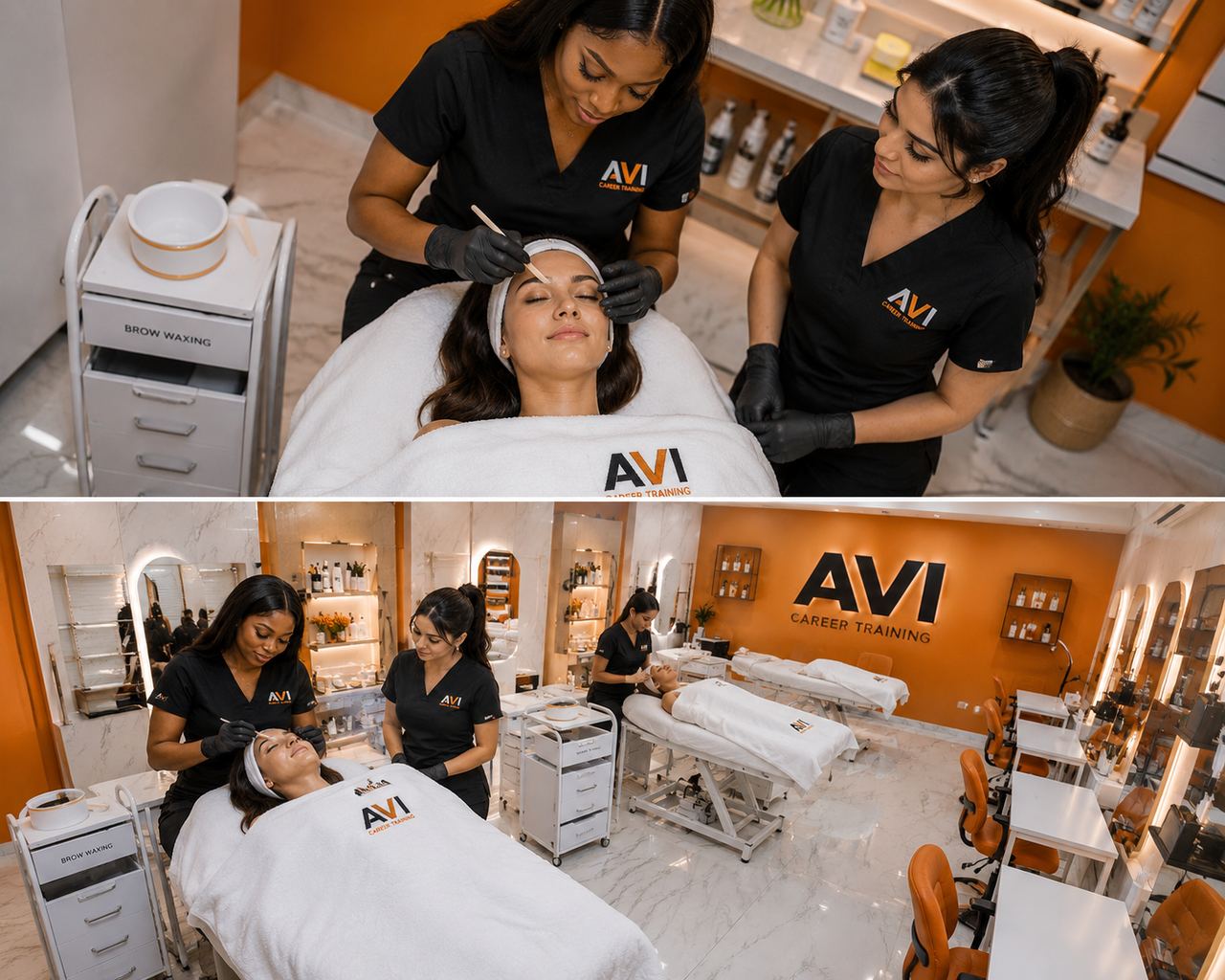
AVI Career Training is a COE-accredited, SCHEV-certified beauty and wellness school located at 1595 Spring Hill Rd #720, Vienna, VA 22182. AVI offers hands-on training in Esthetics, Cosmetic Laser Technology, Massage Therapy, Cosmetology, Nail Technology, and Electrolysis — all taught by licensed industry professionals in a fully equipped training environment.
Why AVI for Medical Esthetics and Laser Training
Faster path to licensure. Virginia’s 600-hour requirement for esthetics licensure means you can be exam-eligible in as few as five months on an accelerated schedule. That’s significantly faster than most medical assistant certificate programs — and far faster than a two-year associate degree.
Career-ready curriculum. AVI’s esthetics program covers skin analysis, facial techniques, hair removal, advanced chemical exfoliation, and clinical-setting protocols. The Cosmetic Laser Technology program adds training in laser hair removal, IPL treatments, and light-based skin therapies — skills that are in direct demand at Northern Virginia’s growing network of med spas and cosmetic clinics.
Inclusive training philosophy. AVI’s curriculum is built to train students to work beautifully on every skin tone. That’s not a footnote — it’s central to how AVI prepares graduates for a diverse, real-world clientele.
Financial aid and GI Bill® accepted. AVI’s COE accreditation makes the school eligible for federal financial aid, including Pell Grants. The school also accepts the GI Bill® — a meaningful option for veterans and active-duty service members in the Northern Virginia area.
A local, connected community. AVI is embedded in the Northern Virginia beauty and wellness industry. The school’s Vienna location puts students close to the Tysons corridor, one of the most active commercial and medical wellness districts in the DC metro area.
Your Next Step
You don’t need to have everything figured out before reaching out. AVI’s admissions team can walk you through program options, scheduling formats, financial aid eligibility, and what the licensing process looks like in Virginia.
If you’re ready to stop comparing and start training, apply now or call AVI directly at (703) 943-9841. You can also schedule a tour of the Vienna campus to see the training environment in person.
A medical assistant career is a solid path for the right person. But if you’re drawn to clinical environments, want to be licensed in under a year, and want real earning potential in a growing industry — esthetics and cosmetic laser technology deserve a serious look. AVI Career Training can show you exactly what that path looks like.
—
AVI Career Training is located at 1595 Spring Hill Rd #720, Vienna, VA 22182. COE Accredited · SCHEV Certified · Financial Aid Available · GI Bill® Accepted.
Salary figures referenced in this article are sourced from Bureau of Labor Statistics Occupational Employment and Wage Statistics data and industry reporting. Figures reflect approximate ranges and should be verified against current BLS.gov data for the most up-to-date information. Virginia licensing requirements are subject to change; always confirm current requirements with the Virginia Department of Professional and Occupational Regulation (DPOR).