Medical Assistant vs. Esthetics: Which Career Fits You?
A medical assistant career and an esthetics career can both place you in a clinical setting, working alongside healthcare professionals and helping people look and feel better — without a four-year degree. The real question is which path fits your strengths, your timeline, and the kind of work you actually want to do every day.
This guide gives you an honest, side-by-side look at both careers. You’ll see how the training compares, what the pay looks like in Virginia, and why a growing number of career explorers are landing in medical spas and dermatology clinics through the esthetics route — not the clinical one.
If you already know esthetics is the right direction, you can apply now to AVI Career Training in Vienna, VA.
—
> ## Key Takeaways
> – Medical assistant certificate programs typically take 9–12 months; Virginia’s esthetics license requires 600 clock hours, completable in approximately 5–6 months full-time
> – Medical assistants in Virginia earn a median annual salary of approximately $38,000–$44,000; med spa and laser-focused estheticians can earn $45,000–$55,000+
> – Virginia does not require a state license for medical assistants — certification is voluntary
> – Virginia does require a state license for estheticians, earned by passing the Virginia State Board theory and practical exams through PSI
> – AVI Career Training in Vienna, VA offers COE-accredited Esthetics and Cosmetic Laser Technician programs — with federal financial aid and GI Bill® eligibility
—
What Does a Medical Assistant Actually Do?
Medical assistants are the backbone of outpatient healthcare. They work in physician offices, urgent care clinics, specialty practices, and sometimes hospital outpatient departments. Their work splits between clinical and administrative tasks — sometimes in the same shift.
On the clinical side, a medical assistant might take vital signs, prep exam rooms, assist with minor procedures, draw blood, administer injections, or collect lab samples. On the administrative side, they handle scheduling, patient intake, insurance paperwork, and medical records. The split varies by employer, but most MAs do both.
Training and Certification
Medical assistant programs are offered at community colleges and career schools. Most certificate programs run 9–12 months. Some associate degree programs take two years, but the certificate route is the most common entry point.
Here’s something many people don’t realize: Virginia does not license medical assistants at the state level. There is no Virginia State Board exam, no required license to practice. Certification — like the Certified Medical Assistant (CMA) credential through the American Association of Medical Assistants (AAMA) or the Registered Medical Assistant (RMA) through American Medical Technologists — is voluntary. Many employers prefer or require it, but it’s not mandated by the state.
This matters when you’re comparing paths. The medical assistant route involves significant training and often a certification exam, but there’s no guaranteed, standardized licensing milestone the way there is in esthetics.
Work Environment
Most medical assistants work in traditional clinical settings — doctor’s offices, multi-specialty clinics, urgent care centers. The environment is fast-paced, often high-volume, and involves exposure to illness and medical procedures. For some people, that’s exactly where they want to be. For others, it’s a dealbreaker.
—
What Is a Medical Esthetician — and How Is It Different?
A medical esthetician is a licensed esthetician who works in a clinical or clinical-adjacent environment: medical spas, dermatology offices, plastic surgery clinics, oncology support programs, or aesthetic medicine practices.
The difference between a salon esthetician and a medical esthetician isn’t a separate license — it’s a specialty. In Virginia, both hold the same state esthetics license. What sets a medical esthetician apart is the scope of services they perform and the setting they work in.
Medical estheticians perform treatments like:
The Laser Technician Lane
Many estheticians working in medical spas add cosmetic laser training to their credentials. Laser hair removal, skin resurfacing, and photofacials are among the highest-demand, highest-revenue services in aesthetic medicine today.
In Virginia, cosmetic laser technology is regulated at the practice level — meaning a licensed physician or medical director oversees laser services, but there is no separate state board license specifically for laser technicians. Training and competency are determined by the supervising medical practice. This makes choosing a reputable, accredited training program especially important.
If the clinical side of beauty work appeals to you — but you don’t want to draw blood or file insurance claims — medical esthetics and cosmetic laser technology are worth a serious look. You can explore AVI Career Training’s Esthetics and Cosmetic Laser Technician programs to see what that training looks like in practice.
—
Training Time, Cost, and Licensing Compared
Let’s put both paths side by side so you can see the real differences.
Medical Assistant
| Factor | Details |
|—|—|
| Program length | 9–12 months (certificate); up to 2 years (associate degree) |
| State license required | No — Virginia does not license MAs |
| Voluntary certification | CMA (AAMA) or RMA — national exams |
| Typical setting | Doctor’s offices, urgent care, hospitals |
| Median salary in Virginia | ~$38,000–$44,000/year (BLS) |
Licensed Esthetician (Virginia)
| Factor | Details |
|—|—|
| Training hours required | 600 clock hours (Virginia State Board) |
| Program length | ~5–6 months full-time |
| State license required | Yes — theory and practical exams through PSI |
| Optional add-on | Cosmetic laser technician training |
| Median salary in Virginia | ~$36,000–$55,000+ depending on setting |
The training timelines are closer than most people expect. Both paths can realistically get you working in under a year. But there are meaningful differences in what that year looks like and what you can do at the end of it.
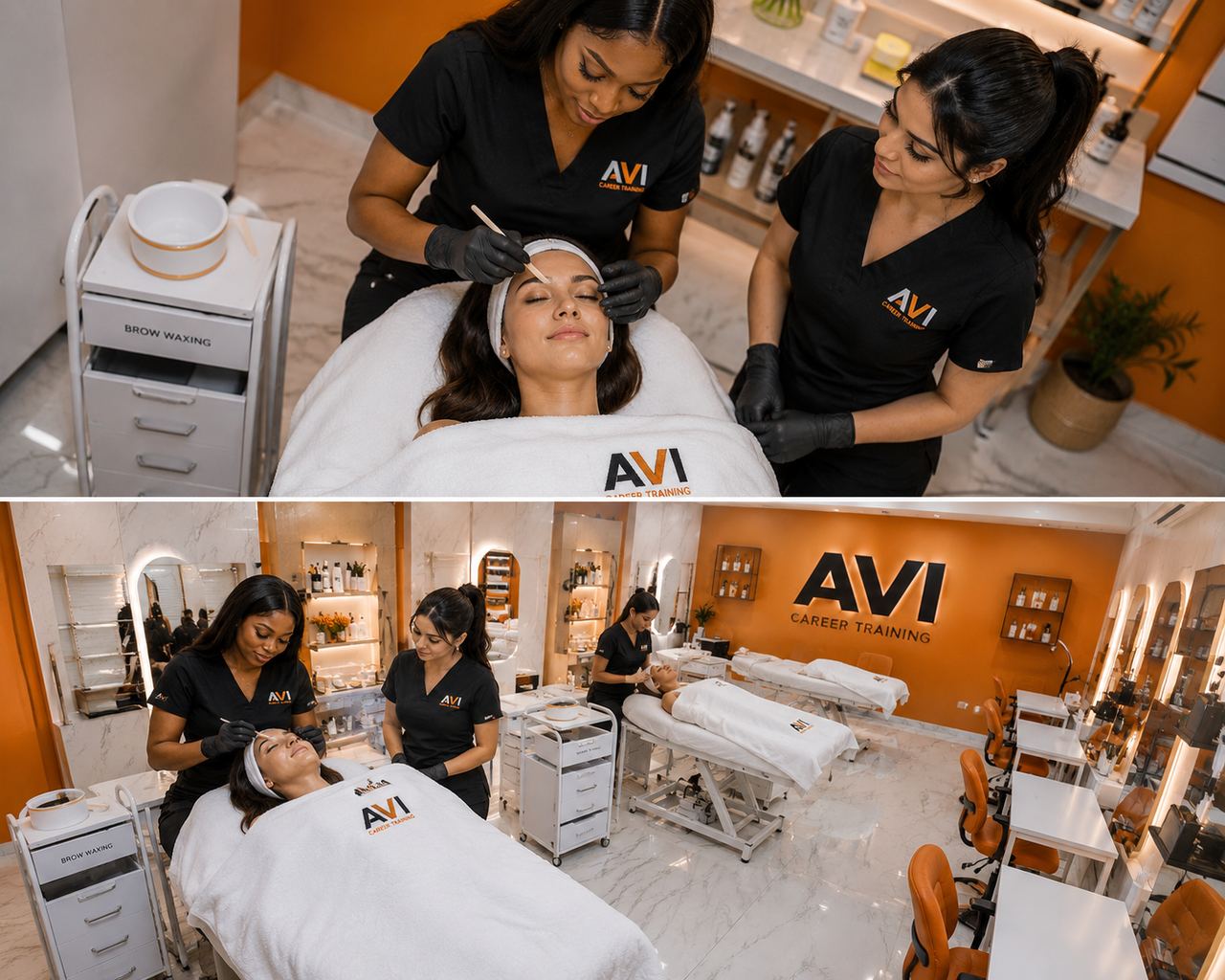
Esthetics training is hands-on from day one — you’re practicing facial techniques, learning skin analysis, and working with clients in a real student clinic setting. Medical assistant training balances clinical skills with administrative coursework, and your day-to-day at work will reflect that same split.
The Cost Factor
Medical assistant programs vary widely in cost — community college programs may run $5,000–$15,000, while private career schools can charge significantly more. Esthetics programs at accredited schools like AVI Career Training are often in a comparable or lower range, with the added benefit of federal financial aid eligibility.
AVI accepts federal financial aid, including Pell Grants, and also accepts the GI Bill® — making the esthetics path financially accessible for career changers, recent grads, and veterans alike.
—
Where Do These Careers Overlap? The Med Spa Connection
Medical spas sit at the intersection of healthcare and beauty — and they employ both medical assistants and estheticians, often on the same team.
A typical med spa staff might include a supervising physician or nurse practitioner, a registered nurse or medical assistant handling clinical intake and injectables, and licensed estheticians or laser technicians performing skincare and energy-based treatments. In this environment, MAs and estheticians work side by side, serving the same clientele, in the same building.
Can an Esthetician Work Alongside Doctors and Nurses?
Yes — and this happens every day in med spas and dermatology practices across Northern Virginia. Licensed estheticians regularly collaborate with physicians, NPs, and PAs on treatment plans, especially for clients managing acne, hyperpigmentation, rosacea, or recovering from cosmetic procedures.
The key difference is scope. Medical assistants may assist with injections, vitals, or clinical prep. Estheticians focus on skin treatment, education, and non-invasive aesthetic services. Neither one overlaps into the other’s lane — but together, they form a complete aesthetic medicine team.
> Mini-Story: Camille was a medical receptionist for three years at a dermatology practice in Tysons Corner. She loved the clinical environment but wanted to be hands-on with patients, not behind a desk. She looked at medical assistant programs but found the administrative component wasn’t what she was after. She enrolled in esthetics training, completed her 600 hours, passed her Virginia State Board exam, and was hired as an esthetician at the same practice where she’d been answering phones. She now performs chemical peels and advanced facials, earns more than she did at the front desk, and works directly with the dermatologist on patient care plans.
Do Medical Assistants Work in Medical Spas?
Some do — particularly in med spas that offer injectable services like Botox or dermal fillers, where clinical oversight and prep work is part of the model. But many medical spa services — laser treatments, facials, peels, skin consultations — fall squarely within esthetics scope. That’s why licensed estheticians are often the primary service providers in a med spa, not the support staff.
If your goal is a career in aesthetic medicine, esthetics may actually be the more direct route than medical assisting.
—
Allied Health vs. Beauty School: Rethinking the Comparison
The “allied health vs. beauty school” framing undersells what esthetics training actually prepares you for. It implies beauty school is a lesser path — a fallback. That’s not accurate, especially in the clinical esthetics space.
Here’s what a licensed esthetician working in a med spa actually knows:
That’s a clinical knowledge base. It’s learned in an accredited program, tested by a state board, and applied in healthcare-adjacent environments every day.
> Mini-Story: Marcus was a Navy veteran finishing his service commitment and considering career options under his GI Bill® benefits. He initially looked at medical assistant programs because they sounded stable and healthcare-adjacent. A friend mentioned that AVI Career Training in Vienna accepted GI Bill® benefits and offered a Cosmetic Laser Technician program. Marcus had never considered esthetics — he assumed it wasn’t for him. He toured the campus, talked to an instructor, and enrolled. Fourteen months later, he holds a Virginia esthetics license and a laser technician certification. He works at a medical spa in McLean, earning more than the median MA salary in Virginia — doing work he actually looks forward to every day.
Medical Spa Careers With No Degree Required
Both medical assisting and esthetics are accessible without a four-year degree. That’s a significant draw for career changers and recent high school graduates who want to enter the workforce quickly and start earning.
The difference is that esthetics leads to a state-issued license — a portable, lifelong credential that travels with you across employers and states (with applicable reciprocity). Medical assistant certification is nationally recognized but not state-regulated. For long-term career clarity and professional identity, licensure matters.
—
How to Start an Esthetics or Laser Career in Northern Virginia
If you’re reading this article, you’re likely at a crossroads — weighing a clinical path against something more hands-on, creative, and wellness-focused. Both paths are legitimate. Both can build a stable career. But they take you to different places.
If you’re drawn to patient contact, skin health, aesthetic treatments, and working in clinical settings without pursuing a traditional healthcare degree, esthetics — and specifically medical esthetics and cosmetic laser work — deserves a serious look.
AVI Career Training in Vienna, Virginia offers:
AVI is COE Accredited and SCHEV Certified. Federal financial aid is available, and AVI accepts the GI Bill® — making these programs accessible to a wide range of students, including career changers, veterans, and those who need flexible funding options.
The school is located at 1595 Spring Hill Rd #720, Vienna, VA 22182, in the heart of Northern Virginia’s thriving aesthetic medicine corridor. You can reach the admissions team at (703) 943-9841.
What to Expect From the Esthetics Program
AVI’s esthetics curriculum covers skin analysis, facial techniques, chemical exfoliation, waxing, advanced skincare, and client consultation — with an intentional focus on all skin tones. This is a non-negotiable part of AVI’s approach to training. You will graduate knowing how to serve a diverse clientele, which is exactly what med spas and dermatology practices in Northern Virginia need.
Graduates sit for the Virginia State Board theory and practical exams through PSI. Upon passing, you hold a Virginia esthetics license — your credential for working in any salon, spa, medical spa, or clinical esthetics setting in the state.
Ready to Take the Next Step?
If a career in esthetics or cosmetic laser technology sounds like the right fit, the best next step is a conversation with AVI’s admissions team. You can apply now online, or call (703) 943-9841 to ask questions and schedule a tour of the Vienna campus.
There’s no commitment required to explore — just a conversation about where you want to go and whether AVI can help you get there.
—
Frequently Asked Questions
What Is the Difference Between a Medical Assistant and a Medical Esthetician?
A medical assistant is a healthcare worker trained to support clinical and administrative functions in a medical setting — taking vitals, assisting with procedures, managing patient records. A medical esthetician is a licensed esthetician who specializes in clinical-grade skin treatments, often working in med spas, dermatology offices, or plastic surgery clinics. The two roles are distinct in training, scope, and daily responsibilities — though they often share the same workplace.
How Long Does It Take to Become a Medical Esthetician in Virginia?
You start by earning your Virginia esthetics license, which requires 600 clock hours of training and passing the Virginia State Board theory and practical exams through PSI. At AVI Career Training, full-time students can complete those hours in approximately 5–6 months. After licensing, many estheticians pursue additional training in advanced clinical techniques or cosmetic laser technology to specialize in medical spa work.
Do Medical Assistants Work in Medical Spas?
Some do, particularly in med spas that offer injectable services (like Botox or dermal fillers) where clinical prep and patient intake support is needed. However, the primary service providers in most medical spas are licensed estheticians and laser technicians — the people performing treatments directly on clients. If working in a med spa is your goal, esthetics training is often the more direct path.
Can an Esthetician Work Alongside Doctors or Nurses?
Yes. Licensed estheticians in Virginia regularly work alongside physicians, nurse practitioners, registered nurses, and physician assistants — especially in medical spas and dermatology practices. Estheticians focus on skincare treatments within their licensed scope, while clinical staff manage medical procedures. It’s a collaborative model, and it’s increasingly common across Northern Virginia’s growing aesthetic medicine market.
What Beauty School Careers Are Similar to Medical Assistant Jobs?
The closest parallel is the medical esthetician or cosmetic laser technician — both work in clinical settings, collaborate with healthcare providers, and serve clients with medical or cosmetic skin concerns. These careers share the clinical environment and patient-facing nature of medical assisting, but operate within esthetics scope rather than clinical medicine. AVI Career Training’s Esthetics and Cosmetic Laser Technician programs are specifically designed to prepare students for this type of career in Northern Virginia.
—
Sources: U.S. Bureau of Labor Statistics (BLS.gov) — Occupational Outlook Handbook, Medical Assistants and Skincare Specialists; Virginia Department of Professional and Occupational Regulation (DPOR); American Association of Medical Assistants (AAMA).