Medical Assistant vs. Esthetics: Which Career Fits You?
Choosing between a medical assistant vs. esthetics career comes down to one question: do you want to work inside a clinical exam room, or do you want to work on skin — and build a career with real entrepreneurial upside?
Both paths are legitimate. Both serve people. Both are well established right now in Northern Virginia. But they are genuinely different jobs with different training requirements, different licensing structures, and different day-to-day realities. This guide breaks it all down honestly so you can make the right call for your goals — not just the one that sounds impressive.
One thing to be upfront about: AVI Career Training in Vienna, VA does not offer a medical assistant program . AVI is a COE-accredited beauty and wellness school. If esthetics, cosmetic laser, or massage therapy turns out to be your path — AVI can get you there. If you want a clinical medical career, you’ll want a healthcare career college or community college instead. That’s not a sales pitch. That’s honest guidance.
> Ready to explore AVI’s esthetics and wellness programs? Start your application here.
—
Key Takeaways
—
What Medical Assistants Actually Do (And What They Don’t)
Medical assistants are the connective tissue of outpatient healthcare. They keep clinics moving. On any given shift, a medical assistant might take a patient’s vitals, update electronic health records, prep exam rooms, draw blood, administer injections, and handle insurance pre-authorizations — all before lunch.
It is a demanding, varied role that requires precision. You are working under the direct supervision of a licensed physician, nurse practitioner, or physician assistant. That supervision structure matters: medical assistants do not diagnose, prescribe, or make independent clinical judgments. They execute clinical tasks and keep the administrative side of patient care organized.
The role suits people who want to be embedded in a medical team, work in a structured healthcare hierarchy, and have direct patient contact in a clinical setting. Hospitals, family practices, urgent care clinics, and specialty offices are the primary employers.
What medical assistants are not: they are not medical estheticians, they are not massage therapists, and they are not licensed to perform skincare or aesthetic treatments. The overlap with beauty and wellness careers is minimal at the clinical level — though both fields involve working closely with people and caring about outcomes.
If your vision is hospital hallways, exam rooms, patient charts, and clinical procedures — medical assisting is worth serious research. If your vision involves skin, light-based treatments, relaxation, and a path toward owning your own business — keep reading.
—
What Estheticians Do — And Why Med-Spa Demand Is Surging
An esthetician is a licensed skincare professional. The day-to-day work includes skin consultations, facials, chemical exfoliants, extractions, waxing, and increasingly — in medical spa and clinical settings — advanced treatments like microdermabrasion, microneedling prep, and laser-adjacent services.
That last part is the story right now in Northern Virginia. The DC metro area has one of the fastest-growing concentrations of medical spas in the country. Med-spas operate at the intersection of clinical skincare and luxury wellness — and they need licensed estheticians who can handle both worlds. Esthetics graduates who train on advanced equipment and diverse skin types are exactly what these businesses are hiring.
A medical esthetician is not a separate license in Virginia. It’s a market positioning term for estheticians who work in clinical or medically supervised environments — performing skin treatments that complement or follow medical procedures like laser resurfacing, injectables, or surgical recovery. The Virginia Board of Cosmetology issues one esthetics license; what you do with it depends on where you work and what additional training you bring.
That distinction matters when you are comparing this career to medical assisting. A licensed esthetician working at a high-volume med-spa in McLean or Tysons Corner is operating in a healthcare-adjacent environment — without the clinical supervision requirements, the administrative burden, or the 18–24 month degree path.
Esthetics also has an entrepreneurial dimension that clinical roles typically do not. Experienced estheticians build repeat clientele, set their own service menus, and often move into booth rental, suite ownership, or product lines. That path exists. It is real. And it starts with licensure.
—
Training Time and Licensing — A Side-by-Side Comparison
This is where the rubber meets the road for most career researchers. Here is an honest, Virginia-specific comparison.
Medical Assistant Training in Virginia
Virginia does not require medical assistants to hold a state license. However, most employers — especially in the competitive DC/NoVA market — strongly prefer or require a nationally recognized credential such as the Certified Medical Assistant (CMA) from the American Association of Medical Assistants or the Registered Medical Assistant (RMA) from American Medical Technologists.
To sit for those exams, you typically need to complete an accredited medical assistant program . Timeline options:
Total time from enrollment to employment-ready: typically one to two years, depending on the path you choose and whether you attend full-time.
Esthetics Training in Virginia
Virginia’s esthetics licensure is governed by the Virginia Board of Cosmetology under the Department of Professional and Occupational Regulation (DPOR). Requirements are clear and consistent:
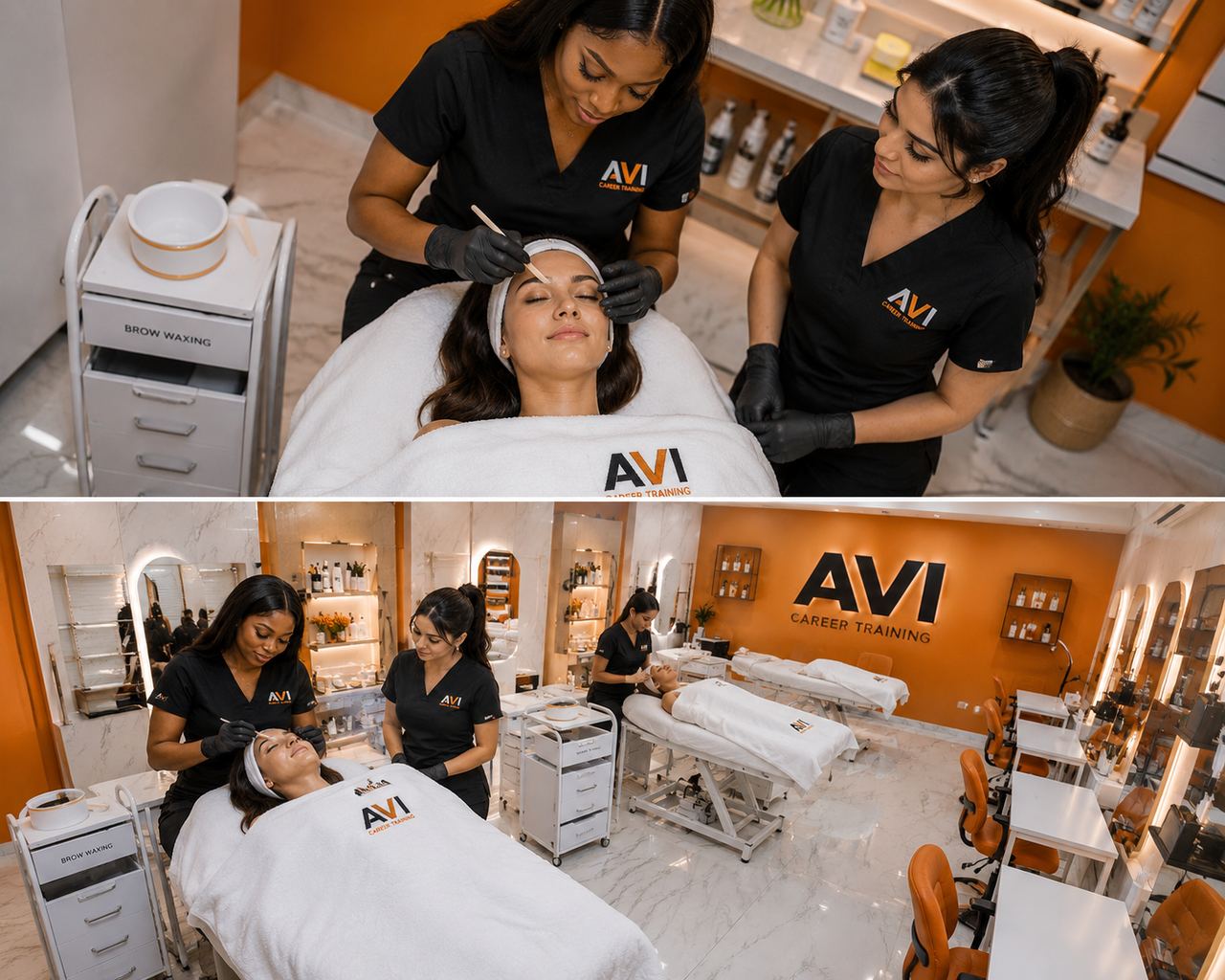
At AVI Career Training, the Basic Esthetics program covers those 600 hours with hands-on training in skin analysis, facial techniques, chemical exfoliants, waxing, and product knowledge. Students practice on real clients in AVI’s student clinic — not just mannequins.
For students who want to go deeper, AVI’s Master Esthetics program builds on the foundation with advanced modalities. And for those drawn to the laser and light-based treatment side of the med-spa world, AVI’s Cosmetic Laser Technician program is a direct pathway into one of Northern Virginia’s fastest-growing clinical skincare roles.
The honest comparison: Esthetics licensure in Virginia — 600 hours, then a state board exam. For many students attending full-time, that is achievable in under a year. Medical assistant certification — typically 9 to 24 months depending on program level. If timeline to employment matters to you, esthetics has a structural advantage.
—
Salary and Job Outlook in Northern Virginia
Numbers matter. Here is what the data actually shows — without inflation or vague promises.
Medical Assistant Salaries
According to the U.S. Bureau of Labor Statistics (BLS), the national median annual wage for medical assistants is approximately $38,270 (as of the most recent available data). In the Washington, DC metro area, that figure trends higher due to cost of living and competitive healthcare employment — but entry-level positions in outpatient clinics still typically start in the $36,000–$42,000 range.
The BLS projects medical assistant employment to grow faster than average nationally — roughly 14–15% over the next decade — driven by an aging population and expansion of outpatient care settings.
Esthetics and Cosmetic Laser Salaries in Northern Virginia
This is where the conversation gets more nuanced — and more interesting.
The BLS median for skincare specialists nationally is approximately $38,090/year — nearly identical to medical assisting at the national level. But that national median does not capture the Northern Virginia market reality.
Northern Virginia has one of the highest concentrations of medical spas, dermatology offices, and cosmetic clinics in the Mid-Atlantic region. Tysons, McLean, Reston, and Arlington are all home to high-volume aesthetics practices that compete for licensed, skilled estheticians. Compensation at these employers frequently includes base pay plus commission on retail and services — a structure that pushes total earnings which varies by experience and location for experienced practitioners.
Cosmetic laser technicians command even stronger compensation in this market. Laser and light-based treatment specialists working in med-spa settings in Northern Virginia can earn $45,000–$65,000 or more annually, depending on experience, employer, and commission structure. This is a role that medical assistant searchers frequently overlook — it sits squarely at the intersection of clinical skill and aesthetics, with a training timeline comparable to or shorter than medical assistant programs.
For those considering the medical spa careers Northern Virginia market specifically, the outlook is strong across esthetics, laser, and massage. The DC corridor’s high income demographics and strong wellness consumer culture drive consistent demand for qualified beauty and wellness professionals.
—
Meet Two People Who Had to Make This Exact Decision
Priya’s Story
Priya spent two years as a front-desk coordinator at a dermatology practice in Fairfax. She watched estheticians perform chemical peels, run laser sessions, and build real relationships with long-term clients. She assumed she needed a medical degree to do that work.
When she looked into medical assisting, she found a 12-month program — but realized the role would keep her on the administrative and clinical support side, not in the treatment room. She looked into esthetics next. Six hundred hours. State board exam. And AVI’s Cosmetic Laser Technician program as a follow-on credential.
Eighteen months after that research moment, Priya is a licensed esthetician working at a med-spa in McLean — doing exactly the work she watched from the front desk. No medical degree required.
Marcus’s Story
Marcus was a military veteran transitioning out of service and researching healthcare careers. He initially searched for medical assistant programs because “healthcare” felt stable and serious. But sitting in information sessions, he kept coming back to the same feeling: he wanted to work with people in a way that felt creative and entrepreneurial, not institutional.
A friend mentioned that AVI Career Training accepts the GI Bill®. Marcus enrolled in AVI’s Massage Therapy program. He is now building a private practice client list while working at a wellness center in Vienna — using benefits he had already earned to fund a career he actually wanted.
Both of these stories are about people who started with a medical assistant search and found a better fit. That is not a knock on medical assisting. It is just an honest account of how career research actually works.
—
How to Decide — And What AVI Offers for the Wellness Path
Here is a clear, pressure-free decision framework.
Choose medical assisting if:
Choose esthetics, cosmetic laser, or massage if:
If you want the clinical-skincare overlap specifically — the “medical esthetician” lane — AVI’s esthetics and cosmetic laser programs are the direct path. You will train on real clients, learn advanced skin analysis, and graduate with a credential that med-spas in this region are actively hiring.
What AVI Career Training Offers
AVI Career Training is a COE-accredited, SCHEV-certified beauty and wellness school located at 1595 Spring Hill Rd #720, Vienna, VA 22182. Programs include:
Financial aid is available. The GI Bill® is accepted. AVI’s student body is diverse, and the curriculum is intentionally built to train students to work on every skin tone — because inclusive technique is not optional, it is the standard.
If you are still figuring out which path is right for you, the best next step is a conversation — not a commitment. Reach out to AVI’s admissions team or start your application to learn exactly what your esthetics or cosmetic laser training would look like, how long it takes, and what it costs.
You can also call directly: (703) 943-9841.
The right career is the one that fits your actual goals — and you deserve honest information to find it.