Medical Assistant vs. Esthetician: Which Career Fits You?
Medical assistants support physicians in clinical settings; estheticians are the primary service provider in skincare and med-spa environments — and if you’re in Northern Virginia, the training timelines, licensing requirements, and earning potential are different enough to matter. This guide breaks down exactly what each role involves, how long training takes, what you can expect to earn in the DC metro market, and which path puts you in a position to thrive faster.
Key Takeaways
- Medical assistant programs typically take 9–12 months (diploma) or 2 years (associate degree) at a community college
- Virginia esthetics licensure requires 600 clock hours — AVI Career Training’s program can be completed in approximately 6 months full-time
- Medical assistants earn a national median of roughly $38,000–$42,000/year; estheticians in med-spa and laser settings in high-cost markets like Northern Virginia can earn $50,000–$65,000+
- Cosmetic laser technicians earn $45,000–$70,000+ depending on specialization and setting
- AVI Career Training is COE Accredited and SCHEV Certified — financial aid and GI Bill® benefits are available
What Does a Medical Assistant Actually Do?
A medical assistant (MA) works in physician offices, outpatient clinics, and hospital-adjacent settings. The role splits into two main functions: clinical and administrative.
On the clinical side, MAs take patient vitals, assist with exams, administer injections, draw blood, and prepare exam rooms. On the administrative side, they schedule appointments, manage patient records, handle insurance paperwork, and process billing. In smaller practices, one person often covers both.
Certifications and Requirements
Medical assistants are not licensed by a state board the way nurses or estheticians are. Most employers prefer or require a nationally recognized credential — either the Certified Medical Assistant (CMA) designation from the American Association of Medical Assistants (AAMA) or the Registered Medical Assistant (RMA) from the American Medical Technologists (AMT).
To earn these credentials, you typically need to complete an accredited medical assisting program first. Virginia doesn’t require MAs to hold a state license, but the national certifications carry significant weight with employers.
Work Settings
Most medical assistants work in:
- Physician offices and group practices
- Urgent care clinics
- Outpatient hospital departments
- Community health centers
The work is steady, often Monday through Friday, with limited weekend hours — which appeals to many career changers. But if you’re drawn to skincare, aesthetics, and working in a spa or clinical beauty environment, the MA role may feel too far removed from what actually excites you.
What Is a Medical Esthetician — and How Is It Different?
A medical esthetician is a licensed esthetician who works in clinical or med-spa environments rather than traditional day spas or salons. The scope of work goes beyond relaxation facials. Medical estheticians treat conditions like hyperpigmentation, acne scarring, rosacea, and post-procedure skin recovery — using advanced modalities that require both technical skill and a deep understanding of skin physiology.
This is where the medical esthetician career path diverges sharply from the standard MA role. You’re not taking blood pressure readings or entering insurance codes. You’re performing chemical peels, microdermabrasion, microneedling prep, and — with additional training — laser and light-based treatments.
Where Medical Estheticians Work
- Medical spas (med spas)
- Plastic surgery and dermatology practices
- Oncology wellness programs
- Luxury resort spas with clinical service menus
- Independent esthetic studios
In the Northern Virginia and DC metro market, med spas are a booming sector. High-income professionals in Tysons, McLean, Arlington, and Bethesda are regular med-spa clients — and practices in these areas actively recruit skilled, licensed estheticians who can deliver clinical results and build client relationships.
The Medical Esthetician vs. Medical Assistant Distinction
The clearest way to frame it: a medical assistant supports physicians. A medical esthetician is the primary service provider. You build your own clientele, develop expertise in specific skin concerns, and — in a commission-based or tip-eligible environment — your income grows with your skill level and client retention.
If you want to be the one clients ask for by name, esthetics is the path.
Ready to explore what training looks like? Apply to AVI Career Training and get the details on our esthetics and cosmetic laser programs.
Training Time and Cost: Side-by-Side Comparison
This is where the comparison gets concrete — and where the esthetics path has a clear structural advantage for people who want to start working sooner.
Medical Assistant Training
| Format | Length | Setting |
|---|---|---|
| Diploma / Certificate | 9–12 months | Community college or vocational school |
| Associate Degree | ~2 years | Community college |
Both pathways require passing a national certification exam after graduation. Some employers also require externship hours, which are built into most programs but extend the overall commitment.
Tuition varies widely — community college programs in Virginia can range from around $5,000 to $15,000+ depending on the school and whether you qualify for in-state rates.

Esthetics Training in Virginia
How long does esthetician school take in Virginia? Virginia’s Board of Cosmetology requires 600 clock hours to qualify for a state esthetics license. At AVI Career Training’s full-time schedule, students can complete those hours in approximately 6 months.
After completing the hours, you sit for two exams administered by PSI: the Virginia State Board written exam and the practical exam. Pass both, and you’re a licensed esthetician in the Commonwealth of Virginia.
AVI’s program is SCHEV certified — meaning Virginia’s State Council of Higher Education has reviewed and approved the curriculum. The hours are fully state-qualifying. There’s no gray area about whether your training counts.
What About Cosmetic Laser Training?
The Cosmetic Laser Technician path at AVI adds clinical laser competency to your esthetics foundation. Laser technician roles at med spas are among the highest-compensating positions in the beauty and wellness sector — and Virginia does require that laser treatments be performed under physician oversight, meaning these roles are embedded in clinical practices where compensation reflects the responsibility.
Compare this to a nursing or PA program — which takes two to four-plus years and significant tuition investment — and the value of a focused laser technician certification becomes clear.
Beauty School vs. Community College: Which Makes More Sense?
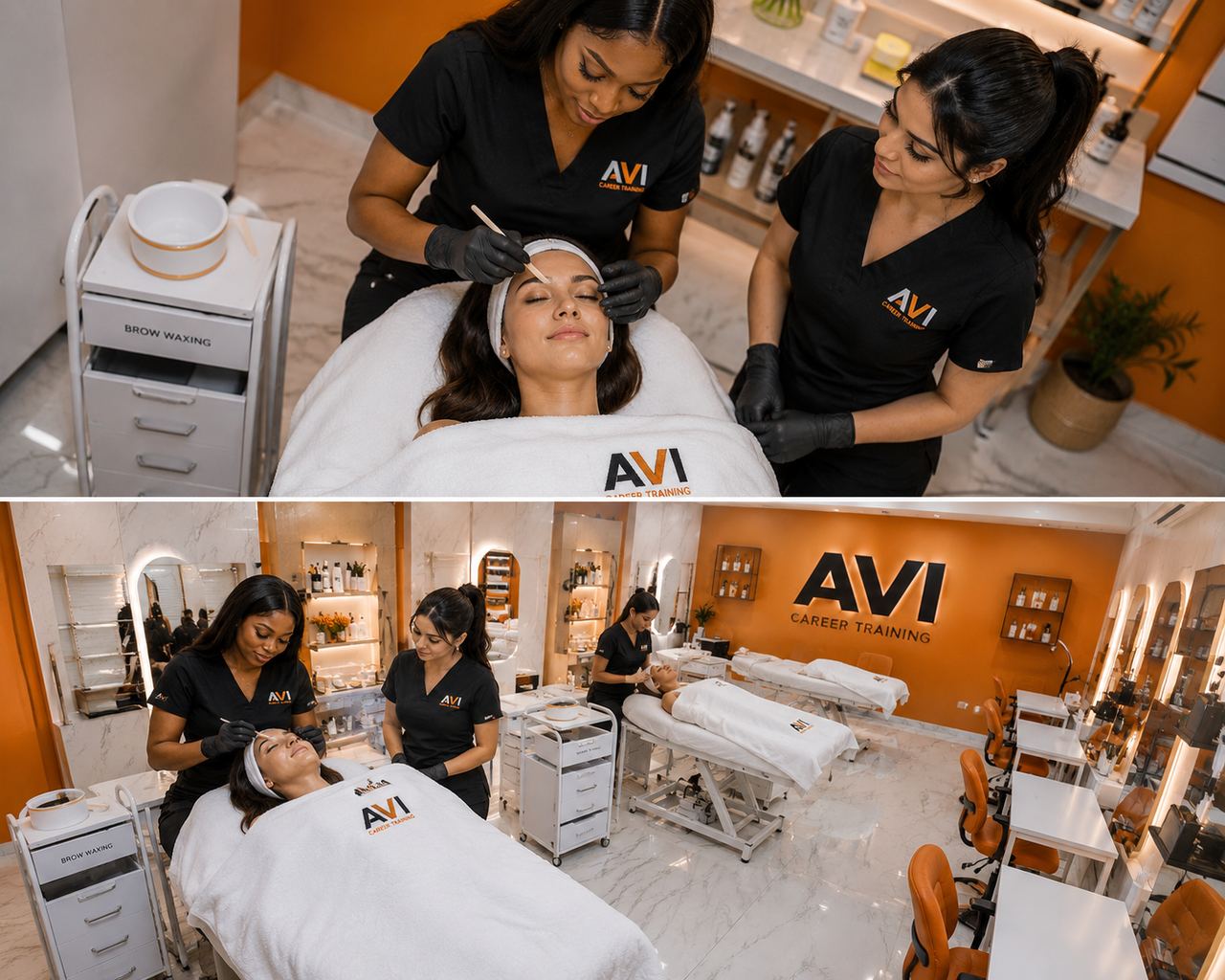
The beauty school vs. community college question comes down to your goal. If you want to work in skincare, med spas, or cosmetic laser settings, a focused esthetics school gets you licensed faster and into a specialized role sooner. Community colleges often offer broader healthcare curricula, but the esthetics training available at a dedicated school like AVI — with hands-on clinical practice built in from day one — is purpose-built for the career you actually want.
A Closer Look: Two Students, Two Paths
Monique’s Story
Monique worked as a dental receptionist in Fairfax for six years. She liked working with people, but she wanted to do something more hands-on — and she’d always been interested in skincare. She looked into medical assisting programs at Northern Virginia Community College, but the 12-month timeline and the administrative-heavy curriculum didn’t match what she was looking for.
She enrolled in AVI’s Basic Esthetics program instead. Six months later, she passed her Virginia State Board exams and accepted a position at a med spa in Tysons. Within her first year, she added chemical peel and microdermabrasion certifications. She’s now building a repeat client base and earning more than she did after two promotions in her dental office role.
David’s Story
David left active-duty service and used his GI Bill® benefits to enroll at AVI Career Training in the Cosmetic Laser Technician program. He’d considered medical assisting — several of his fellow veterans went that route — but he wanted a role where he could specialize and grow his income over time, not just clock hours at a front desk.
The GI Bill® covered his tuition. After completing the program and passing his licensing requirements, David accepted a laser technician position at a dermatology-affiliated med spa in Arlington. The role includes performance-based compensation — and his military discipline made him one of the most consistent performers on the team within months.
Salary and Job Outlook in Northern Virginia
Let’s talk numbers — because salary is one of the main reasons people research these paths in the first place.
Medical Assistant Salaries
According to the Bureau of Labor Statistics (BLS), the national median annual wage for medical assistants is approximately $38,000–$42,000 (2023 data). In the Washington-Arlington-Alexandria metro area, wages trend slightly higher due to the cost of living — but the ceiling is relatively fixed. MAs in most settings are salaried or hourly employees without commission structures.
Note: Verify exact MSA figures at BLS.gov before making any career decision, as wages are updated annually.
Esthetician and Medical Esthetician Salaries
The national median for estheticians hovers around $36,000–$42,000/year — but that number is pulled down by traditional day spa and salon roles with lower hourly rates and limited earning upside.
In medical spa careers in Northern Virginia, the picture shifts significantly. Estheticians working in med-spa environments — especially those with advanced modalities like chemical peels, microneedling, or laser — frequently earn $50,000–$65,000+ annually when you factor in tips, retail commissions, and service bonuses. High-performing estheticians in the DC metro market can earn well above that.
Cosmetic Laser Technician Salaries
Cosmetic laser technicians in Virginia earn in the range of $45,000–$70,000+ depending on the practice setting, level of specialization, and performance-based compensation structure. Laser roles are in high demand at dermatology practices and med spas — and there are far fewer qualified technicians than there are open positions in markets like Fairfax County, Arlington, and Loudoun County.
Job Outlook
The BLS projects steady demand for both roles through 2032. For estheticians specifically, the med-spa sector is growing faster than traditional spa employment — driven by consumer demand for non-invasive cosmetic treatments, anti-aging services, and skin health. In a high-income market like Northern Virginia, that demand is amplified.
Which Path Is Right for You? (And What to Do Next)
Here’s a straightforward decision framework — no fluff, just the honest comparison.
Choose medical assisting if:
– You want to work directly in physician offices or clinical healthcare settings
– You prefer a structured, administrative + clinical hybrid role
– You’re comfortable with a 9–12 month training timeline and national certification exams
– You’re not specifically drawn to skincare or aesthetics
Choose esthetics (or cosmetic laser) if:
– You’re drawn to skincare, aesthetics, and helping people look and feel their best
– You want to be the primary service provider — not a support role
– You want to be licensed and working in under a year
– You’re interested in medical spa careers in Northern Virginia or building a long-term clientele in a growing sector
– You want the earning potential that comes with commission-based, tip-eligible, or specialized clinical roles
What AVI Career Training Offers
At AVI Career Training in Vienna, VA, you can train for:
- Basic Esthetics — Virginia State Board-qualifying 600 clock hours; approximately 6 months full-time
- Master Esthetics — Advanced skincare techniques for med-spa and clinical environments
- Cosmetic Laser Technician — Hands-on laser training for clinical and medical spa settings
AVI is COE Accredited and SCHEV Certified. Financial aid is available, and the school accepts the GI Bill® — making quality training accessible regardless of your financial starting point.
One thing that sets AVI apart in the Northern Virginia market: the curriculum is built to work on all skin tones. In a region as diverse as the DC metro area, that’s not a footnote — it’s a core skill that makes graduates more effective and more employable across every practice setting.
Your Next Step
If you’ve read this far, you’re not just casually browsing — you’re close to making a real decision. The best next step is a direct conversation with AVI’s admissions team.
Ask about program schedules, financial aid options, and what the first week of esthetics training actually looks like. You’ll leave the conversation with a clear picture of whether this is the right fit.
Apply to AVI Career Training today — or call us directly at (703) 943-9841. Our Vienna, VA campus is located at 1595 Spring Hill Rd #720, Vienna, VA 22182, and we’re happy to schedule a tour so you can see the school in person before you commit to anything.
The career you want is closer than you think. The question is which path gets you there.
AVI Career Training is COE Accredited and SCHEV Certified. Financial aid available. GI Bill® accepted. Serving students throughout Northern Virginia and the DC metro area.