Medical Assistant vs. Esthetician: Which Career Fits You?
The medical assistant vs. esthetician career paths lead to meaningful, in-demand work — but they are very different roads, and the one that fits you depends on where you want to spend your days, how quickly you want to start earning, and what kind of work actually excites you.
If you’re drawn to clinical settings, patient care, and healthcare procedures, medical assisting may sound appealing. But if you want hands-on, results-driven work in skin care, cosmetic treatments, or medical spas — and you want to get there faster and for less money — the esthetics path (especially the medical esthetician or cosmetic laser technician lane) deserves a serious look.
This guide breaks down both careers honestly: training requirements, Virginia licensing rules, salary data for the Northern Virginia market, and the one career option most comparison articles completely ignore.
Ready to get started? Apply now at AVI Career Training — it takes just a few minutes.
—
> ### Key Takeaways
> – Virginia requires 600 clock hours of training to become a licensed esthetician — most programs take approximately six months
> – Medical assistant programs in Virginia typically take 9–12 months and lead to voluntary certification, not state licensure
> – Median salaries in Northern Virginia: MAs earn roughly $42,000–$48,000/year; medical spa estheticians and laser technicians can earn $50,000–$70,000+
> – Esthetician income is scalable through tips, self-employment, and product sales — MA income is typically fixed hourly
> – Medical estheticians and cosmetic laser technicians work directly in medspa and clinical environments — often doing the same aesthetic procedures patients seek out
—
What Does a Medical Assistant Actually Do?
Medical assistants support physicians and clinical staff in outpatient settings — think private practices, urgent care clinics, and specialty offices. Their day-to-day work is split between administrative tasks and basic clinical duties.
On the clinical side, that means taking vitals, drawing blood, preparing exam rooms, administering injections, and documenting patient histories. On the administrative side, it means scheduling appointments, processing insurance forms, and managing patient records.
What medical assisting is not: It is not an autonomous clinical role. Medical assistants in Virginia work under direct physician supervision and are not licensed by the state. Certification (through credentials like the CMA from AAMA or RMA from AMT) is voluntary — but most employers prefer it, and most programs prepare students to sit for those exams.
Medical assistant programs in Virginia run 9–12 months at most community colleges and vocational schools. They are solidly healthcare-adjacent, but the role itself is support-based. You will not be performing cosmetic treatments, managing skincare protocols, or working in a medical spa setting.
If your pull toward healthcare is really about wanting to work in aesthetic medicine — laser treatments, skin resurfacing, injectables support — medical assisting will likely leave you wanting more.
—
What Does an Esthetician (or Medical Esthetician) Do?
An esthetician is a licensed skin care professional. At the foundational level, that means facials, chemical peels, waxing, dermaplaning, and skin analysis. But the career path branches significantly depending on where you work and what advanced training you pursue.
Traditional spa esthetician: Works in day spas, salons, or resort settings. Focuses on relaxation-based and corrective skin treatments. Builds a loyal client base over time.
Medical esthetician: Works in dermatology offices, plastic surgery practices, and medical spas. Performs clinical-grade treatments — advanced chemical peels, microdermabrasion, pre- and post-procedure skin care, and often assists with or performs laser procedures. This is where esthetics and healthcare directly overlap.
Cosmetic laser technician: Performs laser hair removal, laser skin resurfacing, IPL photofacials, and other energy-based treatments. Works almost exclusively in medspa or clinical environments. This is one of the fastest-growing roles in aesthetic medicine.
Here is the distinction most career comparison articles miss entirely: medical estheticians and laser technicians work in the same clinical environments as medical professionals — but they are doing the aesthetic procedures that patients specifically come in for. They are not support staff. They are the appointment.
To become a licensed esthetician in Virginia, you need 600 clock hours of approved training, followed by passing the Virginia State Board exam administered through the Virginia Board of Cosmetology. That is the foundational credential for both the traditional and medical spa career paths.
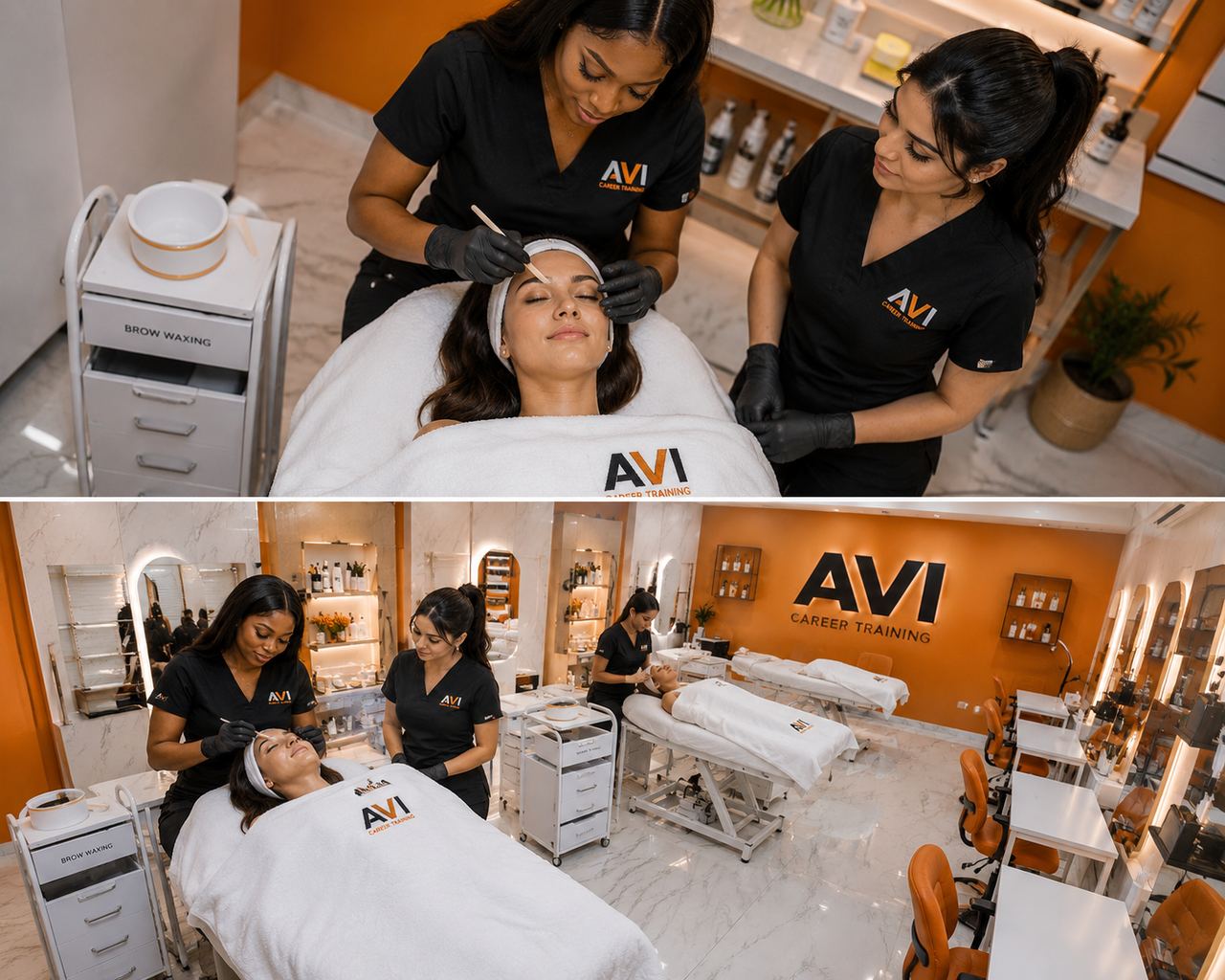
AVI Career Training offers a COE-accredited Esthetics program in Vienna, VA, and a Cosmetic Laser Technology program — both designed to prepare students for exactly this kind of career. If you’re researching medical esthetician training in Northern Virginia, AVI is one of the few schools in the area with both tracks under one roof.
—
Training Time & Cost: Side-by-Side Comparison
Here is where the practical math starts to matter.
| | Medical Assistant | Esthetician (Virginia) | Cosmetic Laser Technician |
|—|—|—|—|
| Training Hours | Varies by program (~720–900 hrs) | 600 clock hours (state minimum) | Varies; often pairs with esthetics license |
| Program Length | 9–12 months | ~6 months | Shorter standalone or add-on track |
| State License Required? | No (Virginia does not license MAs) | Yes — Virginia Board of Cosmetology exam | No state license; esthetics license is industry standard |
| Certification | Optional CMA/RMA (employer-preferred) | Required state license | COE-accredited training + esthetics credential |
| Typical Cost | $10,000–$20,000+ at community colleges | Varies by school; financial aid available | Varies; often bundled with esthetics program |
A few things stand out here.
First, the esthetics path is genuinely faster. Six months of focused training versus 9–12 months is a meaningful difference when you are eager to start working and earning.
Second, Virginia does not currently require a specific state license for laser technicians — but the industry standard for medspa employment is an esthetics license paired with accredited laser training. Schools that skip COE accreditation are cutting corners that employers will notice.
Third, financial aid matters. AVI Career Training is COE Accredited and SCHEV Certified, which means students may qualify for federal financial aid — including Pell Grants and the GI Bill® for eligible veterans and military families. That changes the cost equation significantly compared to an out-of-pocket community college program.
Ready to find out if you qualify? Start your application at AVI — it takes just a few minutes.
—
Salary & Job Outlook in Northern Virginia
Virginia’s proximity to Washington, D.C. pushes wages above national averages for both roles. Here is what the data shows for the Northern Virginia / DC metro market.
Medical Assistants
According to the U.S. Bureau of Labor Statistics, medical assistants in the Washington-Arlington-Alexandria metro area earn a median wage that translates to approximately $42,000–$48,000 per year. The BLS projects 14% job growth nationally through 2032 — faster than average. It is a stable field with consistent demand.
What the salary data does not show: MA wages are almost always fixed hourly rates set by the employer. There is limited upside from tips, commissions, or self-employment. Raises come with time and possibly additional certifications.
Estheticians — and the Medical Spa Premium
Esthetician salary data varies more widely because the role spans so many settings. Nationally, BLS data shows median esthetician wages around $38,000–$42,000 annually. But that average blends together part-time spa workers and full-time medical spa professionals in high-cost markets.
In the Northern Virginia and DC metro corridor — which has one of the densest concentrations of medical spas in the country — the picture looks different. Medical spa estheticians and cosmetic laser technicians in this market regularly earn $50,000–$70,000+, with top performers in high-volume medspa practices earning more. Industry data from the Associated Skin Care Professionals (ASCP) consistently shows that medical spa roles command a significant salary premium over day spa positions.
Beyond base pay, estheticians can earn through:
The income ceiling for an esthetician in Northern Virginia is meaningfully higher than for a medical assistant . The income floor is more variable — especially in the early career stages.
A Closer Look: Cosmetic Laser Technician vs. Medical Assistant
This specific comparison — cosmetic laser technician vs. medical assistant — is worth its own moment.
Both roles can work in clinical settings. Both interact with patients or clients in a healthcare-adjacent environment. But the nature of the work is completely different.
A medical assistant draws labs and updates charts. A cosmetic laser technician performs IPL photofacials, laser hair removal, and skin rejuvenation treatments — the exact services clients book months in advance and pay premium prices for. In a busy Northern Virginia medspa, a skilled laser technician is a direct revenue driver for the practice, and compensation reflects that.
AVI’s Cosmetic Laser Technology program is designed specifically for students who want to work in this growing niche. If you’ve been researching medical assistant careers because you want clinical work, laser technology may be the path you didn’t know you were looking for.
—
Meet Two Students Who Faced This Exact Decision
Story 1: Marcus Was Burned Out on Corporate Work and Wanted Something Real
Marcus spent eight years in project management in Reston, Virginia. He was good at his job, but the work felt abstract — spreadsheets, meetings, deliverables that disappeared into a server somewhere. He wanted work where he could see the results directly on another person.
He spent three months researching medical assistant programs at Northern Virginia Community College. The 12-month timeline and the administrative-heavy job description gave him pause. A friend who worked at a medspa in Tysons Corner told him that her laser technician colleagues made more money than most MAs — and genuinely loved their work.
Marcus enrolled in AVI’s Esthetics and Cosmetic Laser Technology programs. Six months later, he was licensed. Within a year of graduating, he had a full-time position at a medspa near Tysons Corner. “I see the results of what I do every single session,” he said. “Clients cry happy tears. You can’t get that from updating a patient chart.”
Story 2: Keisha Wanted Healthcare — but the MA Role Wasn’t the Right Fit
Keisha was a licensed practical nurse’s aide in Fairfax County who had been exploring a transition out of long-term care. She looked seriously at medical assisting as a step toward a more clinical role. But the more she researched, the more she realized she was drawn to skincare specifically — not blood draws and vital signs.
Her research led her to the concept of the medical esthetician. She discovered that Virginia esthetics licensing required 600 hours of training — less time than the MA program she had been considering. She enrolled at AVI Career Training, completed the Esthetics program, and took a position at a dermatology practice in McLean.
“I get to work with patients who are dealing with real skin issues — acne scarring, rosacea, post-procedure recovery,” Keisha explained. “It feels clinical because it is clinical. But I’m doing skincare, which is what I actually wanted.”
—
If You Want to Work in a Medical Spa or Clinic — Consider This Path
If you’ve been researching medical assistant careers because you want to work in a clinical or medspa environment, here is the honest truth: the esthetics and cosmetic laser path gets you there faster, pays comparably or better in this market, and puts you in the treatment room rather than behind a clipboard.
Virginia’s medspa corridor runs from Tysons Corner through McLean, Reston, and Arlington — and it is growing. These practices employ estheticians, laser technicians, and skincare specialists who perform the services clients actually come in for. They hire from accredited programs with hands-on training and graduates who can pass the Virginia State Board exam on day one.
AVI Career Training’s programs are built around exactly this outcome:
AVI is COE Accredited and SCHEV Certified, located at 1595 Spring Hill Rd #720, Vienna, VA — five miles from the Tysons Corner medspa corridor. Financial aid is available, and the GI Bill® is accepted for eligible veterans and active-duty military families.
You can reach an AVI admissions advisor at (703) 943-9841, or apply directly online to get the process started.
—
Which Career Is Actually Right for You?
Here is a straightforward way to think about it.
Choose medical assisting if:
Choose esthetics or cosmetic laser technology if:
Both are legitimate, rewarding careers. But if your vision of healthcare-adjacent work is really a vision of aesthetic medicine — cosmetic treatments, clinical skincare, laser procedures — then esthetics training at an accredited school is the more direct path to that life.
AVI Career Training exists to help you get there. Start your application today and talk to an admissions advisor about which program fits your goals.
—
AVI Career Training is a COE-accredited, SCHEV-certified beauty and wellness school in Vienna, Virginia. Programs include Esthetics, Cosmetic Laser Technology, Cosmetology, Massage Therapy, Nail Technology, and Electrolysis. Federal financial aid and GI Bill® benefits are available for eligible students. Call (703) 943-9841 or visit avicareertraining.com to learn more.