Medical Assistant vs. Esthetician: Which Career Is Right for You?
Both the medical assistant and esthetician career paths offer hands-on work, real earning potential, and a way to build a fulfilling career without a four-year degree — but the day-to-day reality, training requirements, and long-term opportunities look very different depending on which direction you choose.
If you’re weighing these two paths, you’re asking exactly the right questions. This guide breaks down training time, salary data, work environments, and the growing overlap between beauty and medicine — so you can make a clear-eyed decision about where to invest your time and money.
> Key Takeaways
> – Virginia requires 600 clock hours to become a licensed esthetician — completable in roughly five to six months
> – Medical assistant programs typically run nine to twelve months for a certificate
> – Virginia estheticians earn $36,000–$55,000+ annually, with significant upside from tips, commissions, and self-employment
> – Virginia does not require state licensure for medical assistants — a key fact many career-changers don’t know
> – Medical spa estheticians and cosmetic laser technicians can command premium rates in clinical settings without an MA credential
Ready to explore the beauty and wellness side of this decision? Apply to AVI Career Training and get started on a path that leads directly to the workforce.
—
Training Time: How Quickly Can You Start Working?
One of the first questions any career-changer asks is simple: How long until I’m earning?
Medical Assistant Programs
Most medical assistant certificate programs run between nine and twelve months at community colleges or vocational schools. Some accelerated programs compress training into as few as seven months, while associate degree programs stretch to two years. Coursework typically covers clinical procedures, medical terminology, anatomy, administrative tasks, and electronic health records.
After completing a program, many employers expect — or require — certification through organizations like the American Association of Medical Assistants (AAMA) or the National Healthcareer Association (NHA). Those exams add another layer of preparation on top of your program hours.
Here’s a detail that surprises a lot of people: Virginia does not require state licensure for medical assistants. Unlike nurses, dental hygienists, or cosmetologists, MAs in Virginia work under a physician’s supervision without sitting for a state board exam. That removes one barrier, but it also means your credential is only as strong as the certification you earn voluntarily.
Esthetics Programs
In Virginia, the path to becoming a licensed esthetician is regulated by the Virginia Department of Professional and Occupational Regulation (DPOR). The requirement is 600 clock hours of training at an approved school — after which graduates are eligible to sit for the Virginia State Board exam.
At a full-time pace, 600 hours is completable in approximately five to six months. That means a motivated student can go from enrollment to board-eligible faster through esthetics than through most medical assistant programs.
Beyond basic esthetics, Virginia also licenses cosmetologists (1,000 clock hours) and nail technicians (150 clock hours). Massage Therapy requires 625 clock hours. Each path has its own state board process — meaning your license is a formal, state-recognized credential backed by law.
The bottom line on training time: If speed to licensure matters to you, esthetics offers one of the fastest regulated career pathways in Virginia’s professional landscape.
—
Salary & Earning Potential: What Do the Numbers Say?
Salary is rarely the whole picture, but it’s always part of the conversation. Here’s an honest look at what both paths pay — and where the real earning potential lives.
Medical Assistant Salaries in Virginia
According to the U.S. Bureau of Labor Statistics, the median annual wage for medical assistants in Virginia falls in the range of $40,000–$44,000. Entry-level positions often start lower, and geographic location matters — Northern Virginia’s proximity to major health systems and a high cost of living tends to push wages toward the higher end of the state range.
Growth in this field is real. The BLS projects steady demand for medical assistants nationally as the healthcare system expands. However, the salary ceiling for MAs without additional credentials (nursing, medical coding certification, etc.) tends to be relatively flat unless you continue your education.
Esthetician Salaries in Virginia
Virginia estheticians earn a median in the range of $36,000–$55,000+, but that range understates what’s actually possible. Here’s why: esthetician income is highly variable in ways that can work strongly in your favor.
The Bureau of Labor Statistics Occupational Outlook for Skincare Specialists notes that the top 25% of earners in this field significantly outpace the median — and that disparity is driven largely by specialization, location, and business ownership.
For Northern Virginia specifically, proximity to Washington D.C. and a dense, affluent client base makes this one of the stronger markets for beauty and wellness professionals in the country. Medical spa careers in Northern Virginia are particularly competitive, with experienced estheticians and laser technicians often earning well above state medians.
The Honest Comparison
Medical assisting offers more income predictability. Esthetics offers more income flexibility. Your preference between those two realities is itself a useful data point about which path fits your personality and goals.
—
Work Environment & Daily Reality
Salary data tells you the numbers. Daily reality tells you whether you’ll actually want to go to work.
A Day in the Life of a Medical Assistant
Medical assistants work primarily in physician offices, clinics, outpatient facilities, and hospital departments. A typical day might include taking patient vitals, preparing exam rooms, drawing blood, processing lab specimens, scheduling appointments, and handling insurance documentation.
The work is genuinely meaningful — you’re supporting patient care and often serving as the warm human face of a clinical environment. But the setting is structured, the dress code is clinical, and the pace is dictated by appointment schedules and provider needs. Evenings and weekends are less common in outpatient settings, but urgent care and hospital roles can mean irregular hours.
The patient population is diverse in the best possible way — MAs work with people across every age, background, and health condition. That variety is one of the reasons many people are drawn to the role.
A Day in the Life of an Esthetician
Estheticians work in day spas, salons, medical spas, resort properties, cruise ships, and private studios. A typical day involves performing facials, chemical exfoliation treatments, waxing, lash services, and — depending on advanced training — laser treatments, microdermabrasion, or electrolysis.
The environment is intentionally relaxing and relationship-driven. Many estheticians build a loyal client base over years, with clients returning every four to six weeks. That continuity creates a professional relationship that’s genuinely rewarding — you watch people’s skin health improve, you become someone they trust, and you grow a book of business that belongs to you.
Schedule flexibility is a genuine advantage. Many estheticians set their own hours, choose their own clientele, and have real control over their work-life balance — especially those who rent booth space or operate independently.
—
The Medical-Beauty Crossover: Careers You May Not Have Considered
Here’s where the conversation gets interesting — especially for anyone drawn to both healthcare and beauty.
What Is a Medical Esthetician?
A medical esthetician is a licensed esthetician who works in a clinical or medical spa setting, often performing advanced treatments that complement physician-supervised procedures. These can include:
In Virginia, becoming a medical esthetician starts with earning your standard esthetics license (600 clock hours through DPOR). From there, you build specialized skills through advanced training programs — including cosmetic laser technology and electrolysis — that open doors to clinical environments.
Cosmetic Laser Technician
Cosmetic laser technology is one of the fastest-growing specializations in the beauty and wellness space. Virginia does not have a standalone state board exam for laser technicians — training and certification in this field are industry-governed rather than state-licensed. That means your training program’s quality and reputation matter significantly.
Laser technicians in medical spa settings perform treatments for hair removal, skin tightening, pigmentation correction, and more. In established Northern Virginia markets, experienced laser technicians command hourly rates and compensation packages that compare favorably to — or exceed — many clinical administrative roles.
Electrolysis
Electrolysis is the only FDA-recognized method of permanent hair removal, and it requires its own licensure in Virginia, governed by the Virginia Department of Health. Electrologists operate in both traditional salon/spa settings and medical-adjacent environments, often working alongside dermatologists and plastic surgeons.
If you’re drawn to precise, science-based work with measurable, permanent results for clients, electrolysis is a path worth exploring seriously.
Why This Middle Ground Matters
Many people researching medical assistant vs. esthetician careers don’t realize that the beauty and wellness world has its own clinical tier. You don’t need a nursing credential or an MA certificate to work in a medical spa, perform laser treatments, or assist with cosmetic procedures. You need the right esthetics license, the right advanced training, and the skills to back it up.
That’s exactly the territory where AVI Career Training operates — offering programs in Basic Esthetics, Master Esthetics, Cosmetic Laser Technician, and Electrolysis that are designed to put graduates directly into this growing market.
—
Mini-Story: Two Students, Two Paths
Destiny came to AVI after spending three years working the front desk at a dermatology office in Fairfax. She loved watching the clinical estheticians work — the precision, the technology, the visible transformations. But she assumed she needed a nursing degree or medical background to do that work herself.
When she learned that Virginia’s esthetics license required 600 clock hours — not four years of college — she enrolled in AVI’s Master Esthetics program. Within six months, she sat for her Virginia State Board exam. Within a year of graduating, she was working as a medical esthetician at a cosmetic dermatology practice two miles from her old front desk job. Same building. Different side of the treatment room.
—
Marcus was finishing his medical assistant certificate at a Northern Virginia community college when a friend mentioned AVI’s Cosmetic Laser Technician program. He’d always been interested in aesthetics but assumed “beauty school” wasn’t serious enough for his goals. He took a tour, talked to an instructor, and changed his thinking.
He completed his esthetics training, added the laser technician certification, and landed a role at a medical spa in Tysons Corner — one of the most competitive markets in the DMV. His hourly rate exceeded what most entry-level MA positions in the area were offering, and he had flexibility in scheduling he wouldn’t have had in a physician’s office.
Neither path is wrong. But knowing your options changes the decision entirely.
—
How to Choose the Right Path — and Where to Train in Northern Virginia
The choice between a medical assistant career and an esthetics career ultimately comes down to a few honest questions.
Ask Yourself These Questions
Do you want to work in a regulated clinical setting under physician supervision?
If yes — and if the structure and credentialing of the healthcare system appeal to you — a medical assistant program may be the right fit. Research accredited programs at Northern Virginia community colleges and verify what certifications employers in your target specialty require.
Do you want client relationships, creative work, and control over your own income ceiling?
If yes, esthetics — and especially advanced esthetics in a medical spa setting — is a path worth pursuing seriously. The combination of state board licensure plus specialized training in laser technology or electrolysis positions you for exactly the kind of clinical-adjacent career that many MA students are also hoping to find.
Do you want to enter the workforce as quickly as possible?
Esthetics wins on timeline. 600 hours of training, a state board exam, and you’re licensed. No four-year degree required, no waiting on voluntary certification bodies — just a clear, regulated path from enrollment to employment.
Are you in Northern Virginia specifically?
The Northern Virginia and D.C. metro market is one of the strongest in the country for medical spa careers. The density of medical spas, cosmetic dermatology practices, and high-end wellness studios means qualified estheticians and laser technicians have real options — and real negotiating power in salary discussions.
Where to Train
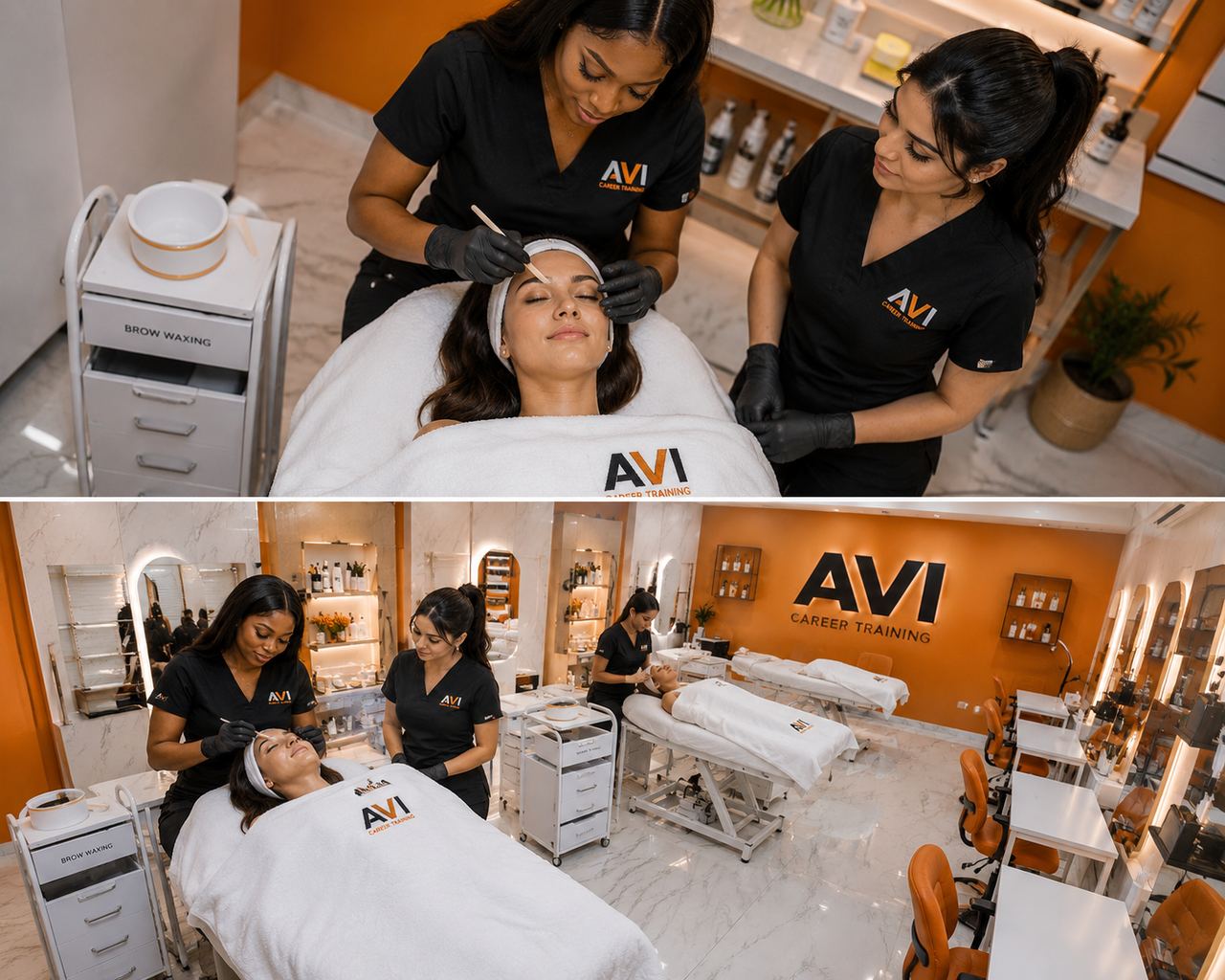
AVI Career Training is a COE-accredited, SCHEV-certified beauty and wellness school located in Vienna, Virginia — in the heart of Northern Virginia’s Tysons/Vienna corridor. AVI does not offer medical assistant training, and we’re straightforward about that. What we do offer is hands-on, career-focused training in the programs that lead directly to employment in this market:
Financial aid is available for those who qualify, and AVI proudly accepts the GI Bill® for eligible veterans and military-connected students. Our instructors are licensed industry professionals, and our curriculum is built around inclusive techniques that work beautifully on every skin tone and hair texture.
If you’re considering a career in beauty, wellness, or medical esthetics in Northern Virginia, AVI is the local answer — with the credentials, the community, and the hands-on training to get you there.
—
Your Next Step
The medical assistant vs. esthetician career decision doesn’t have to be complicated. Both paths are real, both pay real wages, and both get you into meaningful work without a four-year degree.
If esthetics — or the growing world of medical spa careers — sounds like the right direction for you, the next step is simple.
Apply to AVI Career Training today and take the first step toward a career that’s built to last. You can also call us directly at (703) 943-9841 or reach out through our contact form to schedule a campus visit at our Vienna, VA location.
Your career is closer than you think. Let’s get started.