Medical Assistant Programs in Northern Virginia: What to Know
Medical assistant programs in Northern Virginia take nine to 24 months to complete, require no state licensure, and lead to hands-on careers in clinical healthcare — but they are not the only path into a well-paying, client-facing health and wellness role.
If you are researching this field, you are probably in one of two camps. Either you have your sights set specifically on working in a clinical medical setting, or you are drawn to the healthcare-adjacent world — client interaction, skin and body treatments, a clinical feel — without necessarily wanting to work in a hospital or doctor’s office. Both are valid. And both have clear training paths in the Northern Virginia and DC metro area.
This guide walks you through what medical assistants actually do, how training and certification work in Virginia, what you can expect to earn, and — critically — whether a parallel wellness career might get you to similar or better outcomes in less time.
Key Takeaways
– Medical assistant programs in Northern Virginia take nine months to two years to complete
– Virginia does not require state licensure for medical assistants; national certification (CMA or RMA) is industry-preferred
– The DC metro median wage for medical assistants exceeds the national median of $38,270 by roughly 15–20%
– Licensed estheticians in the DC metro earn $45,000–$75,000+, with tip income adding significant upside
– Cosmetic laser technicians in Virginia med spas earn $50,000–$85,000, with training comparable in length to an MA certificate
– AVI Career Training’s Esthetics and Cosmetic Laser Technician programs are available in Vienna, VA, with financial aid and GI Bill® benefits accepted
What Does a Medical Assistant Actually Do?
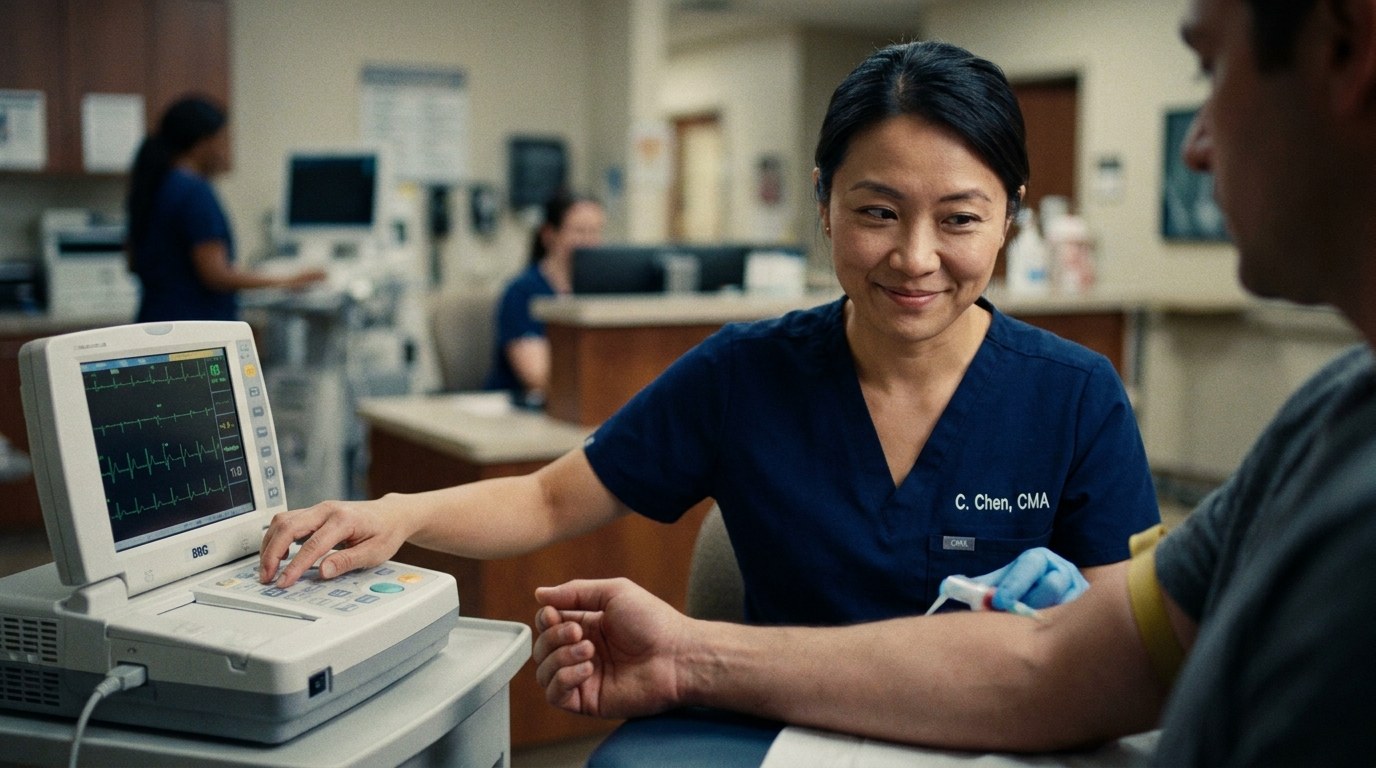
Medical assistants are the connective tissue of outpatient clinical settings. They work in doctors’ offices, urgent care centers, specialty clinics, and increasingly in medical spas. Their daily responsibilities typically include:
- Clinical tasks: Taking patient vitals, drawing blood, administering injections, preparing exam rooms, and assisting physicians during procedures
- Administrative tasks: Scheduling appointments, managing patient records, handling insurance authorizations, and processing referrals
- Patient interaction: Greeting patients, recording medical histories, explaining pre- and post-procedure instructions
The role is genuinely hands-on. If you are someone who wants to be doing something — not sitting behind a desk all day — medical assisting appeals because it keeps you moving and in direct contact with people.
That said, the setting matters. Most medical assistant roles place you in a clinical medical environment: fluorescent lighting, hospital gowns, electronic health records. If that sounds energizing, great. If what actually drew you to the search is the client-care side of healthcare — working with people on their appearance, confidence, and wellness — that distinction is worth sitting with before you invest a year or more in training.
Medical Assistant Requirements and Training in Virginia
Licensure: What Virginia Actually Requires
Virginia does not require medical assistants to hold a state license. The Virginia Department of Health Professions (VDHP) does not regulate the profession at the state level. That means there is no state board exam, no license renewal cycle, and no hours-of-training mandate set by Virginia law.
What the market does require is a different story. Employers — especially larger health systems and specialty practices — strongly prefer candidates who hold national certification. The two most recognized credentials are:
- CMA (Certified Medical Assistant) — issued by the American Association of Medical Assistants (AAMA); requires graduation from a CAAHEP- or ABHES-accredited program
- RMA (Registered Medical Assistant) — issued by American Medical Technologists (AMT); has slightly more flexible eligibility pathways
To sit for the CMA exam, your training program must be accredited by CAAHEP or ABHES. That requirement shapes which schools are worth your time and tuition.
Program Length and Format
Medical assistant programs in Virginia fall into two general categories:
- Certificate programs: Typically nine to 12 months; focused on clinical and administrative core competencies; offered at community colleges and vocational schools
- Associate degree programs: 18 to 24 months; include general education coursework; offered at community colleges including Northern Virginia Community College (NOVA)
Both formats include a clinical externship component — typically 160 to 200 hours of hands-on training in a real healthcare setting. This externship is required for CAAHEP and ABHES accreditation and is non-negotiable if you plan to sit for the CMA.
Common NoVA-area program options include NOVA’s Medical Assistant AAS program and several private vocational schools throughout Fairfax, Arlington, and Loudoun counties. Costs vary widely — community college programs are generally more affordable; private school programs may offer faster scheduling or more flexible cohorts.
Medical Assistant Salary in Northern Virginia — What to Expect
According to the U.S. Bureau of Labor Statistics, the national median annual wage for medical assistants is $38,270 (2023 data). The DC-Maryland-Virginia metro market consistently runs 15–20% above the national median, which puts the practical range for Northern Virginia MAs closer to $44,000–$46,000 at the median.
A few factors move that number significantly:
- Specialty: Dermatology, plastic surgery, and medical spa settings often pay more than general practice
- Certification status: CMAs and RMAs typically earn more than uncertified assistants
- Experience: Entry-level positions start lower; five-plus years of experience can push compensation toward $50,000+
- Setting: Private specialty clinics and concierge practices often pay above health system rates
The Northern Virginia and DC metro area is one of the strongest healthcare markets in the country. Demand for medical support staff is consistent, and the density of specialty practices — including a growing medical spa sector — creates real variation in where MAs end up working.
That last point is important. The med spa market in the DC metro corridor has expanded significantly over the past decade, driven by consumer demand for non-surgical cosmetic procedures. Medical assistants in those settings often find themselves working alongside estheticians, laser technicians, and nurse injectors — which raises a question worth exploring directly.
Is a Medical Assistant Career Right for You — Or Is There a Better Fit?
Here is an honest framework for thinking through your options.
You are a strong fit for medical assisting if:
– You want to work in a clinical medical environment (hospitals, physician offices, urgent care)
– You are interested in the administrative and clinical combination — patient intake, vitals, records, and clinical support
– You want a credential that opens doors across the entire healthcare sector
– You are comfortable with a nine-to-24-month training commitment and a clinical externship requirement
You may be a stronger fit for esthetics or cosmetic laser technology if:
– What draws you to healthcare is appearance, skin, and client transformation — not clinical medicine broadly
– You want to work in a med spa, luxury wellness studio, or aesthetic clinic without the hospital environment
– You want a training timeline that is comparable to or shorter than an MA certificate
– You are drawn to a career with strong tip income potential and entrepreneurial upside (private clients, suite rental, independent practice)
A Tale of Two Career Paths
Consider two people who both searched “medical assistant programs northern virginia” last year.
The first — a 28-year-old who spent five years in retail management — genuinely wanted a clinical medical career. She enrolled in a 12-month certificate program, completed her externship at a family medicine practice, passed her CMA exam, and accepted a position at a specialty clinic in Tysons at $44,500. That was the right move for her.
The second — a 34-year-old former restaurant manager — realized mid-research that what she actually wanted was to work with people on their skin and confidence, not to take vitals in a doctor’s office. She enrolled in an Esthetics program, completed her training, passed her Virginia State Board exam, and landed a position at a medical spa in Northern Virginia earning $52,000 in her first year — with tips pushing that figure significantly higher. Her path took less time and cost less than many of the MA programs she had initially considered.
Neither outcome is objectively better. But the question is worth asking: what environment do you actually want to work in?
Clinical-Adjacent Wellness Careers You Can Train for in Northern Virginia
If the medical spa and aesthetic clinic world is where your interest points, there are two programs in particular worth knowing about — both available right here in the Northern Virginia area.
Esthetics at AVI Career Training
AVI Career Training in Vienna, VA offers a hands-on Esthetics program designed to prepare you for licensure and employment in the DC metro’s growing medical spa and wellness market.
What you need to know:
- Virginia State Board requires 600 clock hours for esthetics licensure
- Upon completion, graduates are eligible to sit for the Virginia State Board written and practical exams (administered by PSI)
- Licensed estheticians in the DC metro area earn $45,000–$75,000+ depending on setting, with tip income adding meaningful additional revenue
- Medical spas, dermatology offices, plastic surgery practices, and luxury day spas all hire licensed estheticians — giving you real options across the clinical-to-wellness spectrum
AVI’s curriculum is built around inclusive techniques that work on every skin tone. That is not a marketing line — it is a curriculum commitment that prepares you to serve the full diversity of the DC metro’s client base. Apply now to take the next step.
Cosmetic Laser Technician Training at AVI
The Cosmetic Laser Technician program at AVI Career Training is one of the strongest direct parallels to clinical MA work in the aesthetics space. Laser technicians perform treatments like laser hair removal, skin resurfacing, and photofacials — procedures that sit squarely at the intersection of clinical precision and aesthetic outcomes.
What you need to know:
- Virginia regulates laser practitioners through the Virginia Department of Professional and Occupational Regulation (DPOR)
- Cosmetic laser roles in Virginia med spas command $50,000–$85,000, with variation based on setting, certification, and volume
- Training timeline is comparable to a medical assistant certificate — without the clinical hospital externship requirement
- AVI’s program is COE Accredited and SCHEV Certified, providing the institutional credibility that employers in this space are looking for
The DC metro medical spa market is one of the fastest-growing in the country. The American Med Spa Association (AmSpa) has documented consistent year-over-year expansion in the number of medical spa locations and the revenue generated by non-surgical aesthetic procedures — and Northern Virginia is at the center of that growth.
Massage Therapy: Another Clinical-Adjacent Option
For readers whose interest in healthcare leans toward therapeutic and wellness outcomes, AVI also offers a Massage Therapy program. Virginia requires 500 hours of training for licensure, overseen by the Virginia Board of Nursing. Massage therapists work across clinical, wellness, and spa settings — and the role pairs naturally with esthetics in many spa and medical spa environments.
How to Take the Next Step
Whether you are leaning toward medical assisting or beginning to see a clearer picture in clinical aesthetics and laser, the decision comes down to two things: the environment you want to work in, and the training investment that makes sense for your timeline and budget.
If a medical assistant program is the right fit, look carefully at NOVA’s accredited program and confirm CAAHEP or ABHES status before enrolling anywhere — it determines whether you can sit for the CMA exam.
If the medical spa, aesthetics, and wellness world is actually where you are headed, AVI Career Training is worth a serious look. The programs are practical, hands-on, and designed to get you licensed and employed in Northern Virginia’s growing clinical wellness market.
Financial aid is available at AVI, and GI Bill® benefits are accepted. You do not need a four-year degree to start — just the decision to move forward.
Start your application today or call AVI directly at (703) 943-9841 to speak with an admissions advisor about which program fits your goals. AVI Career Training is located at 1595 Spring Hill Rd #720, Vienna, VA 22182.
The career you are researching is out there. The question is which version of it fits you best.
Salary data sourced from the U.S. Bureau of Labor Statistics Occupational Outlook Handbook. Virginia licensing requirements referenced from the Virginia Department of Professional and Occupational Regulation (DPOR).