AVI Career Training

Medical Assistant Programs in Northern Virginia: What to Know

Share:

Medical Assistant Programs in Northern Virginia: What to Know

Medical assistant programs in Northern Virginia typically take 9 to 24 months to complete and cost between $4,000 and $15,000 depending on the school and credential level you pursue. If you’re researching this path, you’re in the right place — this guide covers everything: what medical assistants actually do, what training looks like in Virginia, what employers require, and what you can realistically earn. We’ll also walk you through some healthcare-adjacent alternatives that may get you working faster, earning comparably, and doing work you love just as much.

> Key Takeaways
> – Medical assistant certificate programs in Northern Virginia run 9–12 months; associate degree programs run 18–24 months
> – Virginia does not require state licensure for medical assistants — but national certification (CMA or RMA) is strongly preferred by DC metro employers
> – Average medical assistant salary in the Virginia metro area ranges from $38,000 to $52,000 per year
> – Cosmetic laser technicians in Virginia can earn comparable wages — often with less training time
> – AVI Career Training in Vienna, VA offers Cosmetic Laser Technician and Esthetics programs as fast, accredited alternatives for those drawn to healthcare-adjacent work

What Does a Medical Assistant Actually Do?

Medical assistants are the connective tissue of a clinical office. They move between patient care and administrative work, keeping practices running from the moment a patient walks in to the moment they leave.

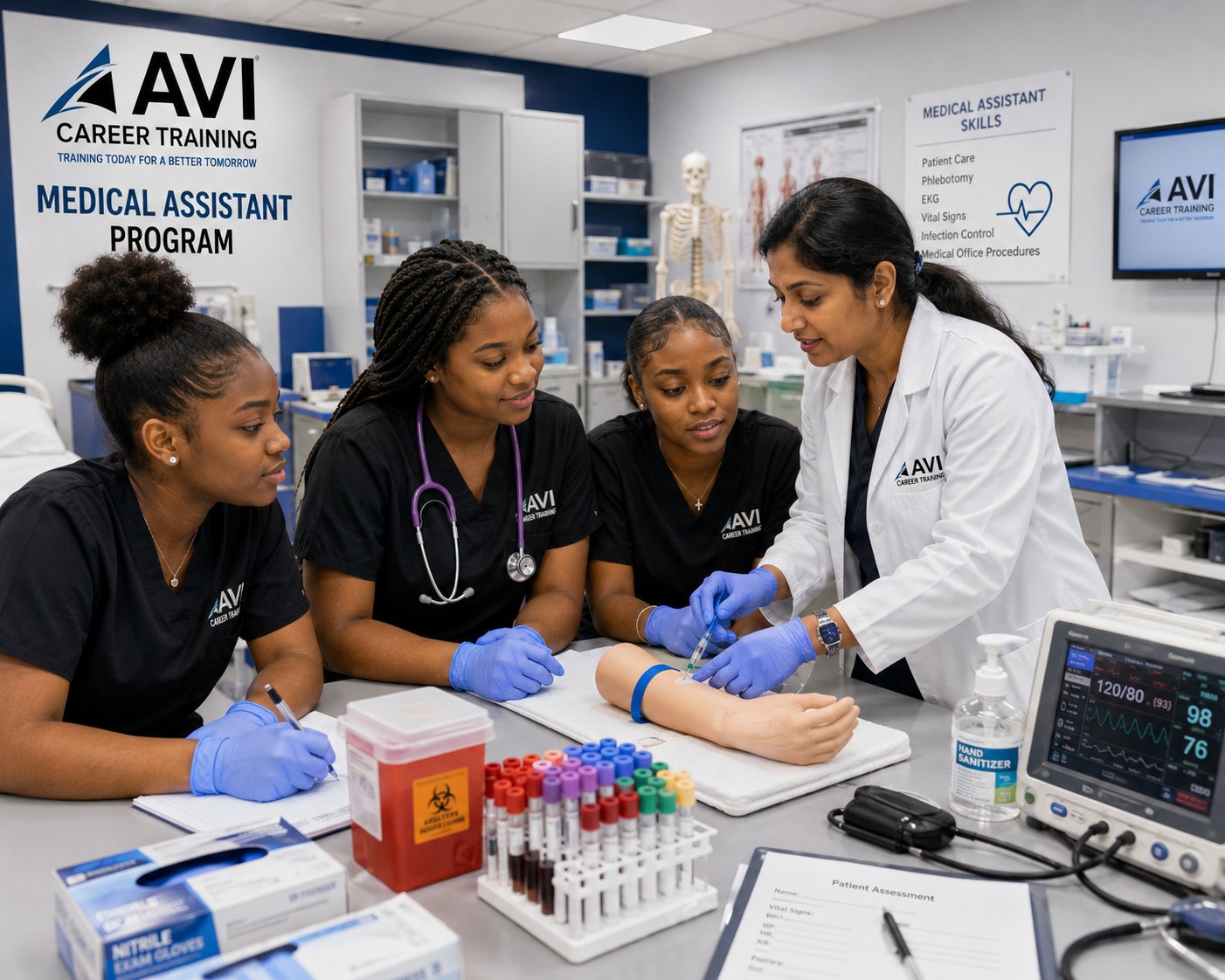
On the clinical side, medical assistants take and record vital signs, prepare patients for examinations, assist physicians with procedures, draw blood, administer injections, and explain post-visit care instructions. These duties require hands-on training, a steady presence, and real attention to detail.

On the administrative side, the same person might be scheduling appointments, verifying insurance, updating electronic health records, and managing patient communications — sometimes all in the same morning.

It’s a role that genuinely requires range. You’re part caregiver, part coordinator, and part first impression for every patient who walks through the door. That blend of clinical and interpersonal skills is exactly what makes the medical assistant role appealing to so many career changers.

The settings vary too. Medical assistants work in physician offices, urgent care clinics, specialty practices, hospital outpatient departments, and — increasingly — medical spas and cosmetic wellness centers. That last setting is worth noting, and we’ll come back to it.

Medical Assistant Training in Virginia — Programs, Timelines, and Costs

If you’re asking how long it takes to become a medical assistant in Virginia, the honest answer is: it depends on how deep you want to go.

Certificate Programs (9–12 Months)

Certificate or diploma programs are the most direct route into the field. These programs focus tightly on clinical and administrative medical assisting skills — typically covering anatomy, pharmacology, phlebotomy, EKG, and medical office procedures. Most run between 9 and 12 months and are offered by community colleges and vocational schools throughout Northern Virginia.

Northern Virginia Community College (NOVA) is the most well-known local option, offering an accredited Medical Assisting certificate program. Tuition for in-state students at NOVA runs significantly lower than private vocational schools, making it a popular first look for budget-conscious students.

Expect total program costs for certificate programs in the region to range from $4,000 to $9,000, depending on the institution, materials, and any additional exam prep fees.

Associate Degree Programs (18–24 Months)

Some students pursue an Associate of Applied Science in Medical Assisting, which adds general education coursework — communications, psychology, and college writing — alongside the core medical assisting curriculum. These programs typically take 18 to 24 months and cost between $9,000 and $15,000 at community colleges, and more at private institutions.

The associate degree can offer advantages in terms of advancement potential and some employer preferences, but for most entry-level medical assisting positions, a certificate from an accredited program is sufficient.

What to Look for in Any Program

Accreditation matters here. For medical assisting specifically, look for programs accredited by CAAHEP (Commission on Accreditation of Allied Health Education Programs) or ABHES (Accrediting Bureau of Health Education Schools). Graduation from a CAAHEP- or ABHES-accredited program is required to sit for the Certified Medical Assistant (CMA) exam through the AAMA.

If a program isn’t accredited by one of those bodies, you may not qualify for the national certification exam that most employers in Northern Virginia expect to see.

Certification and Credentialing — What Virginia Employers Actually Require

Here’s something that surprises a lot of people researching this path: Virginia does not require state licensure to work as a medical assistant. There’s no Virginia State Board exam, no license renewal process, and no state-issued credential required before you can be hired.

What does matter — especially in the competitive DC metro healthcare market — is national certification.

CMA vs. RMA: What’s the Difference?

CMA (Certified Medical Assistant) — Awarded by the American Association of Medical Assistants (AAMA). Requires graduation from a CAAHEP- or ABHES-accredited program. This is the most widely recognized credential in the field.

RMA (Registered Medical Assistant) — Awarded by American Medical Technologists (AMT). Has slightly different eligibility pathways, including options for experienced MAs who didn’t graduate from an accredited program.

For students coming directly out of a training program, the CMA is generally the gold standard that Northern Virginia employers look for. Hospitals, multi-specialty practices, and medical spa groups operating in the DC metro area increasingly list CMA or RMA certification as a preferred — or required — qualification.

Neither credential is a Virginia state license. Both are voluntary national certifications. But in practice, walking into a job interview without one puts you at a disadvantage against candidates who have it.

Plan on CMA exam fees of approximately $125 for AAMA members at the time of this writing. Recertification is required every 60 months through continuing education or re-examination.

Medical Assistant Salary in Northern Virginia — And Where the Ceiling Is

Salary is usually one of the first things people want to know, and the data for Northern Virginia is worth looking at carefully.

What the Numbers Actually Show

According to BLS.gov data for the Washington-Arlington-Alexandria metro area, medical assistants earn a median annual wage in the range of $38,000 to $52,000 per year, with variation based on:

  • Specialty setting (dermatology and cardiology offices tend to pay higher than general practice)
  • Years of experience and certification status
  • Whether the employer is a private practice, hospital system, or medical spa
  • Entry-level positions — particularly in general practice or urgent care — often start at the lower end of that range. With a few years of experience, CMA certification, and a move into a specialty setting, mid-career medical assistants in Northern Virginia can push toward the upper end.

    The Ceiling Problem

    Here’s the honest part: the medical assistant career ladder is fairly flat. Significant salary growth typically requires additional schooling — moving into nursing, healthcare administration, or a clinical specialty. For many people, that means going back to school for another two to four years after already completing MA training.

    That’s not a reason to avoid the path if it’s genuinely right for you. But it is a reason to think carefully about what you want your career to look like in five years — and whether there are other routes that get you there faster or with greater earning potential.

    Some healthcare-adjacent specialties, including cosmetic laser technology and advanced esthetics, offer comparable starting wages to medical assisting — with shorter training timelines and strong demand in the Northern Virginia market.

    Considering Alternatives? Healthcare-Adjacent Beauty Careers in Northern Virginia

    If part of what draws you to medical assisting is the idea of working in a clinical environment, helping people feel better, and using your hands in meaningful ways — you may want to look at what’s happening in the medical spa and cosmetic wellness space.

    This is a fast-growing segment of the Northern Virginia healthcare market, and it’s created strong demand for professionals who sit right at the intersection of beauty and healthcare.

    Cosmetic Laser Technician vs. Medical Assistant

    This is one of the most useful comparisons a career-changer in Northern Virginia can make.

    Cosmetic laser technicians operate laser and light-based treatment devices for procedures like hair removal, skin resurfacing, and photofacials. They work in medical spas, dermatology offices, and cosmetic wellness centers — many of the same environments where medical assistants work.

    The key differences:

    | | Medical Assistant | Cosmetic Laser Technician |
    |—|—|—|
    | Training Time | 9–24 months | Can be significantly shorter with focused programs |
    | Virginia Licensing | No state license required | Virginia requires specific laser training credentials |
    | Work Environment | Clinical offices, urgent care, hospitals | Medical spas, dermatology clinics, laser centers |
    | Earning Potential | $38,000–$52,000/yr (BLS metro data) | Comparable, with upside in commission-based or specialty settings |
    | Career Trajectory | Nursing, healthcare admin (requires more school) | Advanced laser certifications, spa management, practice ownership |

    AVI Career Training in Vienna, VA offers a Cosmetic Laser Technician program designed specifically for the Northern Virginia and DC metro market. It’s hands-on, credential-focused, and built around the clinical and technical skills medical spas and laser centers are actively hiring for right now.

    Esthetics as a Healthcare-Adjacent Career

    Esthetics is another path that career-changers often overlook when they’re thinking about medical or clinical work — and that’s a missed opportunity.

    Licensed estheticians work in medical spas performing chemical peels, microdermabrasion, facial treatments, and pre- and post-procedure skin care. In a medical spa setting, an esthetician is genuinely part of the clinical team. They consult with clients, assess skin conditions, and deliver treatments that have real, measurable outcomes.

    AVI Career Training offers both Basic Esthetics and Master Esthetics programs. These programs prepare students for the Virginia State Board licensing exam and for careers in the growing medical spa market right here in Northern Virginia.

    Why the Medical Spa Market Matters for Your Decision

    Northern Virginia’s proximity to DC, its high-income demographics, and its dense concentration of healthcare and wellness businesses make it one of the stronger markets in the country for medical spa careers. Medical spas in areas like Tysons, McLean, Reston, and Arlington are hiring — and they’re looking for trained professionals who understand both clinical protocols and client experience.

    That’s a description that fits cosmetic laser technicians and licensed estheticians just as well as it fits medical assistants. In some cases, it fits them better, because the beauty and wellness training is more directly aligned with what a medical spa actually needs.

    Meet Vanessa: From Considering Medical Assisting to Building a Laser Career

    Vanessa had spent three years as a receptionist at a dermatology practice in McLean. She liked the clinical environment, she was curious about the treatments, and she kept thinking about what it would mean to actually perform the procedures she was scheduling every day.

    She looked into medical assistant programs — NOVA, a private vocational college in Fairfax, and a few online options. The timelines were longer than she expected. The CMA certification requirements added another layer. And the salary data she found suggested she’d be starting close to what she was already earning.

    Then she found information about cosmetic laser technician training. The program was shorter. The credential was focused on exactly the work she’d been watching dermatologists and laser technicians perform. And the medical spas hiring in her area were actively posting for this role.

    Vanessa enrolled in a laser technician program. Within a year of completing her training, she was working at a medical spa in Tysons — performing the treatments she’d been curious about for years.

    Her story isn’t unusual. Career-changers with clinical curiosity often find that the medical spa path gets them to meaningful, hands-on work faster than the traditional medical assisting route.

    Meet Marcus: A Career Change With a Shorter Runway

    Marcus was 34, working in IT project management, and increasingly burned out. He’d always been interested in wellness — he got massages regularly, paid attention to his skin, and had started wondering whether a career in that world was even possible at his age.

    He initially searched for medical assistant programs because it seemed like the most legitimate clinical path he knew about. But the two-year associate degree timeline felt daunting on top of his current job. The starting salary range wasn’t much of a step up from what he was already planning to negotiate.

    A friend suggested he look into massage therapy and esthetics programs. Marcus found AVI Career Training in Vienna — close to where he lived, COE-accredited, and offering financial aid options including the GI Bill® (which he qualified for as a veteran).

    He enrolled in Massage Therapy. Within months, he was completing clinical hours and building a client base. Today he works at a wellness spa in the DC metro area and takes private clients on weekends.

    His path wasn’t the one he originally searched for. But it got him to a fulfilling, hands-on career — faster than the route he started researching.

    Is a Medical Assistant Program Right for You — Or Is There a Better Fit?

    If your goal is to work in a hospital, a physician’s office, or a traditional clinical setting drawing blood and documenting patient records, a medical assistant program from a CAAHEP- or ABHES-accredited school is the right path. NOVA Community College is a solid local option with affordable in-state tuition, and national CMA certification from the AAMA will make you competitive in the Northern Virginia job market.

    But if what you’re really drawn to is:

  • Working in a modern, client-focused environment
  • Performing hands-on treatments with visible, satisfying results
  • Getting trained and working in under a year
  • Building toward a career in the growing medical spa and cosmetic wellness space
  • …then you may find that a program in Cosmetic Laser Technology, Esthetics, or Massage Therapy is a faster, more direct path to exactly that kind of work.

    AVI Career Training is a COE-accredited, SCHEV-certified school in Vienna, Virginia — right in the heart of the Northern Virginia market you’re looking to work in. Our programs are built for career-changers, are taught by licensed industry professionals, and cover techniques that work on every skin tone and every client who walks through the door.

    Financial aid is available. The GI Bill® is accepted. And our admissions team can walk you through your options honestly — without pressure.

    Ready to explore what your path could look like? Apply today or call us at (703) 943-9841 to talk through which program fits your goals.

    For official Virginia credentialing information, visit the Virginia Department of Professional and Occupational Regulation (DPOR). For national salary data, visit BLS.gov.

    Article details:

    Share: