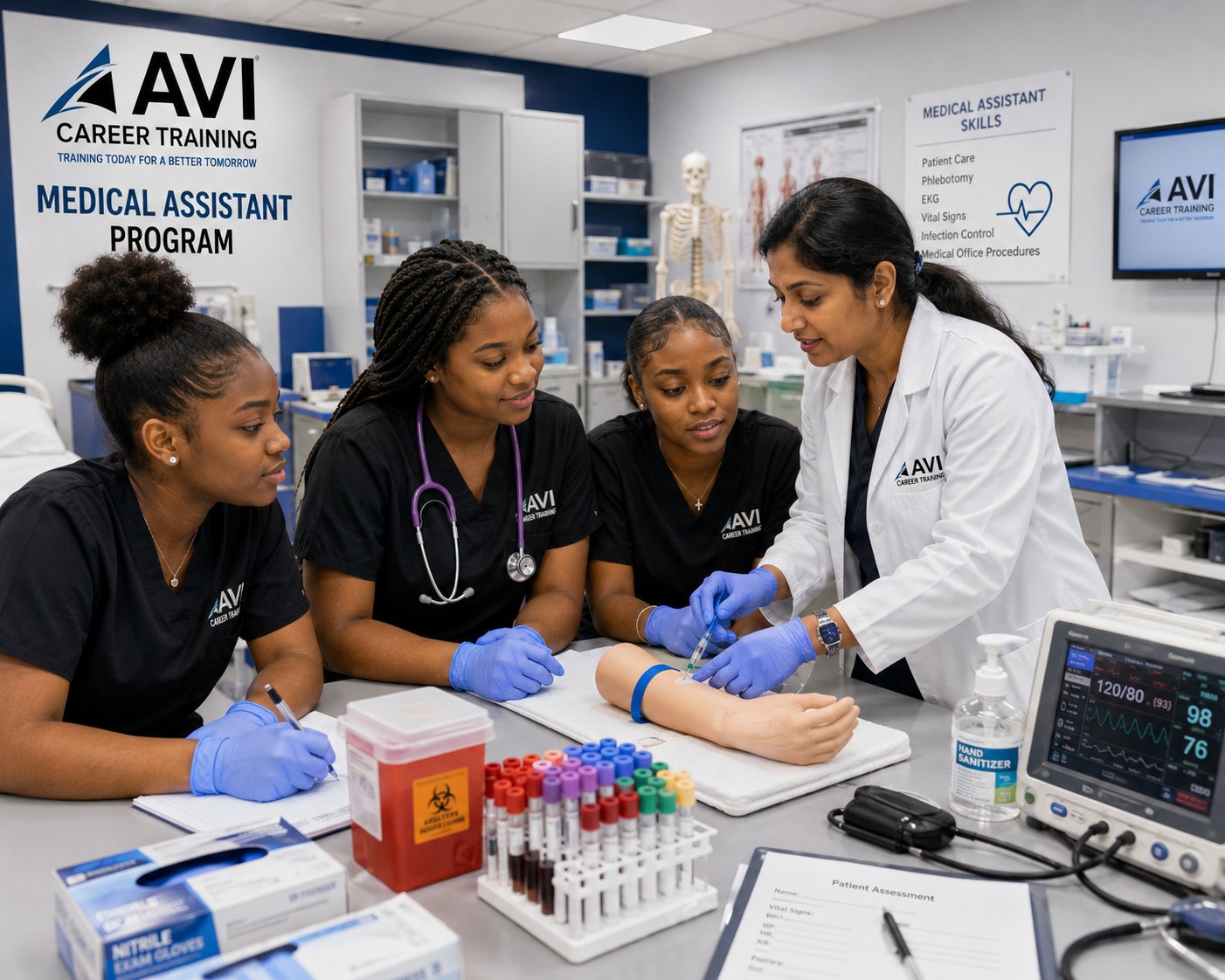
Medical Assistant Careers in Northern Virginia: What to Know
Northern Virginia has some of the strongest demand for healthcare and clinical careers in the entire country — and medical assistant roles are near the top of that list. If you’re researching medical assistant programs in Northern Virginia, this guide covers everything you need to make a smart decision: what the job actually involves, how long training takes, what you can earn in the DC metro market, and which clinical career paths lead to faster credentials and strong earning potential.
One of those paths runs through AVI Career Training in Vienna, Virginia — where programs in Cosmetic Laser Technology, Basic and Master Esthetics, and Electrolysis prepare students for clinical-track careers in medical spas, dermatology offices, and aesthetic clinics. If you’re weighing your options, keep reading. Apply to AVI Career Training to learn how those programs compare.
—
> ## Key Takeaways
> – Virginia does not require state licensure for medical assistants — voluntary certifications like the CMA (AAMA) improve job competitiveness
> – Medical assistant training in Virginia typically takes 9–24 months depending on whether you pursue a certificate or associate degree
> – The median annual wage for medical assistants in the Washington-Arlington-Alexandria metro area is approximately $44,000–$48,000 (BLS, 2024)
> – Cosmetic Laser Technician and Esthetics programs at AVI can be completed in significantly less time and lead to Virginia State Board credentials
> – AVI Career Training is COE Accredited and SCHEV Certified, located in Vienna, VA — at the center of Northern Virginia’s growing medical aesthetics market
—
What Does a Medical Assistant Do in Virginia?
Medical assistants work at the intersection of patient care and clinical operations. They’re the professionals who room patients, record vital signs, update charts, prepare exam rooms, administer injections, assist with minor procedures, and handle administrative tasks like scheduling and insurance documentation.
In Virginia, MAs work across a wide range of settings — primary care offices, urgent care clinics, pediatric practices, OB-GYN offices, and increasingly, dermatology clinics and medical spas. That last category is worth noting. The aesthetic medicine sector has grown sharply in Northern Virginia, and many dermatology and cosmetic clinics specifically seek staff with both clinical comfort and skin care knowledge.
The appeal of medical assisting is real. It’s a healthcare-adjacent career that doesn’t require a four-year degree, offers strong job stability, and puts you directly in clinical settings where you’re making a difference in people’s lives every day. For many students, that combination is exactly what they’re looking for.
Clinical vs. Administrative Duties
Medical assistants typically split their time between two types of responsibilities:
Clinical duties include taking patient histories, measuring vital signs, preparing patients for exams, drawing blood, administering medications under physician direction, sterilizing instruments, and assisting with procedures.
Administrative duties include managing patient records, scheduling appointments, processing billing and insurance claims, answering phones, and coordinating referrals.
The balance varies by practice size and setting. In smaller offices, MAs often do both. In larger hospital systems or specialty clinics, roles may be more narrowly defined.
—
Medical Assistant Training Requirements and Timeline in Virginia
Here’s one fact that surprises many people researching medical assistant careers in Virginia: Virginia does not require medical assistants to hold a state license. Unlike cosmetologists, estheticians, electrologists, and other licensed professionals, MAs in Virginia can work under physician supervision without sitting for a state board exam.
That doesn’t mean credentials don’t matter — they absolutely do, especially in competitive Northern Virginia job markets.
Voluntary Certifications That Matter
Two nationally recognized credentials set medical assistants apart when applying for jobs:
Neither is required by Virginia law, but many employers in the DC metro area list CMA or RMA certification as preferred or required on job postings.
How Long Does It Take to Become a Medical Assistant in Virginia?
Program length depends on the credential you pursue:
Northern Virginia Community College (NOVA), Strayer University, and several private career schools offer MA programs in the region. Externship hours are typically required as part of these programs — usually 160–200 hours — which adds time to the overall completion timeline.
If you’re comparing timelines, some clinical wellness careers have significantly shorter training paths. AVI’s Cosmetic Laser Technician program, for example, can be completed in a fraction of that time while still leading to a credential recognized in clinical settings.
—
Medical Assistant Salary and Job Outlook in Northern Virginia
The Washington-Arlington-Alexandria metropolitan statistical area consistently ranks among the highest-paying regions in the country for medical assistants. According to the Bureau of Labor Statistics, the median annual wage for medical assistants in this metro area falls in the range of $44,000–$48,000, meaningfully above the national median of approximately $40,700.
Virginia statewide data shows median wages around $39,000–$42,000 annually — meaning Northern Virginia’s premium labor market adds real value to the same credential.
Job Outlook: Strong and Growing
The BLS projects medical assistant employment to grow 15% nationally through 2032 — much faster than the average for all occupations. In Northern Virginia, that growth is amplified by the region’s dense concentration of physician practices, urgent care networks, and expanding specialty clinics.
Dermatology and cosmetic medicine clinics have been among the fastest-growing employers of clinical support staff in the DC metro area. That reflects broader consumer demand for aesthetic medicine, from medical-grade skin treatments to laser procedures to injectables. And that same demand is exactly what’s driving growth in clinical aesthetics careers like the ones AVI prepares students for.
—
Clinical Aesthetics Careers — A Parallel Path Worth Considering
If you’re drawn to medical assisting because of the clinical environment, the skin care applications, the technology involved, or the patient interaction — there’s a parallel career track that may actually fit your goals even better. And it’s one where AVI Career Training in Vienna, Virginia offers direct training.
Esthetics, Cosmetic Laser Technology, and Electrolysis are clinical-adjacent careers that share many of the same qualities that make medical assisting attractive. You’re working with clients one-on-one, using advanced equipment and techniques, improving their skin health and confidence, and operating in medical or wellness clinic settings. The key difference is in the training pathway and the type of work.
What These Careers Look Like Day-to-Day
Estheticians in clinical settings perform advanced skin analysis, chemical peels, microdermabrasion, LED therapy, and pre/post-procedure skin care for patients undergoing cosmetic procedures. Many work alongside dermatologists or plastic surgeons in medical spas or aesthetic clinics.
Cosmetic Laser Technicians operate laser and energy-based devices for hair removal, skin resurfacing, pigmentation correction, and body contouring. This is a highly technical role that requires specialized training — and it’s one of the fastest-growing specialties in medical aesthetics.
Electrologists provide permanent hair removal using electrical current. It’s a precision skill that requires a dedicated license in Virginia and serves both general and medical populations, including transgender patients and people with hormonal conditions affecting hair growth.
Why the Timeline Works in Your Favor
Here’s a concrete comparison that matters if you’re weighing your options:
Medical assistant certificate programs in Virginia typically run 9–12 months. Associate degree programs run 18–24 months. Neither path leads to a Virginia state license — because no such license exists for MAs.
At AVI Career Training, the Basic Esthetics program requires 600 hours of training, the Master Esthetics program requires 1,200 hours, and both lead to Virginia State Board licensure — a credential that travels with you anywhere in the state and signals professional legitimacy to every employer who sees it.
Cosmetic Laser Technician training at AVI is designed to get you working in clinical settings faster, with hands-on experience on real equipment, in a COE Accredited school that employers in the DC metro area recognize.
—
> ### Meet Danielle: From Healthcare Administration to Laser Technician
>
> Danielle had spent three years working the front desk of a dermatology practice in Tysons Corner. She knew the clinical side of the office, watched laser treatments happen daily, and kept thinking she wanted to be the one performing the procedures — not scheduling them. She researched medical assistant programs in Northern Virginia but realized an MA credential wouldn’t qualify her to operate the laser equipment she was already watching every day.
>
> She enrolled in AVI’s Cosmetic Laser Technician program, completed her training, passed her Virginia State Board requirements, and returned to the aesthetics industry — this time behind the device. Within six months of graduating, she was working full-time as a laser technician at a medical spa in McLean, serving clients she recognized from her front desk days.
—
How to Choose the Right Clinical Career Path in Northern Virginia
Choosing between medical assisting and a clinical aesthetics track isn’t about which path is better — it’s about which path is better for you. Here’s a practical framework to help you decide.
Ask Yourself These Four Questions
1. What kind of work environment excites you?
Medical assistants typically work in physician offices, urgent care clinics, or hospital systems. Clinical estheticians and laser technicians more often work in medical spas, dermatology aesthetics suites, or independently. If you’re drawn to the energy of a spa or aesthetics clinic over a traditional medical office, that’s worth factoring in.
2. How important is a state-recognized credential to you?
Virginia requires no license for medical assistants. That means your credential is employer-dependent — some value it highly, others don’t require certification at all. Virginia State Board licensure for estheticians and electrologists is legally required to practice, which makes it a stronger professional signal and a more portable credential.
3. What’s your timeline?
If you need to be working in a new field within the next year, esthetics or cosmetic laser training may offer a faster on-ramp. If you have 18–24 months and want to pursue an associate degree, the MA path is viable.
4. Are you interested in entrepreneurship?
Licensed estheticians and electrologists in Virginia can work as independent contractors, rent a suite, or eventually open their own practice. Medical assistants are almost always employees of a physician or health system. If flexibility and self-employment appeal to you, the aesthetics track opens those doors.
—
> ### Meet Marcus: A Career Changer Who Ran the Numbers
>
> Marcus was 34, working in retail management in Fairfax, and ready for a change. He’d been researching medical assistant programs in Northern Virginia for months — he liked the idea of healthcare work, and the 12-month certificate programs seemed doable. But when he started reading about Virginia’s no-licensure policy for MAs, he got curious. He wanted to leave retail with a credential that meant something concrete.
>
> A friend mentioned AVI Career Training. Marcus scheduled a tour, talked to an admissions advisor, and learned that Electrolysis training leads to a Virginia State Board license and a specialty skill with strong demand in the DC metro market — including growing demand from clients seeking permanent hair removal across all skin tones. He enrolled, completed his training, passed his state boards, and opened an independent electrolysis practice in Arlington within 18 months of his first visit to AVI.
—
AVI Career Training: Northern Virginia’s Clinical Aesthetics School
AVI Career Training is located at 1595 Spring Hill Rd #720, Vienna, VA 22182 — in the heart of Northern Virginia, minutes from Tysons Corner, McLean, and the broader DC metro area. AVI is COE Accredited and SCHEV Certified, meaning its programs meet rigorous educational standards and qualify for federal financial aid, including Pell Grants and the GI Bill®.
Programs offered at AVI include:
AVI’s curriculum is built around inclusive techniques that work on every skin tone and hair type. That’s not a marketing line — it’s a teaching philosophy reflected in the equipment used, the case studies covered, and the clients served in AVI’s student clinic.
Financial aid is available for those who qualify, and AVI’s admissions team can walk you through options during a free consultation.
If you’re researching medical assistant programs in Northern Virginia and want to understand whether a clinical aesthetics career might be a better fit for your goals, connect with AVI Career Training to schedule a tour or speak with an advisor. You can also call directly at (703) 943-9841.
—
Frequently Asked Questions
How long does it take to become a medical assistant in Virginia?
Most medical assistant certificate programs in Virginia take 9–12 months of full-time study. Associate degree programs take 18–24 months. Neither path requires a Virginia state license, since Virginia does not have a licensure requirement for medical assistants.
Is medical assistant a good career in 2025?
Yes — the BLS projects 15% growth in MA employment through 2032, well above the national average for all occupations. In the Northern Virginia/DC metro area, demand is particularly strong. That said, clinical aesthetics careers like cosmetic laser technology and esthetics are experiencing comparable or faster growth, driven by the expanding medical spa and aesthetic medicine market.
What is the difference between a medical assistant and a clinical esthetician?
Medical assistants handle a mix of clinical support tasks (vitals, charting, injections) and administrative work under physician supervision. Clinical estheticians specialize in advanced skin care, often working in dermatology offices or medical spas to perform treatments like chemical peels, laser-assisted facials, and pre/post-procedure skin care. Estheticians in Virginia hold a Virginia State Board license; medical assistants do not require a state license.
Do medical assistants need a license in Virginia?
No. Virginia is one of relatively few states that does not require medical assistants to hold a state license. Voluntary national certifications — such as the CMA (AAMA) or RMA — are available and often preferred by employers, but they are not required by law.
What beauty or wellness careers are similar to medical assistant ?
Several licensed wellness careers share the clinical-track appeal of medical assisting: esthetics (skin analysis, facials, chemical peels, light therapy), cosmetic laser technology (laser hair removal, skin resurfacing, body contouring), and electrolysis (permanent hair removal). All three are offered at AVI Career Training in Vienna, VA, lead to Virginia State Board credentials, and are well-suited to students drawn to the clinical and patient-care aspects of medical work. Apply to AVI Career Training to learn more.