Medical Assistant Programs in Northern Virginia: What to Know Before You Enroll
Northern Virginia has strong demand for medical assistants — and if you’re researching medical assistant programs in Northern Virginia, you’re already on the right path toward a real career in healthcare or wellness. Before you commit to any program, though, it’s worth understanding exactly what MA training involves, what it pays, and whether a closely related career path might actually be a better fit for your goals.
This guide gives you honest, specific answers — including a look at some shorter, state-licensed wellness and clinical beauty career tracks that many healthcare-curious students in the DC metro area overlook entirely.
Key Takeaways
- Virginia does not require state licensure for medical assistants — national employer certifications (CMA, RMA) are the standard
- Typical MA certificate programs run 9–12 months with tuition ranging from $5,000–$15,000
- The median annual wage for medical assistants in the Washington-Arlington-Alexandria metro area is approximately $44,000–$48,000 (BLS, SOC 31-9092)
- Medical estheticians and cosmetic laser technicians work in clinical settings — medspas, dermatology offices, and plastic surgery practices — with Virginia licensing available in under a year
- AVI Career Training in Vienna, VA offers COE-accredited, SCHEV-certified programs in Basic Esthetics, Master Esthetics, Cosmetic Laser Technician, and Massage Therapy — all with Virginia State Board licensing pathways
What Does a Medical Assistant Actually Do?
Medical assistants are the backbone of outpatient healthcare. In a typical physician’s office, urgent care center, or specialty clinic, a medical assistant handles both clinical and administrative work — often within the same shift.
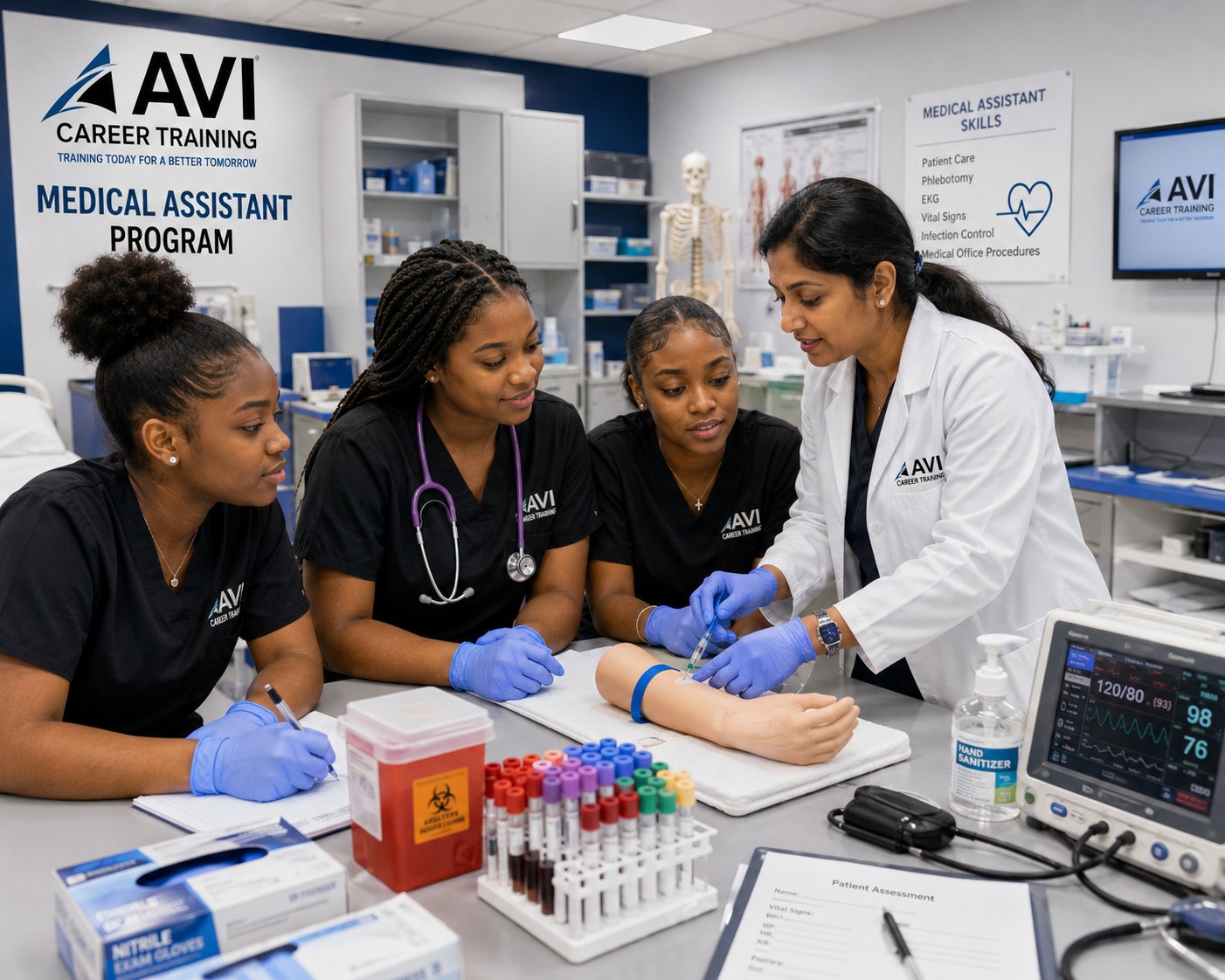
On the clinical side, that means taking patient vitals, preparing exam rooms, administering injections, drawing blood (phlebotomy), running EKGs, and assisting physicians during procedures. On the administrative side, MAs often manage patient scheduling, handle medical billing codes, process insurance paperwork, and maintain electronic health records.
Most medical assistants work in physician offices, outpatient clinics, and specialty practices — not hospitals, which typically require higher-level clinical credentials. The role sits at the intersection of patient care and clinic operations, which is why it appeals to people who want meaningful healthcare work without the years of schooling required for nursing or physician assistant careers.
If you want healthcare proximity, patient interaction, and a relatively short training path, medical assisting makes sense to explore. But it’s not the only path — and depending on your interests, it may not be the best one.
Medical Assistant Program Requirements and Timelines in Virginia
Here’s something many students don’t realize: Virginia does not require medical assistants to hold a state license. Unlike nurses, massage therapists, or estheticians — who must pass Virginia State Board exams before practicing — medical assistants in Virginia can work without state-issued credentials.
What employers require instead are nationally recognized certifications. The two most recognized are:
- CMA (Certified Medical Assistant) — issued by the American Association of Medical Assistants (AAMA), requires graduation from a CAAHEP- or ABHES-accredited program
- RMA (Registered Medical Assistant) — issued by American Medical Technologists (AMT), with multiple eligibility pathways
To sit for these exams, you typically need to complete a certificate or associate degree program. Certificate programs run 9–12 months at most community colleges and career schools. Associate degree programs take 18–24 months. Tuition for certificate programs generally falls in the $5,000–$15,000 range, depending on the institution.
Community colleges in the Northern Virginia area — including Northern Virginia Community College (NOVA) — offer allied health training programs that include medical assistant tracks. These programs are worth researching directly for the most current enrollment requirements and costs.
One thing to factor into your decision: completing an MA program gets you to a certification exam, not an automatic state license. That distinction matters when you’re comparing career tracks — some paths in Virginia lead directly to a state-issued license that is more portable and more immediately recognized by employers.
Medical Assistant Salary and Job Outlook in Northern Virginia
Northern Virginia is one of the better markets in the country for medical assistant employment, largely because of the density of federal healthcare facilities, military medical centers, private physician practices, and specialty clinics in the DC metro corridor.
According to the U.S. Bureau of Labor Statistics, the median annual wage for medical assistants (SOC 31-9092) in the Washington-Arlington-Alexandria metropolitan area is approximately $44,000–$48,000 — higher than the national median of around $38,000–$40,000. You can verify current figures directly at BLS.gov.
Nationally, the BLS projects approximately 14% job growth for medical assistants through 2032 — faster than average across all occupations. An aging population, expanded outpatient care, and growing preventive health services are the main drivers.
That’s a solid outlook. But salary and growth projections don’t tell the whole story. Your earning potential also depends on where you work, whether you specialize, and how your credentials compare to other candidates. That’s where it helps to look at the full landscape of healthcare-adjacent career options — not just the obvious ones.
Exploring Adjacent Careers: Where Beauty, Wellness, and Medicine Intersect
Not every career in clinical settings requires an MA credential — and some of the fastest-growing roles in Northern Virginia’s healthcare landscape sit at the intersection of beauty, wellness, and medicine.
If you’re drawn to healthcare because you want to work directly with clients, see visible results, and operate in a clinical environment, medical esthetics and cosmetic laser technology may deserve a serious look alongside traditional allied health training.
What Is a Medical Esthetician?
A medical esthetician — sometimes called a clinical esthetician — provides advanced skincare treatments in medical settings: dermatology offices, plastic surgery practices, medspas, and cosmetic clinics. Services include chemical peels, microdermabrasion, pre- and post-surgical skin prep, photofacials, and specialized treatments for acne, hyperpigmentation, and aging skin.
This is not the same as a day spa esthetician. Medical estheticians work alongside physicians and nurse practitioners. They need a strong foundation in skin science, wound healing, and skin of color — and they need a Virginia State Board license.
In Virginia, esthetics licensure requires 600 clock hours of approved training from a SCHEV-certified school. That’s a defined, achievable pathway — and it leads directly to a state-issued credential that employers recognize immediately.
What About Cosmetic Laser Technology?
Cosmetic laser technicians operate laser and light-based devices used in hair removal, skin resurfacing, tattoo removal, body contouring, and rejuvenation treatments. In Virginia, laser operation falls under specific supervision requirements — and specialized training is increasingly expected by employers, particularly in the growing medspa market across Fairfax County, Loudoun County, and the broader DC metro area.
The Northern Virginia medspa market is expanding. Demand for trained cosmetic laser technicians with formal, hands-on credentials is rising in step with it.
Clinical Massage Therapy
Clinical massage therapy is another healthcare-adjacent track worth considering. Virginia requires 500 clock hours from an approved Massage Therapy program to qualify for state licensure through the Virginia Board of Nursing. Licensed massage therapists work in physical therapy offices, chiropractic practices, wellness centers, hospitals, and medspas — making this another genuine entry point into clinical healthcare settings.
The point isn’t that any of these careers is “better” than medical assisting. The point is that your options are wider than you might think — and some of them offer a faster path to a state-issued license and clinical employment than a traditional MA program does.
AVI Career Training — Wellness and Clinical Beauty Programs in Northern Virginia
AVI Career Training is a COE-accredited, SCHEV-certified career school located in Vienna, Virginia — right in the heart of Northern Virginia’s Fairfax County corridor. AVI is not a medical assistant school. But for students who want clinical, hands-on healthcare-adjacent careers with defined Virginia State Board licensing pathways, AVI’s programs are directly relevant.
Here’s what AVI offers and why it matters:
Basic Esthetics and Master Esthetics
AVI’s esthetics programs train students in skincare science, facial treatments, chemical exfoliation, waxing, advanced skin analysis, and inclusive techniques that work on every skin tone. Virginia’s 600-hour esthetics requirement is built into the program structure. Graduates sit for the Virginia State Board exam and can move directly into clinical or spa employment.
For students weighing the clinical aesthetics vs. medical assistant comparison, this is the track that gets you into dermatology offices, plastic surgery practices, and medspas with a state license in hand.
Cosmetic Laser Technician
AVI’s Cosmetic Laser Technician program provides hands-on training with the laser and light-based technologies used in medspa and cosmetic clinic environments. This specialized training positions graduates for a growing segment of the Northern Virginia healthcare-adjacent market that many traditional allied health programs don’t cover at all.
Massage Therapy
AVI’s Massage Therapy program meets Virginia’s 500-hour approved program requirement, preparing students for the Virginia Board of Nursing licensure exam. This is a direct pathway into clinical wellness employment — physical therapy offices, chiropractic practices, wellness centers, and beyond.
Thinking about a clinical beauty or wellness career in Northern Virginia?
AVI Career Training’s COE-accredited programs offer Virginia State Board licensing pathways in esthetics, cosmetic laser technology, and massage therapy — all from a Vienna, VA campus in the heart of the DC metro area.
Apply to AVI Career Training today.
Real Student Story: From Healthcare Curiosity to Esthetics License
Consider someone like Danielle — a 28-year-old from Reston who spent two years as a patient care technician at an outpatient clinic. She liked the clinical environment and the patient contact, but she wanted a career with more creative latitude and client relationship depth. She researched medical assistant certification in Virginia, ran the numbers on a 12-month certificate program, and found herself equally drawn to medical esthetics.
Danielle enrolled in AVI’s Master Esthetics program. Within the program’s training hours, she built hands-on skills in advanced facial treatments, chemical peels, and skin of color techniques she hadn’t seen covered in any MA program she’d reviewed. After completing her hours and passing the Virginia State Board exam, she took a position at a Fairfax County medspa — working alongside a physician and nurse injector in a clinical setting that felt a lot like the healthcare environment she’d always wanted. The path was shorter than she expected, and the credential she earned was immediately recognized by her employer.
Real Student Story: Career Change at 40
Marcus was 41, working in IT project management in McLean, and tired of screen time. He’d looked into allied health training in Northern Virginia — including MA programs at a couple of local schools — but kept coming back to massage therapy. He had a background in sports and had always believed in the clinical value of bodywork.
He enrolled in AVI’s Massage Therapy program, met Virginia’s 500-hour training requirement, and passed his licensure exam. He now works part-time at a physical therapy practice in Tysons and is building a private client roster. He kept his IT consulting work during training. The program’s schedule made that possible.
Frequently Asked Questions
How Long Does It Take to Become a Medical Assistant in Virginia?
Most certificate programs run 9–12 months. Associate degree programs take 18–24 months. Virginia does not require state licensure, so your timeline depends on completing an accredited program and passing a national certification exam (CMA or RMA).
What Is the Difference Between a Medical Assistant and a Medical Esthetician?
A medical assistant handles both clinical tasks (vitals, phlebotomy, injections) and administrative functions (billing, scheduling) in a physician’s office or clinic. A medical esthetician provides clinical skincare treatments — chemical peels, laser prep, post-surgical skin care — in dermatology or medspa settings. Medical estheticians in Virginia need a state esthetics license (600 hours of approved training). Medical assistants in Virginia do not need a state license.
Are There Short-Term Healthcare Career Programs Near Me in Northern Virginia?
Yes. In addition to MA certificate programs at schools like NOVA, AVI Career Training in Vienna, VA offers esthetics (600 hours), massage therapy (500 hours), and cosmetic laser technology programs with Virginia State Board licensing pathways. These are clinical or healthcare-adjacent careers with defined, achievable training timelines.
What Careers in Wellness or Healthcare Can I Start in Less Than a Year?
Several. Esthetics licensure in Virginia requires 600 clock hours of approved training. Massage therapy licensure requires 500 hours. Nail technology requires 150 hours. Cosmetic laser technician training is available through specialized programs like those at AVI. All of these lead to licensure or recognized credentials in under 12 months for full-time students.
Does AVI Career Training Offer Medical Assistant Programs?
AVI Career Training does not offer medical assistant programs. AVI is a COE-accredited beauty and wellness school focused on esthetics, cosmetology, massage therapy, cosmetic laser technology, nail technology, and electrolysis. For students interested in clinical environments and client-focused care, AVI’s programs offer a strong, licensed alternative worth exploring alongside traditional allied health training options.
Take Your Next Step
Researching medical assistant programs in Northern Virginia means you’re already thinking seriously about a clinical career. That’s a smart place to start. Whether your path leads to an MA certification, an esthetics license, or a cosmetic laser credential, the most important thing is finding a program that matches your goals, your timeline, and your financial situation.
AVI Career Training can’t help you become a medical assistant — but if a clinical, hands-on career in esthetics, cosmetic laser technology, or massage therapy is on your radar, AVI offers accredited training in Vienna, VA with direct Virginia State Board licensing pathways.
Financial aid is available. The GI Bill® is accepted.
Ready to explore your options? Apply to AVI Career Training or call us at (703) 943-9841 to talk through which program fits your goals.
You can also verify current Virginia licensing requirements for esthetics and massage therapy directly through the Virginia Department of Professional and Occupational Regulation (DPOR).