Medical Assistant Requirements in Virginia: A Complete Guide
Virginia does not require medical assistants to hold a state license — but that doesn’t mean credentials don’t matter. In fact, most employers across the Northern Virginia and DMV area expect candidates to hold a nationally recognized certification before they’re hired.
This guide breaks down exactly what you need to know: the difference between licensed and certified, which credentials Virginia employers actually want, how long training takes, and what you can expect to earn in this region. If you’re exploring healthcare or wellness careers in the Tysons Corner area, keep reading — including a note at the end on related paths worth considering.
Apply Now at AVI Career Training →
—
- Virginia has no state license for medical assistants — unlike nurses or cosmetologists
- The three dominant national credentials are CMA (AAMA), RMA (AMT), and CCMA (NHA)
- The CMA exam requires graduation from a CAAHEP- or ABHES-accredited program
- Virginia’s median annual MA salary is approximately $38,000–$42,000; Northern Virginia/DC metro typically runs higher due to cost of living
- Accredited certificate programs typically take 9–12 months to complete
—
Does Virginia License Medical Assistants? (The Short Answer)
No — Virginia does not issue a state license for medical assistants. The Virginia Department of Health Professions (dhp.virginia.gov) does not regulate the medical assistant profession at the state level the way it regulates nurses, physical therapists, or cosmetologists.
That makes Virginia what’s known as an unlicensed state for MAs. You won’t find a “Virginia Medical Assistant License” application form, a required hours log submitted to the state, or a state-administered exam to pass before you can work.
So does that mean anyone can practice as a medical assistant in Virginia? Technically, yes — but practically, no.
Most hospitals, physician practices, urgent care centers, and medical spas across Northern Virginia require candidates to hold a nationally recognized credential before extending a job offer. In a competitive healthcare market like the DC metro corridor — home to Inova Health System, Kaiser Permanente Mid-Atlantic, and dozens of federally adjacent healthcare employers — voluntary certification is the real barrier to entry.
Think of it this way: Virginia doesn’t license MAs, but the market does.
> ⚠️ Important Disclaimer: Regulatory rules can change. Always verify current Virginia requirements directly with the Virginia Department of Health Professions before making enrollment or career decisions.
—
Voluntary Certifications: CMA, RMA, and CCMA Explained
Because Virginia doesn’t issue a state credential, national certifications fill that role. There are three you’ll encounter most often when job-hunting in Northern Virginia.
CMA — Certified Medical Assistant (AAMA)
The Certified Medical Assistant (CMA) credential is issued by the American Association of Medical Assistants (AAMA) and is widely considered the gold standard in the field.
Eligibility requirements (verify directly at aama-ntl.org):
Exam format (verify with AAMA before sitting):
Renewal: The CMA must be renewed every 60 months through continuing education or re-examination.
Virginia employer preference: Large healthcare systems and hospital-affiliated practices in Northern Virginia most commonly list “CMA (AAMA)” as a preferred or required credential. If you’re targeting Inova, NOVA Medical Centers, or any major health system, the CMA carries significant weight.
—
RMA — Registered Medical Assistant (AMT)
The Registered Medical Assistant (RMA) credential comes from the American Medical Technologists (AMT) organization. It’s a well-respected alternative to the CMA and is accepted by a broad range of Virginia employers.
Key differences from CMA:
Renewal: Annual renewal through continuing education units (CEUs).
—
CCMA — Certified Clinical Medical Assistant (NHA)
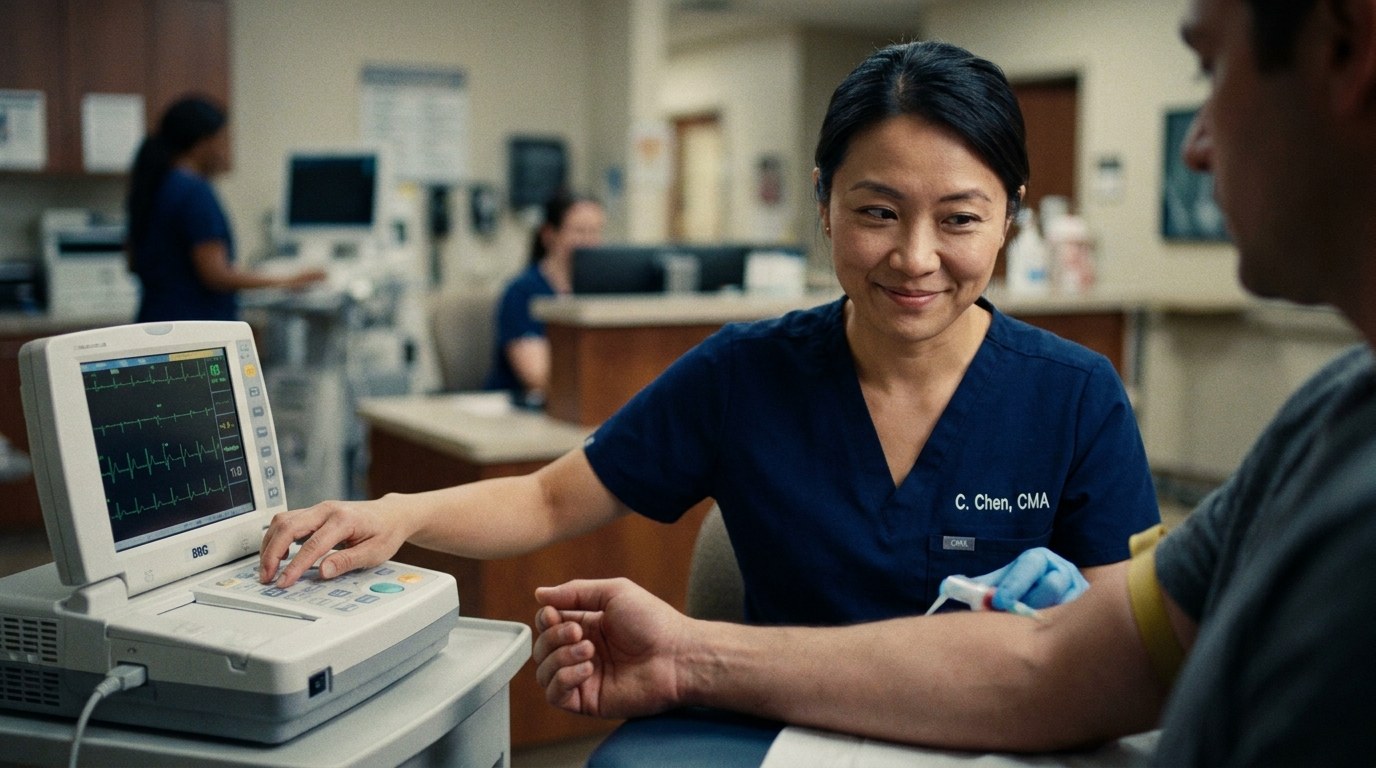
The Certified Clinical Medical Assistant (CCMA) is issued by the National Healthcareer Association (NHA). It focuses specifically on clinical skills — patient intake, phlebotomy, EKG, and clinical procedures — rather than the broader administrative scope of the CMA or RMA.
Who it’s best for: Students who complete shorter, clinically focused training programs or who are already working in a clinical support role and want to formalize their credentials.
Virginia context: The CCMA is growing in acceptance, particularly among urgent care chains, private practices, and medical spas in the Northern Virginia area.
—
Gold standard
Requires CAAHEP/ABHES program
Flexible pathways
Work experience option
Clinical focus
Growing acceptance
—
Education and Training Requirements in Virginia
Virginia sets no minimum state-mandated training hours for medical assistants — but your certification pathway dictates your education requirements more precisely than any state rule does.
Here’s what the typical training landscape looks like for Virginia residents.
Accredited Certificate Programs (9–12 Months)
This is the most common pathway for people entering the field. Certificate programs typically run nine to 12 months and cover both clinical and administrative competencies: anatomy and physiology, medical law and ethics, clinical procedures, phlebotomy, EKG interpretation, medical billing basics, and electronic health records.
Accreditation matters enormously here. If your goal is to sit for the CMA exam, your program must be accredited by CAAHEP or ABHES. Choosing a non-accredited program may save money upfront but can disqualify you from the most widely recognized credential in the field.
When evaluating programs, ask:
For Virginia residents, programs are available at community colleges throughout the state — Northern Virginia Community College (NOVA), for instance, offers health science pathways — as well as through private vocational schools and online programs with in-person clinical components.
—
Associate Degree Programs (2 Years)
Some students opt for a two-year Associate of Applied Science in Medical Assisting. These programs go deeper into healthcare science, include more general education requirements, and can position graduates for supervisory roles or easier lateral transitions into related healthcare fields.
The tradeoff: more time and typically more cost. For most entry-level MA roles in Northern Virginia, a certificate is sufficient.
—
On-the-Job Training
Some smaller medical practices in Virginia still hire and train MAs on the job — particularly for administrative-focused roles. However, this pathway limits your ability to earn national certifications (especially the CMA) and may cap your earning potential and geographic mobility.
In the competitive Northern Virginia healthcare market, on-the-job training is increasingly rare as a sole credential. Employers — particularly larger systems — use certification as a baseline screening filter.
—
Before enrolling in any program, verify CAAHEP or ABHES accreditation status directly at caahep.org or abhes.org. Program accreditation pages can become outdated — always confirm with the accrediting body directly.
—
Medical Assistant Salary and Job Outlook in Virginia
Medical assisting is one of the fastest-growing occupational categories in the U.S. — and Northern Virginia is one of the strongest regional markets in the country for this career.
What Do Medical Assistants Earn in Virginia?
According to the U.S. Bureau of Labor Statistics (BLS) Occupational Employment and Wage Statistics, medical assistants in Virginia earn a median annual wage in the range of approximately $38,000–$42,000 (verify current figures at bls.gov/oes).
The Northern Virginia / Washington DC metro area consistently outperforms the state median. The density of high-paying federal contractors, large integrated health systems, and medical-adjacent employers in Fairfax County and surrounding areas pushes compensation above the state average. Entry-level MAs in Tysons Corner-area practices often start at or above the state median.
Factors that affect earnings:
—
Job Growth Outlook
The BLS projects medical assisting to grow significantly faster than average across occupational categories — driven by an aging U.S. population, expanded outpatient care, and increased demand for preventive services. Virginia’s healthcare corridor — stretching from Loudoun County through Fairfax and Prince William into the DC metro core — positions Northern Virginia residents to benefit directly from that growth.
(Verify at BLS.gov — subject to change)
—
Student Spotlight: Consider someone like Marcus, a 29-year-old former retail manager from Fairfax who decided he wanted to move into healthcare without committing to a four-year degree. After completing a 10-month ABHES-accredited certificate program and earning his CMA, he accepted a position at a Fairfax County urgent care center. Within 18 months, he was promoted to lead MA — supervising the front-of-house clinical team. His story isn’t unusual in Northern Virginia, where accredited credentials open doors that résumé experience alone cannot.
—
Is a Medical Assistant Career Right for You? Related Healthcare Paths to Consider
Medical assisting is a strong choice for people who want a structured clinical environment, patient contact, and clear certification pathways. But it’s not the only healthcare-adjacent career that offers hands-on work, real earning potential, and a relatively short training runway.
If you’re exploring the broader healthcare and wellness space — particularly anything that involves skin, body treatments, or medical-adjacent cosmetic procedures — there are parallel career paths worth knowing about.
Medical Spas and Aesthetic Clinics: A Growing Overlap
One of the fastest-growing clinical environments in Northern Virginia is the medical spa — a hybrid setting that sits at the intersection of healthcare and beauty. Procedures like laser hair removal, intense pulsed light (IPL) treatments, laser skin resurfacing, and cosmetic laser technology are performed in these settings daily.
In Virginia, performing cosmetic laser procedures typically requires specific training and licensure — not a medical assistant certification. The relevant credential is closer to what’s covered in a Cosmetic Laser Technician training program.
That’s where AVI Career Training in Vienna, Virginia enters the picture.
AVI offers a Cosmetic Laser Technician program designed specifically for people who want to work in medical spa and aesthetic clinic environments — the same settings where medical assistants often work alongside laser and skincare professionals. AVI’s programs are built around hands-on, real-world technique training, and the school’s inclusive curriculum means graduates are prepared to serve clients across every skin tone — a critical competency in Northern Virginia’s diverse population.
—
Student Spotlight: Priya, a 34-year-old from Reston, spent three years working as an uncertified MA in a dermatology office. She loved the aesthetic side of the practice — the laser treatments, the skincare consultations, the cosmetic procedures — more than the clinical administrative work. After researching her options, she enrolled in AVI Career Training’s esthetics and laser pathway. Within six months of completing her program, she transitioned to a laser technician role at a medical spa in Tysons Corner — doing work she found genuinely fulfilling, with a schedule that fit her family.
—
AVI Career Training Programs Worth Considering
AVI Career Training is a Council on Occupational Education (COE)-accredited and SCHEV-certified beauty and wellness school located at 1595 Spring Hill Rd, Vienna, VA 22182 — in the heart of the Northern Virginia / Tysons Corner area.
AVI does not offer a medical assistant program . However, if your interest in healthcare careers is driven by a passion for aesthetics, skincare, or laser procedures, these programs may be exactly what you’re looking for:
GI Bill® benefits are accepted at AVI, making these programs accessible to veterans and military families in the DMV area. Financial aid is available for qualifying programs — contact AVI directly to discuss your specific program eligibility.
Apply Now at AVI Career Training →
—
—
Frequently Asked Questions: Medical Assistants in Virginia
Q: Does Virginia require medical assistants to have a license?
A: No. Virginia does not issue a state license for medical assistants. The profession is not regulated by the Virginia Department of Health Professions. However, most employers in Northern Virginia and the DC metro area require nationally recognized certification — CMA, RMA, or CCMA — as a condition of employment.
Q: What is the difference between a certified and registered medical assistant in Virginia?
A: A Certified Medical Assistant (CMA) holds a credential issued by the AAMA and must graduate from a CAAHEP- or ABHES-accredited program to sit for the exam. A Registered Medical Assistant (RMA) holds a credential issued by AMT, which offers more flexible eligibility pathways including relevant work experience. Both are nationally recognized and accepted by Virginia employers.
Q: How long does it take to become a medical assistant in Virginia?
A: Most accredited certificate programs run nine to 12 months. Associate degree programs take approximately two years. After completing a qualifying program, you’ll need to pass a national certification exam (CMA, RMA, or CCMA) before most employers will consider you credentialed.
Q: How much do medical assistants make in Virginia?
A: Virginia MAs earn a median annual wage in the range of $38,000–$42,000, based on BLS data (verify current figures at bls.gov). Northern Virginia and the Washington DC metro area typically pay above the state median due to cost of living and employer concentration. Specialty practices and hospital-based positions often pay more than general practice settings.
Q: Can medical assistants perform clinical tasks without certification in Virginia?
A: Legally, yes — Virginia does not require MA certification to perform clinical support tasks. However, individual employers set their own hiring requirements, and most healthcare employers in Northern Virginia require certification before allowing clinical responsibilities. Some tasks (e.g., medication administration, injections) may be regulated separately under physician delegation rules.
Q: What accreditation should I look for in a Virginia medical assistant program ?
A: If your goal is the CMA credential, your program must be accredited by CAAHEP or ABHES. Verify accreditation status directly at caahep.org or abhes.org before enrolling — program websites can become outdated. For the RMA or CCMA, accreditation requirements are less restrictive, but attending an accredited program remains the strongest preparation for any national exam.