Medical Aesthetics Training in Virginia: What to Know |
To perform laser treatments, advanced skin care, or clinical aesthetic services in Virginia, you need the right training and licensure for the aesthetic career path you actually want — not a nursing degree. Medical aesthetics is one of the fastest-growing sectors in the beauty and wellness industry, and Northern Virginia’s booming med spa market means qualified, credentialed professionals are well established right now.
This guide breaks down the difference between a medical assistant and a medical aesthetician, explains Virginia’s licensing requirements, and shows you exactly how to get started — including how AVI Career Training’s Cosmetic Laser Technology and Esthetics programs give you the hands-on, clinical-adjacent skills to build a real career in medical aesthetics.
Apply to AVI Career Training and speak with an admissions advisor about which program aligns with your goals.
—
> ### Key Takeaways
> – Medical aestheticians and laser technicians perform cosmetic treatments — a different career path from medical assistants, who handle clinical admin and nursing support.
> – Virginia requires 600 clock hours of esthetics training to sit for the state board exam through DPOR.
> – Cosmetic laser technicians in Virginia typically must operate under physician supervision — no nursing degree required for many aesthetic roles.
> – AVI Career Training offers COE-accredited programs in Cosmetic Laser Technology, Basic and Master Esthetics, and Electrolysis — all with clinical aesthetic applications.
> – Skincare specialists in the DC metro market can earn $45,000–$75,000+ annually in medical spa settings (Indeed, ASCP Salary Survey).
—
Medical Assistant vs. Medical Aesthetician: What’s the Difference?
These two careers sound similar, but they lead in completely different directions — and confusing them can send you down a training path that doesn’t match your actual goals.
A medical assistant works in a clinical healthcare setting — a doctor’s office, urgent care clinic, or hospital. Their work involves taking vital signs, drawing blood, managing patient records, and supporting physicians with administrative and basic clinical tasks. It’s a meaningful career, but it is not a beauty or aesthetic career. Medical assistants typically complete a 1–2 year associate-level program and are not licensed to perform cosmetic procedures.
A medical aesthetician — sometimes called a clinical esthetician or aesthetic technician — performs skin care treatments in medical and spa settings. That means facials, chemical peels, laser treatments, dermaplaning, and other cosmetic procedures that require a licensed esthetician’s skills and, in some settings, additional certifications. They work in med spas, dermatology offices, plastic surgery practices, and laser clinics. Their training is rooted in esthetics and cosmetic science, not clinical nursing.
A cosmetic laser technician takes that a step further. They specialize in laser and light-based treatments — hair removal, skin resurfacing, photorejuvenation, and more. In Virginia, this role typically requires working under physician supervision, but it does not require a nursing degree or a medical assistant credential.
The bottom line: If your goal is to perform aesthetic treatments — not clinical support work — the medical aesthetics career path is the right one. And it starts with esthetics and laser training, not a medical assistant program .
—
What Licenses and Certifications Do You Need in Virginia?
Virginia has clear licensing requirements for aesthetic careers, and getting them right from the start matters. Here’s what you need to know before you enroll anywhere.
Esthetician Licensure (DPOR)
To work as a licensed esthetician in Virginia, you must:
1. Complete at least 600 clock hours of approved esthetics training at an accredited school
2. Pass the Virginia State Board written and practical exams
3. Apply for licensure through the Virginia Department of Professional and Occupational Regulation (DPOR)
Virginia’s DPOR oversees cosmetology and esthetics licensure. You can verify current requirements directly at dpor.virginia.gov. Once licensed, estheticians in Virginia can work in salons, spas, and — with additional clinical training — medical spa environments.
Electrology Licensure
Electrologists in Virginia are licensed through the Virginia Department of Health Professions (DHP), not DPOR. Electrolysis is the only FDA-approved method of permanent hair removal, which means its oversight falls under a different regulatory body than most beauty services. AVI Career Training offers an Electrolysis program that prepares students for this licensing pathway.
Cosmetic Laser Technician Certification
Virginia does not have a single unified state license specifically for laser technicians the way it does for estheticians. However, laser and intense pulsed light (IPL) procedures in Virginia typically require:
- A licensed esthetician credential or healthcare background as a baseline
- Operation under physician supervision in most clinical settings
- In many med spas, employers require additional laser certification from an accredited program
Because this regulatory space can shift, always verify current guidance with the Virginia Department of Health Professions before entering the workforce. AVI’s Cosmetic Laser Technology program provides training that positions graduates to meet these requirements in clinical and med spa settings.
What About Nursing or Medical Degrees?
You do not need to be a nurse or hold a medical degree to work in a medical spa in Virginia. Most aesthetic technician and laser technician roles require esthetician licensure and hands-on laser training — not a nursing credential. If you want to perform injections (Botox, fillers), that is a different scope of practice reserved for licensed medical professionals. But for laser treatments, skin care, and related services, a beauty-focused credential is the right starting point.
—
Cosmetic Laser Technology: The Clinical Aesthetic Career Path
AVI Career Training’s Cosmetic Laser Technology program is designed for students who want to work at the intersection of beauty and clinical science. This is not a standard spa esthetics program — it prepares you for the equipment, terminology, and client care standards you’ll encounter in med spas, laser clinics, and dermatology offices.
What the Program Covers
The Cosmetic Laser Technology curriculum at AVI includes:
- Laser physics and light-based technology fundamentals
- Skin anatomy and how different skin tones respond to laser energy
- Hair removal techniques using laser and IPL devices
- Skin rejuvenation and photorejuvenation treatments
- Safety protocols, contraindications, and client consultation
- Hands-on clinical practice with professional equipment
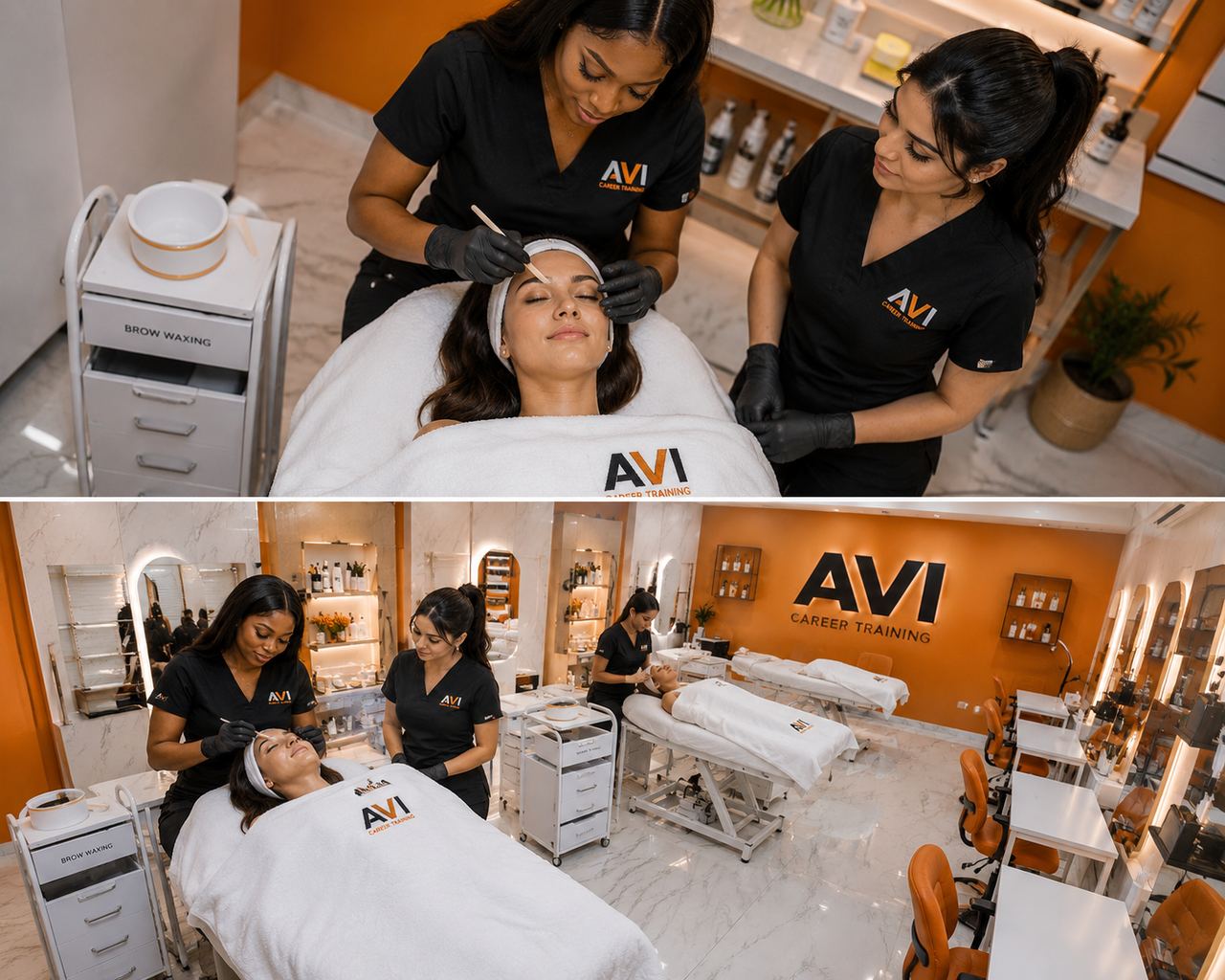
That last point matters. AVI’s training is built on practical, hands-on experience — not just classroom theory. Students work with real clients and real equipment in a supervised environment so they’re ready to perform from day one of employment.
Inclusive Skin Tone Training
AVI specifically prepares students to work on all skin tones — a critical skill in laser aesthetics, where the risk of adverse effects on deeper skin tones is real and must be addressed with proper technique and equipment settings. Many laser schools gloss over this. AVI doesn’t. This inclusive training approach is a core value that makes AVI graduates more capable, more confident, and more marketable to employers serving diverse communities across Northern Virginia and the DC metro area.
Who This Program Is For
The Cosmetic Laser Technology program is a strong fit if you:
- Already hold or are pursuing your esthetics license and want to specialize
- Are changing careers and want a clinical-adjacent beauty role without a nursing degree
- Are drawn to technology-based treatments rather than traditional spa services
- Want to work in a med spa, laser clinic, plastic surgery practice, or dermatology office
—
Meet Danielle. She spent eight years as a front-desk coordinator at a dermatology office in Tysons Corner. She saw laser technicians work every day, watched patients transform, and knew she wanted to be the one performing the treatments — not just scheduling them. But she assumed she’d need to go back to school for nursing or a two-year medical program. When she found AVI’s Cosmetic Laser Technology program, she realized she could build that career in a fraction of the time. She completed her training, earned her esthetics license, and landed a position at a Northern Virginia med spa within three months of graduating. Today, she earns significantly more than she did at the front desk — and she loves the work.
—
How Long Does Aesthetic Career Training Take in Virginia?
One of the most common questions prospective students ask is: How long will this take? The honest answer depends on the program — but aesthetic career training is dramatically faster than a nursing degree, a medical assistant program , or a four-year college track.
Here’s a realistic comparison:
| Program | Clock Hours | Approximate Timeline |
|—|—|—|
| Nail Technician (Virginia) | 150 hours | As few as 8 weeks |
| Basic Esthetics (Virginia) | 600 hours | Approximately 6–8 months* |
| Master Esthetics (AVI) | Additional hours beyond Basic | Extended specialization |
| Electrolysis (AVI) | Verify with AVI admissions | Varies by schedule |
| Cosmetic Laser Technology (AVI) | Verify with AVI admissions | Varies by schedule |
| Cosmetology (Virginia) | 1,000 hours | Approximately 12–14 months |
| Medical Assistant (Associate Degree) | 12–24 months | 1–2 years |
| Nursing (RN) | 2–4 years | 2–4 years |
Contact AVI for exact program hours and current schedule options.
The practical reality: you can complete esthetics training at AVI, sit for your Virginia State Board exam, and be working in a med spa well before a medical assistant student finishes their second semester. Speed-to-career matters — especially if you’re changing careers, supporting a family, or simply ready to start earning.
AVI also accepts financial aid and the GI Bill®, which makes this accelerated path accessible for a much wider range of students. If you’ve served — or are currently serving — your benefits may cover a significant portion of your training costs.
—
Meet Marcus. He was a 34-year-old Army veteran living in Fairfax County when he started exploring career options after transitioning out of service. He’d always been interested in health and wellness but didn’t want to commit to a four-year degree program right away. A friend mentioned AVI’s veteran-friendly financial aid options, and Marcus scheduled a tour. He enrolled in the Cosmetic Laser Technology program using his Post-9/11 GI Bill® benefits. Less than a year later, he was working at a medical spa in Arlington — a career he hadn’t imagined before he walked through AVI’s doors. He now serves clients across every background, applying the inclusive skin care techniques he learned at AVI daily.
—
Esthetics vs. Medical Aesthetics in Virginia: Which Path Fits You?
This is one of the most searched comparisons in the Northern Virginia beauty education market — and the answer depends on where you want to work and what kind of treatments you want to perform.
Traditional Esthetics
A licensed esthetician in Virginia can work in day spas, resort spas, hotel spas, salons, and skincare studios. The work is client-centered, relationship-driven, and deeply satisfying. Treatments typically include facials, waxing, lash and brow services, body treatments, and skin analysis. It’s a well-established career with strong local demand.
Medical Aesthetics
Medical aesthetics overlaps heavily with traditional esthetics — your license is the same foundation — but the setting and the treatments are different. Medical aesthetic roles are found in:
- Med spas — which are physician-supervised facilities offering both relaxation and clinical services
- Dermatology offices — where estheticians support skin health treatments
- Plastic surgery practices — where pre- and post-op skin care is part of patient care
- Laser and body contouring clinics — specialized in technology-driven cosmetic services
The key differentiator is usually technology. Medical aesthetic roles lean heavily on laser devices, IPL, microneedling, and other equipment-driven treatments. That’s where specialized training — like AVI’s Cosmetic Laser Technology program — separates candidates from the rest of the applicant pool.
Earning Potential in the DC Metro Market
According to the Bureau of Labor Statistics, the median annual wage for Skincare Specialists (SOC 39-5094) nationally is approximately $40,000. However, in the Northern Virginia and DC metro market, medical spa roles regularly command significantly more — with positions ranging from $45,000 to $75,000+ depending on experience, specialization, and employer (Indeed.com, ASCP Salary Survey data). Northern Virginia’s high median household income and density of medical facilities and med spas create stronger demand — and stronger wages — than many other markets in the country.
The med spa industry itself has grown rapidly in recent years. According to the American Med Spa Association (AmSpa), the medical spa market has expanded consistently year over year, with Northern Virginia and the DC metro area among the most saturated and competitive markets for medical aesthetics in the mid-Atlantic region.
—
Is a Career in Medical Aesthetics Right for You?
A career in medical aesthetics isn’t just a job — it’s a relationship-driven, skill-based profession where you directly help people feel better about how they look and feel. If that appeals to you, here’s what you can expect.
The Work Environment
Medical aestheticians and laser technicians typically work in clean, professional environments — often clinical in feel, but still client-centered and focused on wellness. You’ll work one-on-one with clients, consult on treatment plans, and track progress over time. It’s both technical and personal, which makes it a great fit for people who enjoy science and human connection.
The Client Community
Northern Virginia is one of the most diverse regions in the United States. AVI graduates work with clients of every age, background, skin tone, and hair type. Because AVI specifically trains students to perform on all skin tones, you’ll enter the workforce ready to serve that full range of clients — which is both an ethical imperative and a competitive advantage.
Who Thrives in This Career
You may be a great fit for medical aesthetics training if you:
- Are detail-oriented and comfortable with technology and equipment
- Enjoy ongoing education — laser technology and aesthetic science evolve quickly
- Want a career that’s flexible and not confined to one setting for life
- Care about helping clients achieve real, visible results
- Want to work in a field that’s growing, not shrinking
What to Do Next
If you’re ready to stop researching and start building your career in medical aesthetics, AVI Career Training in Vienna, Virginia is ready for you. Our Cosmetic Laser Technology, Basic Esthetics, Master Esthetics, and Electrolysis programs are COE-accredited, hands-on, and taught by licensed industry professionals. Financial aid is available, and we proudly accept the GI Bill®.
Call us at (703) 943-9841 to speak with an admissions advisor, or apply now to take the first step toward a career that’s worth showing up for every day.
You can also learn more about AVI Career Training — our programs, our instructors, and what makes our Vienna, VA campus a place where careers actually launch.
—
Virginia licensing requirements and regulatory guidelines are subject to change. Always verify current requirements with the Virginia Department of Professional and Occupational Regulation (DPOR) and the Virginia Department of Health Professions before enrolling in a training program.