Massage Therapy School in Northern Virginia: Your Top Questions Answered
AVI Career Training’s Massage Therapy program in Vienna, Virginia is a 500-hour, hands-on training program that prepares you to become a licensed massage therapist and launch a wellness career in the Northern Virginia and DC metro area. If you’ve been searching for a credible, accredited massage therapy school in Northern Virginia that gives you straight answers — about cost, time, licensing, and real career outcomes — you’re in exactly the right place.
AVI Career Training is a COE-accredited (Council on Occupational Education), SCHEV-certified career school located at 1595 Spring Hill Rd #720, Vienna, VA 22182 — right in the heart of Fairfax County, minutes from Tysons Corner. This FAQ breaks down everything you need to know before you enroll, from program length and curriculum to Virginia’s licensing requirements and what massage therapists actually earn in the DMV.
Ready to take the first step? Apply now at AVI Career Training or call (703) 943-9841 to speak with admissions today.
—
⚡ Key Takeaways
- AVI’s Massage Therapy program is 500 hours — meeting Virginia’s exact licensing education requirement
- The program is located in Vienna, VA, serving students from across Fairfax County, Arlington, Tysons Corner, and the greater DC metro
- Graduates are prepared to sit for the MBLEx (Massage & Bodywork Licensing Examination) — the state-required licensing exam in Virginia
- Virginia massage therapy licensing is regulated by the Virginia Department of Professional and Occupational Regulation (DPOR)
- Federal financial aid (FAFSA/Title IV) is NOT available for this program — it is under 600 hours; see the tuition section for payment options
- AVI is COE Accredited and SCHEV Certified — one of the few fully accredited massage therapy schools in Fairfax County
—
How Long Is Massage Therapy School at AVI Career Training?
AVI’s Massage Therapy program (NO FINANCIAL AID FOR THIS PROGRAM) is 500 hours — and that’s the number you need to know, because it’s the exact threshold Virginia requires to qualify for licensure.
Those 500 hours aren’t spent sitting in a classroom copying notes. The program is divided across hands-on technique labs, clinical practice, anatomy and physiology instruction, and professional development. You’ll spend real time working on real people in a supervised, professional setting — because that’s the only way to actually become competent as a massage therapist.
How long does 500 hours take in terms of calendar time? That depends on your schedule. Students attending on a full-time basis can complete the program in approximately 20–25 weeks. Part-time scheduling options may extend that timeline, making it more accessible for working adults and career changers in the Northern Virginia area who can’t simply quit their jobs to go to school.
The bottom line: this is not a weekend certificate course. It’s a serious, structured professional training — but it’s also genuinely achievable in under a year.
—
What Does Massage Therapy School Cost — and Is Financial Aid Available?
Let’s be direct: federal financial aid (FAFSA / Title IV) is NOT available for AVI’s Massage Therapy program. Because the program is under 600 hours, it does not meet the federal eligibility threshold for Title IV funding. Any school that implies otherwise is not being straight with you.
Here’s what that means practically: you’ll need to plan for out-of-pocket payment, a private payment plan, or private financing. AVI works with students to make tuition manageable. Contact admissions at (703) 943-9841 or reach out online to get current tuition figures and ask about available payment arrangements.
What about veterans? The GI Bill® may cover approved career training programs — speak directly with AVI’s admissions team to confirm current eligibility status for the Massage Therapy program under your specific GI Bill® benefit tier.
Is the cost worth it? Consider the math. A 500-hour program completed in roughly six months can launch a full-time career in a field where Virginia massage therapists earn competitive wages (more on that in the career outcomes section below). Compared to a two- or four-year degree, the investment-to-income timeline for a licensed massage therapist is genuinely short.
⚠️ Financial Aid Transparency Notice
AVI’s Massage Therapy program is under 600 hours and does not qualify for federal financial aid (FAFSA or Title IV funds). Payment plan and private financing options are available. Contact admissions at (703) 943-9841 for current tuition and payment details.
—
What Will You Learn in AVI’s Massage Therapy Program?

AVI’s Massage Therapy program teaches you the technical skills, anatomical knowledge, and professional judgment to become an effective, confident massage therapist — one who can serve a genuinely diverse client base.
Here’s a snapshot of what the curriculum covers:
Core Technique Training
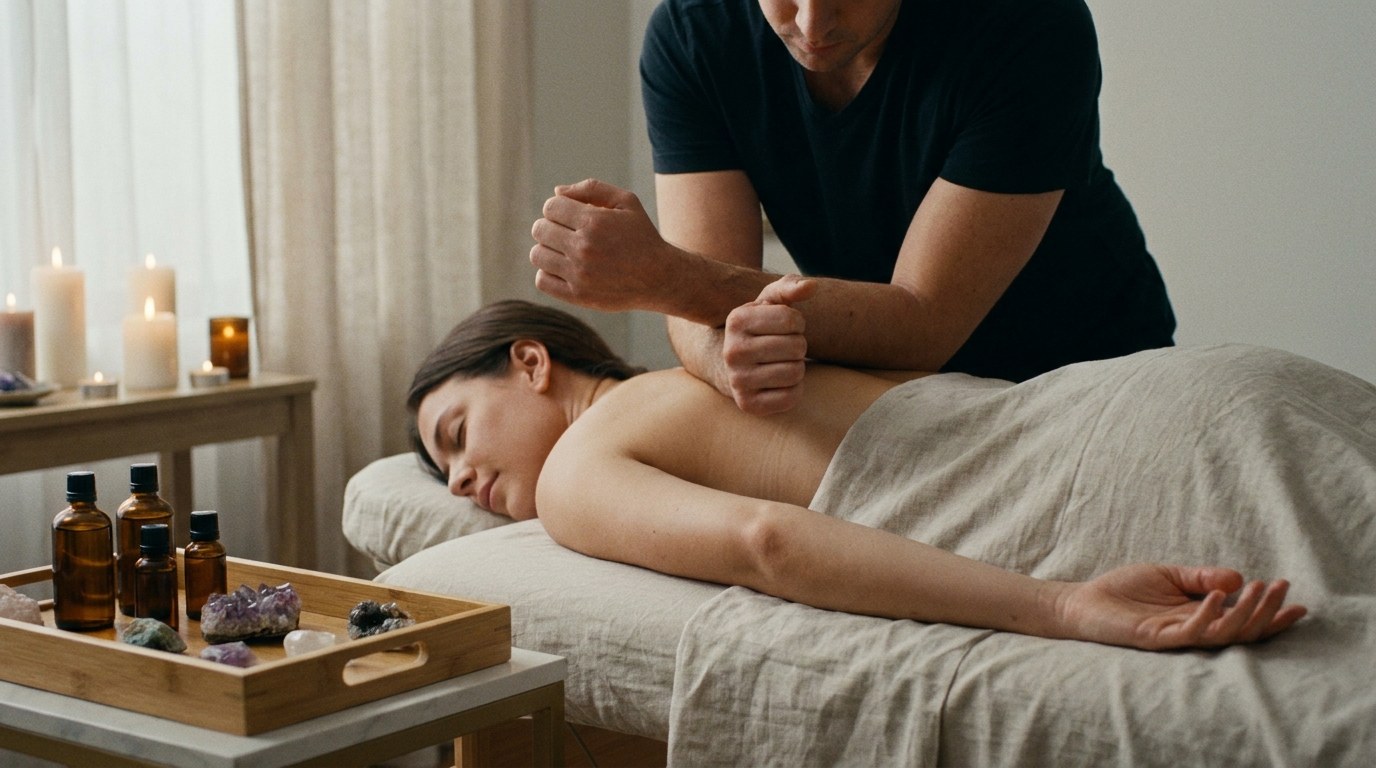
You’ll train in foundational massage modalities: Swedish massage, deep tissue work, myofascial approaches, and therapeutic techniques used in spa, clinical, and wellness settings. The emphasis is always on hands-on practice — not just watching demonstrations, but doing the work under licensed instructor supervision.
Anatomy, Physiology & Kinesiology
You can’t massage effectively without understanding the body. The program builds a solid foundation in musculoskeletal anatomy, the nervous system, circulatory system, and how movement and posture affect soft tissue health. This knowledge is also tested on the MBLEx exam, so it’s not optional theory — it’s essential.
Inclusive Client Care
One of AVI’s core values is training students to work well with every client — different body types, cultural backgrounds, comfort levels, and health needs. This matters in the DC metro area, which is one of the most demographically diverse regions in the country. Massage therapists who can adapt their approach to meet every client where they are build stronger practices and more loyal clienteles.
Ethics, Professionalism & Business Basics
Knowing how to massage is only part of the job. AVI’s program covers professional ethics, draping and client boundaries, intake procedures, contraindications (when massage is not appropriate), and the basics of working in a professional wellness environment. These aren’t soft skills — they’re the difference between a therapist clients trust and recommend and one they don’t return to.
Mini-story: Priya had worked as a medical office coordinator for eight years and loved being around healthcare — but she wanted to actually work with patients, not just schedule their appointments. She enrolled in AVI’s Massage Therapy program while still working part-time. The schedule worked around her existing commitments. By the time she finished her 500 hours, she had already landed an interview with a sports rehabilitation clinic in McLean — exactly the clinical setting she’d been picturing.
—
What Are Virginia’s Licensing Requirements for Massage Therapists?
Virginia requires massage therapists to be licensed before practicing professionally — and the path to that license is clear and achievable.
Here’s what the Virginia licensing process looks like, step by step:
Step 1: Complete 500 Hours of Approved Education
Virginia requires a minimum of 500 hours of massage therapy education from a state-approved school. AVI’s Massage Therapy program meets this requirement exactly. The school is SCHEV-certified, meaning the Virginia State Council of Higher Education for Virginia has reviewed and approved the program.
Step 2: Pass the MBLEx
After completing your program, you’ll sit for the MBLEx (Massage & Bodywork Licensing Examination) — the nationally recognized licensing exam accepted by Virginia and most other states. The MBLEx tests anatomy and physiology, kinesiology, pathology, massage theory, ethics, and guidelines for professional practice. AVI’s curriculum is designed to prepare you for every content area on this exam.
Step 3: Apply to DPOR
Massage therapy licensing in Virginia is regulated by the Virginia Department of Professional and Occupational Regulation (DPOR) — not, as some sources incorrectly state, the Board of Nursing. You’ll submit your application, education verification, and MBLEx scores directly to DPOR to receive your Virginia massage therapy license.
Step 4: Maintain Your License
Virginia massage therapy licenses require renewal and continuing education. Once you’re licensed, you’ll need to meet CE requirements to keep practicing — a commitment that keeps professionals current and clients well-served.
Virginia Massage Therapy Licensing — Quick Reference
- Licensing Body: Virginia Department of Professional and Occupational Regulation (DPOR)
- Education Requirement: 500 hours from a state-approved school
- Required Exam: MBLEx (Massage & Bodywork Licensing Examination)
- AVI’s Program Hours: 500 hours (meets requirement exactly)
- AVI’s Accreditation: COE Accredited · SCHEV Certified
—
What Can You Do With a Massage Therapy License in Northern Virginia?

A Virginia massage therapy license opens doors across a wide range of settings — and the Northern Virginia / DC metro market is one of the strongest in the country for wellness employment.
Where Massage Therapists Work in the DC Metro Area
What Do Massage Therapists Earn in Virginia?
According to the U.S. Bureau of Labor Statistics, massage therapists in the Washington-Arlington-Alexandria metropolitan area earn wages that are competitive with — and often above — national median figures. Before publishing, verify current BLS OES data for the DC-Arlington-Alexandria MSA for the most accurate, up-to-date salary figures. What’s clear from the data is that therapists who specialize, build repeat clientele, and work in high-demand clinical or luxury settings consistently out-earn those in entry-level positions.
Earnings also scale with experience, specialization, and employment type. Self-employed massage therapists who build private practices in affluent Northern Virginia communities often earn significantly more than salaried positions suggest.
Mini-story: Marcus was a former Army medic who’d separated from service and spent two years in a job that paid fine but didn’t light anything up for him. He heard about AVI’s program from a friend who’d gone through the cosmetology track. Six months after enrolling, Marcus had his Virginia massage therapy license and a position at a sports performance facility in Reston — doing work that actually felt connected to his medical background. He tells people the training reminded him of the parts of military medicine he liked best: hands-on, results-oriented, and genuinely helping people.
Is Massage Therapy School Worth It Financially?
The honest answer is: yes — if you’re willing to build a practice or work in a setting that rewards skill and consistency. Massage therapy is not a passive income stream. It rewards therapists who specialize, who earn client loyalty, and who treat it as the professional career it is. For career changers in Northern Virginia who want to enter wellness without a four-year degree and four years of lost income, the calculus is genuinely favorable.
—
Why Choose AVI Career Training as Your Massage Therapy School in Northern Virginia?
There are a handful of massage therapy schools in the Northern Virginia and Fairfax County area. Here’s what sets AVI apart.
COE Accreditation and SCHEV Certification
AVI Career Training is accredited by the Council on Occupational Education (COE) — a nationally recognized accrediting body for career and technical schools — and certified by SCHEV (the State Council of Higher Education for Virginia). That combination matters. It means AVI’s programs have been independently reviewed for quality, curriculum rigor, and student outcomes. You’re not handing tuition dollars to a fly-by-night operation.
Genuinely Inclusive Training
AVI’s approach to massage therapy — like everything the school teaches — is built around serving the full spectrum of clients. Northern Virginia and the DC metro area are among the most diverse communities in the United States. Massage therapists who graduate knowing how to adapt techniques for different body types, health backgrounds, and cultural comfort levels are better therapists and more employable professionals.
A Real School With Real Instructors
AVI’s massage therapy instructors are licensed professionals with field experience — not people who once took a weekend seminar. The school’s Vienna, VA campus is a working, active training environment, not a distance-learning platform with a fake address. When you train at AVI, you’re in a real clinical environment from day one. Learn more on AVI’s about page.
Location Built for Northern Virginia Students
The Vienna campus is accessible from across Fairfax County, Arlington, McLean, Falls Church, Reston, and the broader DC metro — including via Metro. For working adults who can’t relocate or spend hours commuting, that geographic convenience matters.
—
Frequently Asked Questions — Massage Therapy School in Northern Virginia
Q: How many hours do you need to become a massage therapist in Virginia?
A: Virginia requires 500 hours of massage therapy education from a state-approved school. AVI Career Training’s Massage Therapy program is exactly 500 hours, meeting this requirement in full.
Q: How long does it take to complete massage therapy school at AVI?
A: Full-time students typically complete AVI’s 500-hour Massage Therapy program in approximately 20–25 weeks. Part-time scheduling options are available for working adults and may extend the timeline.
Q: Is massage therapy school worth it financially?
A: For most graduates in the Northern Virginia and DC metro market, yes. The investment is relatively modest compared to a degree program, and the timeline to licensure and employment is short — often under a year from enrollment to first paycheck.
Q: What can I do with a massage therapy license in Virginia?
A: Licensed massage therapists in Virginia work in day spas, chiropractic and physical therapy clinics, sports facilities, hotels, medical wellness practices, and private practice. The DC metro area has strong, consistent demand across all of these settings.
Q: Does AVI Career Training offer financial aid for the Massage Therapy program?
A: Federal financial aid (FAFSA / Title IV) is NOT available for the Massage Therapy program because it is under 600 hours. Payment plans and private financing options may be available. Veterans should ask AVI admissions about GI Bill® eligibility. Contact AVI at (703) 943-9841 for current options.
Q: What exam do I take after massage therapy school in Virginia?
A: Virginia requires passing the MBLEx (Massage & Bodywork Licensing Examination). AVI’s curriculum prepares you for every content area covered on the MBLEx.