EKG Technician Training in Vienna, VA | 80 Hours | AVI
✦ Health Sciences · NHA CET Certification Prep

EKG
Technician

Learn to perform and interpret electrocardiograms in just 4 weeks. AVI's EKG Technician program prepares you for the NHA Certified EKG Technician (CET) exam and roles in hospitals, cardiology clinics, and urgent care centers.

80
Clock Hours
4
Weeks Full-Time
NHA
CET Certification Ready
4
Courses

EKG Technician Quick Answers

How long is EKG technician training at AVI?

AVI Career Training's EKG Technician program is 80 clock hours (50 hours of theory and 30 hours of hands-on lab). Full-time classes run Monday to Thursday, 10:00 AM to 3:00 PM, for about 4 weeks at our Vienna, VA campus. Start dates are monthly, so contact admissions for the next one.

How much does EKG technician training cost?

AVI lists a total cost of $2,500: $2,000 tuition, $400 materials, and a $100 non-refundable registration fee, with no application fee. Standing alone, this program is self-pay and is not eligible for FAFSA, GI Bill, or WIOA funding. Ask admissions about payment options.

Do you need a license or certification to be an EKG technician?

We found no Virginia state license for EKG technicians: the profession is not among the boards of the Virginia Department of Health Professions. Employers set their own rules and may prefer a national credential such as the NHA Certified EKG Technician (CET), which AVI's program prepares you to take. Confirm current rules with DHP and your employer.

How do you become an EKG technician?

Have a high school diploma or GED, complete an EKG training program such as AVI's 80-hour course, document at least 10 EKGs performed on live individuals, and sit for a national exam such as the NHA CET. BLS notes EKG technicians may qualify for entry-level jobs with a high school diploma and a certificate program of under a year.Source: BLS Occupational Outlook Handbook

Program Overview

Become a Certified EKG Technician in 4 Weeks

The EKG Technician program at AVI Career Training is an 80 clock-hour certificate program combining 50 hours of theory and 30 hours of hands-on lab training. Students master 12-lead EKG setup, electrode placement, cardiac rhythm interpretation, and Holter monitoring under the guidance of experienced clinical instructors.

Graduates are eligible to sit for the National Healthcareer Association (NHA) Certified EKG Technician (CET) examination. Our SOC Code is 29-2031 and CIP Code is 51.0902.

✓ Certified to operate by SCHEV SOC 29-2031 NHA CET Exam Prep
Program Details
Everything you need to know
Total Hours
80 clock hours — 50h Theory + 30h Lab
Duration
4 weeks full-time (Mon–Thu, 10:00 AM – 3:00 PM)
Total Cost
$2,500 total cost — $2,000 tuition + $400 materials + $100 registration fee (registration fee non-refundable). No application fee.
Stand-alone, this program is self-pay and is not eligible for FAFSA, GI Bill or WIOA funding. Students who enroll in the full Clinical Certified Medical Assistant (CCMA) program may be able to use Federal Pell Grant funding for it as part of CCMA, if eligible — see the CCMA program.
Credential Awarded
Certificate in Electrocardiography Technician
Certification
NHA CET Exam Eligible upon program completion
CIP / SOC Code
CIP: 51.0902  |  SOC: 29-2031
Start Dates
Monthly enrollment — contact us for next available date
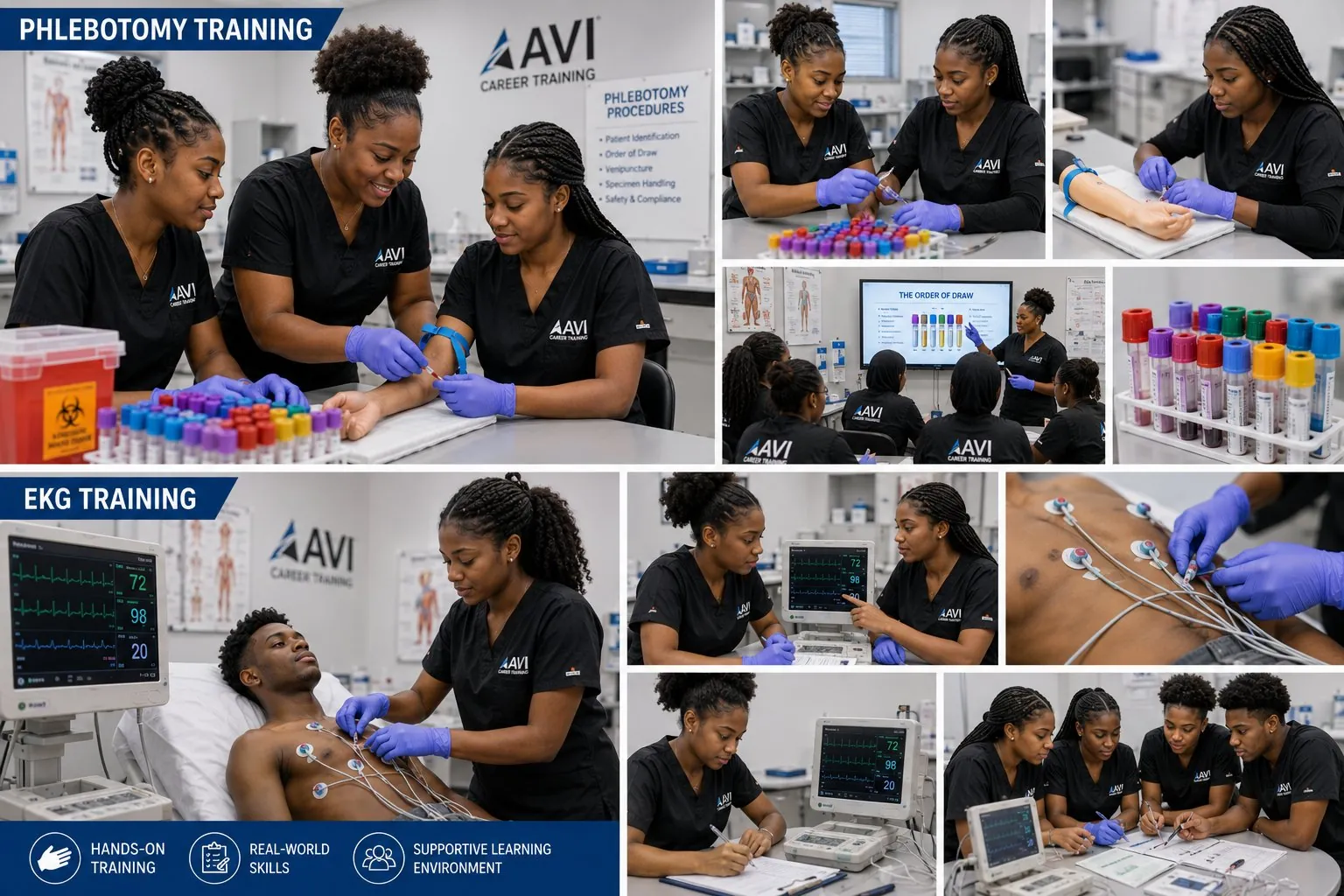
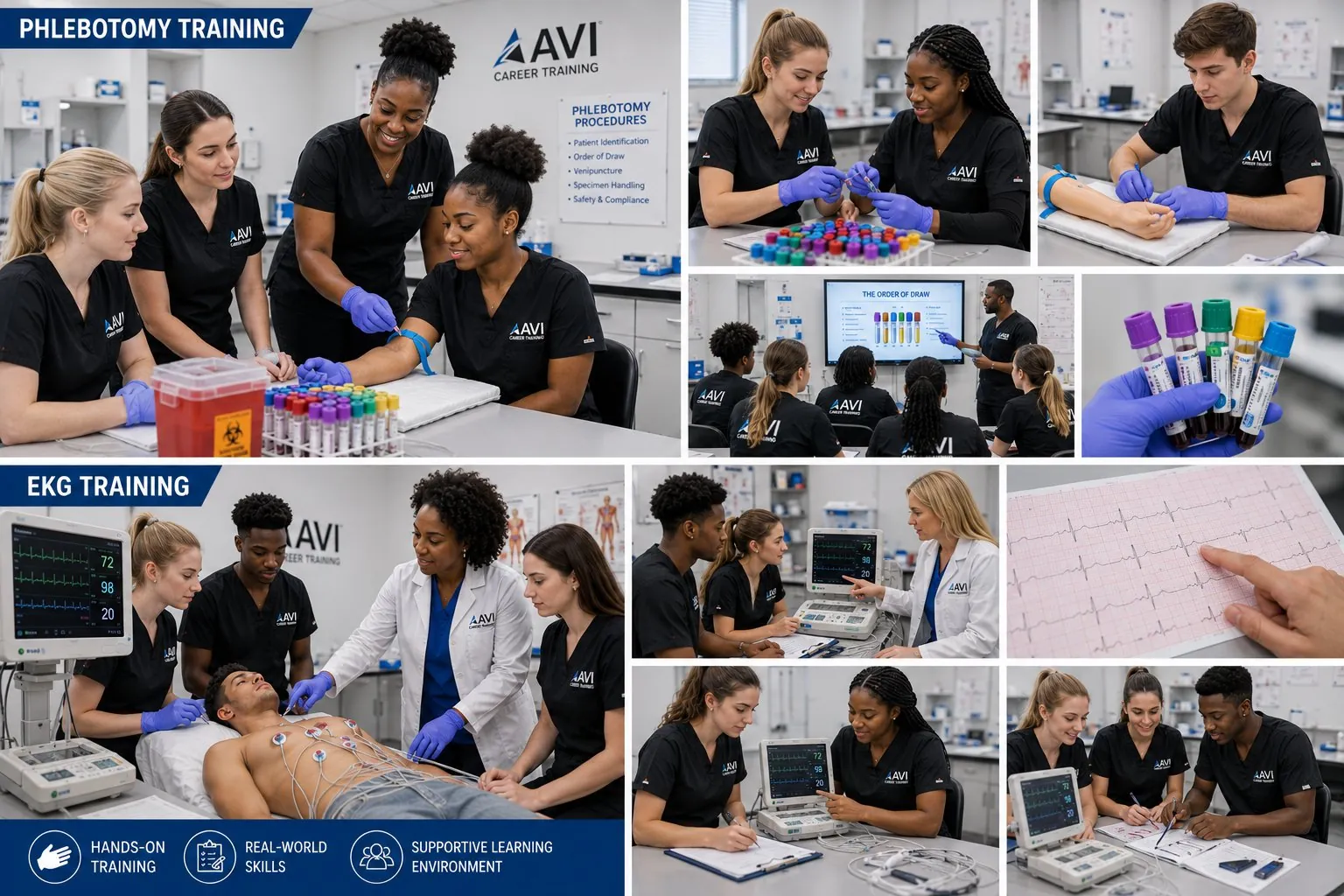
EKG technician students in clinical training at AVI Career Training Vienna VA
EKG Lab Training — AVI Career Training, Vienna VA

Course Curriculum

4 Courses · 80 Clock Hours

A focused, competency-based curriculum building from cardiac anatomy through advanced rhythm interpretation and NHA CET exam readiness.
EK101 — Foundations of Electrocardiography and Patient Care
Theory 20h · Lab 5h
25h
EK102 — Cardiac Anatomy, Physiology and EKG Procedures
Theory 15h · Lab 10h
25h
EK103 — Electrocardiograph Procedures and Cardiac Monitoring
Theory 10h · Lab 15h
25h
EK104 — EKG Interpretation, Quality Assurance and Certification Review
Theory 5h · Lab 0h
5h
4 courses  |  50h Theory + 30h Lab
80h Total
EKG technician training hands-on AVI Career Training
12-Lead EKG Lab Practice
Supervised electrode placement and rhythm reading
❤️
NHA CET Certification
Graduates are exam-eligible for the National Healthcareer Association Certified EKG Technician credential.
NHA CET Ready

NHA CET Certification

Core EKG Competency Areas

Our curriculum prepares you for every domain tested on the NHA Certified EKG Technician examination.

❤️
Cardiac Anatomy
Heart chambers, conduction system, coronary arteries, electrical pathways
📊
EKG Equipment Operation
12-lead machine setup, lead placement, calibration, paper speed, sensitivity
🔬
Waveform Analysis
P wave, QRS complex, T wave, intervals, segments, axis determination
🫀
Rhythm Interpretation
Sinus rhythms, atrial arrhythmias, ventricular rhythms, heart blocks
🛡️
Patient Safety & Privacy
Patient preparation, HIPAA compliance, electrical safety, infection control
📋
Holter & Stress Testing
Ambulatory monitoring setup, event recorders, exercise stress test preparation
80
Total Clock Hours
4
Weeks to Complete
70%
Minimum Passing Grade
NHA
CET Certification

Class Schedule

Full-Time Daytime Program

Mon – Thu
Class Days
Monday through Thursday
No Friday or weekend classes
4 Days/Week
10:00 AM – 3:00 PM
Class Hours
Daytime instruction
20-hour school week
5 Hours/Day
4 Weeks
Program Length
Approximately 1 month
Monthly start dates
Monthly Enrollment

What You Will Master

Clinical EKG Skills

12-Lead EKG
Setup, electrode placement, acquisition
Rhythm Interpretation
Normal & abnormal cardiac rhythms
Artifact Identification
Motion, interference, lead displacement
Holter Monitoring
Ambulatory recorder setup & patient education
Patient Safety
Electrical safety, infection control
Documentation
EKG records, HIPAA, reporting

Career Opportunities

Where Graduates Work

Certified EKG Technicians work across cardiac care settings in the DC Metro area and nationwide.

🏥
Hospitals & Health Systems
Cardiology departments, telemetry units, and cardiac catheterization labs
❤️
Cardiology Practices
Outpatient cardiology clinics and cardiovascular specialty offices
🚑
Urgent Care Centers
Walk-in clinics requiring EKG services for acute cardiac evaluation
🏨
Outpatient Clinics
Internal medicine, primary care, and multi-specialty clinic settings
👴
Long-Term Care
Skilled nursing facilities and assisted living centers serving elderly patients
🏃
Cardiac Stress Labs
Exercise stress testing facilities and diagnostic cardiology departments
Common Job Titles for EKG Graduates
EKG Technician Certified EKG Technician Cardiac Monitor Technician Telemetry Technician Cardiovascular Technician SOC Code: 29-2031

Admission Requirements

How to Qualify

Education
High school diploma or GED required
Interview
Admissions interview with school representative
English Proficiency
Must be able to read, write, and communicate in English
Age
Must be 18 years of age or older

Graduation Requirements

Earning Your Certificate

Clock Hours
Complete all 80 scheduled clock hours
Minimum Grade
Achieve a cumulative grade of 70% or higher in all courses
Competency Demonstrations
Successfully demonstrate all required EKG competencies
Financial Standing
All financial obligations to the school must be satisfied

Why AVI Career Training

Your Success is Our Mission

Accredited & Certified

AVI Career Training is accredited by the Council on Occupational Education (COE) and certified to operate by the State Council of Higher Education for Virginia (SCHEV).

Experienced Clinical Instructors

Learn from instructors who bring real-world cardiology and clinical experience to every class session.

Admissions & Tuition

Total cost $2,500 ($2,000 tuition + $400 materials + $100 registration fee). Stand-alone, this program is self-pay and is not eligible for FAFSA, GI Bill or WIOA funding. Students who enroll in the full Clinical Certified Medical Assistant (CCMA) program may be able to use Federal Pell Grant funding for it as part of CCMA, if eligible — see the CCMA program. Contact admissions for payment options.

Hands-On EKG Lab

Practice 12-lead EKG setup and rhythm reading in our clinical simulation lab before entering real healthcare environments.

NHA CET Exam Preparation

Our capstone course includes dedicated NHA CET exam review, practice assessments, and test-taking strategies.

Northern Virginia Location

Located in Vienna, VA — minutes from Tysons Corner and the DC Metro, giving graduates access to one of the nation's largest healthcare job markets.

Frequently asked questions

EKG Technician Program Frequently Asked Questions

No state license applies in Virginia that we could find, so the usual credential is a voluntary national certification. AVI prepares students for the National Healthcareer Association (NHA) Certified EKG Technician (CET) exam. Other organizations offer cardiographic credentials with different eligibility rules, so check what your target employer prefers.
NHA requires a high school diploma or GED (or scheduled to earn one within 18 months). You then qualify by completing an EKG technician training program within the last 5 years, or by having 1 year of supervised EKG work in the last 3 years (or 2 years in the last 5). Either way you must show evidence of at least 10 EKGs performed on live individuals. Ask admissions how AVI documents this.
AVI's published $2,500 total covers $2,000 tuition, $400 materials, and a $100 registration fee. The NHA exam fee is not included in the $2,500. It is paid separately to NHA, which sets its own exam fee and policies.
BLS does not report EKG technicians separately. It groups them with cardiovascular technologists and technicians, whose May 2025 median pay was $74,310 per year ($35.73 per hour), though that group typically holds an associate's degree and includes more advanced specialties. Entry-level EKG roles requiring only a certificate can pay differently. AVI does not guarantee income or employment.Source: BLS Occupational Outlook Handbook
BLS projects employment of cardiovascular technologists and technicians, the group that includes EKG technicians, to grow 4 percent from 2025 to 2035, about as fast as the average for all occupations. Opportunities depend on your local market and the credentials employers ask for.Source: BLS Occupational Outlook Handbook
AVI's program is 80 clock hours over about 4 weeks full-time. You learn 12-lead EKG setup, electrode placement, cardiac anatomy, waveform analysis, rhythm recognition, artifact identification, Holter monitoring, patient safety and privacy, and NHA CET exam review. Practice happens in AVI's lab before any real patient setting.
You must have a high school diploma or GED, be at least 18 years old, complete an admissions interview, and be able to read, write, and communicate in English. There is no application fee. To finish, you complete all 80 clock hours, earn at least 70% in your courses, and demonstrate the required EKG competencies.
AVI's published schedule is daytime classes on campus in Vienna, VA, Monday to Thursday, with hands-on 12-lead EKG lab practice. The program page lists no online option. Contact admissions to confirm the current format and start date.
Not for this program on its own. Stand-alone, AVI's EKG Technician program is self-pay and is not eligible for FAFSA, GI Bill, or WIOA funding. Students who enroll in the full Clinical Certified Medical Assistant (CCMA) program may be able to use a Federal Pell Grant for it as part of CCMA, if eligible. Contact admissions for payment options.
An EKG technician places electrodes and records the heart's electrical activity with an electrocardiograph, including resting, Holter, and stress-test setups. A phlebotomist collects blood and other specimens for lab testing. They are separate skills with separate NHA credentials (CET and CPT). See AVI's Phlebotomy Technician program.
Yes, nothing prevents you from holding both skill sets. They are separate credentials (NHA CET and NHA CPT) and separate AVI programs, each 80 clock hours. You can also look at AVI's CCMA program, which is a broader medical assistant path. Ask admissions how to sequence them.
Common settings include hospital cardiology departments and telemetry units, cardiology practices, urgent care centers, outpatient clinics, long-term care facilities, and cardiac stress labs. Which employers hire, and what credential they require, is up to each employer.

Sources: U.S. Bureau of Labor Statistics, Occupational Outlook Handbook: Cardiovascular Technologists and Technicians (May 2025 data); National Healthcareer Association, Certified EKG Technician (CET); Virginia Department of Health Professions, Health Regulatory Boards. Wages are national figures, not a promise of earnings. Credential rules can change, so confirm current requirements with the credentialing body and with admissions.

✦ Begin Your Healthcare Career

Ready to Become a
Certified EKG Technician?

Apply today or contact our admissions team to learn about upcoming start dates, tuition, and what to expect in your first week.

Apply Now → Contact Admissions

AVI Career Training  ·  Vienna, VA  ·  (571) 520-4417