Massage Therapy School in Northern Virginia | AVI Career Training
AVI Career Training in Vienna, VA is one of the few COE-accredited massage therapy schools in Northern Virginia — offering hands-on training that meets Virginia’s 625-hour licensure requirement and prepares you to work in spas, clinics, and beyond.
If you’re ready to build a career that combines real skill with real demand, you’re in the right place. Northern Virginia’s concentration of med spas, wellness clinics, chiropractic offices, and high-income clientele makes this one of the strongest markets in the country for licensed massage therapists. The path from where you are today to a Virginia massage therapy license is more direct than most people expect.
Here’s exactly what that path looks like — and how AVI makes it happen.
—
Key Takeaways
—
What Does Massage Therapy Training Actually Cover?
Massage therapy training is not just learning to give a good back rub. It’s a structured, clinically grounded curriculum that prepares you to assess clients, apply multiple techniques safely, and operate professionally in a licensed healthcare-adjacent environment.
At AVI Career Training, the Massage Therapy program covers the foundational skills and knowledge you need to graduate, pass your boards, and work confidently on day one.
Core Modalities
You’ll learn the techniques that make up the backbone of professional massage practice:
The Northern Virginia market rewards therapists who can do more than one thing. Med spas, sports facilities, and upscale hotel spas are looking for versatile practitioners — not specialists in a single technique.
Anatomy, Physiology, and Pathology
You’ll study the muscles, bones, and connective tissue you’re working with every session. Understanding anatomy isn’t just about passing your exam — it’s what separates a therapist who gets referrals from one who doesn’t. Clients notice when their therapist understands what’s actually happening in their body.
Ethics, Communication, and Business Skills
Professional practice isn’t only hands-on. The curriculum includes client intake procedures, informed consent, professional boundaries, and the basics of running your own practice — because a significant number of Northern Virginia massage therapists work for themselves, either full-time or as a supplement to salaried employment.
Clinical Practice Hours
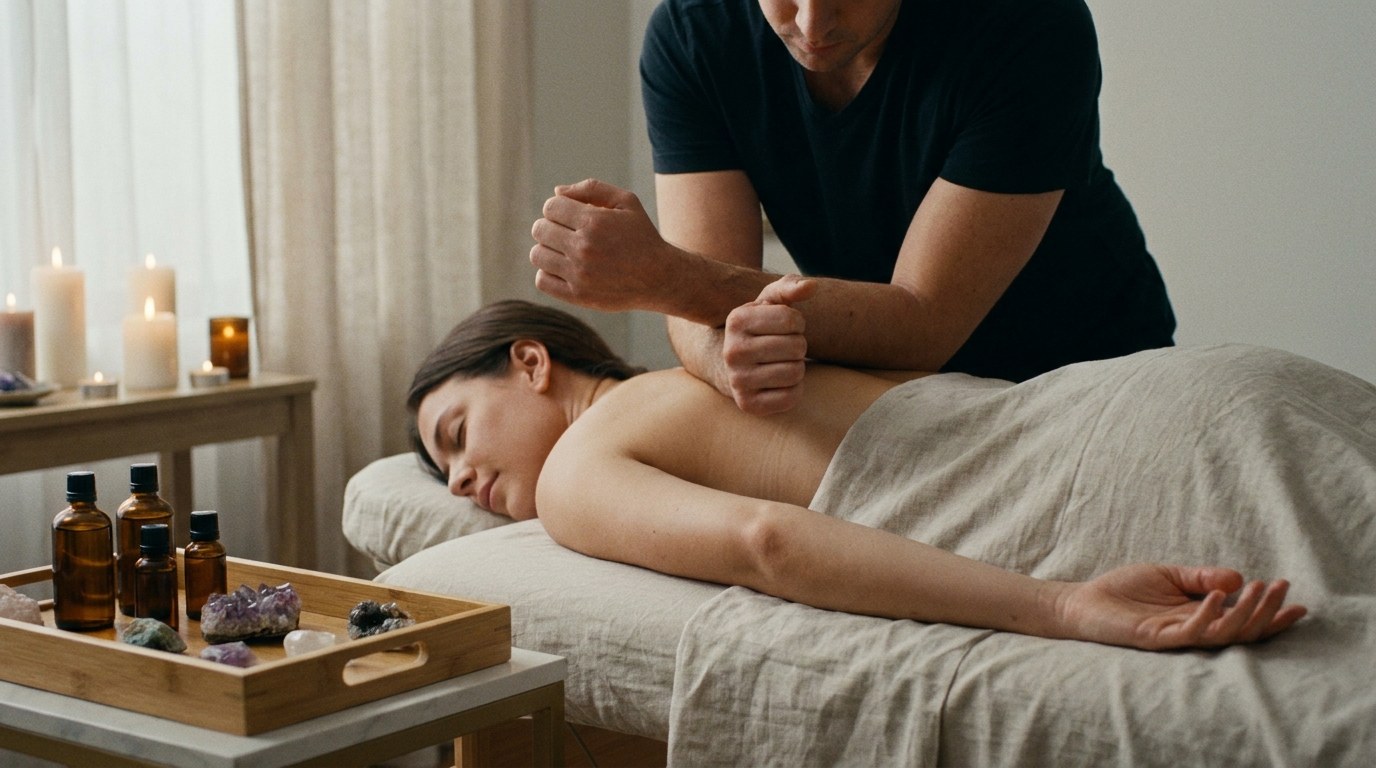
You’ll spend a substantial portion of your training in hands-on clinical practice, working with real clients under instructor supervision. This is where textbook knowledge becomes professional confidence. By graduation, you won’t just know how to perform a session — you’ll know how to run one.
—
Virginia Massage Therapy License Requirements
Virginia has clear, specific requirements for massage therapy licensure — and meeting them is entirely achievable with the right program. Here’s what you need to know.
500 Clock Hours of Training
Virginia requires a minimum of 500 clock hours of supervised massage therapy education from an approved school. This is the floor, not a suggestion. Programs that don’t meet this threshold cannot qualify their graduates for Virginia licensure.
AVI’s Massage Therapy program is structured to meet this requirement, with hours split across classroom instruction, anatomy study, and supervised clinical practice.
The MBLEx Exam
After completing your program, you’ll need to pass the MBLEx — the Massage & Bodywork Licensing Examination — administered by the Federation of State Massage Therapy Boards (FSMTB). The MBLEx is the national standard exam used by most U.S. states, including Virginia.
The exam covers:
Your training at AVI is designed to prepare you for this exam — not just to graduate you. Every content area in your coursework maps directly to what the MBLEx tests.
Licensure Through the Virginia Board of Nursing
Here’s something that surprises many prospective students: in Virginia, massage therapy licenses are issued by the Virginia Board of Nursing — not a separate massage therapy board. This is worth knowing because it’s where you’ll submit your application, pay your licensure fee, and manage your license going forward.
Once you pass the MBLEx, you apply to the Virginia Board of Nursing with your exam results and program completion documentation. Licensure can follow within a few weeks of passing.
License Renewal
Virginia massage therapy licenses must be renewed every two years. Renewal requires continuing education, so staying current in your field isn’t just good practice — it’s a legal requirement.
For full, current licensing requirements, refer directly to the Virginia Department of Health Professions.
—
How Long Does It Take — and What Does It Cost?
One of the most common questions prospective students ask is how long the process actually takes. The honest answer: faster than most people expect.
Timeline
Most 625-hour massage therapy programs complete in 6–9 months, depending on whether you attend full-time or part-time. AVI offers scheduling options designed to work around your life — whether you’re transitioning from another career, managing family responsibilities, or working while you train.
After graduation, you can sit for the MBLEx immediately. If you’re prepared and schedule your exam promptly, you can go from enrolled student to licensed massage therapist in under a year.
Specific program schedule details for AVI’s Massage Therapy program are available when you contact AVI admissions directly. Program start dates and scheduling options are confirmed at enrollment.
The Cost — and How to Cover It
Massage therapy school is an investment, and AVI is committed to making that investment accessible.
Financial aid is available for students who qualify. As a COE-accredited institution, AVI meets federal standards that allow eligible students to access Title IV financial aid programs, including Pell Grants.
AVI accepts the GI Bill®. If you’re a veteran or an eligible dependent, your benefits may cover a significant portion of your tuition. Northern Virginia has one of the largest veteran populations in the country — serving Fort Belvoir, the Pentagon, and dozens of military-adjacent communities — and AVI is positioned to serve that community directly.
When you’re thinking about cost, weigh it against earning potential. The U.S. Bureau of Labor Statistics reports a median annual wage of approximately $49,860 for massage therapists nationally (BLS, May 2023). In the Northern Virginia and DC metro region, where demand is high and disposable income varies by experience and location, wages trend meaningfully higher. Many therapists in the area supplement their income with private clients, further increasing total annual earnings.
A program that takes less than a year to complete, opens doors to a career paying above the national median, and can be partially funded through financial aid or the GI Bill® — the math tends to work in your favor.
—
Meet Two Students Who Made the Switch
From Desk Job to Dream Career: Keisha’s Story
Keisha spent seven years in administrative work in Fairfax County. She was good at her job, but she wanted to work with people in a different way — something physical, meaningful, and with real growth potential. She’d been getting massages for years to manage her own stress and back tension, and her therapists kept telling her she had strong hands and genuine empathy.
At 34, Keisha enrolled in AVI’s Massage Therapy program on a part-time schedule, attending classes around her existing work hours. Nine months later, she passed the MBLEx on her first attempt and accepted a position at a med spa in Tysons Corner — five minutes from AVI’s campus. Within her first year of licensure, she had built a loyal client base and was earning more per hour than she had in her previous role.
“I kept waiting for the ‘right time,'” she said. “The right time was the day I stopped waiting.”
Active Duty to Licensed Therapist: Marcus’s Transition
Marcus separated from the Army after eight years of service and moved back to Northern Virginia to be near family. He wanted a career that used his hands, paid well, and didn’t require four more years of school. He’d heard about AVI through the local veteran community and discovered they accepted the Post-9/11 GI Bill®.
He enrolled in the full-time Massage Therapy program. His military background — discipline, attention to detail, the ability to stay calm under pressure — turned out to be exactly the foundation a good massage therapist needs. He graduated in under seven months, passed his boards, and now works at a physical therapy clinic in Arlington, where he specializes in deep tissue work with athletes and post-surgical recovery clients.
For Marcus, AVI wasn’t just a school. It was the clearest path from military service to a civilian career that respected what he already knew how to do.
—
What Can You Do With a Massage Therapy License in Northern Virginia?
A Virginia massage therapy license opens more doors than most people realize — especially in this market.
Employment Settings
Licensed massage therapists in Northern Virginia work across a wide range of environments:
Self-Employment
A significant number of massage therapists in Northern Virginia work for themselves — either as their sole income source or alongside part-time employed work. With a client base of 15–20 regular clients, a self-employed therapist can generate income that competes favorably with salaried spa positions, with the added benefit of setting your own schedule.
The high disposable income and wellness-oriented culture of Fairfax County, Arlington, and the broader DC metro area make private practice more viable here than in most U.S. markets.
The DC Metro Demand Advantage
Northern Virginia is not a typical regional market. The concentration of federal government employees, defense contractors, tech workers, and corporate headquarters creates a dense population of working professionals with above-average incomes, high stress levels, and a demonstrated willingness to invest in personal wellness. That combination drives consistent, year-round demand for licensed massage therapists — and it’s one reason why starting your massage therapy career in this area is a strategic decision, not just a geographical one.
—
Why Train at AVI Career Training in Vienna, VA?
There are several options for massage therapy training in Northern Virginia. Here’s what sets AVI apart.
COE Accreditation and SCHEV Certification
AVI Career Training is accredited by the Council on Occupational Education (COE) and certified by the State Council of Higher Education for Virginia (SCHEV). These aren’t just credentials on a wall — they’re the reason AVI students can access federal financial aid, and they’re the quality signal that employers and licensing boards recognize.
Not every massage therapy school in the region carries both. When you train at an accredited, certified institution, you graduate with credentials that hold up.
Hands-On Clinical Training
AVI’s program is structured around doing, not just listening. The clinical component of your training puts you in front of real clients under instructor supervision — building the practical experience that makes you employable, not just licensed.
By the time you graduate, you’ll have performed dozens of professional massage sessions. That’s not something you can learn from a textbook, and it’s the difference between a graduate who is technically licensed and one who is genuinely ready to work.
Inclusive Training Philosophy
The DC metro area is one of the most demographically diverse regions in the United States. The clients you’ll serve will come from every background, body type, age, and health situation imaginable.
AVI’s curriculum is built around inclusive practice — teaching you to work skillfully and confidently with every client who walks through the door. That means understanding how to adapt your technique, your communication, and your approach based on the individual in front of you. In a market as diverse as Northern Virginia, that skill isn’t optional. It’s what separates good therapists from great ones.
Location: Vienna, VA — Central to Everything
AVI is located at 1595 Spring Hill Rd #720, Vienna, VA 22182 — less than a mile from the Greensboro Metro station and minutes from Tysons Corner. Whether you’re commuting from Fairfax, Arlington, Reston, or further out in Northern Virginia, AVI is accessible by car or public transit.
You’re not just training in the area where you’ll build your career — you’re building connections and clinical experience in the exact market where you plan to work.
GI Bill® Accepted
For veterans and eligible dependents, AVI’s GI Bill® acceptance means your training investment may be substantially or fully covered. This is a meaningful differentiator in a region with one of the country’s highest concentrations of military-connected residents.
—
Frequently Asked Questions
How many hours do you need to become a massage therapist in Virginia?
Virginia requires a minimum of 625 clock hours of supervised massage therapy training from an approved school before you can apply for licensure.
How long does massage therapy school take in Virginia?
Most 500-hour programs complete in 6–9 months. Full-time students typically finish faster; part-time schedules extend the timeline but offer more flexibility.
How much do massage therapists make in Northern Virginia?
The U.S. median annual wage is approximately $49,860 (BLS, May 2023). Northern Virginia wages trend above that national median, and many therapists supplement with private clients to increase total earnings.
Is massage therapy a good career in the DC metro area?
Yes. The region’s combination of high disposable income, wellness culture, and density of spas, clinics, and medical facilities creates consistent, above-average demand for licensed massage therapists.
What is the Virginia State Board exam for massage therapy?
Virginia uses the MBLEx — the Massage & Bodywork Licensing Examination — administered by the FSMTB. Passing the MBLEx is required before applying for a Virginia massage therapy license through the Virginia Board of Nursing.
—
Your Next Step Starts Here
You now know what Virginia requires, what the training covers, and what the career looks like in Northern Virginia. The only thing left is to take the first step.
AVI Career Training is accepting applications for the Massage Therapy program. Whether you’re changing careers, returning to the workforce, or using your GI Bill® benefits, AVI gives you the hands-on training, accredited credentials, and Northern Virginia network to build a career that lasts.
Apply now to get started, or call us directly at (703) 943-9841 with any questions. You can also visit our campus at 1595 Spring Hill Rd #720, Vienna, VA 22182 — we’d love to show you around.
Your massage therapy career in Northern Virginia is closer than you think. AVI is ready when you are.