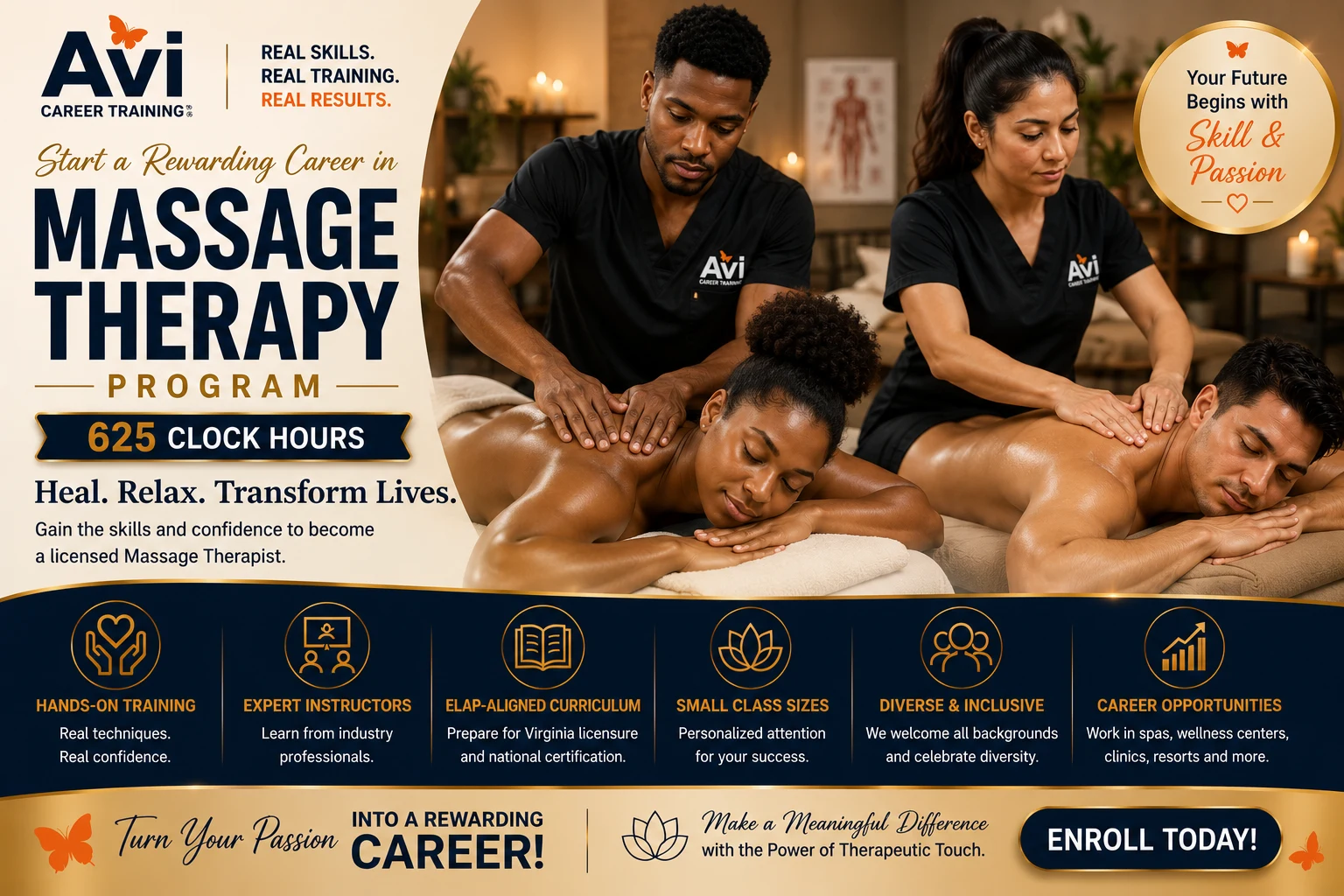
A Career Dedicated to Healing
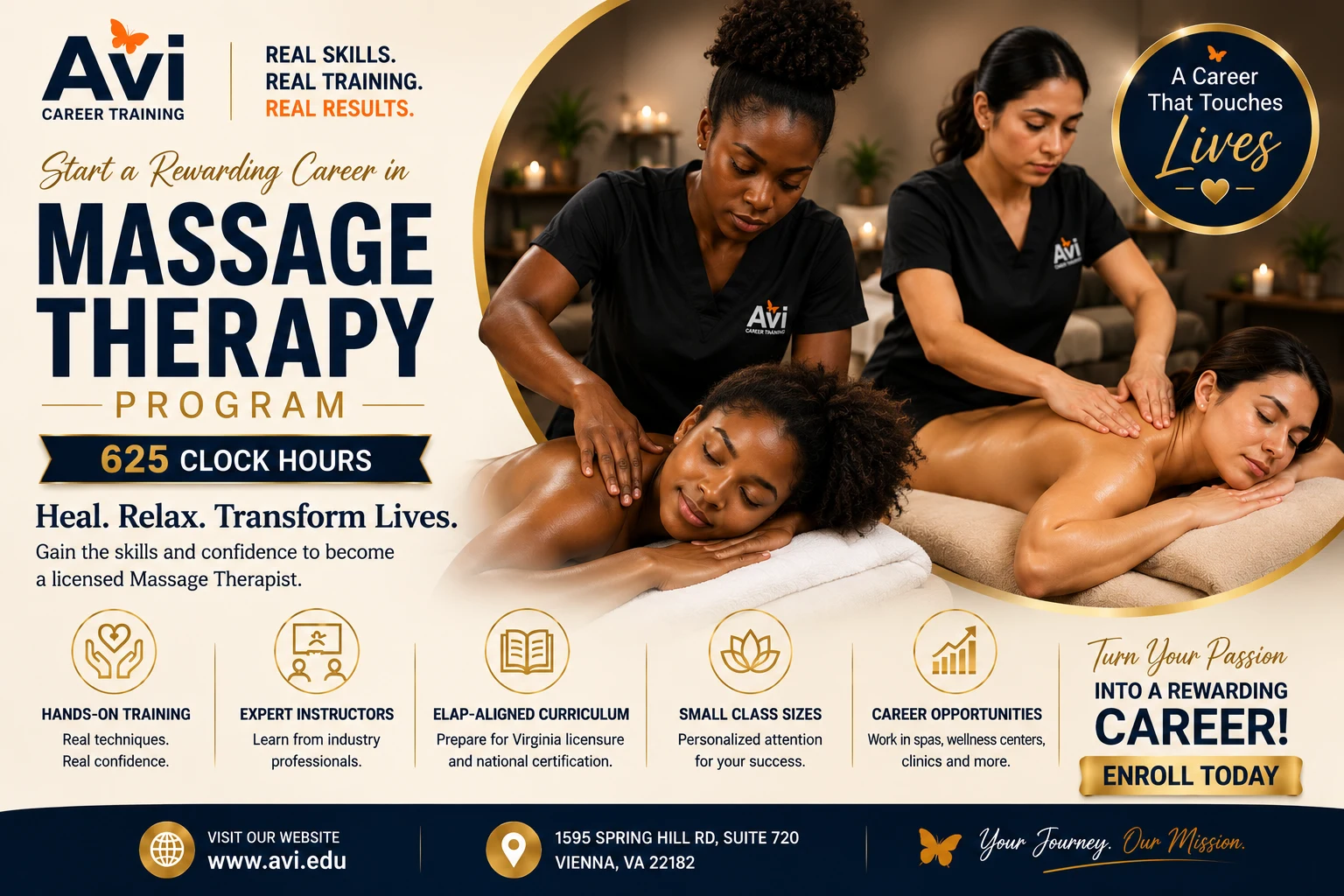
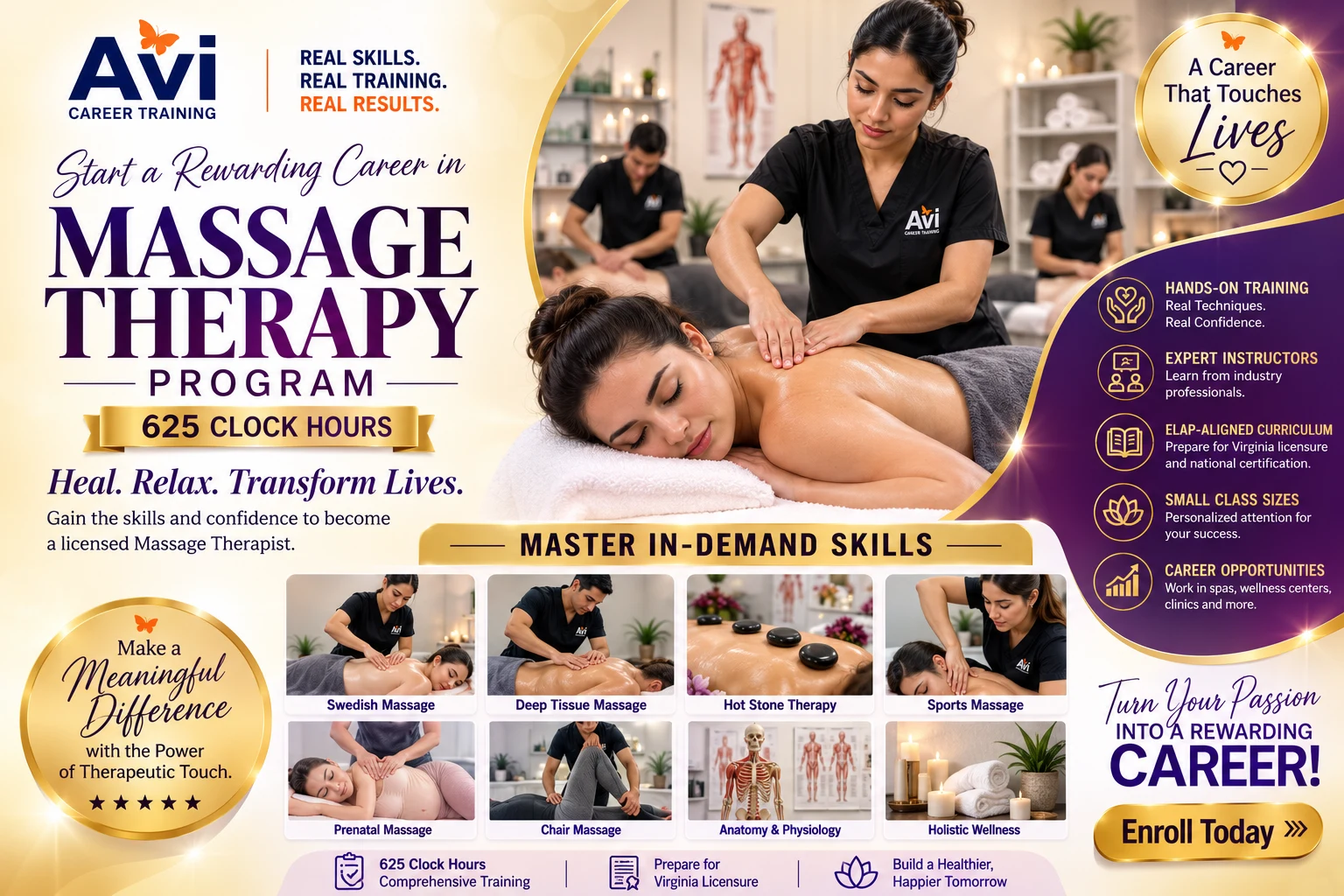
AVI's 625-clock-hour Massage Therapy program integrates massage theory and principles, anatomy and physiology, hands-on massage and bodywork techniques, professional practices, and business and career development. The curriculum is ELAP-aligned, and AVI is certified to operate by SCHEV.
Graduates meet or exceed the educational requirements to sit for a nationally recognized examination — the MBLEx (Federation of State Massage Therapy Boards) — and to apply for licensure through the Virginia Board of Nursing.
Financial Aid is available for eligible students through Federal Pell Grants, Direct Loans, Title IV, GI Bill, and WIOA workforce funding.
Massage Therapy Quick Answers
How to become a massage therapist in Virginia
Virginia's Board of Nursing licenses massage therapists. Under 18VAC90-50-40 you must be at least 18, complete a massage therapy program of at least 500 hours certified or approved by the State Council of Higher Education for Virginia (or an equivalent agency in another state), and pass the FSMTB licensing exam (MBLEx) or another exam the Board accepts. AVI's program is 625 clock hours.
How long is massage therapy school at AVI?
AVI's Massage Therapy program is 625 clock hours: 210 hours of theory and 415 hours of laboratory. It takes about 19 weeks plus a final evaluation week, with day, evening, and weekend schedules listed. At least 400 hours must be completed face-to-face on campus in Vienna, VA.
How much does massage therapy school cost?
AVI Career Training lists a total cost of $12,040 for the 625-hour Massage Therapy program. Financial aid may be available to eligible students, including Federal Pell Grants, Direct Loans, the GI Bill, and WIOA funding. See financial aid or apply to talk with admissions.
How much do massage therapists make?
The U.S. Bureau of Labor Statistics reports 2025 median pay of $58,450 per year ($28.10 per hour) for massage therapists nationwide, with employment projected to grow 15 percent from 2025 to 2035. Earnings vary by location, employer, hours, and clientele, and AVI does not guarantee income or employment.Source: BLS Occupational Outlook Handbook
Course Breakdown
9 courses · 210 theory hours · 415 laboratory hours · 625 total clock hours
| Course | Theory | Lab | Total |
|---|---|---|---|
| MT101 — Massage Theory & Principles History, modalities, physiological effects, indications, contraindications, therapist self-care |
17h | 10h | 27h |
| MT102 — Massage Professional Practices Ethics, scope of practice, HIPAA basics, Virginia laws & regulations, infection control |
10h | 10h | 20h |
| MT103 — The Therapeutic Relationship Client-centered communication, informed consent, cultural competency, trauma-informed practice |
20h | 20h | 40h |
| MT104 — Anatomy, Physiology & Pathology Body systems, major muscles, bones & joints, common pathologies, massage indications & contraindications |
50h | 30h | 80h |
| MT105 — Assessment & Documentation Health history & intake, postural assessment, range-of-motion screening, SOAP notes, treatment planning |
25h | 25h | 50h |
|
MT106 — Massage & Bodywork Application
● Face-to-Face Only Body mechanics; Swedish full-body routines; deep-tissue, sports, hydrotherapy, stone therapy & chair massage; supervised clinic |
0h | 175h | 175h |
|
MT107 — Palpation & Movement
● Face-to-Face Only Surface anatomy, palpation of major muscle groups, joint structure, active/passive/resisted movement |
0h | 71h | 71h |
| MT108 — Adapting Sessions for Clients Modifications for older adults, prenatal clients, athletes, and common clinical conditions within scope |
30h | 50h | 80h |
| MT109 — Career Development Career pathways, business planning, marketing, client retention, resume & interview skills, continuing education |
58h | 24h | 82h |
| TOTAL | 210h | 415h | 625h |
MT106 and MT107 are delivered face-to-face only on campus. Minimum 400 hours of the program must be completed in person.
Delivery & Schedule
- Minimum 400 hours delivered face-to-face on campus
- Up to 225 hours of eligible didactic content via approved distance education (SCHEV-reviewed LMS)
- Day, evening, or weekend schedules available
- Approximately 19 weeks to completion (plus final evaluation)
- MT106 and MT107 are exclusively face-to-face — no remote option
Required Textbooks
Additional references: current massage-therapy research, AMTA/ABMP publications, and Virginia massage laws & regulations.
Grading Scale
| Grade | Percentage | Standing |
|---|---|---|
| A | 90% – 100% | Excellent |
| B | 80% – 89% | Good |
| C | 70% – 79% | Satisfactory |
| F | Below 70% | Unsatisfactory |
Minimum "C" average (70%) is required to graduate. Successful completion of all required practical evaluations and all 625 clock hours are required.
Grade Weight Distribution
Flexible Learning Options
Program is approximately 19 weeks plus a final evaluation week. Contact admissions for current start dates and class schedules.
Funding Options Available
- Title IV Federal Student Aid
- Federal Pell Grants (need-based, no repayment)
- Federal Direct Loans (subsidized & unsubsidized)
- GI Bill® for veterans and military families
- Virginia Career Works / WIOA
Virginia Massage Therapy License
Massage therapy in Virginia is regulated by the Virginia Board of Nursing. Graduates of AVI's 625-hour program are prepared to sit for the MBLEx (Massage & Bodywork Licensing Examination) administered by the Federation of State Massage Therapy Boards (FSMTB), the most widely accepted state licensure exam.
- Complete 625-hour AVI program
- Pass the MBLEx (or another accepted exam)
- Apply to the Virginia Board of Nursing for licensure
- Meet all state continuing-education requirements to renew
Career Opportunities
Where your Virginia massage therapy license can take you
Frequently asked questions
Massage Therapy Program Frequently Asked Questions
Sources: Virginia Administrative Code 18VAC90-50-40 (Virginia Board of Nursing, massage therapy licensure); U.S. Bureau of Labor Statistics, Occupational Outlook Handbook: Massage Therapists (2025 data); AVI Career Training published catalog data. Wages are national figures, not a promise of earnings, and requirements can change, so confirm current rules with the Virginia Board of Nursing.