Laser technician training in Virginia prepares you for one of the fastest-growing specialties in the beauty and wellness industry — and the Northern Virginia and DC metro area is one of the strongest regional markets for this career in the country. Here’s exactly what you need to know: the state’s regulatory framework, what good training looks like, what you report earning, and how AVI Career Training’s Cosmetic Laser Technology program prepares you to work in a clinical setting from day one.
Apply to AVI’s Cosmetic Laser Technology program and build the credential that Virginia employers recognize.
—
Key Takeaways
- Virginia does not issue a standalone laser technician license — trained technicians work under the delegation of a licensed physician, nurse practitioner, or physician assistant, as regulated by the Virginia Board of Medicine
- Entry-level laser technicians in the DC metro area earn approximately $40,000–$52,000 per year; experienced technicians in medical spas can earn $55,000–$75,000+ depending on commission structure
- The global medical spa industry is projected to reach $47.1 billion by 2030 — Northern Virginia’s concentration of medical spas and dermatology clinics makes it an exceptionally strong local market
- AVI Career Training’s Cosmetic Laser Technology program covers multiple laser modalities and explicitly trains students on all Fitzpatrick Skin Types I–VI
- AVI is COE Accredited and SCHEV Certified, with financial aid and GI Bill® benefits available
—
What Does a Laser Technician Do?
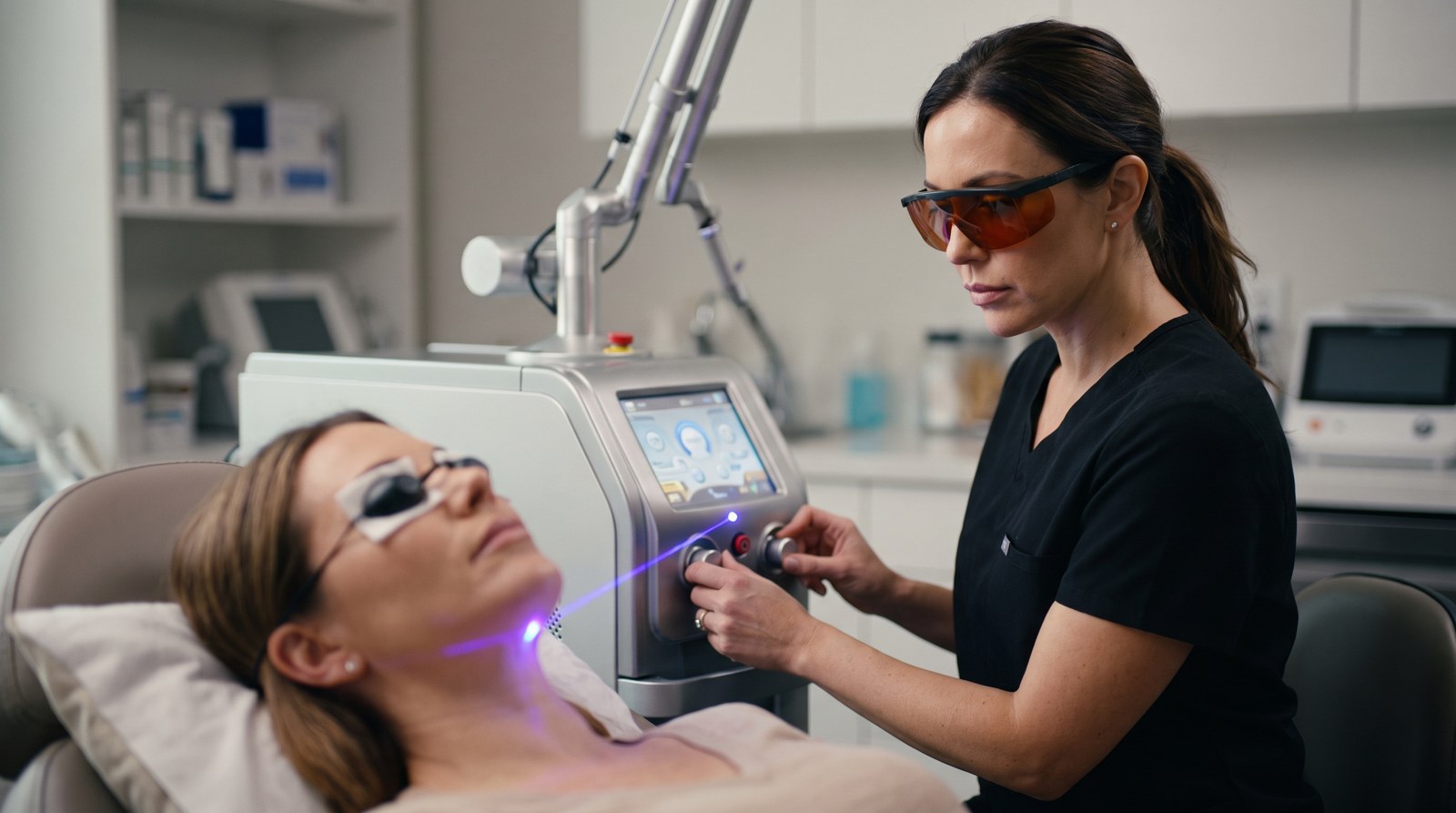
A laser technician — sometimes called a laser esthetician or cosmetic laser specialist — performs light-based and energy-based skin treatments in medical spas, dermatology clinics, plastic surgery offices, and aesthetic centers. This is a specialized clinical role that goes well beyond general esthetics.
Core Treatments and Services
Laser technicians typically perform a focused range of treatments that require both technical precision and a strong understanding of skin science:
- Laser hair removal — the more established service, using targeted laser energy to reduce unwanted hair across a wide range of skin tones and body areas
- Photofacials and IPL treatments — Intense Pulsed Light therapy used to address sun damage, hyperpigmentation, redness, and uneven skin tone
- Skin rejuvenation and resurfacing — non-ablative and fractional laser treatments that stimulate collagen production and improve skin texture
- Vascular and pigmented lesion treatments — targeting specific skin concerns with wavelength-specific laser energy
How It Differs From General Esthetics
A licensed esthetician uses chemical, mechanical, and topical treatments. A laser technician uses regulated energy-based devices — lasers, IPL systems, and radiofrequency tools — that interact with skin at a deeper level. That difference matters clinically and legally in Virginia. The tools are more powerful, the safety protocols are more demanding, and the credential pathway is distinct.
If you’re coming from an esthetics background, laser training is a high-value specialty that can significantly expand your scope of practice and your earning potential. If you’re entering the field fresh, it’s a direct path into a clinical career without requiring a four-year degree.
—
Virginia Laser Technician Licensing Requirements
This is where most guides fail you — they either skip state-specific regulations entirely or get them wrong. Here’s how Virginia’s framework actually works.
The Virginia Board of Medicine Oversees Laser Treatments
In Virginia, laser and light-based cosmetic treatments are classified as medical procedures and fall under the authority of the Virginia Board of Medicine, not the Board of Cosmetology or Board of Barbers and Cosmetologists. This distinction has direct implications for how you get credentialed and where you can work.
There Is No Standalone Laser Technician License in Virginia
This is the most important thing to understand — and the biggest point of confusion in search results. Virginia does not issue a standalone “laser technician license.” You will not sit for a state laser technician exam the way you would for a cosmetology or esthetics license.
Instead, the credentialing model works like this:
1. You complete a recognized laser technician training program — this is where your clinical knowledge and hands-on skills are built
2. A licensed physician, nurse practitioner, or physician assistant formally delegates the authority for you to perform laser treatments under their supervision or oversight
3. You work within that supervised clinical structure — typically in a medical spa, dermatology clinic, or plastic surgery practice where a licensed medical professional is part of the team
Your training certification, combined with that physician delegation, is the operative credential that allows you to practice in Virginia. Choosing a rigorous, accredited training program is therefore not just about learning the skills — it directly affects your employability and your ability to secure that critical physician delegation.
> Always verify current requirements directly with the Virginia Department of Health Professions at the time you enroll. Regulatory frameworks can update, and you want the most current guidance.
Why Your Training Program Matters More in Virginia
Because Virginia’s framework relies on physician delegation rather than a state licensing exam, employers and supervising physicians are evaluating your training credentials carefully. A rigorous, accredited program signals that you’ve received the clinical hours, equipment experience, and safety training necessary to work responsibly with laser devices. Thin or unrecognized training creates barriers to employment. Comprehensive, accredited training opens doors.
—
What to Look for in a Laser Technician Training Program
Not all cosmetic laser technology programs are built the same. Here are the criteria serious students should evaluate — and the questions to ask before enrolling anywhere.
Hands-On Clinical Hours
Reading about laser physics is not the same as performing treatments. The best programs give you substantial time behind the device — on real clients, with real clinical feedback. Ask any school you’re considering: how many hands-on hours are included? What percentage of the program is clinical vs. classroom?
Equipment Variety
The medical spa industry uses a wide range of devices. The more equipment types you train on, the more versatile and hireable you are. Look for programs that include multiple laser and light modalities:
- Nd:YAG lasers — effective on darker skin tones and deeper targets
- Diode lasers — widely used for laser hair removal across skin types
- IPL (Intense Pulsed Light) — essential for photofacials and pigmentation treatments
- Radiofrequency (RF) — increasingly standard in med spa service menus for skin tightening
Training Across All Skin Tones — The Fitzpatrick Scale
This is non-negotiable, and it’s where many programs fall short. The Fitzpatrick Scale classifies skin types from Type I (very fair, burns easily) through Type VI (deeply pigmented). Laser parameters — wavelength, pulse duration, fluence — must be adjusted based on skin type. Undertrained technicians working on skin tones they’re not prepared for create real safety risks.
AVI Career Training explicitly trains students across all Fitzpatrick Skin Types I–VI. This is both a clinical safety commitment and a practical career advantage — you’ll be prepared to serve the full diversity of clients you’ll actually encounter in Northern Virginia’s multicultural market.
Accreditation and Instructor Credentials
COE accreditation (Council on Occupational Education) is a recognized standard for career and technical schools. SCHEV certification confirms the school meets Virginia’s standards. These credentials matter for financial aid eligibility and signal that the program has been independently evaluated for quality.
Instructor credentials matter just as much. Are your instructors licensed professionals with real clinical experience in laser and light-based treatments? At AVI, you learn from industry professionals — not just educators.
Career Placement Support
Does the school help you connect with employers after graduation? In Virginia’s physician-delegation model, your first position is critically important — it establishes your supervised practice environment. Schools with strong industry networks make that transition significantly easier.
—
Laser Technician Career Outlook & Salary in Virginia
What Laser Technicians Earn in Northern Virginia
The DC metro area is one of the highest-paying markets for laser technicians in the country. Here’s a realistic picture of earning ranges:
- Entry-level laser technician: approximately $40,000–$52,000 per year in the Northern Virginia / DC metro market
- Experienced laser technician in a medical spa: $55,000–$75,000+, depending on base pay plus commission structure
- Top performers at high-volume med spas, particularly those cross-trained in multiple modalities, can exceed these ranges significantly
Source: BLS Skincare Specialists data (SOC 39-5094) and regional data from Indeed and ZipRecruiter. Figures reflect market conditions at time of writing — verify current ranges at BLS.gov and current local listings. Earnings are not guaranteed.
Where Laser Technicians Work
The Northern Virginia and DC metro area has a high concentration of exactly the employers who hire laser technicians:
- Medical spas — the primary employer, offering full treatment menus that center on laser services
- Dermatology clinics — where laser treatments are integrated into medical-grade skincare protocols
- Plastic surgery practices — offering pre- and post-surgical skin treatments alongside cosmetic procedures
- Aesthetic centers — boutique practices specializing in non-surgical rejuvenation
Northern Virginia’s affluent, health-conscious population and high concentration of these facility types make it one of the strongest regional markets for laser careers on the East Coast.
Industry Growth You Can Count On
The global medical spa industry is projected to reach $47.1 billion by 2030. Demand for non-surgical cosmetic treatments — laser hair removal, skin rejuvenation, body contouring — continues to grow as procedures become more accessible and more socially normalized across demographics. This is not a shrinking field. It’s one of the most resilient growth sectors in healthcare-adjacent wellness.
Career Growth Paths
A laser technician role is not a ceiling — it’s a starting point. From your first position, common advancement paths include:
- Lead Technician — mentoring newer staff and managing device protocols at a clinic or med spa
- Clinic / Practice Manager — overseeing operations, scheduling, and team development
- Trainer or Educator — teaching laser techniques within a brand, device manufacturer, or school setting
- Practice Owner — with the right business background, launching your own aesthetic practice
—
AVI’s Cosmetic Laser Technology Program — What’s Included
Built for the Virginia Market
AVI Career Training’s Cosmetic Laser Technology program is specifically designed to prepare students for the realities of working in Virginia’s physician-supervised laser landscape. The curriculum covers the science, safety protocols, and hands-on technique you need to walk into a medical spa or clinical setting and perform confidently from your first day on the floor.
Meet Marcus: A Career-Changer Who Found His Direction
Marcus spent eight years in IT before he started paying attention to how many of his coworkers were talking about their med spa appointments. He’d always been interested in health and wellness, but he didn’t want to go back to school for four years. When he researched laser technician training in Virginia and found AVI, he was struck by how practical the program was — real equipment, real clinical hours, real skin tones. Six months after graduating, Marcus was working at a high-volume medical spa in Tysons, handling a full schedule of laser hair removal and IPL clients, earning more than he’d expected in his first year and training toward a lead technician role.
What the Program Covers
AVI’s Cosmetic Laser Technology program includes:
- Laser physics and light science — understanding how different wavelengths interact with tissue, melanin, and water at the cellular level
- Device training — hands-on work with multiple laser and light platforms including IPL, diode, and Nd:YAG systems (confirm current equipment list with AVI admissions)
- Safety protocols — eye safety, skin cooling, parameter selection, contraindication screening, and adverse event management
- Fitzpatrick Skin Type training (I–VI) — learning to assess, adjust, and perform safely across all skin tones
- Client consultation and documentation — intake forms, informed consent, treatment planning, and progress tracking
- Business and professional practice — how to operate professionally within a physician-supervised clinical environment
The Inclusive Training Difference
AVI’s commitment to training students on all Fitzpatrick skin types is not just a curriculum checkbox — it’s a core value and a market advantage. Northern Virginia is one of the most diverse regions in the country. The clients walking into local med spas reflect that diversity. Technicians who are trained and confident working on every skin tone are more employable, more effective, and provide better care. That’s what AVI prepares you to do.
Meet Priya: From Esthetic Foundations to Laser Specialist
Priya completed her esthetics training and worked at a spa for two years before realizing she wanted to move into a clinical setting with more earning potential and career growth. She enrolled in AVI’s Cosmetic Laser Technology program while continuing to work part-time. The hands-on hours gave her real confidence with devices she’d never touched before, and the inclusive skin tone training was especially meaningful — her own clients had always been diverse, and she wanted to serve them safely at a higher level. After completing the program, she secured a position at a dermatology practice in McLean where she now handles a full laser treatment schedule.
Financial Aid and GI Bill® Benefits
AVI Career Training offers financial aid for students who qualify, and the school accepts GI Bill® benefits for eligible veterans and service members. If cost has been a barrier to starting your training, connect with AVI admissions to explore your options.
How Long Does Laser Technician Training Take?
Program length varies by format and curriculum depth. Contact AVI admissions directly for current clock hours and scheduling options — and ask about part-time formats if you’re balancing work or family commitments while you train.
—
Frequently Asked Questions
How do I become a laser technician in Virginia?
Complete an accredited Cosmetic Laser Technology training program, then secure a position at a medical spa, dermatology clinic, or aesthetic practice where a licensed physician, nurse practitioner, or physician assistant can provide the required supervisory delegation under the Virginia Board of Medicine’s framework.
Does Virginia require a license to perform laser hair removal?
Virginia does not issue a standalone laser technician license. Laser and light-based treatments are classified as medical procedures regulated by the Virginia Board of Medicine. Trained technicians must operate under the delegation of a licensed physician, NP, or PA. Always verify current requirements with the Virginia Department of Health Professions.
How long does laser technician training take?
Program lengths vary by school and format. Contact AVI admissions at (703) 943-9841 for current program length and scheduling options.
How much do laser technicians make in Virginia?
Entry-level laser technicians in the Northern Virginia / DC metro area typically earn $40,000–$52,000 per year. Experienced technicians in medical spas can earn $55,000–$75,000+ depending on base pay and commission structure.
What is the difference between a laser technician and an esthetician?
An esthetician performs topical, chemical, and mechanical skin treatments. A laser technician uses energy-based devices — lasers, IPL systems, radiofrequency tools — that work at a deeper tissue level and are classified as medical procedures in Virginia. The roles require different training and operate under different regulatory frameworks.
—
Your Next Step Starts Here
The laser technician field in Northern Virginia is growing, the pay is competitive, and the career path is clear — but it starts with the right training program. AVI Career Training’s Cosmetic Laser Technology program gives you the hands-on hours, equipment experience, skin tone training, and professional foundation to step confidently into a clinical role.
Apply now and take the first step toward your laser technician career in Virginia. Or call us at (703) 943-9841 to speak with admissions directly.
AVI Career Training | 1595 Spring Hill Rd #720, Vienna, VA 22182 | COE Accredited · SCHEV Certified · Financial Aid Available · GI Bill® Accepted