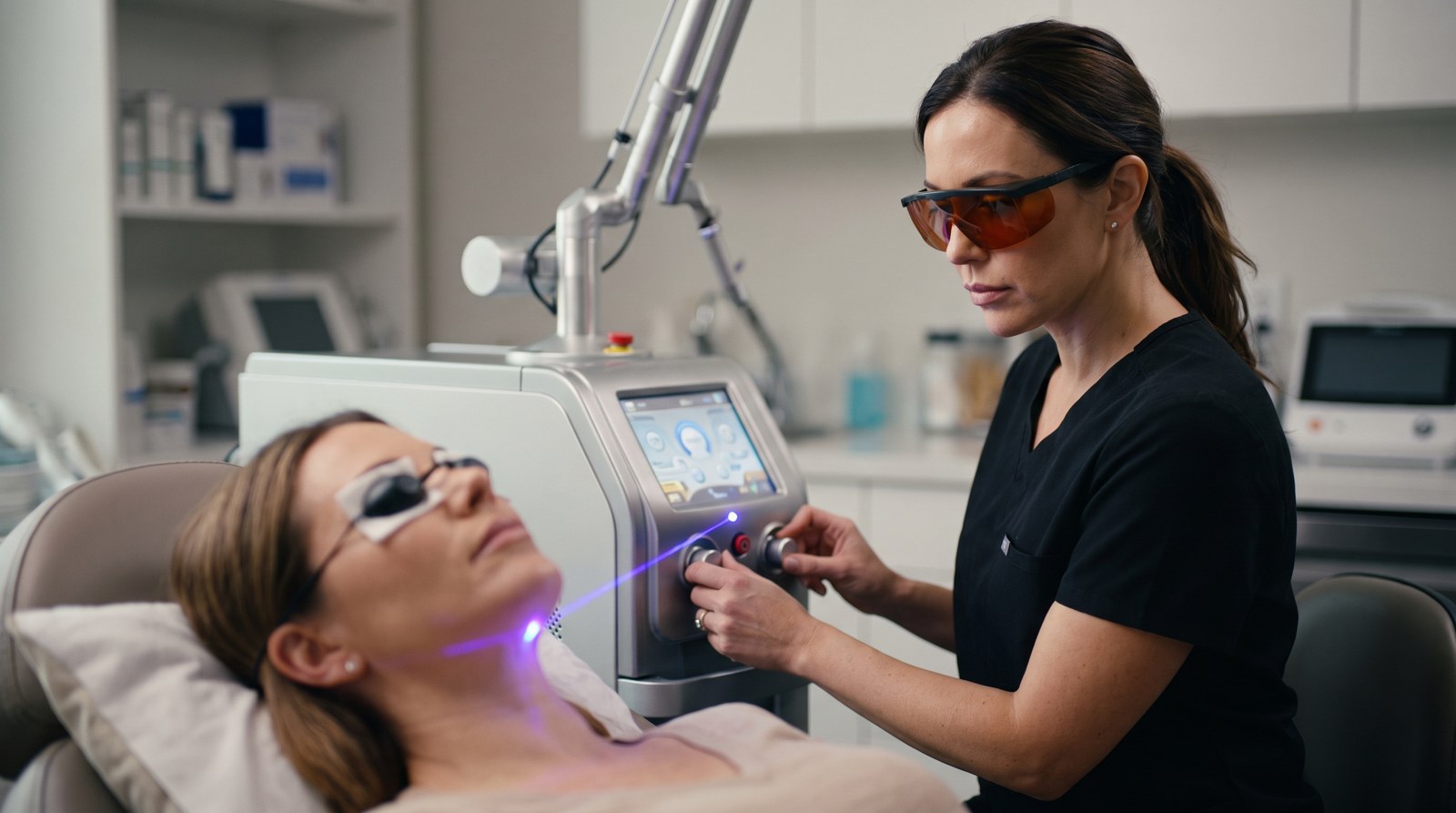
How to Become a Laser Technician in Virginia
Becoming a laser technician in Virginia requires completing an esthetician license first — 600 clock hours of approved training — and then adding specialized cosmetic laser certification through an accredited program like AVI Career Training’s Cosmetic Laser Technology program in Vienna, VA.
That’s the short answer. But if you’re seriously considering this career path, you need the full picture: exactly what Virginia requires, what training covers, what you’ll earn in the Northern Virginia market, and how to choose a program that prepares you for the real work — not just the exam.
This guide covers all of it.
—
> ### Key Takeaways
> – Virginia requires an active esthetician license before you can legally perform cosmetic laser procedures
> – Esthetician licensure requires 600 clock hours of approved training, overseen by DPOR
> – Laser procedures in Virginia must be performed under physician supervision or established medical protocols
> – Skincare specialists are projected to see ~17% job growth through 2032 — much faster than average
> – Experienced laser technicians in Northern Virginia med spas can earn $70,000–$80,000+ with commission structures
> – AVI Career Training is COE-accredited and SCHEV-certified, with GI Bill® eligibility and financial aid available
—
What Does a Laser Technician Actually Do?
Laser technicians use controlled light-based energy to treat a range of cosmetic concerns — and the scope of work is broader than most people expect.
The most common service is laser hair removal, which permanently reduces unwanted hair through selective photothermolysis — targeting melanin in the hair follicle without damaging surrounding skin. But that’s just one service in a growing treatment menu that also includes:
This is a clinical-adjacent, hands-on role. Every client is different — different skin tone, different treatment history, different goals. A skilled laser technician reads the skin, selects the right device and parameters, and adjusts in real time to deliver safe, effective results.
That’s why a weekend certification course isn’t enough. This work requires formal, structured training — and in Virginia, it requires licensure.
—
Virginia Licensing Requirements for Laser Technicians
Virginia’s rules around cosmetic laser procedures are more specific than many states — and misunderstanding them can cost you a job opportunity or, worse, put clients at risk.
Here’s what you need to know.
You Need an Esthetician License First
In Virginia, performing cosmetic laser procedures requires an active esthetician license issued by the Virginia Department of Professional and Occupational Regulation (DPOR). There is no standalone “laser technician license” in Virginia — the esthetics license is the legal foundation.
To earn that license, you must complete a minimum of 600 clock hours of approved esthetics training at a DPOR-recognized school. After completing your hours, you sit for the Virginia State Board exams — written and practical — before you can work independently.
If you’re starting from zero with no prior esthetics background, your path looks like this:
1. Complete esthetics training (600 hours minimum)
2. Pass the Virginia State Board exams
3. Obtain your DPOR esthetician license
4. Complete a cosmetic laser certification program
5. Begin working under medical supervision
If you already hold a Virginia esthetician license, you can move directly into laser training — which is where a program like AVI’s Cosmetic Laser Technology program comes in.
Physician Supervision Is Required
Virginia requires that cosmetic laser procedures be performed under the supervision of — or pursuant to protocols established by — a licensed physician or other authorized medical professional. This is a critical detail for job placement.
Most laser technician positions in Virginia are based in medical spas, dermatology clinics, or plastic surgery offices — settings where physician oversight is built into the operating structure. When you’re job hunting, you’re not just looking for a spa that uses lasers. You’re looking for a medically compliant workplace. Employers in this space expect candidates who understand that distinction.
Ready to start your path toward cosmetic laser certification? Apply to AVI Career Training and speak with an admissions advisor about your next steps.
—
What You’ll Learn in a Cosmetic Laser Technology Program
A strong cosmetic laser technology program does more than teach you how to press a button on a device. It builds clinical judgment — the ability to assess a client, select the right treatment approach, and deliver results safely across a diverse range of skin tones and concerns.
Here’s what a quality curriculum covers:
Laser Physics and Device Technology
You’ll learn how laser energy works at the tissue level — wavelength, pulse duration, fluence, and spot size. Understanding the physics behind the technology isn’t academic trivia. It’s what allows you to troubleshoot a suboptimal result, select the right device for a client’s skin type, and explain what’s happening during treatment in terms clients can understand.
Different devices treat different concerns. IPL, Nd:YAG, alexandrite, diode, CO₂, and Er:YAG lasers all have distinct applications and safety profiles. A well-trained laser technician knows which tool to reach for — and why.
Fitzpatrick Skin Type Classification
The Fitzpatrick scale is the clinical framework laser technicians use to assess how a client’s skin responds to light-based energy. Skin types I through VI range from very light (high burn risk, low tan risk) to very dark (lower burn risk, higher post-inflammatory hyperpigmentation risk).
Getting this assessment right is foundational to safe treatment. The wrong parameters on the wrong skin type can cause burns, blistering, or permanent pigmentation changes.
AVI’s curriculum is built to train students on all skin tones — not just a narrow range. This matters practically and ethically. Northern Virginia is one of the most racially and ethnically diverse regions in the country. The clients walking through the door of a NoVA med spa reflect that diversity. A laser technician who can only treat lighter skin types is limited in ways that directly affect employment and earning potential.
Laser Safety Protocols
You’ll train to ANSI Z136.3 standards — the industry benchmark for safe use of lasers in healthcare settings. This includes:
Many employers require documented laser safety training as a condition of employment. This certification signals to medical directors and practice managers that you’re a safe, accountable operator.
Contraindications and Client Assessment
Not every client is a candidate for every laser treatment. You’ll learn to screen for contraindications — active skin infections, recent sun exposure, certain medications (like isotretinoin or photosensitizing drugs), pregnancy, and more. A strong contraindication screening process protects your clients and protects your license.
Treatment Parameters and Clinical Practice
Hands-on clinical practice is where everything comes together. You’ll work with real equipment, practice client consultations, perform supervised treatments, and learn to document sessions accurately. This clinical component is what separates a graduate who can work on day one from someone who needs months of on-the-job remediation.
—
Career Outlook — Where Laser Technicians Work and What They Earn
The laser aesthetics market is growing fast — and Northern Virginia is one of the strongest regional markets in the country for this career.
Job Settings
Laser technicians in the NoVA/DC metro area work in a range of settings:
What Laser Technicians Earn in Virginia
According to the Bureau of Labor Statistics (BLS) Occupational Outlook Handbook, the national median salary for skincare specialists — the BLS category that includes laser technicians — is approximately $38,000–$60,000 per year, depending on experience, location, and specialty.
Northern Virginia and the DC metro area consistently trend 10–20% above national medians due to regional cost of living, concentration of high-end practices, and client demand for premium services.
Experienced laser technicians working in premium NoVA or DC med spas — particularly those with strong client retention and a broad treatment menu — can earn $70,000–$80,000 or more annually when commission and performance bonuses are factored in.
Note: All salary figures should be verified with your employer during the hiring process. Earnings vary based on experience, employment structure, and individual performance.
Industry Growth
The BLS projects approximately 17% growth for skincare specialists through 2032 — a rate the BLS classifies as “much faster than average.” The global laser aesthetic devices market is expanding rapidly, and demand for trained, licensed operators is outpacing supply in most major metro markets. For career-seekers entering laser aesthetics now, the timing is favorable.
—
What’s the Difference Between a Laser Technician and an Esthetician?
This is one of the most common questions from people researching the field — and the answer matters for how you plan your training path.
An esthetician is a licensed skincare professional who provides services like facials, chemical peels, waxing, microdermabrasion, and body treatments. In Virginia, esthetician licensure requires 600 clock hours of training and passing the Virginia State Board exams.
A laser technician uses light-based energy devices — lasers, IPL systems — to treat cosmetic concerns like unwanted hair, pigmentation, and skin texture. In Virginia, laser technicians must hold an esthetician license as a prerequisite. So a laser technician is an esthetician who has added specialized laser training.
In practice, many laser technicians working in med spas perform both esthetic services and laser treatments — which makes them significantly more valuable to an employer. A technician who can deliver a facial, perform a chemical peel, and operate a laser platform generates more revenue per chair than a single-specialty technician.
This is one reason the combined esthetics + laser training pathway at AVI Career Training makes practical career sense: you’re not choosing between two careers. You’re building a broader, more marketable skill set.
—
A Note on “Do You Need an Esthetics License to Do Laser Hair Removal in Virginia?”
Yes — unambiguously. Virginia requires an active esthetician license from DPOR before a practitioner can legally perform cosmetic laser procedures, including laser hair removal. The esthetics license isn’t optional or waivable based on other credentials.
This is a point of genuine confusion online. Some sources describe a path where a “laser certification” alone is sufficient — that’s not accurate for Virginia. If a school or training provider is offering a laser-only credential and suggesting it satisfies Virginia’s requirements without the esthetics license foundation, proceed with caution and verify directly with DPOR before enrolling.
—
Why Train at AVI Career Training in Vienna, VA
If you’re pursuing laser technician training in Northern Virginia, your choice of school directly affects the quality of your clinical preparation, your credential, and your job prospects.
Here’s what sets AVI Career Training apart.
Accreditation That Employers Recognize
AVI Career Training is COE-accredited (Council on Occupational Education) and SCHEV-certified (State Council of Higher Education for Virginia). These aren’t decorative credentials — they’re the recognized marks of institutional quality that federal financial aid programs, employers, and licensing boards look for.
COE accreditation in particular signals that AVI meets rigorous standards for curriculum, faculty qualifications, student outcomes, and administrative integrity. When you graduate from an accredited school, employers take your credential seriously.
Financial Aid and GI Bill® Eligibility
Investing in career training should be a financially sound decision. AVI offers access to financial aid for eligible students — including federal Pell Grants and other aid programs. AVI also accepts the GI Bill®, making this an accessible path for veterans and active-duty service members in the Northern Virginia military community.
If you’re unsure what financial support you qualify for, AVI’s admissions team can walk you through your options. Start by submitting an application and requesting a financial aid consultation.
Hands-On Clinical Training
AVI’s approach to training is hands-on from the start. Classroom instruction builds your foundational knowledge; supervised clinical practice builds your real-world competency. By the time you graduate, you’ve worked with actual equipment on actual clients — not just watched videos or practiced on mannequins.
That clinical experience is what allows AVI graduates to walk into a med spa job and contribute from day one.
Inclusive Curriculum Built for Every Client
AVI’s curriculum is designed to train students to work on every skin tone — not just the lighter end of the Fitzpatrick scale. This is a meaningful differentiator in a region as diverse as Northern Virginia.
Laser treatments carry different risks and require different parameters across Fitzpatrick Types I–VI. A school that only trains on a narrow range of skin tones is producing graduates with a significant blind spot. AVI’s inclusive training approach means you graduate ready to serve the full diversity of the Northern Virginia and DC metro client base.
Location in the Heart of the NoVA Market
AVI is located at 1595 Spring Hill Rd #720, Vienna, VA 22182 — minutes from Tysons Corner, one of the highest-concentration areas for med spas, dermatology practices, and cosmetic clinics in the region. Your training puts you in close proximity to the employers who will hire you.
—
Meet Two Students on the Laser Path
Danielle came to AVI already holding her Virginia esthetician license. She’d been working at a spa for two years doing facials and waxing, but her clients kept asking about laser hair removal — a service her spa didn’t offer. She enrolled in AVI’s Cosmetic Laser Technology program to add laser to her credential stack. Within three months of completing her training, she had accepted a position at a med spa in McLean offering laser hair removal and IPL photofacials at a salary significantly higher than her previous role.
Marcus was transitioning out of the military after eight years of service. He knew he wanted a healthcare-adjacent career with strong income potential and room to grow — but not a four-year degree path. A career advisor pointed him toward laser esthetics. Marcus started with AVI’s Basic Esthetics program using his GI Bill® benefits, then moved into the Cosmetic Laser Technology program. He’s now in clinical training, with a clear line of sight to licensure and a job target in one of the Arlington-area dermatology practices where several AVI graduates already work.
—
Take the Next Step Toward Laser Technician Training in Virginia
A career in cosmetic laser technology is specific, hands-on, and well-compensated — particularly in the Northern Virginia and DC metro market. The path is clear: earn your esthetics license, complete your laser training at an accredited school, and enter a field that’s growing faster than almost any other in personal care.
AVI Career Training in Vienna, VA gives you everything you need to get there: COE accreditation, inclusive clinical training, financial aid, GI Bill® eligibility, and a location in the center of one of the strongest med spa markets in the Mid-Atlantic.
Apply to AVI Career Training today and take the first step toward your laser technician career.
Have questions before you apply? Call AVI admissions directly at (703) 943-9841 — we’re happy to walk you through the program, the licensing path, and your financial aid options.
—
AVI Career Training | 1595 Spring Hill Rd #720, Vienna, VA 22182 | (703) 943-9841 | COE Accredited · SCHEV Certified