Laser Technician Training in Virginia: Your Career Guide
To become a laser technician in Virginia, you need a state-approved esthetics license, laser-specific training, and a program that prepares you to work under Virginia’s physician-delegation framework — starting with a DPOR-approved school like AVI Career Training.
The demand for cosmetic laser services is growing fast in Northern Virginia. Med spas, dermatology clinics, and upscale salons across the Tysons–DC corridor are actively hiring trained laser professionals. But the path to this career is more specific than most articles explain, especially when it comes to Virginia’s regulatory framework.
This guide breaks down exactly what Virginia requires, what to look for in a training program, what you report earning, and why AVI Career Training’s Cosmetic Laser Technology program is built to launch your career in this market.
Ready to get started? Apply now or keep reading to learn what the path looks like.
—
> ### Key Takeaways
> – Virginia does not issue a standalone “laser technician” license — laser and IPL procedures fall under esthetician or cosmetologist licensure, typically performed under physician delegation
> – Virginia’s esthetics license requires a minimum of 260 clock hours of training through a DPOR-approved school
> – Laser technicians in the Northern Virginia/DC metro market can earn $45,000–$65,000+, which varies by experience and location for skincare specialists
> – The medical aesthetics industry is projected to grow 12–15% through 2030, creating sustained demand for qualified laser professionals
> – AVI Career Training is COE Accredited and SCHEV Certified, with financial aid and GI Bill® eligibility available
—
What Does a Laser Technician Actually Do?
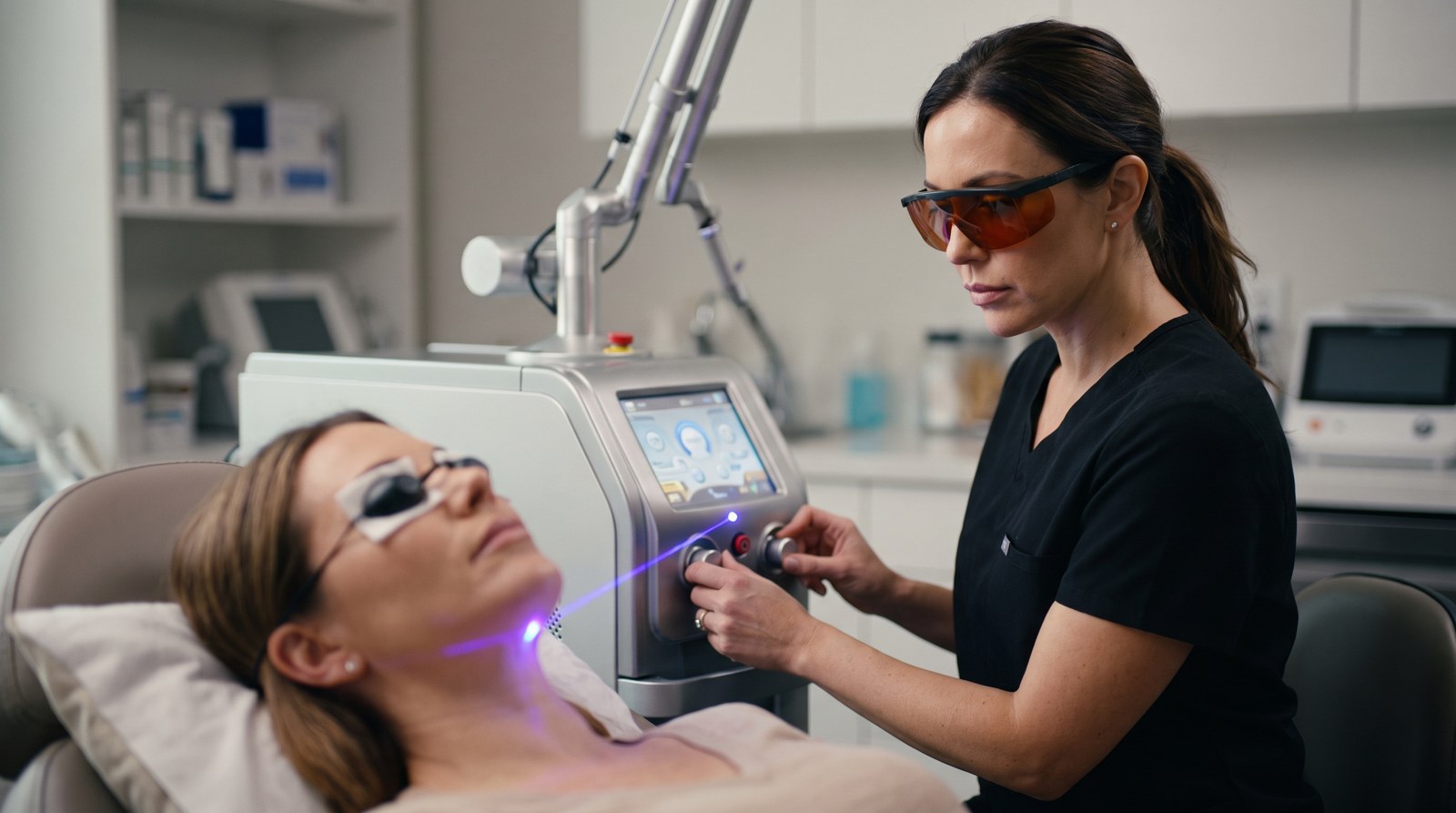
A laser technician performs non-surgical cosmetic procedures using laser and light-based technology. Day to day, that work looks like this:
The work is detail-oriented and client-facing. Every session requires a thorough consultation, a review of contraindications, proper skin-type assessment using the Fitzpatrick scale, and precise device calibration. You are not just pressing a button — you are making clinical decisions about energy settings, treatment intervals, and client safety.
How Is a Laser Technician Different from an Esthetician?
This is one of the most common questions from people entering the field. Here’s the practical answer:
An esthetician performs skin care treatments — facials, chemical peels, waxing, microdermabrasion, and similar services — using manual or low-energy tools. A laser technician uses medical-grade devices that deliver concentrated light energy to the skin, which carries higher risk and requires deeper training in skin science and safety protocols.
In Virginia, the two roles often overlap. Many laser technicians begin as licensed estheticians, then complete additional laser-specific training. Virginia’s regulatory structure essentially requires this path — which we explain in the next section.
—
Virginia Licensing Requirements for Laser Technicians
Virginia does not issue a separate “laser technician license.” That’s the single most important fact to understand before you start researching programs.
Under the Virginia Department of Professional and Occupational Regulation (DPOR), laser and IPL procedures are considered expanded-scope services. They must be performed by a licensed esthetician or cosmetologist operating under physician delegation or supervision — meaning a supervising physician has formally authorized the technician to perform specific procedures within a specific clinical setting.
What Virginia Actually Requires
To legally perform cosmetic laser services in Virginia, you generally need to:
1. Hold a Virginia esthetics or cosmetology license — issued through DPOR after completing a state-approved program and passing the applicable board exams
2. Complete laser-specific training — covering device operation, safety protocols, Fitzpatrick skin typing, contraindications, and OSHA laser safety standards
3. Work under physician delegation — most med spa and clinical laser positions in Virginia require this arrangement; your employer typically establishes the delegation agreement with a supervising physician
This means your first credential is a Virginia esthetics license. Virginia’s minimum training requirement is 260 clock hours for basic esthetics. From there, laser-specific training — like AVI’s Cosmetic Laser Technology program — builds the skills and credentials employers require.
Why Accredited Training Matters for Compliance
Not every school that advertises laser training is DPOR-approved or COE Accredited. Completing an unaccredited program can leave you unable to sit for the Virginia State Board exam, ineligible for federal financial aid, and at a disadvantage when employers verify your credentials.
AVI Career Training is both COE Accredited and SCHEV Certified, meaning the school and its programs meet the specific standards Virginia and federal regulators require. That matters from day one.
—
What to Look for in a Laser Technician Program
With the number of programs advertising laser training — from weekend workshops to online-only courses — knowing what actually qualifies you is critical.
Here are the elements a serious laser training program must include:
Hands-On Hours with Real Equipment
You cannot learn laser techniques without performing them. A credible program puts you behind professional-grade laser and IPL devices, working on real clients under instructor supervision. Look for programs that specify clock hours of hands-on clinical practice — not just classroom time.
Skin Science and the Fitzpatrick Scale
The Fitzpatrick skin typing system (Types I–VI) is the clinical foundation of safe laser practice. It classifies skin by its reaction to UV exposure, which directly guides device settings and treatment protocols. Every laser professional must be fluent in this system — and they must be trained to work confidently across all six skin types.
This is where many programs fall short. Training on a narrow range of skin tones creates technicians who are skilled with some clients and underprepared for others. In a diverse market like Northern Virginia, that is not acceptable. A strong program trains you on every Fitzpatrick type so you are ready for every client who walks through the door.
Safety and Contraindication Training
Laser devices carry real risk when misused. A quality program covers OSHA laser safety standards, proper eye protection, skin sensitivity assessments, and the contraindications that should stop a treatment — medications, skin conditions, recent sun exposure, and more.
Accreditation and Virginia State Board Eligibility
As noted above, COE accreditation and SCHEV certification are the markers that confirm a Virginia school meets state and federal standards. Before enrolling anywhere, verify these credentials directly on the DPOR website or the Council on Occupational Education website.
Financial Aid Eligibility
An accredited program can unlock federal financial aid — Pell Grants, student loans, and GI Bill® benefits for eligible veterans. A non-accredited “workshop” cannot. This difference can be worth thousands of dollars in funding.
—
Laser Technician Career Outlook and Salary in Northern Virginia
The medical aesthetics industry is one of the fastest-growing sectors in healthcare-adjacent services. Demand for non-surgical cosmetic procedures — including laser hair removal, skin resurfacing, and light-based rejuvenation — has grown steadily as treatments become more accessible and more trusted.
What the Numbers Show
The U.S. Bureau of Labor Statistics classifies laser technicians under skincare specialists (SOC 39-5094). The national median wage for this category is approximately $42,000–$48,000 annually. However, that national figure significantly understates what Northern Virginia professionals earn.
The DC metro market commands a 15–25% premium above the national median due to the region’s cost of market, concentration of high-end med spas, and consumer spending on aesthetics. In practice, laser technicians working in Northern Virginia med spas and dermatology clinics typically earn $45,000–$65,000+, depending on employer, commission structure, and specialization.
Northern Virginia has one of the highest concentrations of med spas per capita in the Mid-Atlantic region — and those businesses are competing for qualified, credentialed laser professionals. The medical aesthetics industry is projected to grow 12–15% through 2030 (IBISWorld), which means the hiring demand behind those salaries is only increasing.
Where Laser Technicians Work
Graduates entering this field in Northern Virginia have real options:
A Real Career Change Story
Consider someone like Marcus, a former military logistics specialist who used his GI Bill® benefits to enroll in AVI’s Cosmetic Laser Technology program after separating from service. He had no prior background in beauty or skincare — but he was detail-oriented, good with people, and drawn to a field where his precision skills translated directly. Within six months of completing his training and earning his Virginia esthetics license, Marcus was working at a med spa in Tysons Corner, earning a competitive base salary plus commission. The regulated, procedure-driven nature of laser work felt natural to him — and the career path he built was entirely funded by benefits he had already earned.
—
AVI’s Cosmetic Laser Technology Program — What Sets It Apart
AVI Career Training offers a Cosmetic Laser Technology program built specifically for the Northern Virginia market — structured around Virginia’s licensing requirements, staffed by licensed industry professionals, and designed to train students on every skin tone.
Virginia-Specific Curriculum
AVI’s program doesn’t treat Virginia as an afterthought. The curriculum is aligned with DPOR requirements and prepares students to work within Virginia’s physician-delegation framework from day one. You graduate understanding not just how to operate laser devices, but how to function professionally in the legal and clinical environment Virginia employers expect.
Inclusive Training Across All Skin Tones
AVI’s curriculum is built around the full Fitzpatrick scale — Types I through VI. You practice on diverse clients with diverse skin types, because that reflects the actual client base you will serve in Northern Virginia. This is not a surface-level commitment. It is baked into the program structure.
Many schools default to training on a narrow range of skin tones and expect students to figure out the rest on the job. AVI does not operate that way. Inclusive laser training is a non-negotiable part of what makes a graduate practice-ready.
Hands-On Training on Professional Equipment
Students at AVI train on professional-grade laser and IPL systems — the same category of devices they will use in clinical settings after graduation. Classroom instruction and hands-on clinical hours are both part of the program structure, ensuring you build real confidence before you ever see your first solo client.
COE Accreditation and SCHEV Certification
AVI is COE Accredited and SCHEV Certified. These credentials confirm the school meets rigorous standards for curriculum quality, instructor qualifications, facilities, and student outcomes. They also make AVI eligible to offer federal financial aid and accept GI Bill® benefits — a meaningful advantage for many students.
Financial Aid and GI Bill® Eligibility
AVI accepts the GI Bill® for eligible veterans and service members. Federal financial aid — including Pell Grants — is available to qualifying students. If cost has been a barrier to starting your training, these options are worth exploring directly with AVI’s admissions team.
Another Path Worth Knowing
Take someone like Priya, a licensed esthetician who had been doing facials and chemical peels at a salon in Fairfax for three years. She was good at her work, but she saw her clients spending money at med spas on laser services she wasn’t trained to offer — and she wanted in. She enrolled in AVI’s Cosmetic Laser Technology program while continuing to work part-time. The program fit her schedule, built directly on her existing esthetics knowledge, and within a few months she had the laser-specific credentials her employers were asking for. She transitioned to a med spa role in the Tysons area, where she now earns significantly more than she did doing facials alone.
Location Advantage
AVI is located at 1595 Spring Hill Rd #720, Vienna, VA 22182 — in the heart of the Northern Virginia corridor, minutes from Tysons Corner, McLean, and the broader DC metro area. The businesses that will hire you are your neighbors. The network you build during training is the network you will work within.
—
Take the Next Step
The laser aesthetics industry in Northern Virginia is growing — and the employers in this market are looking for trained, credentialed professionals who are ready to work on day one.
AVI Career Training’s Cosmetic Laser Technology program gives you Virginia-aligned training, inclusive curriculum, hands-on hours on professional equipment, and the COE accreditation that matters when you sit for your board exam and walk into your first job interview.
If you’re ready to start, apply now or call us directly at (703) 943-9841 to speak with an admissions team member about enrollment, financial aid, and program start dates.
Your career in cosmetic laser technology starts here.