Laser Technician Training in Northern Virginia
Laser technician training in Northern Virginia prepares you for one of the fastest-growing specialties in the medical aesthetics industry — and AVI Career Training in Vienna, VA gives you the hands-on, Virginia-specific education to launch that career the right way.
The DC metro area is home to hundreds of medical spas, dermatology clinics, and laser centers. Demand for skilled laser technicians is strong, compensation is well above national averages, and the career path is far more accessible than most people expect. But getting there requires the right training, the right credentials, and a clear understanding of Virginia’s regulatory landscape.
This guide covers everything you need to know: what laser technicians actually do day-to-day, how Virginia’s licensing framework works, what a quality program should teach, what you can expect to earn in Northern Virginia, and how to take the first concrete step toward enrollment.
Ready to move forward? Apply to AVI’s Cosmetic Laser Technology program today.
—
Key Takeaways
—
What Does a Laser Technician Actually Do?
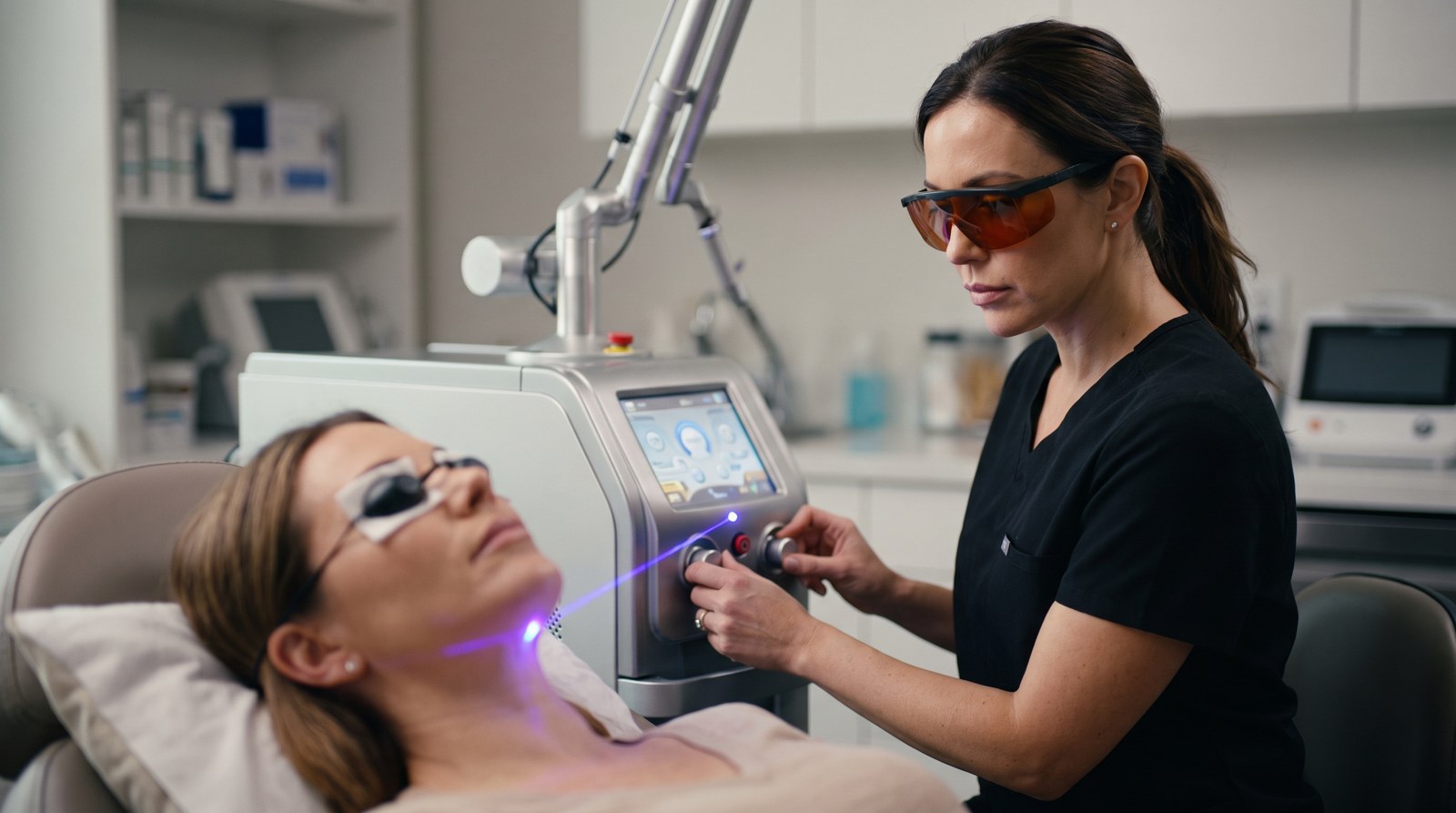
A laser technician performs cosmetic procedures using light-based technology to improve the appearance and health of skin. This isn’t a single-service role. Most laser technicians work across several treatment categories, depending on their training and the setting they work in.
Laser hair removal is typically the highest-volume service. Clients come in for a series of sessions to permanently reduce unwanted hair on the face, legs, underarms, and other areas. Treatments require precise calibration of laser energy based on the client’s skin tone, hair color, and hair texture — which is exactly why thorough training matters.
Skin rejuvenation and resurfacing treatments use fractional or ablative laser energy to reduce fine lines, acne scars, and uneven texture. These services are common in medical spa and dermatology settings and require more advanced clinical knowledge.
Pigmentation and sun damage treatments target hyperpigmentation, age spots, and melasma using technologies like IPL (Intense Pulsed Light) and Nd:YAG lasers. Results depend heavily on proper skin assessment and the technician’s ability to match the correct device and settings to the individual client.
Photofacials combine light-based energy to address redness, rosacea, and overall tone — popular in both standalone laser centers and full-service medical spas.
Beyond the procedures themselves, laser technicians are responsible for conducting thorough client consultations, reviewing medical histories and contraindications, documenting treatments, and educating clients on pre- and post-care protocols. Strong communication skills and clinical attention to detail are just as important as technical proficiency.
In Northern Virginia, laser technicians work in settings like Tysons Corner-area medical spas, Arlington and McLean dermatology practices, standalone laser centers, and high-end day spas that have expanded into light-based services. The variety of settings means you have real flexibility in where and how you build your career.
—
Virginia Licensing Requirements for Laser Technicians
This is where most online resources fall short — and where getting accurate, Virginia-specific information matters most.
Virginia does not issue a standalone “laser technician license.” Unlike some states that have a separate credentialing pathway for laser operators, Virginia regulates cosmetic laser procedures under the oversight of the Virginia Board of Medicine. That means laser procedures must occur under physician delegation or in a medically-directed setting.
In practical terms, this means laser technicians in Virginia typically work under a supervising physician, physician assistant, or advanced practice registered nurse (APRN) who holds ultimate responsibility for client safety and treatment protocols. The supervising provider establishes the scope of services the technician can perform and the conditions under which they can perform them.
The Role of Esthetics Licensure
While Virginia doesn’t require a dedicated laser license, esthetics licensure is widely required by employers and strongly recommended as a foundation. Virginia’s Department of Professional and Occupational Regulation (DPOR) oversees esthetics licensure, which currently requires 260 clock hours of approved training followed by passing the Virginia State Board exam.
An esthetics license demonstrates that you understand skin anatomy, contraindications, sanitation, and client care — the foundational knowledge that makes you a safer and more effective laser technician. Most reputable medical spas and laser centers in Northern Virginia expect prospective laser technicians to hold esthetics licensure or to be actively pursuing it alongside laser training.
AVI’s program is designed with this combined pathway in mind. Students who complete both the Esthetics program and the Cosmetic Laser Technology program graduate with a comprehensive credential set that meets employer expectations in this market.
What Compliance Looks Like in Practice
When you work as a laser technician in Virginia, your employer — typically a medical spa or dermatology practice — will have established protocols that align with the Board of Medicine’s delegation requirements. You’ll document treatments, follow written protocols from the supervising provider, and stay within the defined scope of services.
Understanding this regulatory structure before you train means you’ll enter the workforce ready to operate correctly from day one. For the most current regulatory guidance, reference the Virginia Department of Professional and Occupational Regulation (DPOR) directly.
—
What You’ll Learn in a Cosmetic Laser Technology Program
Quality laser technician training goes well beyond learning which button to press. A strong program builds clinical competence, safety judgment, and the hands-on confidence to work effectively with real clients.
AVI Career Training’s Cosmetic Laser Technology program covers these core areas:
Laser Physics and Technology Fundamentals
You’ll learn how laser energy works at the tissue level — wavelengths, pulse duration, fluence, and the principle of selective photothermolysis. Understanding the science behind the equipment makes you a significantly safer and more adaptable practitioner. When you know why a specific setting is appropriate, you can make better clinical decisions.
Skin Anatomy and Physiology
Laser procedures interact directly with the skin’s layers — the epidermis, dermis, and underlying structures. You’ll study how different skin conditions present, how melanin and hemoglobin absorb light energy, and how healing occurs after treatment. This knowledge underpins every treatment decision you’ll make.
Fitzpatrick Skin Typing and Inclusive Practice
This is one of AVI’s defining differentiators — and it matters both clinically and ethically.
The Fitzpatrick scale classifies skin tones from Type I (very fair) to Type VI (deeply pigmented). Laser energy interacts very differently with darker skin tones, and undertrained technicians cause real harm: burns, hyperpigmentation, scarring, and long-term damage. These injuries disproportionately affect clients with skin tones in the Fitzpatrick IV–VI range who have historically been underserved by the industry.
AVI’s curriculum explicitly trains students to work safely and effectively on all skin tones. You’ll learn how to select appropriate laser wavelengths and parameters for each Fitzpatrick type, how to spot contraindications, and how to customize treatment plans. This isn’t just a moral imperative — it’s a market advantage in Northern Virginia, where the client population is genuinely diverse.
Contraindications, Safety Protocols, and Risk Management
You’ll learn the full range of contraindications — medications, skin conditions, recent treatments, and medical histories — that affect client eligibility and treatment parameters. Proper protective equipment, eye safety, room protocols, and emergency procedures are covered in detail.
Hands-On Clinical Practice
Laser training cannot be completed in a classroom alone. AVI’s program includes supervised hands-on clinical hours where you practice techniques on real clients under the guidance of experienced instructors. This is how confidence is built — not from watching demonstrations, but from performing treatments with qualified oversight.
Learn more about AVI’s Cosmetic Laser Technology program and apply today.
—
Career Outlook and Earning Potential in the DC Metro Area
The DC-Arlington-Alexandria metropolitan area consistently ranks among the highest-paying markets for skincare and aesthetics professionals in the country. That’s not a marketing claim — it’s a reflection of the region’s concentration of high-income households, dense medical aesthetics infrastructure, and proximity to federal government and private sector employers who offer strong benefits packages to employees who value personal wellness services.
What Laser Technicians Earn in Northern Virginia
According to data from the Bureau of Labor Statistics, skincare specialists in the Washington-Arlington-Alexandria MSA earn median wages significantly above the national average. Laser technicians working in medical spa settings in Northern Virginia typically earn between $20 and $35 per hour, depending on experience, setting, and the range of services they’re certified to perform. Technicians who bring additional credentials — esthetics licensure, advanced device training, or specialization in skin of color treatments — are consistently at the higher end of that range.
Annual earnings for full-time laser technicians in this market commonly fall between $45,000 and $70,000+, with commission or tips on top of base wages in many medical spa environments. For current regional wage data, the Bureau of Labor Statistics Occupational Employment Statistics provides the most up-to-date figures for skincare specialists by MSA.
Where the Jobs Are in Northern Virginia
The Tysons Corner corridor — which puts AVI Career Training’s Vienna campus squarely in the middle of the action — has one of the highest concentrations of medical spas in the region. Arlington, McLean, Reston, Ashburn, and Alexandria all have established and growing aesthetics markets.
Settings where laser technicians work in this area include:
A Career Story Worth Considering
Imagine a career-changer in her mid-30s — a former healthcare administrator who’s always been drawn to aesthetics but assumed a career pivot would take years. She completes AVI’s Esthetics program, then moves directly into the Cosmetic Laser Technology program. Within a few months of finishing, she’s working at a Tysons Corner medical spa, earning $27 per hour performing laser hair removal and photofacial treatments, with a clear pathway to take on more advanced services as her skills grow. The pivot she thought would take years took less than one.
That kind of outcome is realistic in this market — if you get the right training.
—
How to Start Your Laser Technician Training at AVI
AVI Career Training is located at 1595 Spring Hill Rd #720, Vienna, VA 22182 — minutes from Tysons Corner and easily accessible from across Northern Virginia and the DC metro area.
AVI’s Accreditations and Why They Matter
AVI is COE-accredited (Council on Occupational Education) and SCHEV-certified (State Council of Higher Education for Virginia). These aren’t just logos on a website. COE accreditation means AVI meets rigorous standards for educational quality, student outcomes, and institutional integrity. SCHEV certification means the school is approved by Virginia’s higher education authority to operate and issue credentials.
When you’re evaluating laser technician schools in Virginia, accreditation status should be one of your first questions. It affects your eligibility for financial aid, your ability to sit for licensing exams, and the credibility of your credential with employers.
Financial Aid and GI Bill® Eligibility
AVI offers financial aid options for students who qualify, including Pell Grants and other federal assistance programs. AVI also accepts the GI Bill®, making the program accessible to veterans and active-duty service members transitioning to civilian careers. If you’ve served, you’ve likely earned education benefits — contact AVI’s admissions team to find out exactly what’s available for your situation.
The Combined Esthetics and Laser Pathway
If you don’t yet hold a Virginia esthetics license, AVI offers a logical combined pathway: complete the Esthetics program (260 hours), sit for your Virginia State Board exam, and then move into the Cosmetic Laser Technology program. Many employers in the DC metro area prefer candidates who hold both credentials — and the combined pathway at AVI is designed to move efficiently.
Another Student’s Story
Consider a veteran transitioning out of the military who’s interested in a stable, skilled trade in the civilian workforce. He’s drawn to the healthcare-adjacent nature of laser aesthetics — the clinical precision, the client relationships, the real results. He uses his GI Bill® benefits to enroll at AVI, completes the esthetics and laser programs back-to-back, and steps into a position at a McLean dermatology practice that values his discipline and attention to detail. His military background prepared him for the precision the work demands. AVI’s training prepared him for the technique. The combination made him a compelling hire.
What to Do Next
The process of getting started is straightforward:
1. Connect with AVI admissions to ask questions about program schedules, prerequisites, and financial aid
2. Tour the campus at 1595 Spring Hill Rd #720, Vienna, VA to see the training environment in person
3. Submit your application to reserve your spot
You can reach AVI by phone at (703) 943-9841 or take the first step online right now.
Apply to AVI Career Training’s Cosmetic Laser Technology program.
—
Frequently Asked Questions
What license do you need to operate a laser in Virginia?
Virginia does not issue a standalone laser technician license. Laser procedures must be performed under physician delegation or in a medically-directed setting, as governed by the Virginia Board of Medicine. Esthetics licensure is a common employer requirement and strongly recommended as a foundational credential.
How long does it take to become a certified laser technician?
If you already hold an esthetics license, a focused cosmetic laser technology program can be completed in a matter of weeks. If you’re starting from scratch, completing the Virginia esthetics program (260 hours) and then laser training adds time to the pathway — but many students complete the combined sequence within a single year.
How much does a laser technician make in Northern Virginia?
Laser technicians in the DC-Arlington-Alexandria metro typically earn between $20 and $35 per hour in medical spa and clinical settings. Annual compensation for full-time positions commonly ranges from $45,000 to $70,000 or more, depending on experience, credentials, and setting.
Do you need an esthetics license before laser training?
Virginia doesn’t legally mandate esthetics licensure as a prerequisite for all laser work, but most employers in Northern Virginia expect it. AVI recommends — and supports — the combined esthetics and laser pathway for the strongest career positioning.
Is laser hair removal a good career in the DC metro area?
Yes. The density of medical spas, dermatology practices, and aesthetics clinics in Northern Virginia creates consistent demand for trained laser technicians. The market also pays a regional premium over national averages, making this one of the stronger local markets in the country for this career.
—
Laser technician training in Northern Virginia is a concrete, achievable path to a skilled, well-compensated career in medical aesthetics. AVI Career Training gives you the Virginia-specific knowledge, inclusive clinical training, and accredited credentials to pursue it with confidence.
Start your application to AVI Career Training today. Or call us at (703) 943-9841 — we’re happy to answer your questions and help you figure out the right path forward.