How to Become a Laser Technician in Northern Virginia
Becoming a laser technician in Northern Virginia requires completing a state-approved Cosmetic Laser Technology program, meeting Virginia’s licensing requirements, and building hands-on experience with the light-based treatments that med spas and dermatology clinics across the DC metro area hire for every day.
The demand for skilled laser technicians in Northern Virginia is real — and it’s growing. Upscale med spas in Tysons Corner, dermatology practices in Arlington, and aesthetic clinics throughout Fairfax County are actively looking for trained professionals who can perform laser hair removal, skin rejuvenation, and pigmentation treatments safely and effectively. If you’ve been wondering whether this career is worth pursuing — and how to actually get started — this guide walks you through every step.
> Ready to take the first step? Apply to AVI Career Training’s Cosmetic Laser Technology program and start building a career in one of the fastest-growing segments of the beauty industry.
—
Key Takeaways
—
What Does a Cosmetic Laser Technician Actually Do?
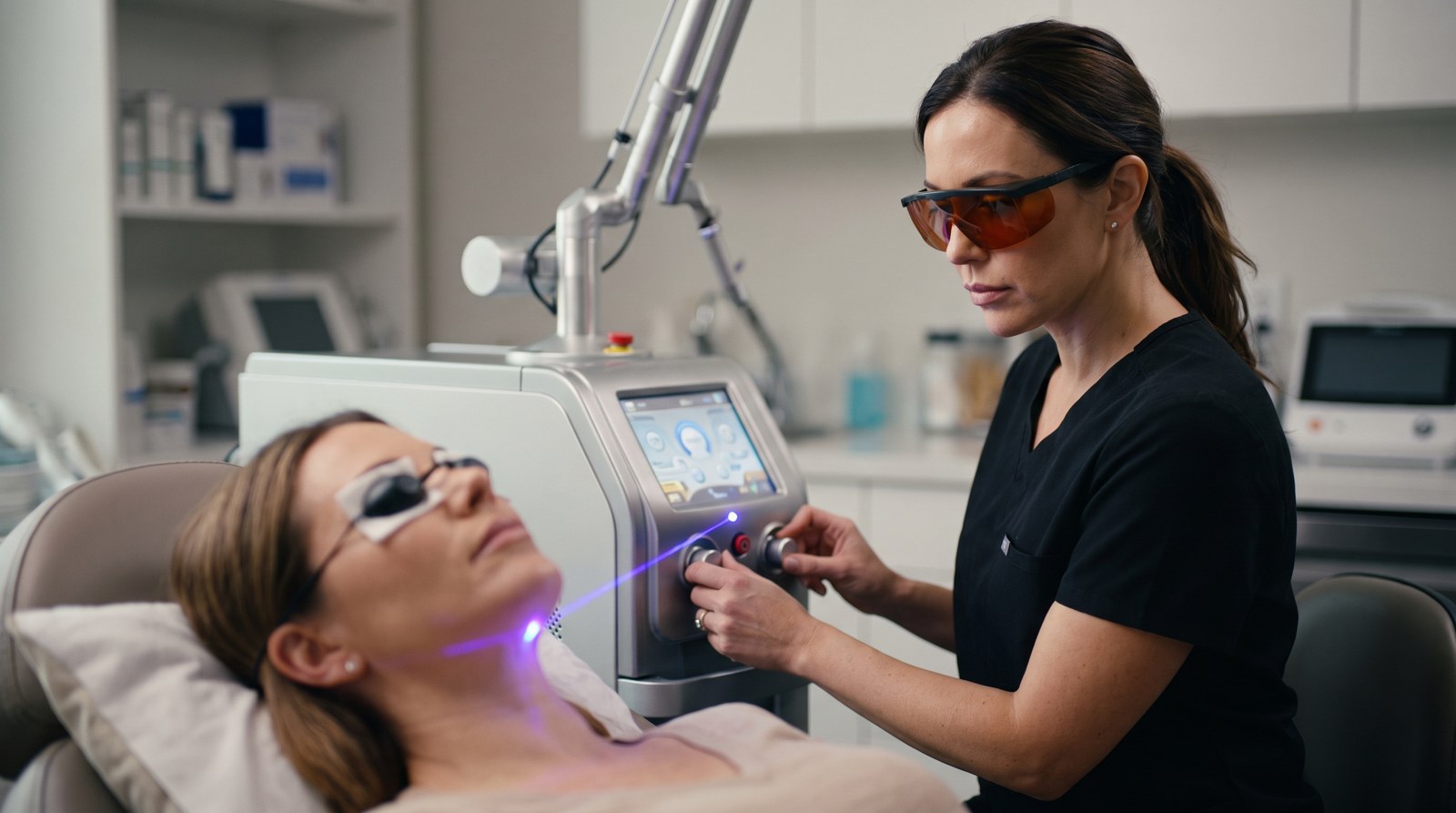
A cosmetic laser technician performs light-based skin and hair treatments in professional aesthetic settings — think med spas, dermatology offices, plastic surgery practices, and upscale day spas. The role is hands-on, client-facing, and highly technical.
The most common services a cosmetic laser technician performs include:
It’s worth clarifying what a cosmetic laser technician is not. This role is distinct from medical laser technicians who operate equipment in surgical or ophthalmological settings, and from industrial laser operators. Cosmetic laser technology sits firmly within the beauty and wellness industry — and it requires specific training in skin science, laser physics, and safety protocols to do it well and do it safely.
The client relationship matters, too. A skilled laser technician consults with clients before each session, assesses skin type using tools like the Fitzpatrick Scale, customizes treatment settings, and provides aftercare guidance. You’re not just operating a machine — you’re delivering a clinical-grade experience that clients trust you with.
—
Virginia Licensing Requirements for Laser Technicians
Who Regulates Cosmetic Laser in Virginia?
Virginia’s regulatory landscape for cosmetic laser is nuanced, and understanding it matters before you enroll in any program. In Virginia, the Department of Professional and Occupational Regulation (DPOR) oversees cosmetology and esthetics licensure. However, cosmetic laser services may also fall under oversight by the Virginia Board of Medicine, depending on the specific treatment being performed and the level of supervision required.
Note: The exact regulatory split between DPOR and the Board of Medicine for cosmetic laser services is an active area of Virginia law. AVI Career Training recommends confirming current requirements directly with Virginia DPOR before beginning your licensure path.
Do You Need an Esthetics License to Do Laser Treatments in Virginia?
This is one of the most common questions prospective laser technicians ask — and the answer has real practical consequences for your career path.
Many Virginia employers — particularly med spas, dermatology clinics, and plastic surgery practices — require technicians to hold an active esthetics or cosmetology license before performing laser services. Even if state law doesn’t mandate it in every context, employers set their own hiring standards, and having an underlying esthetics license makes you significantly more employable.
Virginia’s esthetics license requires completing 260 clock hours at a DPOR-approved school and passing the Virginia State Board examination. For students who want to work as laser technicians, pairing an esthetics foundation with dedicated laser training is the most direct path to full employment readiness in Northern Virginia’s job market.
Cosmetic Laser Certification vs. Medical-Supervised Laser Work
There’s an important distinction between cosmetic laser treatments and medical-supervised laser procedures. Cosmetic laser technicians typically work on skin-surface aesthetic concerns — hair removal, pigmentation, mild rejuvenation. More aggressive treatments, such as ablative resurfacing or laser treatments performed in clinical medical settings, generally require physician oversight or supervision under Virginia’s Board of Medicine.
Understanding the scope of your license matters. A well-structured laser technology program — like AVI Career Training’s Cosmetic Laser Technology program — will teach you exactly where those lines are, so you can practice confidently and legally.
—
What to Expect from a Cosmetic Laser Technology Program
Classroom and Theory Curriculum
A quality cosmetic laser technology program doesn’t just hand you the controls to expensive equipment and wish you luck. The classroom component covers the scientific foundation you need to perform treatments safely on every client who sits in your chair.
Core theory topics typically include:
Hands-On Clinical Training
Theory only takes you so far. The clinical component of a laser program is where you build the real-world confidence employers are looking for. During hands-on training, students practice performing actual treatments under the supervision of licensed instructors.
At AVI Career Training, the Cosmetic Laser Technology program is built around inclusive-skin training — meaning you’ll gain experience working with clients across the full spectrum of skin tones and types. This is not a small distinction. Many generic training programs default to a narrow range of skin types in their clinical hours, leaving graduates underprepared for the diverse clientele they’ll actually serve in Northern Virginia’s market.
What Makes Inclusive-Skin Training Matter for Laser Technicians
Laser and light-based treatments carry real risk if not calibrated correctly for deeper skin tones. Hyperpigmentation, burns, and ineffective outcomes are all possible consequences of improperly adjusted settings. A laser technician trained specifically to work on all Fitzpatrick skin types — not just types I through III — is a more skilled, safer, and more employable professional. It’s also simply the right way to do this work.
AVI’s curriculum is designed from the ground up to reflect the real diversity of the clients you’ll serve — from Fairfax County to Arlington to Washington, DC.
—
Career Outlook — Laser Technician Salaries and Job Opportunities in Northern Virginia
What Laser Technicians Earn in Virginia
Compensation for laser technicians in Virginia varies based on setting, experience, and specialization — but the numbers are encouraging.
For context, the Northern Virginia market includes some of the largest med-spa territory on the East Coast. Tysons Corner alone has multiple established medical aesthetics practices competing for skilled technicians. That competition benefits you as a job seeker.
Where Laser Technicians Work in Northern Virginia
The employment landscape for laser technicians in the DC metro area is diverse:
Industry Growth
The BLS projects employment for skincare specialists to grow approximately 8–10% through 2032 — faster than the average for all occupations. Within that category, cosmetic laser services represent one of the fastest-growing treatment segments. The American Society for Dermatologic Surgery (ASDS) and global aesthetics industry data consistently show year-over-year increases in demand for laser hair removal and laser skin treatments.
Put simply: this isn’t a trend. It’s a structural shift in how people approach personal care and appearance — and Northern Virginia is at the center of it.
—
A Real Career Path: Two Students Who Made the Shift
From Retail to the Treatment Room
Consider someone like Maya — a 28-year-old retail manager from Reston who spent years helping customers but never felt like she was building toward anything. She researched laser technician training in Northern Virginia after noticing a new med spa open near her apartment and wondering what it took to work there. After completing AVI’s Cosmetic Laser Technology program and pairing it with her esthetics certification, she landed a position at a Tysons Corner med spa within three months of graduation. The hands-on clinical hours she completed at AVI — working on clients with a wide range of skin types — gave her the practical confidence that her employer specifically mentioned during her interview.
A Military Spouse Finds Her Career Footing
Then there’s someone like Diane — a military spouse who had followed her partner to Northern Virginia and was looking for a career she could build here and carry with her if they moved again. She used the GI Bill® to offset tuition costs at AVI and completed the Cosmetic Laser Technology program while managing a busy household. The flexible scheduling and the school’s location in Vienna — central to the whole NoVA region — made it manageable. She’s now employed at a dermatology-adjacent aesthetic practice in Arlington and has referred two other military spouses to AVI’s admissions team.
These aren’t outliers. They reflect the kind of career transitions AVI Career Training is built to support.
—
Why Train at AVI Career Training in Vienna, VA
COE-Accredited, SCHEV-Certified — and Local
AVI Career Training is COE-accredited and SCHEV-certified, which means your credentials carry institutional weight that employers recognize. National accreditation isn’t just a quality signal — it’s often a requirement for federal financial aid eligibility and employer reimbursement programs. Generic online-only laser training courses or weekend certification workshops don’t offer the same standing.
AVI is located at 1595 Spring Hill Rd #720, Vienna, VA 22182 — positioned in the center of the Northern Virginia market you’re training to enter. You’re not commuting to a distant campus or completing clinical hours in an unfamiliar market. You’re learning in the community where you’ll work.
GI Bill® and Financial Aid
AVI accepts the GI Bill®, making the Cosmetic Laser Technology program accessible for veterans and military family members — a meaningful differentiator in a region with one of the largest active-duty and veteran populations in the country. Financial aid is also available for qualified students.
If cost has been the barrier between you and this career, it’s worth having that conversation with AVI’s admissions team before you assume it’s out of reach.
Hands-On Clinical Environment With Real Clients
AVI’s training model is built around real experience with real people — not just mannequins and practice pads. The clinical hours you complete as part of the Cosmetic Laser Technology program expose you to actual client consultations, treatment sessions, and the professional communication skills that translate directly to day-one job performance.
The instructors at AVI are licensed industry professionals, not academics who haven’t touched a laser in years. That practical expertise shapes the quality of what you learn and the confidence you carry into your first professional role.
Inclusive Curriculum Built for the Market You’ll Serve
Northern Virginia’s population is one of the most ethnically and culturally diverse in the country. The clients walking into Fairfax County med spas reflect that diversity — and they deserve technicians trained to serve them well. AVI’s inclusive-skin curriculum ensures you graduate ready to work confidently on every skin tone, not just the narrow range covered by programs that haven’t updated their approach in decades.
What’s the Difference Between a Laser Technician and an Esthetician?
This question comes up often — especially for people already considering esthetics school or currently working as estheticians. The short answer: an esthetician focuses on skin care services like facials, chemical peels, waxing, and manual treatments. A laser technician specializes in light-based technology treatments.
The two careers overlap significantly, which is why many laser technicians also hold an esthetics license. In fact, for anyone serious about building a full-service career in medical aesthetics, combining both credentials is often the smartest professional strategy. AVI offers both Basic Esthetics and Cosmetic Laser Technology training, which means you can build that combined foundation in one place.
—
Your Next Step
The Northern Virginia market is hiring laser technicians right now. The path to getting there is clear: complete a quality, accredited Cosmetic Laser Technology program, understand Virginia’s licensing landscape, and build your clinical experience with real clients across all skin types.
AVI Career Training in Vienna, VA offers all of that — along with financial aid, GI Bill® acceptance, and a training philosophy rooted in inclusion and real-world career outcomes.
Apply to AVI Career Training today and take the first concrete step toward a laser technician career in Northern Virginia. You can also call (703) 943-9841 or reach out to our admissions team to ask questions, schedule a tour, or learn more about program start dates and financial aid options.
—
Regulatory note: Virginia’s licensing requirements for cosmetic laser technicians involve both DPOR and the Virginia Board of Medicine, depending on scope of practice. Confirm current requirements at Virginia DPOR before enrolling. Salary data referenced from BLS Skincare Specialists (SOC 39-5094) — verify current figures at BLS.gov.