How to Become a Laser Technician in Virginia
Becoming a laser technician in Virginia requires two things: an active esthetics or cosmetology license issued by the Virginia State Board, plus completion of an approved laser training program — and the full path can realistically take under 12 months.
That two-step framework surprises a lot of people. Many assume laser technology is a standalone certification you can jump into right away. In Virginia, it’s not — and understanding that distinction early will save you time, money, and frustration as you plan your career path.
This guide breaks down every step: what laser technicians actually do, Virginia’s specific licensing requirements, what you’ll learn in training, realistic timelines and costs, and what the career looks like once you’re working in the Northern Virginia and DC metro market.
If you’re ready to move from research to action, you can apply to AVI Career Training right now. Otherwise, keep reading — there’s a lot of useful information ahead.
—
Key Takeaways
—
What Does a Laser Technician Actually Do?
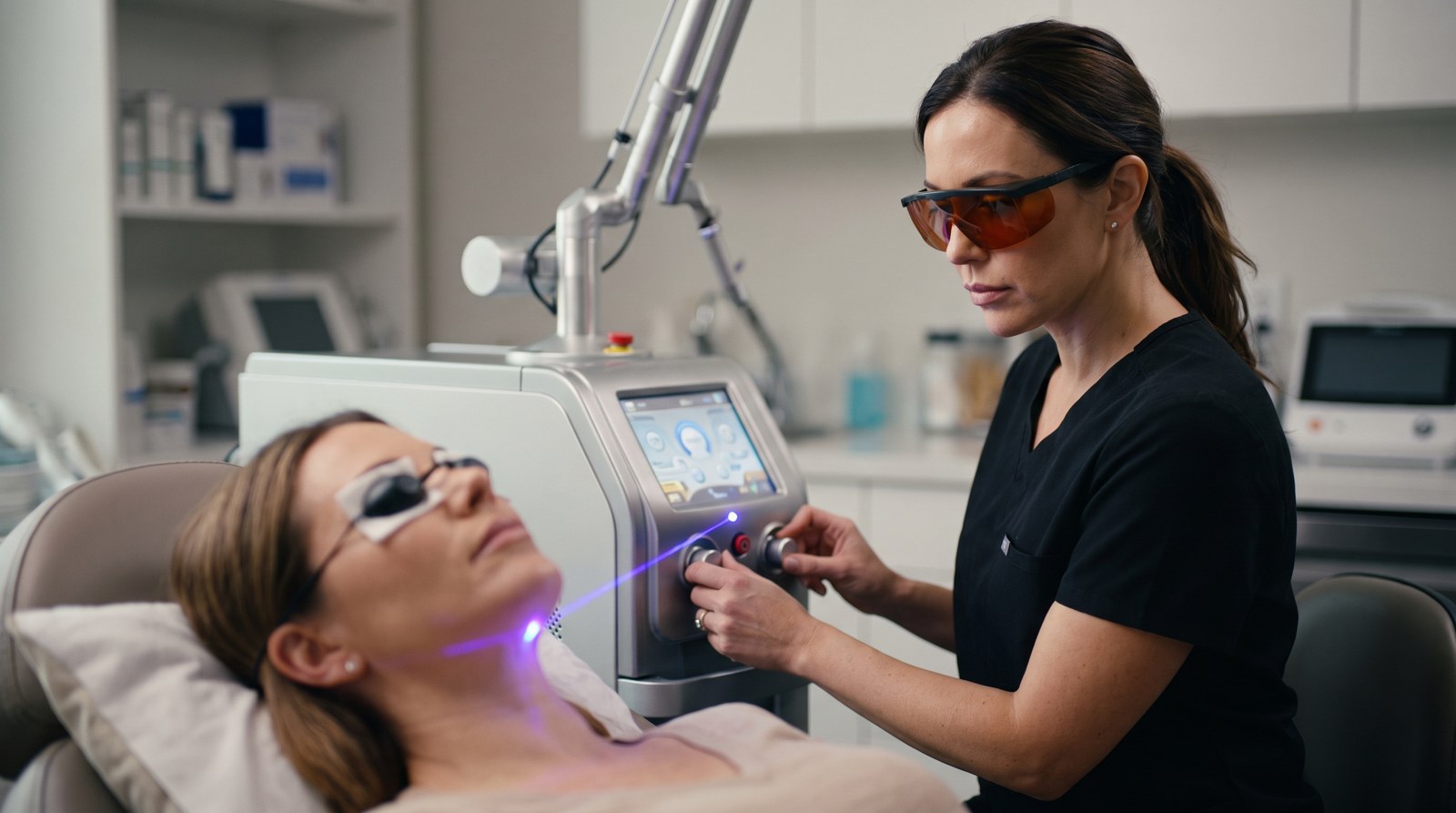
A laser technician — sometimes called a cosmetic laser technician or laser esthetician — uses medical-grade and cosmetic laser and light-based equipment to perform a range of skin and hair treatments for clients.
The most common services include:
This is a specialized role that sits at the intersection of esthetics and medical technology. Laser technicians need to understand skin science at a clinical level, operate sophisticated equipment safely, and make precise treatment decisions for clients with a wide range of skin tones and conditions.
That last point matters more than most training programs acknowledge. Laser energy behaves differently on different skin tones. Improper calibration for clients with deeper skin tones — Fitzpatrick Types IV through VI — can cause burns, scarring, or hyperpigmentation. A well-trained laser technician knows how to adjust fluence levels, wavelength settings, and cooling protocols for every client, regardless of skin tone. At AVI Career Training, inclusive skin training is built into the curriculum from the start — not treated as an afterthought.
Because of the technical complexity and the medical nature of the treatments, laser technicians command higher earning potential than general estheticians. In Northern Virginia and the DC metro area — one of the strongest markets in the country for this career — that earning premium is significant.
—
Virginia Licensing Requirements for Laser Technicians
This is where many people get confused, so let’s be specific.
Virginia does not offer a standalone “laser technician license.” Instead, the Commonwealth regulates cosmetic laser use under a combined framework overseen by the Virginia Department of Professional and Occupational Regulation (DPOR) and the Virginia Board of Medicine.
Here’s what that means in practice:
Step 1: Earn Your Esthetics or Cosmetology License
Before you can legally operate laser or intense pulsed light equipment in Virginia, you must hold an active state license in esthetics or cosmetology. For most people pursuing a laser career specifically, the Esthetics license is the more efficient path.
The Virginia State Board requires 600 clock hours of approved esthetics training to sit for the licensing exam. After completing those hours at an accredited school, you’ll take the Virginia State Board written and practical exams to earn your license.
The Cosmetology license requires 1,500 clock hours — more comprehensive, but a longer time investment if your primary goal is laser work.
Step 2: Complete an Approved Laser Training Program
With your esthetics license active, you can then enroll in a cosmetic laser training program. Virginia requires that laser operators complete a Board-recognized laser and light-based therapy course before working independently with that equipment.
This additional training covers the science and safety protocols specific to laser work: laser physics, tissue interaction, contraindications, treatment protocols by skin type, and hands-on clinical practice.
Why This Two-Step Structure Exists
Virginia’s regulatory framework exists to protect clients. Laser equipment delivers targeted energy to living tissue. Without a solid foundation in skin science, anatomy, and professional client care — the kind built through an esthetics program — operating that equipment creates real risk of injury.
Think of it this way: your esthetics license is your credential as a skin professional. Your laser training is the specialized skill set you layer on top of that foundation. Both are required. Neither is optional.
> PAA: Do laser technicians need to be licensed estheticians first in Virginia?
> Yes. In Virginia, you must hold an active esthetics or cosmetology license before you can legally perform cosmetic laser treatments. Laser training is a specialty that builds on your foundational license — not a replacement for it.
—
What You’ll Learn in a Cosmetic Laser Training Program
A quality laser technician training program covers far more than how to point a device at a client. Here’s what a comprehensive curriculum includes:
Laser Physics and Safety
You’ll learn how laser and light energy works at a technical level — wavelengths, pulse durations, energy output, and how different tissues absorb light differently. You’ll also learn safety protocols for yourself and your clients: protective eyewear requirements, equipment maintenance, and emergency procedures.
Fitzpatrick Skin-Type Classification
The Fitzpatrick Scale is a clinical classification system that describes how a person’s skin responds to UV exposure. It runs from Type I (very fair, always burns, never tans) to Type VI (deeply pigmented, never burns). This classification is essential for laser work because it directly determines which settings, wavelengths, and cooling methods are appropriate for each client.
Many laser programs teach this scale but apply it only to lighter skin tones in their hands-on training. AVI Career Training’s approach ensures students work across the full Fitzpatrick spectrum — because your future clients will represent every skin tone, and you need to be genuinely prepared for all of them.
Contraindications and Client Consultation
Not every client is a candidate for every laser treatment. You’ll learn to identify contraindications — medical conditions, medications, or skin states that make certain treatments unsafe — and how to conduct thorough consultations that protect both your client and your professional standing.
Treatment Protocols
Hands-on training in actual laser and light-based treatment protocols: laser hair removal, photofacials, skin rejuvenation, and pigmentation correction. You’ll practice on real clients under licensed instructor supervision, building the clinical confidence that employers look for.
Documentation and Professional Practice
Charting client records, obtaining informed consent, handling adverse events, and understanding the scope of your practice as a laser technician in a professional setting.
—
How Long Does It Take — and What Does It Cost?
Here’s an honest breakdown of the timeline and investment for becoming a laser-qualified esthetician in Virginia.
Timeline
Esthetics license path at AVI Career Training: approximately 5–6 months of full-time training to complete the required 600 clock hours. Part-time schedules are also available and extend the timeline accordingly.
Cosmetic Laser Technology program: Additional specialized training completed after — or integrated with — your esthetics foundation.
Combined path to laser-ready employment: Realistically under 12 months for most students pursuing a full-time schedule. That’s less than a year from starting school to being eligible to work as a laser technician in a medical spa or clinical setting.
Compare that to a four-year degree program, and the return on investment becomes clear quickly.
Cost
AVI Career Training offers competitive tuition for the Northern Virginia market. Specific program costs are best discussed directly with our admissions team — tuition can vary based on program selection and scheduling.
Financial aid is available for students who qualify, including federal aid programs. AVI also accepts the GI Bill®, making this an accessible path for veterans and active-duty service members transitioning to civilian careers.
To get specific numbers and talk through your options, reach out to AVI Career Training — the admissions team can walk you through total costs, aid eligibility, and payment plans.
—
From Career-Changer to Laser Technician: One Student’s Path
Consider someone like Maya — a former dental hygienist in her mid-30s who loved her work but wanted a career that combined science with aesthetics and gave her more flexibility. She had heard about laser technician work from a client at her dentist’s office who worked at a medical spa in McLean.
She enrolled in AVI’s Basic Esthetics program, completed her 600 hours over about five months, passed her Virginia State Board exams on the first attempt, and then moved directly into AVI’s Cosmetic Laser Technology program. Ten months after her first day of school, she was working at a dermatology-affiliated med spa in Tysons Corner, performing laser hair removal and photofacial treatments.
Her income in year one exceeded what she had earned in her final year as a hygienist — and she had a schedule that finally gave her weekends back.
—
Career Outlook: Where Do Laser Technicians Work and What Do They Earn?
The Northern Virginia and DC metro market is one of the strongest in the country for laser technician careers. The combination of high household incomes, a large professional population, and a dense concentration of medical spas, dermatology practices, and plastic surgery offices creates consistent, year-round demand for qualified laser technicians.
Where Laser Technicians Work
Laser Technician Salary in Virginia
According to the U.S. Bureau of Labor Statistics, skincare specialists nationally earn a median annual wage of approximately $40,000–$65,000, depending on specialization, experience, and location. (BLS Skincare Specialists data)
The Northern Virginia and DC metro area commands a meaningful premium above national medians. Experienced laser technicians working in medical spas and clinical settings in this market commonly earn $55,000–$75,000+ per year, factoring in base pay, tips, and performance-based commission structures.
Entry-level laser technicians with an esthetics license and laser certification typically start in the $40,000–$50,000 range and move up quickly as they build a client base and expand their treatment competencies.
Laser Technician vs. Esthetician: What’s the Difference?
A general esthetician provides skin care services: facials, chemical peels, waxing, brow shaping, and body treatments. A laser technician is an esthetician who has completed additional training in laser and light-based therapies — which are higher-tech, higher-demand, and higher-paying services.
The two roles aren’t competing career paths. The laser technician career starts with the esthetics credential and builds upward from there. Many laser technicians continue offering traditional esthetics services alongside their laser work, giving them a broader service menu and stronger earning potential.
—
Making the Shift: A Second Mini-Story
James was a 28-year-old working in retail management in Fairfax when a friend who worked at a med spa in Arlington told him about her job. The science aspect appealed to him — he’d always been interested in how things worked. The earning potential was real. And the career felt stable in a way his retail job never had.
He didn’t know anything about esthetics. He’d never thought of himself as someone who would go to beauty school. But he researched the Virginia licensing requirements, found AVI Career Training in Vienna, and called the admissions office.
Eleven months later, he was working full-time as a laser hair removal technician. He describes it as the first job he’s had where he’s genuinely excited to go to work — and where he can see a clear path to growing his income as he takes on more complex laser treatments.
The barrier to entry was lower than he expected. The payoff was higher.
—
Why AVI Career Training Is the Right Place to Start
AVI Career Training is a COE Accredited, SCHEV Certified beauty and wellness school located in Vienna, Virginia — in the heart of the Northern Virginia market where laser technicians are well established.
Our Esthetics program and Cosmetic Laser Technology program are taught by licensed industry professionals who bring real clinical experience into the classroom. Our campus gives students hands-on training on real clients, not just mannequins — because confidence with clients is built through actual practice.
AVI’s curriculum is built on an inclusive training philosophy. You’ll learn to work on every skin tone, classify skin accurately across the full Fitzpatrick Scale, and calibrate laser treatments that are safe and effective for every client who sits in your chair. That’s not just an ethical commitment — it’s what makes you a more skilled, more employable technician in a diverse market like Northern Virginia.
Financial aid is available for eligible students, and AVI proudly accepts the GI Bill® — honoring the service of veterans and military families by making quality career training accessible.
If you’re serious about becoming a laser technician in Virginia, the next step is simple: connect with the AVI admissions team, ask your questions, and find out exactly what your path looks like.
Start your application at AVI Career Training — or call us directly at (703) 943-9841.
Our Vienna, VA campus is ready when you are.