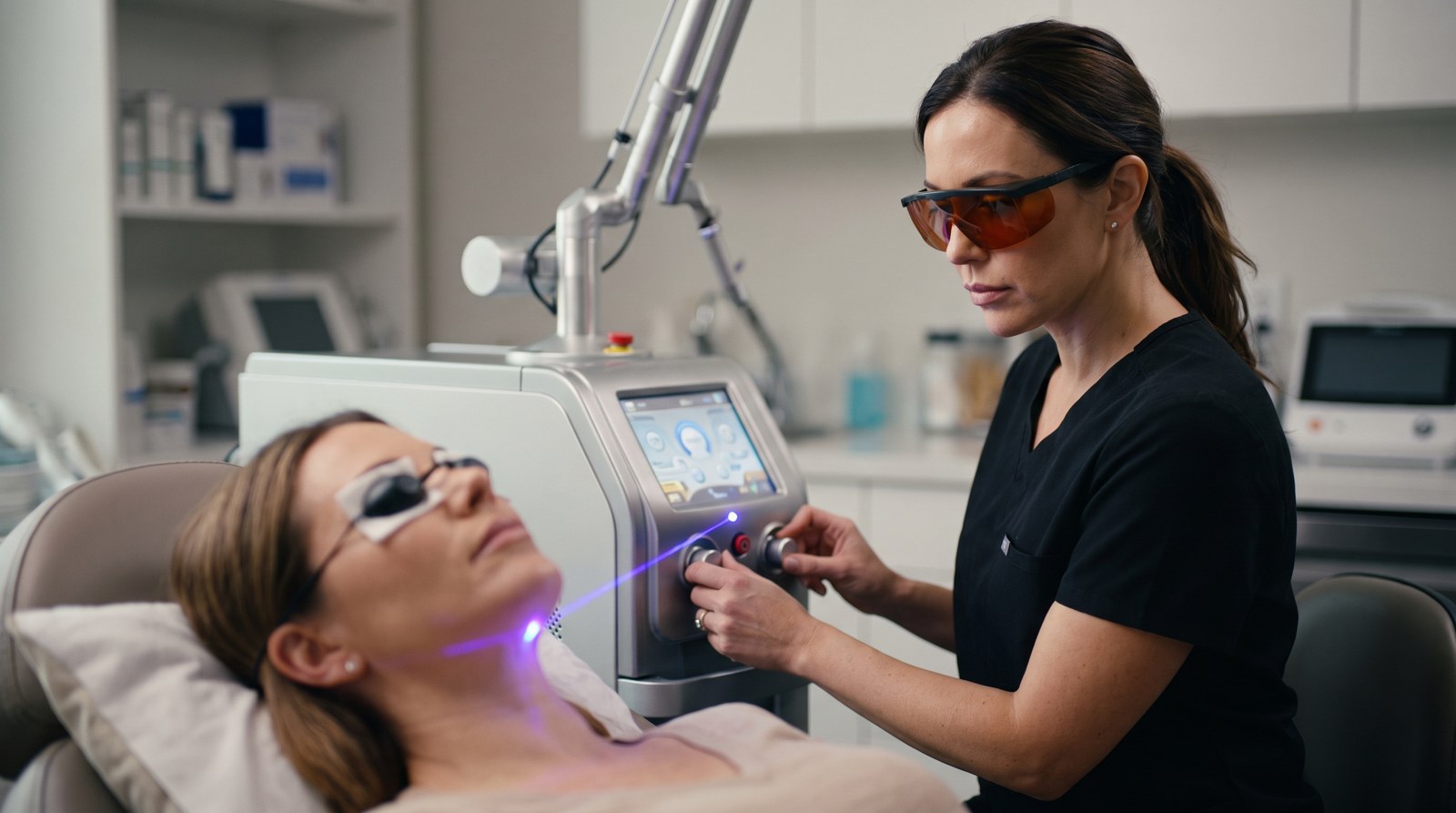
How to Become a Laser Technician in Virginia
To become a laser technician (NO FINANCIAL AID FOR THIS PROGRAM) in Virginia, complete a formal accredited training program and secure a position working under licensed medical supervision — there is no standalone state license issued for this role, which makes your choice of program the single most consequential step in this career path.
If you are researching laser technician (NO FINANCIAL AID FOR THIS PROGRAM) training in Virginia, this guide covers everything you need to know: what the job actually looks like day-to-day, how Virginia regulates laser procedures, what to look for in a program, and what you report earning in the Northern Virginia and DC metro market.
Apply to AVI’s Cosmetic Laser Technology program today or call (703) 943-9841 to speak with the admissions team.
Key Takeaways
– Virginia does not issue a standalone laser technician license; credential comes through an accredited program plus supervised practice under a licensed medical professional.
– Laser technicians in Virginia earn approximately $40,000 – $65,000 per year, with medical spas in the DC metro typically paying at the higher end (Indeed, Northern Virginia salary data).
– AVI Career Training’s Cosmetic Laser Technology program is COE-accredited and SCHEV-certified — two credentials that matter when employers verify your training.
– AVI trains students on the full Fitzpatrick Scale I–VI, preparing you to safely treat every skin tone.
– The medical spa and aesthetic laser industry is among the fastest-growing segments in the beauty and wellness sector.
What Does a Laser Technician Do?
A laser technician (NO FINANCIAL AID FOR THIS PROGRAM) — sometimes called a laser aesthetic technician or cosmetic laser specialist — operates energy-based devices to perform a range of skin and body treatments for clients.
The scope of the work goes well beyond laser hair removal. Depending on the clinical setting, a laser technician may perform:
- Laser hair removal using diode, Nd:YAG, or alexandrite laser systems
- Photofacials and IPL (Intense Pulsed Light) treatments for sun damage, redness, and uneven tone
- Skin rejuvenation and resurfacing treatments targeting fine lines, texture, and pigmentation
- Vascular and pigmented lesion treatments in dermatology or medical spa settings
- Body contouring using non-invasive energy-based technologies
Each treatment requires technical precision. You are working with medical-grade equipment that interacts with skin at the cellular level. Done well, these treatments deliver meaningful results for clients. Done incorrectly — especially on the wrong skin type or with improper settings — they can cause burns, hyperpigmentation, or scarring.
That is why training quality matters so much in this field.
How Is a Laser Technician Different from an Esthetician?
This is one of the most common questions from people exploring this career path, and the distinction is important.
An esthetician performs skin care treatments — facials, exfoliation, waxing, chemical peels — using topical products and non-energy-based modalities. An esthetician license in Virginia requires completing an approved esthetics program and passing the Virginia State Board exam.
A laser technician (NO FINANCIAL AID FOR THIS PROGRAM) operates energy-based devices (lasers, IPL, radiofrequency) that penetrate deeper into skin tissue. In Virginia, this work falls under medical supervision rather than the esthetics licensing framework. Many laser technicians do hold an esthetics background, but the laser-specific training is a separate, specialized credential.
At AVI Career Training, students can pursue both paths — AVI offers both Basic and Master Esthetics programs alongside its Cosmetic Laser Technology program.
Virginia Licensing Requirements for Laser Technicians
Understanding Virginia’s regulatory framework is essential before you enroll anywhere.
Virginia does not issue a separate, standalone “laser technician license.” Instead, the Virginia Board of Medicine governs the use of laser and energy-based devices as medical procedures. This means:
- Laser procedures must be performed under the supervision of a licensed medical professional — typically a physician, nurse practitioner, or physician assistant — in accordance with Virginia Board of Medicine guidelines.
- There is no DPOR-issued laser technician credential equivalent to a cosmetology or esthetics license. Your qualification comes from completing a recognized training program and working within a properly supervised clinical setting.
- Accreditation of your training program becomes the primary differentiator. Because Virginia does not create a licensing exam for laser technicians the way it does for estheticians, employers and supervising physicians look to your program’s accreditation status as proof that your training meets a recognized standard.
This regulatory structure has a direct implication for your school search: completing a COE-accredited program — like AVI’s Cosmetic Laser Technology program — signals to every medical spa director, dermatologist, and plastic surgeon reviewing your resume that your training met a rigorous, independently verified standard.
Note: Virginia’s regulatory landscape for aesthetic laser procedures can evolve. Always verify current requirements directly with the Virginia Department of Professional and Occupational Regulation (DPOR) and the Virginia Board of Medicine before enrolling in any program.
A Note on Electrolysis vs. Laser
Virginia does regulate electrologists separately — electrology is a licensed profession under DPOR. While elect