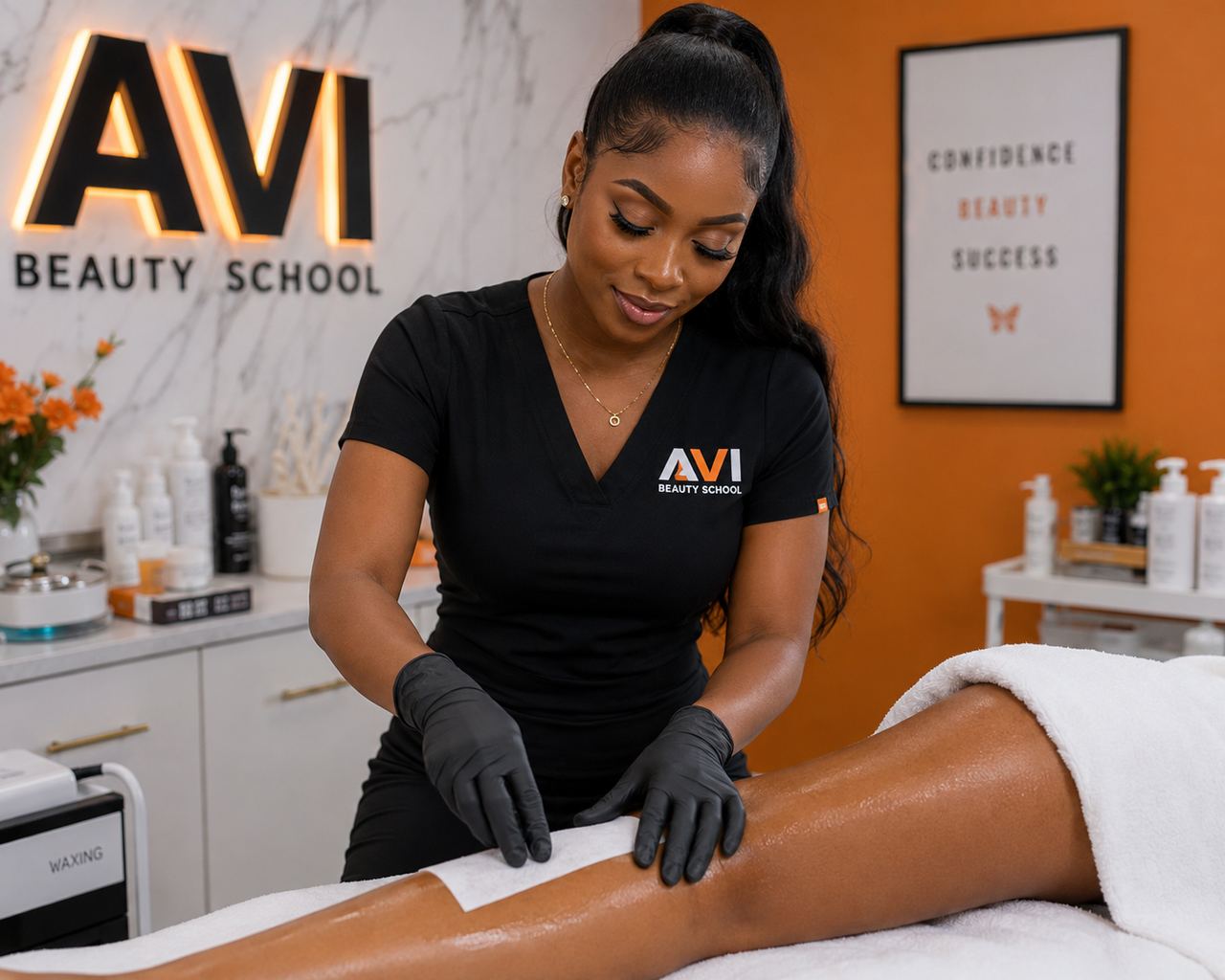
You can complete a 600-hour esthetics program at AVI Career Training in as few as six months attending full time — and walk out ready to sit for your Virginia State Board licensing exam and start your career. Apply now and take the first step toward your esthetics license today.
That’s the short answer. But the real answer depends on your schedule, your goals, and how you structure your time in the program. Whether you’re a career-changer who wants to move fast or someone balancing a job and family who needs more flexibility, the 600-hour path to an esthetics license in Virginia is designed to work around real life.
This guide breaks down exactly what the 600 hours cover, how your schedule affects your timeline, and how AVI’s program is structured so you can plan your next move with confidence.
Key Takeaways
- Virginia requires 600 training hours at a state-approved school before you can sit for the esthetics licensing exam
- Full-time students at AVI can complete the program in approximately 6 months
- Part-time students typically finish in 10–14 months, depending on weekly hours attended
- AVI’s program covers skin analysis, facial treatments, hair removal, chemical exfoliation, sanitation protocols, and Virginia State Board exam prep
- AVI Career Training is COE Accredited and SCHEV Certified — two credentials that matter when choosing a school
- Financial aid is available, and AVI accepts the GI Bill® for eligible veterans
Virginia Requires 600 Hours to Become a Licensed Esthetician
The Virginia State Board of Cosmetology sets the rules, and the requirement is clear: you need 600 training hours at a Virginia-approved school before you can apply to take the licensing exam.
This is not optional, and no school can shortcut it. Any program advertising a path to an esthetics license in Virginia with fewer than 600 hours is not a legitimate route to licensure in this state. The hour requirement exists to protect both you and your future clients — estheticians handle chemical exfoliants, waxing, electrical equipment, and advanced skin treatments that require real skill and real training.
Once you complete your 600 hours, you apply to the Virginia Department of Professional and Occupational Regulation (DPOR) to sit for the state licensing exam. Pass that exam, and you’re a licensed esthetician in Virginia — eligible to work in spas, salons, medical offices, and beyond.
The good news: 600 hours is a focused, achievable goal. Compared to cosmetology, which requires 1,000 hours in Virginia, esthetics training gets you licensed and earning in roughly a third of the time.
What Do Those 600 Hours Actually Cover?
Before we talk timelines, it’s worth understanding what you’re doing inside those 600 hours — because this is hands-on, skill-building training, not classroom seat time.
Core Technical Skills
The majority of your hours are spent learning and practicing the treatments you’ll perform every day as a working esthetician:
- Skin analysis — identifying skin types, conditions, and contraindications before recommending or performing any treatment
- Facial treatments — cleansing, steaming, extractions, masks, and customized facial protocols
- Hair removal — waxing techniques for the face and body, threading basics, and client consultation
- Chemical exfoliation — understanding AHAs, BHAs, and enzyme treatments, and how to apply them safely across different skin types
- Electrical modalities — galvanic current, high frequency, and other tools used in advanced facials
- Sanitation and safety protocols — Virginia State Board compliance, infection control, and proper equipment sterilization
Inclusive Skin Training
At AVI Career Training, the curriculum is built around working on every skin tone — not just a narrow standard. You’ll learn how conditions like hyperpigmentation, melasma, and post-inflammatory responses present differently across diverse skin types, and how to adjust your techniques accordingly. This isn’t a bonus — it’s built into the core program, because your future clients will reflect the full diversity of Northern Virginia.
State Board Exam Prep
The final portion of your training focuses directly on preparing for the Virginia State Board exam — both the written and practical components. You’ll review state regulations, practice exam scenarios, and build the professional vocabulary needed to pass.
By the time you complete your 600 hours at AVI, you’re not just logging time. You’re building a working skill set with real clients in a supervised clinical setting.
Full-Time vs. Part-Time: How Your Schedule Affects Your Timeline
Here’s where “how fast can I finish?” gets a concrete answer. The 600-hour requirement doesn’t change. What changes is how many of those hours you complete each week.
Full-Time Schedule
A full-time student attending approximately 25–30 hours of training per week will complete 600 hours in roughly 5 to 6 months.
That’s a meaningful commitment — but for someone who wants to change careers quickly and start earning, it’s one of the fastest legitimate paths to a new license in Northern Virginia. You’re looking at less than half a year from enrollment to exam eligibility.
Part-Time Schedule
A part-time student attending roughly 15–20 hours per week will typically complete the 600 hours in 10 to 14 months.
This track is popular among students who are working a current job while training, managing family responsibilities, or simply prefer a more measured pace. The career outcome is identical — the same 600 hours, the same licensing exam, the same credential. You just get there on a timeline that fits your actual life.
What Affects Your Specific Timeline
A few real-world factors can shift your completion date:
- Attendance consistency — Missed days extend your timeline. The 600 hours are cumulative; every session counts
- Program start dates — When you enroll affects when you finish. Speak with AVI admissions about current cohort schedules
- Holidays and school schedule — Factor in scheduled breaks when estimating your completion window
- Your starting knowledge — No prior experience is required, but students with previous skincare or client service backgrounds often move through certain material more confidently
The honest answer to “how fast” is this: the timeline is largely in your hands. Show up consistently, engage with the material, and the 600 hours move faster than most people expect.
How AVI Career Training Structures the 600-Hour Esthetics Program
Now that you understand the requirement and the timeline math, here’s what the experience actually looks like at AVI Career Training in Vienna, Virginia.
Hands-On from Day One
AVI’s approach is practical by design. You learn by doing — under the supervision of licensed, working estheticians who bring real industry experience into the classroom. You won’t spend months on theory before touching a client. The curriculum integrates hands-on practice early and builds progressively as your confidence and technique develop.
A Classroom That Reflects the Real World
AVI’s student body reflects the diversity of the Northern Virginia and DC metro community. So does the training. You’ll practice on real clients with a wide range of skin tones, concerns, and backgrounds — preparing you to serve every client who walks through the door of your future workplace. This is one of the reasons AVI graduates consistently feel prepared when they enter the job market. They’ve already worked on the range of clients they’ll encounter professionally.
COE Accreditation and SCHEV Certification
These two credentials aren’t just abbreviations on a wall. They’re the reason your hours count.
COE Accreditation (Council on Occupational Education) signals that AVI meets rigorous national standards for educational quality, faculty qualifications, facilities, and student outcomes. Many financial aid programs require COE accreditation to be eligible.
SCHEV Certification (State Council of Higher Education for Virginia) means AVI is formally recognized and approved to operate as a postsecondary institution in Virginia. This is required for your 600 training hours to count toward your Virginia State Board licensing application.
When you’re choosing between schools, accreditation is not a minor detail. It’s the foundation everything else rests on. Learn more about AVI’s accreditations and mission here.
Financial Aid and the GI Bill®
Tuition is a real consideration, and AVI offers multiple ways to make the program accessible. Financial aid is available for eligible students, including federal Pell Grants. AVI also accepts the GI Bill® for qualifying veterans and service members — making it one of the few beauty and wellness schools in Northern Virginia where military-connected students can put their benefits to work.
If you’re ready to explore your options, contact AVI admissions to ask about current financial aid opportunities and schedule a tour of the Vienna campus.
What Happens After You Finish the 600 Hours?
Completing your training hours is the milestone — but it’s not the finish line. Here’s what comes next.
Applying for the Virginia State Board Exam
Once AVI confirms your 600 hours are complete, you’ll apply to Virginia DPOR to sit for the esthetics licensing exam. The exam has two components:
- Written (theory) exam — covering skin science, safety, sanitation, Virginia regulations, and professional ethics
- Practical exam — demonstrating hands-on skills including skin analysis, facial procedures, and sanitation compliance
AVI’s State Board exam prep — built into your final training hours — is specifically designed to get you ready for both components.
What Licensing Opens Up
A Virginia esthetics license qualifies you to work in:
- Day spas and resort spas
- Medical spas and dermatology offices (often with additional training requirements depending on services)
- Salons offering skin care services
- Makeup studios and film/TV production
- Self-employment and suite rental
According to the U.S. Bureau of Labor Statistics, the median annual wage for skin care specialists nationally is approximately $40,000, with higher earning potential in metropolitan markets like Northern Virginia and Washington, DC — where demand for skilled estheticians continues to grow.
A Closer Look: Two Students, Two Paths
Career-Changer: From Retail to Skincare
Take someone like Priya — a 29-year-old working in retail management who’s been doing her own skincare research for years and finally decides to turn her passion into a paycheck. She enrolls in AVI’s esthetics program full time, attending five days a week. Within six months, she completes her 600 hours, passes her Virginia State Board exam on the first attempt, and accepts a position at a medical spa in Tysons Corner. The thing she credits most? The hands-on training on real clients — including clients with deeper skin tones whose specific concerns she learned to treat with confidence.
Working Parent: Evening and Weekend Track
Then there’s Marcus — a 37-year-old father of two working full time in logistics who has always wanted to own his own skincare studio. He can’t quit his day job yet, so he maps out a part-time schedule at AVI, attending evenings and Saturdays. Thirteen months later, he completes his 600 hours, earns his license, and begins building his client base on weekends before eventually transitioning to his studio full time. For Marcus, the flexible schedule wasn’t a compromise — it was the only path that made the goal possible.
Both routes lead to the same license. The right timeline is the one that works for your life.
Is 600 Hours Enough to Build a Real Career?
Yes — and it’s worth saying directly.
Six hundred hours of structured, hands-on esthetics training at an accredited school gives you a complete foundation. You’ll graduate with real clinical experience, a Virginia state license, and the technical vocabulary to grow continuously in your field. Many estheticians build successful careers — including higher businesses — starting from exactly this foundation.
The 600-hour requirement isn’t a minimum to scrape by. It’s a rigorous, focused training program that prepares you for the actual work of esthetics. What happens after licensing depends on your hustle, your continuing education, and the clients you build relationships with over time.
Ready to Start? Here’s Your Next Step
If you’re researching how long it takes to complete a 600-hour esthetics program in Virginia, you’re already asking the right questions. The path is clear: 600 hours at a SCHEV-certified, COE-accredited school, followed by the Virginia State Board licensing exam.
At AVI Career Training in Vienna, Virginia, that path is structured, supported, and designed to get you to your license with real skills and real confidence.
Call us at (703) 943-9841 to speak with admissions, ask about current program schedules, and find out when the next cohort starts.
Or apply now and take the first step toward your esthetics license today.
AVI Career Training is located at 1595 Spring Hill Rd #720, Vienna, VA 22182. COE Accredited · SCHEV Certified · Financial Aid Available · GI Bill® Accepted.