Esthetics School in Northern Virginia
AVI Career Training in Vienna, VA is a COE-accredited esthetics school in Northern Virginia that prepares students for licensure and a hands-on career in skin care — in as few as four to six months.
If you’ve been researching where to train, you already know the DC metro market is one of the strongest in the country for estheticians. Medical spas, luxury hotel spas, and dermatology clinics are hiring — and they’re paying above the national median. What they need are graduates who are trained rigorously, licensed correctly, and ready to work on every client who walks through the door.
That’s exactly what AVI’s Esthetics program is built to deliver.
Apply now to AVI’s Esthetics program and take the first step toward your Virginia esthetician license.
—
Key Takeaways
—
What Does an Esthetician Actually Do?
An esthetician is a licensed skin care professional. Every day on the job looks a little different — and that’s part of the appeal.
In a spa or salon setting, you might perform facials, hydrating treatments, exfoliation, and manual extractions. In a medical spa or dermatology clinic, you could be assisting with chemical peels, microdermabrasion, microneedling, or pre- and post-procedure skin prep. Add waxing, lash and brow services, and product consultations, and you have a skill set that clients return for again and again.
Where Do Estheticians Work?
The settings are more varied than most people expect:
The Northern Virginia and DC metro market is particularly well-positioned for all of these. The concentration of high-income households, defense and government workers, and a strong health-and-wellness culture means steady, well-paying demand for skilled estheticians.
—
Virginia Esthetician Licensing Requirements
Before you can legally perform esthetic services for pay in Virginia, you need a license issued by the Virginia Board of Cosmetology through the Department of Professional and Occupational Regulation (DPOR).
Here’s what’s required, step by step.
Step 1: Meet the Basic Eligibility Requirements
You must be at least 16 years old and hold a high school diploma or GED. That’s it for prerequisites — no prior beauty experience required.
Step 2: Complete 600 Clock Hours of Approved Training
Virginia mandates 600 clock hours of esthetics training at a state-approved school. This is non-negotiable. Those hours must cover both theory (the science of skin, ingredients, contraindications, sanitation protocols) and hands-on practical skills in a clinical or salon setting.
This is where school selection matters. Not every program structures those 600 hours equally. A well-built curriculum uses every hour intentionally — mixing lecture, demonstration, and real client work so you’re exam-ready and career-ready at graduation.
Step 3: Graduate and Apply to Sit for the State Board Exam
After completing your program, you’ll apply through Virginia DPOR to sit for the Virginia State Board exam. The exam has two components:
Passing both earns you your Virginia esthetician license.
Step 4: Apply for Your License
Once you’ve passed both portions of the exam, you submit your license application to the Virginia Board of Cosmetology. After approval, you’re licensed to practice in the state of Virginia.
> Quick answer: Virginia requires 600 training hours to become a licensed esthetician. A full-time program can be completed in approximately 4–6 months. After graduation, students must pass both the written and practical portions of the Virginia State Board exam.
—
What to Look for in a Virginia Esthetics Program
Not all esthetics programs are the same — even when they cover the same 600 hours. Here’s what separates a program that launches a real career from one that just checks a box.
Accreditation: COE and SCHEV
Accreditation is the single most important filter when evaluating an esthetics school.
COE (Council on Occupational Education) accreditation means the school has passed a rigorous review of its curriculum, faculty qualifications, facilities, and student outcomes. It’s not a rubber stamp — it’s a serious credential that indicates a school has been held to national standards.
SCHEV certification (State Council of Higher Education for Virginia) is the Virginia-specific credential that confirms the school is approved to operate and offer programs in the commonwealth.
Why does this matter to you? Two reasons:
1. Financial aid eligibility — Federal Pell Grants, student loans, and the GI Bill® are only available at accredited institutions. If a school isn’t accredited, you may be paying entirely out of pocket.
2. Employer trust — Hiring managers at medical spas and dermatology clinics look at where you trained. Graduating from a COE-accredited program signals that your education met a recognized standard.
AVI Career Training is both COE Accredited and SCHEV Certified. Learn more about AVI’s accreditations and mission.
Inclusive Curriculum: Training for Every Skin Tone
This is a professional skill issue, not just a values issue.
Virginia’s population — and especially the Northern Virginia and DC metro area — is one of the most ethnically diverse in the country. Your future clients will represent every skin tone, Fitzpatrick type, and skin concern imaginable. If your training only covers a narrow range of skin types, you’ll walk into your first job with gaps.
AVI’s curriculum is built to prepare estheticians to work confidently and skillfully across all skin tones. That means understanding how melanin affects treatment protocols, how certain chemical peels and laser-adjacent treatments respond differently on deeper skin, and how to consult effectively with every client. That’s a professional advantage that shows up in your results — and your reviews.
Hands-On Clinic Hours
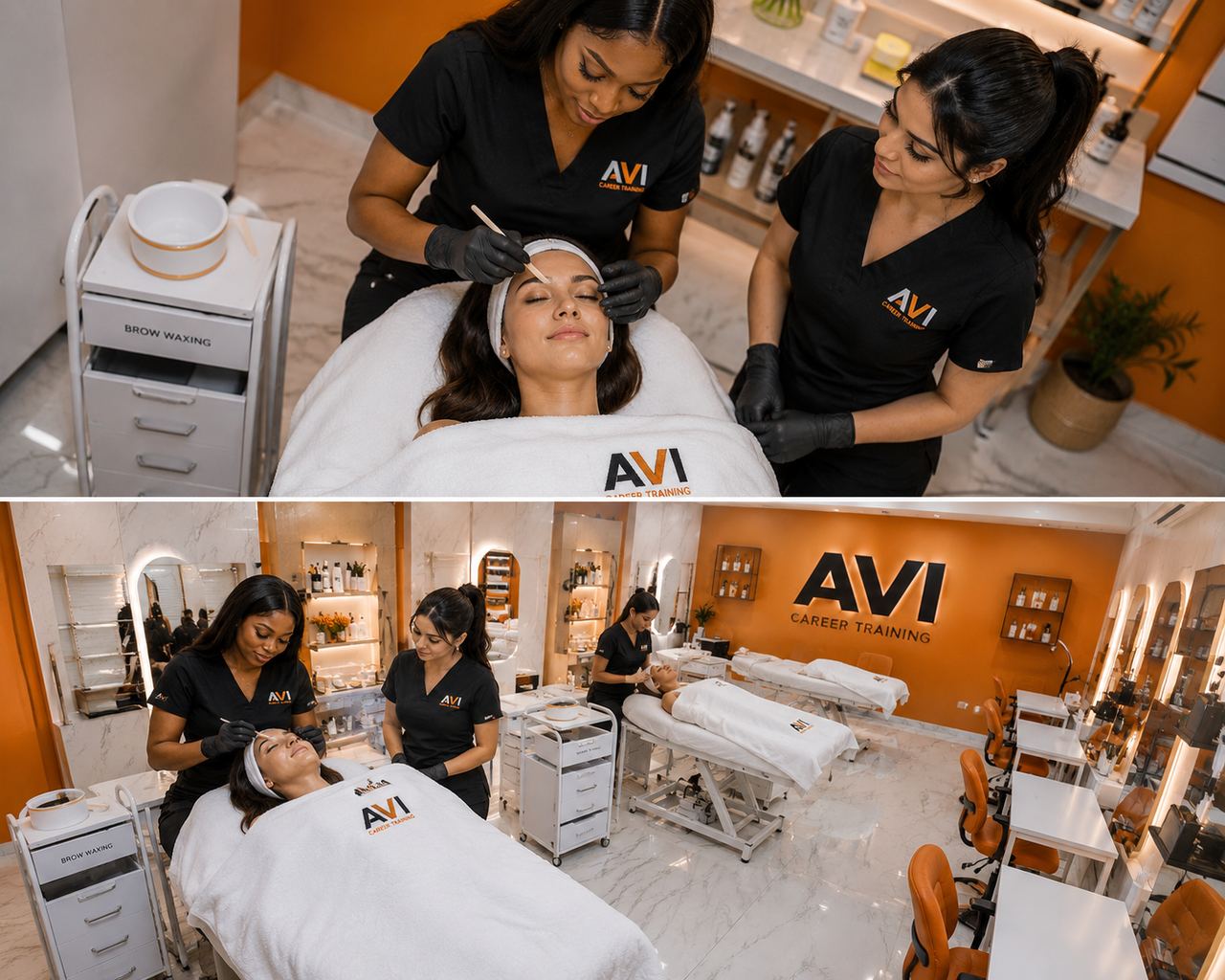
Reading about facials doesn’t make you good at facials. Look for a program that puts you in front of real clients in a supervised clinic setting — not just mannequins and practice boards. At AVI, students log hands-on hours in the student clinic as part of the 600-hour program, so you’re building real skills on real people before graduation.
Instructor Credentials
Your instructors should be licensed professionals with real-world experience — not just theoretical knowledge. At AVI, instructors bring industry credentials and clinical experience into the classroom, which means you’re learning from people who’ve actually worked the jobs you’re training for.
—
Esthetician Career Outlook and Salary in Northern Virginia
Let’s talk about the return on your investment.
What Estheticians Earn in the DC Metro Market
According to the U.S. Bureau of Labor Statistics, the national median annual wage for skincare specialists is approximately $42,000. The DC metro area — which includes Northern Virginia, Washington DC, and suburban Maryland — consistently skews above that national median.
Why? Cost of living plays a role, but so does the concentration of high-end employers. The NoVA/DC market is dense with medical spas, luxury hotel spas, and dermatology practices that pay premium wages for skilled estheticians. Top earners in medical spa or self-employed settings in this market can reach $60,000–$70,000 or more.
Self-employment and suite rental add another dimension. Many estheticians in the area eventually move into renting their own suite — setting their own prices, building a loyal client base, and keeping more of what they earn.
Job Growth: A Field with Momentum
The BLS projects employment for skincare specialists to grow approximately 16% through 2032 — significantly faster than the average for all occupations. That’s not a typo. The wellness industry, the medical spa boom, and a growing cultural focus on skin health are all driving sustained demand.
In Northern Virginia specifically, the expansion of medspa chains, boutique wellness studios, and integrated dermatology practices means the pipeline of job openings is real and ongoing.
—
A Career Change That Paid Off
Consider someone like Maya — a former retail manager in her early 30s who spent years making other businesses profitable but couldn’t build anything of her own. She enrolled in AVI’s Esthetics program on a part-time schedule while still working. Six months later, she passed her Virginia State Board exam on the first attempt.
Within three months of licensing, she was booked four days a week at a Tysons-area medical spa. Eighteen months after that, she moved into a suite rental, set her own hours, and grew her income past what she’d ever made in retail. The 600 hours she put into training were the most leveraged investment she’d made in herself.
That story isn’t unique to Maya. It’s what happens when the right training meets a market that’s ready to hire.
—
How to Enroll in AVI’s Esthetics Program in Vienna, VA
AVI Career Training is located at 1595 Spring Hill Rd #720, Vienna, VA 22182 — easily accessible from Tysons, Fairfax, Reston, Arlington, and the broader Northern Virginia area.
Program Details
AVI offers both Basic Esthetics and Master Esthetics tracks, allowing students to choose the level of training that matches their career goals.
Program duration is approximately 4–6 months depending on whether you enroll full-time or part-time. AVI offers schedule options designed to work for students who are balancing work, family, or other commitments.
Financial Aid and GI Bill®
AVI Career Training is one of the few esthetics schools in Northern Virginia that accepts the GI Bill® — a meaningful differentiator for active-duty service members, veterans, and military spouses in the region. Federal financial aid is also available for eligible students, including Pell Grants and student loans.
If cost has been a barrier, talk to AVI’s admissions team about your options before assuming a program is out of reach. Many students are surprised by what’s available to them.
Answering the Financial Aid Question
Is financial aid available for esthetics school in Virginia? Yes — at accredited schools like AVI Career Training, federal financial aid programs including Pell Grants and student loans are available to eligible students. AVI also accepts the GI Bill®, making it one of the most accessible esthetics programs in the Northern Virginia area for veterans and military families.
—
From the Classroom to Tysons Corner
Here’s another example of what the path forward can look like.
James had served eight years in the Army and wasn’t sure what came next. He’d always been interested in aesthetics — his sister was a dermatologist — but he assumed beauty school wasn’t for him. A friend pointed him toward AVI. He used his Post-9/11 GI Bill® benefits to cover tuition, enrolled in the Master Esthetics program, and finished in five months.
He interviewed at three medical spas before graduating. By his first week post-licensure, he had a job offer in hand at a medspa in Tysons Corner — a role that combined pre- and post-procedure skin consultations with advanced facial treatments. His technical training on diverse skin types gave him a confidence in the consultation room that his employer noticed immediately.
The GI Bill® made the training accessible. The quality of the training made the outcome possible.
—
Ready to Start? Here’s Your Next Step
If you’ve been researching esthetics schools in Northern Virginia, you’ve done the comparison work. You know what to look for: accreditation, hands-on training, an inclusive curriculum, and a school that understands this market.
AVI Career Training checks every one of those boxes — and it’s been doing so as a COE-accredited institution in the Vienna, VA area for years.
Your Virginia esthetician license starts with 600 hours of training. Those hours go faster than you think, and the career that follows is real.
Apply now to AVI’s Esthetics program or call us directly at (703) 943-9841 to speak with an admissions advisor about enrollment, schedule options, and financial aid.
You can also visit AVI Career Training’s website to learn more about the full range of programs available.
The next cohort has open seats. The DC metro market is hiring. The only question is when you start.
—
For official Virginia licensing requirements, visit the Virginia Department of Professional and Occupational Regulation (DPOR). For national career and salary data, visit the U.S. Bureau of Labor Statistics Occupational Outlook Handbook.