Esthetics School in Northern Virginia | AVI Career Training
AVI Career Training is Northern Virginia’s COE-accredited esthetics school — offering hands-on, inclusive esthetics training in Vienna, VA, minutes from Fairfax County and the DC metro area. If you’re ready to build a skincare career with real credentials and real skills, this is where you start.
The DC metro area is one of the strongest markets in the country for licensed estheticians. High household incomes, a dense concentration of medical spas and luxury day spas, and growing demand for specialized skincare services all point to the same conclusion: if you’re going to invest in esthetics training, Northern Virginia is an excellent place to do it.
Here’s everything you need to know about the program, the Virginia licensing path, realistic timelines, and what you can expect to earn — so you can make a fully informed decision.
Apply to AVI’s Esthetics Program →
—
Key Takeaways
—
What You’ll Learn in AVI’s Esthetics Program
Esthetics training at AVI goes well beyond the basics. The curriculum is designed to prepare you for the full range of services you’ll actually perform in a professional setting — from the first client consultation to advanced treatment protocols.
Core Curriculum Areas
Skin Science and Anatomy
You’ll build a strong foundation in the biology of skin — cell structure, skin conditions, Fitzpatrick scale classifications, and how environmental and hormonal factors affect skin health. This isn’t background knowledge. It’s what makes the difference between a technician who follows steps and a practitioner who understands why each step matters.
Facial Treatments
Classic European facials, deep-cleansing treatments, and customized protocols for different skin types and concerns. You’ll learn to analyze skin, select appropriate products, and adapt your technique based on what the client actually needs — not a one-size-fits-all routine.
Chemical Exfoliation
Alpha hydroxy acids, beta hydroxy acids, enzyme peels, and superficial chemical exfoliation. You’ll learn contraindications, proper application, and how to select the right treatment intensity for each client’s skin — including how melanin-rich skin responds differently to exfoliation and why that matters.
Waxing and Hair Removal
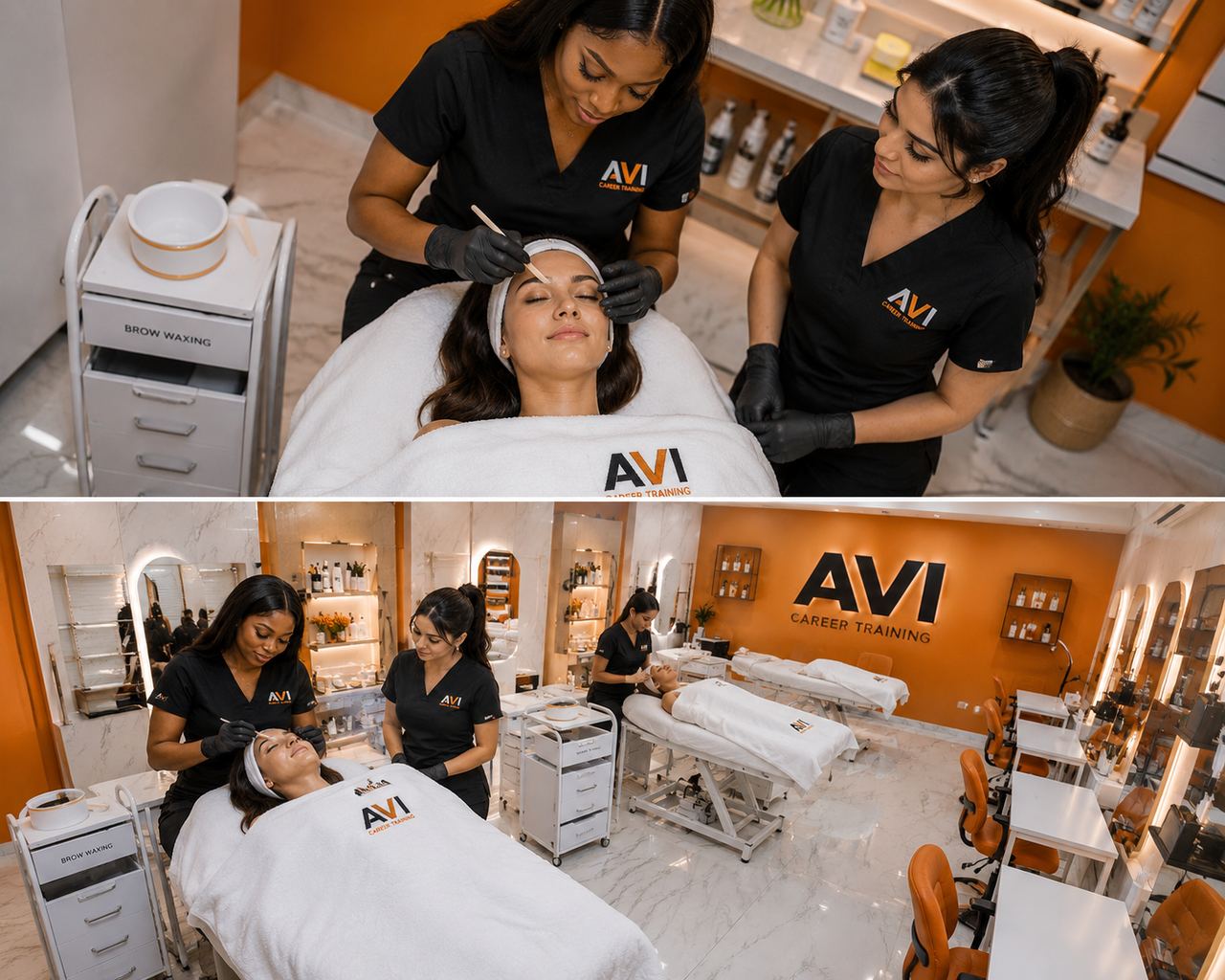
Soft wax, hard wax, facial waxing, and body waxing techniques. You’ll practice on real clients in AVI’s clinical training environment before you graduate.
Makeup Application
Color theory, skin preparation, and application techniques for everyday, corrective, and special occasion makeup. You’ll also learn how to select products and shades that work across the full spectrum of skin tones.
Client Consultation and Business Skills
How to conduct a professional intake, identify contraindications, document client history, and recommend home-care routines. You’ll also cover retail sales, client retention, and the fundamentals of running a profitable esthetics practice.
Inclusive Training — By Design, Not by Afterthought
Here’s something worth saying plainly: most esthetics programs were built around a narrow range of skin tones, and it shows. Chemical peel guidance calibrated for lighter skin. Waxing techniques that don’t account for coarser hair textures. Makeup application that defaults to one reference point.
AVI’s curriculum is built differently. Training students to perform treatments on every skin tone isn’t a footnote here — it’s a core principle woven into how every technique is taught. For your future clients, that means better outcomes. For your career, it means you’re prepared to work with the full, diverse clientele that Northern Virginia’s communities represent.
—
Virginia Esthetician License Requirements
Becoming a licensed esthetician in Virginia follows a clear, structured path. Here’s exactly what the Virginia Board of Cosmetology requires.
The Basic Requirements
That’s the complete checklist. If you’ve graduated from AVI’s program, you’ve met the training requirement and are fully prepared to sit for both portions of the State Board exam.
The State Board Exam
The written exam covers the theory you’ll study throughout your program — skin anatomy, chemistry, sanitation, contraindications, and Virginia-specific regulations. The practical exam tests your hands-on technique in a proctored setting.
AVI’s program is specifically structured to prepare you for both. The 600 hours you complete aren’t just time logged — they’re a curriculum designed to map directly to what the Virginia State Board tests.
For the official licensing requirements, you can verify current standards directly through the Virginia Department of Professional and Occupational Regulation (DPOR).
After You’re Licensed
Once you pass both exams, you apply for your Virginia esthetician license through DPOR. From there, you’re legally authorized to work in any licensed establishment in the Commonwealth — a day spa, medical spa, salon, hotel, or your own suite.
—
How Long Does Esthetics School Take?
The short answer: Virginia requires 600 clock hours of training. How quickly you complete those hours depends on your schedule.
Full-Time Schedule: 4–6 Months
If you attend on a full-time basis, most students complete the 600-hour requirement in approximately four to six months. For someone starting in January, that means a realistic target of being licensed and working by early summer.
This is the fastest path to licensure and the best option if you’re able to commit your days to training and want to enter the workforce as quickly as possible.
Part-Time Schedule: 8–12 Months
AVI offers scheduling options designed for students who are balancing current employment, family responsibilities, or other commitments. On a part-time schedule, completing 600 hours typically takes eight to twelve months.
This is a genuinely practical option, not a consolation prize. Many successful AVI graduates built their esthetics careers while working another job right up until they were licensed and ready to transition.
A Real Example
Take someone like Maya — a 34-year-old marketing coordinator from Herndon who had been doing skincare research for herself for years and realized she knew more about active ingredients than most people she’d talked to at spas. She enrolled in AVI’s part-time program, kept her office job, and graduated ten months later. She passed her State Board exam on the first attempt and took a position at a medical spa in Tysons. She was earning more in her first full year as an esthetician than she had been in marketing.
That timeline is real and repeatable. The 600-hour requirement exists for a reason — it gives you genuine competence. The schedule flexibility exists so that competence is accessible to people who have real lives while they train.
—
What Estheticians Earn in Northern Virginia
National salary data for estheticians is useful context, but it undersells what’s possible in the DC metro market. Northern Virginia is one of the highest-income regions in the country — Fairfax County consistently ranks among the top counties in the U.S. by median household income — and that economic reality directly shapes what clients spend on skincare and what skilled estheticians can earn.
Baseline Earning Data
According to the U.S. Bureau of Labor Statistics, the median annual wage for skincare specialists nationally is approximately $42,000–$48,000. The BLS also projects employment for skincare specialists to grow roughly 16% through 2032 — significantly faster than the average for all occupations.
In Northern Virginia and the DC metro area, those numbers run higher. Here’s how earning potential typically breaks down by setting:
Earning Potential by Career Setting
| Setting | Typical Annual Range (NoVA) |
|—|—|
| Day Spa or Salon | $38,000–$52,000 |
| Luxury Hotel / Resort | $45,000–$60,000 |
| Medical Spa | $55,000–$75,000+ |
| Dermatology Clinic | $50,000–$70,000 |
| Self-Employed / Suite Rental | Uncapped |
Medical spa and dermatology settings represent the higher end of the market — and they’re also where specialized esthetics training pays the biggest dividends. Clients in these settings have specific skin concerns and expect practitioners who understand skin science, not just skincare product application.
The Entrepreneurial Path
Some estheticians build their own client base and rent a private suite. In Northern Virginia, with the right clientele and the right niche, self-employed estheticians can earn well above the ranges listed above. This path requires business development skills alongside technical skills — both of which AVI’s program addresses.
The point isn’t that everyone will hit the top of the range. The point is that in Northern Virginia’s market, a licensed esthetician with strong technique and good business instincts has genuine earning potential — not just “decent pay for a beauty job.”
—
Why Choose AVI Career Training for Esthetics in Northern Virginia?
There are esthetics programs in the DC metro area. Here’s what makes AVI a different choice.
COE Accreditation and SCHEV Certification
AVI Career Training is accredited by the Council on Occupational Education (COE) — one of the most respected accrediting bodies for career and technical schools in the country. AVI is also certified by the State Council of Higher Education for Virginia (SCHEV).
These aren’t just credentials on a wall. COE accreditation means AVI meets rigorous standards for curriculum quality, student outcomes, and institutional integrity. It also matters for financial aid eligibility and employer recognition.
Financial Aid — Including the GI Bill®
AVI’s accreditation status means eligible students can access federal financial aid programs, including Pell Grants. AVI also accepts the GI Bill® — making quality esthetics training accessible to veterans and military-connected students in the Northern Virginia community.
If cost has been a barrier to enrolling, it’s worth a direct conversation with AVI’s admissions team about what aid you may qualify for.
Start Your Application and Ask About Financial Aid →
Hands-On Clinical Training
Esthetics is a tactile skill. You learn it by doing it — on real clients, in a real clinical environment, under the supervision of licensed instructors who work in the industry. AVI’s training model is built around that reality. By the time you graduate, you’ve performed the treatments, handled the consultations, and navigated the situations that will show up in your first professional position.
Inclusive Curriculum
As noted throughout this page: AVI’s program trains you to work beautifully on every skin tone. In a market as diverse as Northern Virginia, this isn’t optional expertise — it’s fundamental competence. You’ll leave AVI prepared to serve the full range of clients you’ll actually encounter.
Location — Vienna, VA
AVI’s campus is located at 1595 Spring Hill Rd #720, Vienna, VA 22182 — accessible from Tysons, Fairfax, Reston, McLean, and the broader DC metro area. You’re training in the same market where you’ll build your career.
A Student Who Used Every Advantage AVI Offers
Consider someone like Darnell — a 28-year-old Army veteran from Woodbridge transitioning out of active duty service. He used his Post-9/11 GI Bill® benefits to cover his training costs at AVI, completed the program full-time in five months, and passed his State Board exam on the first try. Within three months of getting his license, he was working at a high-end medical spa in Arlington, building a client list that included referrals from clients who specifically sought out an esthetician trained to work with melanin-rich skin. His first-year income exceeded $60,000.
That combination — COE-accredited training, inclusive curriculum, GI Bill® eligibility, and a strong local market — is what AVI offers students who are serious about building a real career.
—
Frequently Asked Questions
How many hours do you need to become an esthetician in Virginia?
Virginia requires 600 clock hours of esthetics training at a SCHEV-certified school to qualify for the State Board licensing exam. This is set by the Virginia Board of Cosmetology.
How long does esthetics school take in Virginia?
At a full-time schedule, 600 hours typically takes 4–6 months. Part-time students generally complete the program in 8–12 months. Your timeline depends on how many hours per week you can commit to training.
How much does an esthetician make in Northern Virginia?
Nationally, the BLS reports a median annual wage of approximately $42,000–$48,000 for skincare specialists. In Northern Virginia’s DC metro market, estheticians in medical spa or dermatology settings commonly earn $55,000–$75,000+ including tips and commission. Self-employed estheticians have uncapped earning potential.
What is the difference between esthetics and cosmetology school?
Esthetics training focuses on skincare — facial treatments, chemical exfoliation, waxing, and related services. Cosmetology school covers a broader range of services including hair cutting, coloring, chemical services, and nail care. The licensing requirements, training hours, and career paths are distinct. Virginia requires 600 hours for esthetics licensure and 1,000 hours for a cosmetology license.
Do esthetics schools in Virginia offer financial aid?
Yes — if the school holds COE accreditation and SCHEV certification, eligible students can access federal financial aid programs. AVI Career Training is both COE Accredited and SCHEV Certified. AVI also accepts the GI Bill®. Contact AVI’s admissions team to discuss your specific eligibility.
—
Ready to Start Your Esthetics Career in Northern Virginia?
The path from where you are right now to a licensed esthetics career in Virginia is 600 hours of hands-on training, a two-part State Board exam, and a decision to start. AVI Career Training is the esthetics school in Northern Virginia built to get you there — with the accreditation, the inclusive curriculum, the financial aid options, and the clinical training that the DC metro market demands.
Apply to AVI Career Training Today →
Questions before you apply? Call AVI’s admissions team directly at (703) 943-9841 or visit the campus at 1595 Spring Hill Rd #720, Vienna, VA 22182.