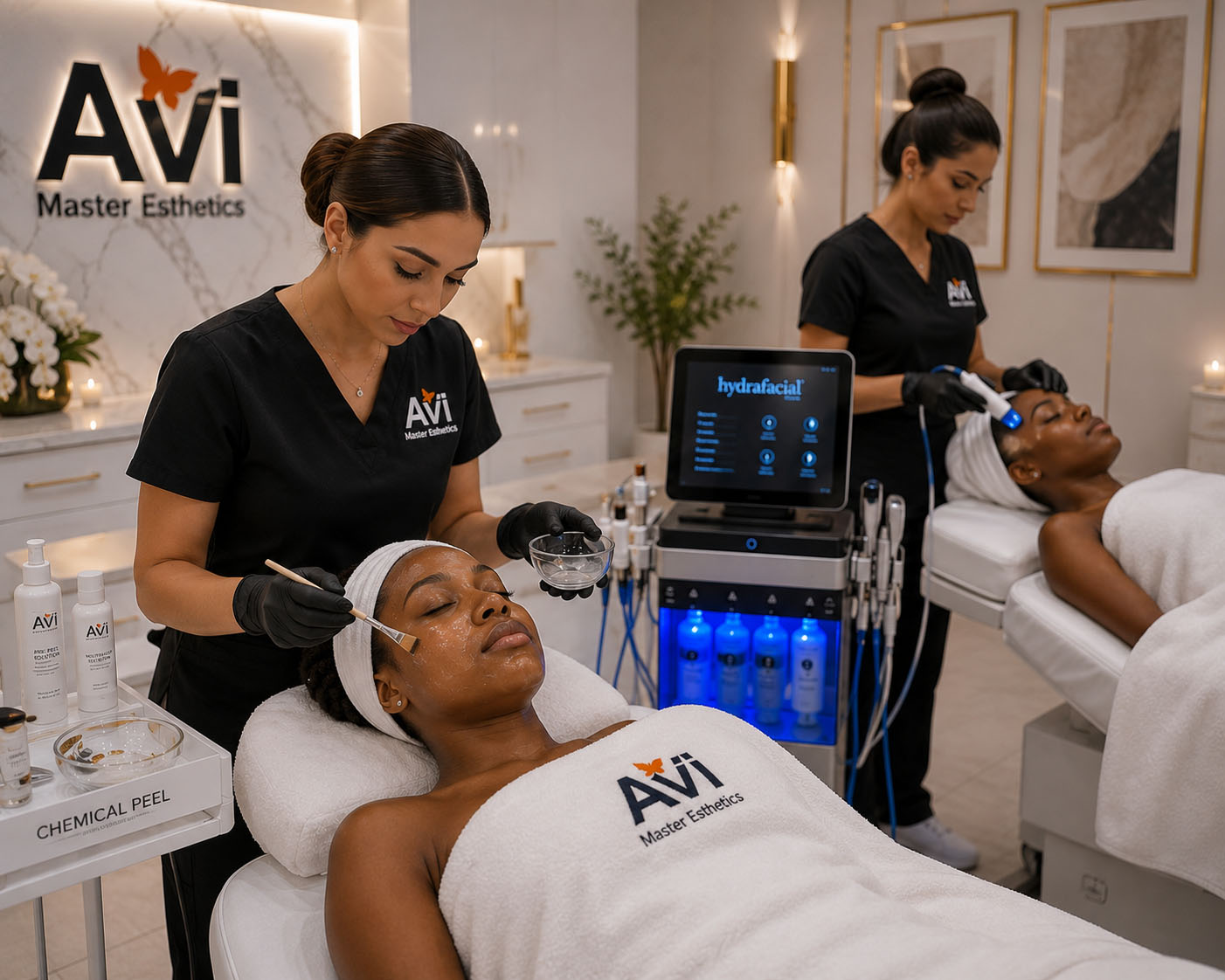
The difference between basic esthetics and master esthetics comes down to three things: hours of training, scope of practice, and the types of environments where you can legally work. Basic Esthetics requires 600 clock hours in Virginia and prepares you for foundational skin care services. Master Esthetics requires 1,200 clock hours and qualifies you for advanced clinical treatments — including chemical peels, microdermabrasion, and medical spa-level services.
Both are legitimate, rewarding career paths. The right one depends on your goals, your timeline, and how far you want to take your esthetics career.
Key Takeaways
- Virginia requires 600 clock hours for a basic esthetics license and 1,200 clock hours for master esthetics
- Basic estheticians work primarily in day spas and salons; master estheticians are qualified for medical spas, dermatology clinics, and advanced wellness centers
- Both tracks require passing written and practical exams through PSI Exams for the Virginia State Board of Cosmetology
- Basic esthetics programs typically take 4–5 months full-time; master esthetics programs typically take 9–12 months
- Master estheticians in the DC metro market can earn $45,000–$65,000+ annually in clinical settings
What Is Basic Esthetics — and What Does It Cover?
Basic Esthetics is the entry-level esthetics credential in Virginia. It is the starting point for the vast majority of students entering the skin care field — and it is a fully marketable, career-ready license on its own.
To earn a basic esthetics license in Virginia, you must complete 600 clock hours of approved training at an accredited school, then pass both a written and practical examination administered through PSI Exams on behalf of the Virginia State Board of Cosmetology.
What a Basic Esthetician Can Do
A licensed basic esthetician in Virginia is trained and legally authorized to perform:
- Facials and facial massage — cleansing, toning, moisturizing, and manual massage techniques
- Basic exfoliation — including enzymatic treatments and mild surface-level exfoliation
- Waxing and hair removal — facial and body waxing, threading (where trained)
- Skin analysis — assessing skin type, condition, and appropriate treatment protocols
- Makeup application — corrective, special occasion, and everyday application
- Brow and lash services — tinting, shaping, and lash application
These services represent a strong and in-demand menu. Many estheticians build entire careers — and loyal client books — at this level. Day spas, resort spas, salons, and skin care boutiques are all realistic employment destinations for a basic esthetics graduate.
If you are ready to start building your career in skin care without an extended training commitment, Basic Esthetics is a smart, strategic entry point. Apply to AVI Career Training’s Basic Esthetics program today and take the first step toward your license.
What Is Master Esthetics — and How Does It Go Further?
Master Esthetics is the advanced esthetics credential in Virginia. It builds directly on the foundation of basic esthetics — expanding both what you know and what you are legally permitted to do in a professional setting.
To become a licensed master esthetician in Virginia, you must complete 1,200 clock hours of approved training. That is double the basic requirement. The additional hours are not filler — they cover advanced clinical techniques that carry real responsibility and require deep technical knowledge.
What a Master Esthetician Can Do
A licensed master esthetician in Virginia is trained and authorized to perform everything a basic esthetician can, plus:
- Chemical peels — including medium-depth exfoliation protocols that require precise skin assessment and aftercare management
- Microdermabrasion — mechanical resurfacing of the skin using controlled abrasion
- Advanced exfoliation treatments — including enzyme combinations and multi-acid protocols
- Laser-adjacent and energy-based treatments — in supervised clinical settings (scope varies by employer and additional certifications)
- Medical spa services — including pre- and post-procedure skin prep and care in collaboration with licensed medical staff
- Advanced skin analysis and treatment planning — assessing complex conditions including hyperpigmentation, rosacea, acne, and aging across all skin types
This is where the importance of inclusive training becomes critical. Chemical peels and advanced exfoliation do not behave the same on every skin tone. Treatments calibrated only for lighter Fitzpatrick skin types can cause serious complications — post-inflammatory hyperpigmentation, chemical burns, and scarring — when applied incorrectly to deeper skin tones. A master esthetician with thorough, inclusive training is not just more employable. They are genuinely safer for every client they serve.
A Student’s Path: From Basic to Master
Consider a student like Maya, who enrolled in Basic Esthetics after spending years as a makeup artist at a retail counter. She wanted a license that would let her offer skin care services alongside her makeup work. After completing her 600 hours and passing her Virginia State Board exams, she worked at a day spa in Tysons for two years — building her client base, sharpening her technique, and saving money. When she was ready to move into a medical spa environment, she went back to school for Master Esthetics. The additional 600 hours of advanced clinical training — including chemical peel protocols and advanced skin analysis — opened the door to a medical esthetics role that nearly doubled her income. Her path was not linear. It was intentional.
Virginia Licensing Requirements: Hours, Exams, and the State Board
Virginia esthetics licensing is governed by the Virginia Department of Professional and Occupational Regulation (DPOR) through the State Board of Cosmetology. Here is what you need to know before you enroll.
Hour Requirements
| License Level | Clock Hours Required | Typical Full-Time Program Length |
|---|---|---|
| Basic Esthetics | 600 hours | 4–5 months |
| Master Esthetics | 1,200 hours | 9–12 months |
⚠️ Hour requirements are established by the Virginia State Board and are subject to legislative change. Always verify current requirements directly at dpor.virginia.gov before making enrollment decisions.
Examinations
Both basic and master esthetics candidates must pass two exams to receive their Virginia license:
- Written Examination — tests knowledge of skin theory, sanitation, safety, and the science behind esthetics procedures
- Practical Examination — a hands-on skills assessment evaluating your ability to perform core esthetics services correctly and safely
Both exams are administered through PSI Exams on behalf of the Virginia State Board of Cosmetology. You must complete your required training hours at an approved school before you are eligible to sit for either exam.
What Licensure Allows
Your Virginia esthetics license is your legal permission to work. Without it, you cannot legally perform esthetics services for compensation in the state — regardless of your skills or experience. Employers at reputable spas and clinics verify licensure before hiring. State inspectors can audit salons and spas for unlicensed practitioners.
Earning your license through an accredited program is not a formality. It is the foundation of your entire career.
Career Outcomes and Earning Potential — Which Path Is Right for You?
Both basic and master estheticians work in the beauty and wellness industry. The difference is where they work, what they charge, and how their career can grow over time.
Basic Esthetics: Where You Land
Graduates with a basic esthetics license typically find employment in:
- Day spas — the most common entry-level destination
- Full-service salons — offering skin care services alongside hair and nails
- Skin care boutiques — boutique facial studios and single-service providers
- Resort and hotel spas — particularly in the Northern Virginia and DC metro market
- Retail environments — department store counters and specialty beauty retailers that offer skin consultations
Nationally, estheticians earn a median wage of approximately $38,000–$42,000 per year according to Bureau of Labor Statistics data. In the DC metro market — which includes Northern Virginia — wages trend higher due to cost of living and the concentration of high-end spas, hotels, and wellness facilities in the region.
Many basic estheticians also build independent client bases and move into booth rental or suite rental models, where earning potential scales with your book.
Master Esthetics: Where You Can Go
A master esthetics license expands your employment options significantly — particularly in the growing medical esthetics sector.
Master estheticians in Virginia qualify to work in:
- Medical spas (medspas) — one of the fastest-growing segments of the beauty and wellness industry
- Dermatology clinics — supporting licensed physicians with pre- and post-procedure skin care
- Plastic surgery centers — providing pre-operative prep and post-operative recovery skin care
- Advanced wellness centers — offering comprehensive skin health programs
- High-end destination spas — where advanced services command premium pricing
In metro markets with strong clinical demand — like Northern Virginia — master estheticians working in medical environments can earn $45,000–$65,000+ per year, with experienced practitioners at top medspas often exceeding that range through service commissions and retail sales.
Earning figures represent typical industry ranges and are not guarantees of individual income. Compensation varies by employer, experience, location, and business model.
A Realistic Scenario: Choosing the Right Track
Jasmine had just moved to Northern Virginia from Atlanta after her partner accepted a position at a tech company in Tysons Corner. She had always loved skin care and wanted to build a career she could grow in a new city. She did her research carefully. She knew she wanted to work in a medical spa environment eventually — the clinical precision appealed to her, and she had seen how well medical estheticians were paid. But she also needed income sooner rather than later.
She enrolled in Basic Esthetics at AVI first. Four months later, she passed her Virginia State Board exams and started working at a day spa in McLean. A year later, she returned to AVI and completed her Master Esthetics training. With her combined experience and advanced license, she accepted a position at a medspa in Vienna — working with a dermatologist on chemical peel protocols and advanced resurfacing services. Her base salary was significantly higher than what she had earned at the day spa, and she was doing exactly the clinical work she had originally envisioned.
Her path took about two years from start to finish. It was worth every hour.
How AVI Career Training Prepares You for Both Paths
AVI Career Training is a COE-accredited, SCHEV-certified beauty and wellness school located in Vienna, Virginia — at the center of the Northern Virginia and DC metro market. AVI offers both Basic Esthetics and Master Esthetics programs designed to meet Virginia State Board requirements and prepare graduates for the full range of professional environments available in this region.
Hands-On Clinical Training from Day One
AVI’s esthetics curriculum is built around clinical, practical training. You are not sitting in lectures for months before touching a client. You are building real skills in a real environment — supervised by licensed, experienced instructors who are active professionals in the field.
Both programs include:
- Skin analysis and treatment planning across all skin types and conditions
- Practical application of facial, waxing, and exfoliation techniques
- Product knowledge, ingredient science, and treatment selection
- Virginia State Board exam preparation — both written and practical
- Professional business skills including client communication, record keeping, and retail
Inclusive Training That Sets AVI Apart
One of the clearest differentiators in AVI’s curriculum is its commitment to inclusive esthetics education. Many esthetics programs teach techniques that default to lighter Fitzpatrick skin types — leaving graduates unprepared to safely treat the full range of clients they will actually encounter in Northern Virginia’s diverse market.
AVI trains students to work on every skin tone. For basic estheticians, this means understanding how different skin types respond to exfoliation and hydration. For master estheticians, it means knowing how to safely perform chemical peels and advanced resurfacing on deeper skin tones without causing harm. This is not an optional add-on. It is woven into the curriculum.
In a region as diverse as Northern Virginia — where your clients will come from every background — this is not just a value. It is a professional advantage.
Financial Aid and Flexible Enrollment
AVI offers financial aid options for eligible students, including Pell Grants and acceptance of the GI Bill® for qualifying veterans. Whether you are starting fresh out of high school, changing careers in your 30s or 40s, or transitioning out of military service, AVI has pathways to help make enrollment financially accessible.
You do not need previous experience in beauty or skin care to apply. You need a commitment to your training and a clear goal for where you want to take your career.
Frequently Asked Questions
How many hours do you need to become an esthetician in Virginia?
Virginia requires 600 clock hours of approved training for a basic esthetics license and 1,200 clock hours for a master esthetics license. Both require passing written and practical exams through PSI Exams for the Virginia State Board of Cosmetology.
What is the difference between an esthetician and a master esthetician?
A basic esthetician is licensed to perform foundational skin care services — facials, waxing, makeup, and basic exfoliation. A master esthetician has completed additional training and is licensed to perform advanced services including chemical peels, microdermabrasion, and medical spa-level treatments.
Can a basic esthetician do chemical peels in Virginia?
No. Chemical peels are within the scope of practice for master estheticians in Virginia, not basic estheticians. Performing services outside your licensed scope is a violation of Virginia State Board regulations and can result in fines, disciplinary action, or loss of licensure.
How long does it take to complete a master esthetics program?
A Master Esthetics program in Virginia requires 1,200 clock hours. Full-time students typically complete the program in 9–12 months. Program pacing varies by school and schedule.
Is master esthetics worth it compared to basic esthetics?
For students who want to work in medical spas, dermatology clinics, or advanced clinical environments — yes. Master esthetics opens doors that a basic license cannot. It requires a greater time investment, but the earning potential and career flexibility in a market like Northern Virginia make it a strong return for the right student.
Ready to Start Your Esthetics Career in Northern Virginia?
Whether Basic Esthetics or Master Esthetics is the right fit for your goals, AVI Career Training has a program designed to get you licensed, job-ready, and confident in the skills that matter most.
Call us at (703) 943-9841 to speak with an admissions advisor, or apply online today to take the next step. You can also schedule a tour of our Vienna, VA campus to see our facilities and meet our instructors in person.
Your esthetics career starts with one decision. Make it today.