
Cosmetology school and apprenticeship are the two recognized training paths for earning a cosmetology license in the United States, and the cosmetology school vs apprenticeship differences come down to three core factors: training hours, cost, and learning structure. About 40% of US states currently allow an apprenticeship route as an alternative to formal school enrollment. That means the majority of states still require school as the only option. Understanding which path fits your goals, budget, and learning style is the most important decision you will make before starting a beauty career.
1. What are the main training hour differences between cosmetology school and apprenticeships?
Training hour requirements are the most concrete difference between the two paths. Cosmetology school programs typically require 1,000–1,600 hours depending on the state, completed over 9–18 months of full-time study. Apprenticeships, by contrast, often require double those hours because they count general salon work alongside technical training.
Apprenticeships take 2–3 years to complete, compared to roughly a year for school. The extended timeline exists because apprentices split their time between serving clients, cleaning stations, and learning skills, rather than focusing purely on training. That slower pace adds up quickly on a calendar.
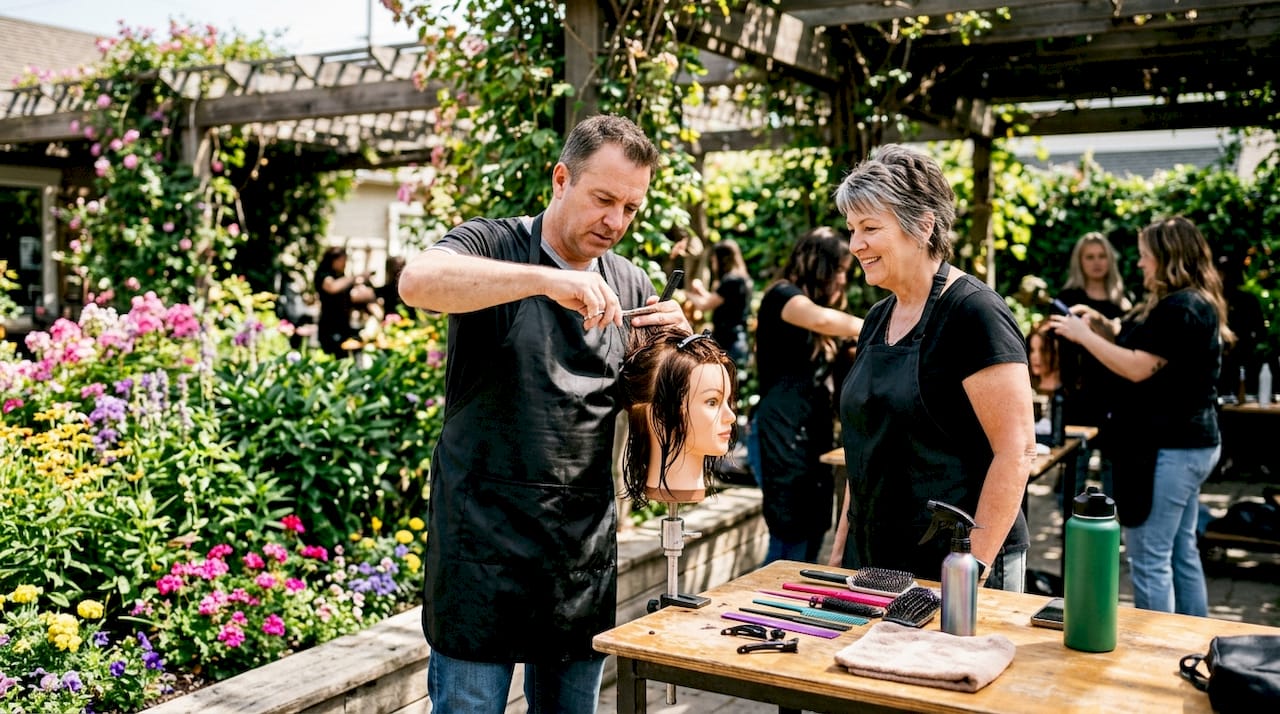
State rules vary significantly. California requires 3,200 apprenticeship hours versus 1,600 for school. Indiana recently introduced an apprenticeship pathway that mirrors this double-hour structure. Checking your state board’s exact requirements before choosing a path is not optional. It is the first step.
Pro Tip: Visit your state cosmetology board website and download the current hour requirements for both paths before you commit to either option. Requirements change, and 2026 has seen several states update their rules.
| Training Factor | Cosmetology School | Apprenticeship |
|---|---|---|
| Typical required hours | 1,000–1,600 hours | 2,000–3,200 hours |
| Average completion time | 9–18 months | 2–3 years |
| State availability | All 50 states | ~40% of states |
| Hour structure | Structured curriculum blocks | On-the-job plus theory |
2. How do cost and financial factors differ between cosmetology schools and apprenticeships?
Cost is where the two paths diverge most sharply, and the difference is not always what you expect. Cosmetology school tuition runs $6,500–$25,000, plus $1,200–$2,500 for kits and books. That is a significant upfront investment, and most students use financial aid or student loans to cover it.
Apprenticeships flip the financial model entirely. Apprentices earn wages during training, typically minimum wage plus tips, rather than paying tuition. That earn-while-you-learn structure removes the debt burden but comes with its own trade-offs.
The hidden costs of apprenticeship are easy to overlook:
- State exam fees apply to both paths equally, typically $75–$200 per attempt
- Supplies and tools may not be provided by the sponsoring salon
- Lost earning potential from a longer training period offsets wage income over time
- Mentor salon dependency means your income is tied to that salon’s client volume
School students face their own hidden costs. Kit upgrades, uniform requirements, and transportation to a campus add up. Financial aid through Title IV programs is available at accredited schools, which apprenticeships do not offer. For students who qualify for Pell Grants or subsidized loans, school can end up costing less out of pocket than it appears on a tuition sheet.
The real financial question is not “which costs less upfront?” It is “which path leaves me in the best financial position after licensing?” A school graduate who finishes in 12 months and lands a full-time salon job may out-earn an apprentice still training two years later, even after accounting for student loan payments.
3. How does the learning environment differ between cosmetology schools and apprenticeships?
Structured curriculum is the defining advantage of cosmetology school. School programs cover sanitation, OSHA safety standards, EPA regulations, chemical theory, anatomy, and a full range of technical services in a planned sequence. Students practice on mannequins before moving to live clients, and instructors supervise every step. That structure builds a consistent baseline across every graduate.
Apprenticeships offer something schools cannot replicate: daily immersion in a working salon from day one. You learn to manage real clients, handle booking systems, and read a room. That early business exposure is genuinely valuable, and salons recognize it.
The problem is consistency. Apprenticeship curricula vary by mentor salon and may lack structured theory teaching. A mentor who specializes in color may never teach you nail care, waxing, or updos. Those gaps show up on state board exams.
“Apprenticeships are not an easy shortcut. They often require more total time and a higher degree of self-motivation than school, and the quality of your training depends entirely on the quality of your mentor.”
Cosmetology Authority
Hands-on cosmetology training in a school setting combines supervised clinic floor time with classroom theory, giving students both depth and breadth. Apprentices get depth in whatever their mentor does well, and gaps everywhere else. For state board exam readiness, breadth wins.
4. What are the licensing, reciprocity, and career mobility implications of each path?
Both paths lead to the same state licensing exam, typically the National-Interstate Council of State Boards of Cosmetology (NIC) written and practical tests. Passing scores and exam content are identical regardless of how you trained. The difference appears when you try to move states.
License portability is easier for school graduates. Most states recognize cosmetology school hours from accredited programs during reciprocity applications. Apprenticeship hours face more scrutiny because many states do not have an apprenticeship pathway themselves and cannot verify or credit those hours.
Here is what that means practically:
- Research your target state first. If you plan to work in a state that does not recognize apprenticeship training, you may need to complete additional hours or retake portions of your training.
- Keep all documentation. Apprentices must maintain detailed logs of hours and services performed. Missing records can block a reciprocity application entirely.
- Check accreditation status. School graduates should confirm their program holds accreditation from the National Accrediting Commission of Career Arts and Sciences (NACCAS) or a recognized equivalent.
- Plan for exam fees in multiple states. Moving states often requires a new application fee and sometimes a new exam, regardless of training path.
License reciprocity complexity makes cosmetology school the safer long-term choice for anyone who might relocate. Salon owners also tend to hire school graduates more readily because they trust the standardized baseline those programs produce. Certification from an accredited program signals to employers that you covered the full scope of cosmetology services.
Pro Tip: Before enrolling in any program, call the cosmetology board in every state you might want to work in and ask directly whether they accept apprenticeship hours for reciprocity. Get the answer in writing.
5. Which training path suits different learner profiles and career goals?
The right path depends on your specific situation, not on which option sounds better in theory. Both routes produce licensed cosmetologists. The question is which one fits your life right now.
Cosmetology school is the better fit if you:
- Want a predictable timeline and a clear graduation date
- Need access to financial aid, Pell Grants, or federal student loans
- Plan to work across multiple states during your career
- Learn best with structured theory, supervised practice, and instructor feedback
- Have limited access to a willing mentor salon in your area
Apprenticeship is worth considering if you:
- Have secured a committed, experienced mentor willing to teach a full range of services
- Live in a state that formally recognizes and regulates apprenticeship programs
- Are financially self-sufficient during a 2–3 year training period without loan access
- Thrive in independent, self-directed learning environments
- Plan to stay in the same state long-term
Local availability matters more than most guides admit. Cosmetology education options vary widely by region. In rural areas, finding an accredited school may require relocation or online theory components. In urban markets, accredited programs are abundant and often have externship networks built in. Avi, for example, connects students in Northern Virginia with leading spas and salons for real-world placement before graduation.
The cosmetology program investment at an accredited school pays off most clearly for students who want career flexibility, employer confidence, and a structured path to licensure without the uncertainty of mentor-dependent training.
Key Takeaways
Cosmetology school offers a faster, more structured path to licensure with better license portability, while apprenticeships provide real-world experience but require more total time and carry greater variability in training quality.
| Point | Details |
|---|---|
| Training hours | School requires 1,000–1,600 hours; apprenticeships often require double that amount. |
| Cost structure | School costs $6,500–$25,000 in tuition; apprenticeships pay wages but offer no financial aid access. |
| Learning quality | School delivers standardized theory and exam prep; apprenticeships depend on mentor skill and service range. |
| License portability | School graduates face fewer barriers when transferring licenses across states. |
| Best fit | School suits structured learners and career movers; apprenticeship suits self-directed learners with strong mentor access. |
What I have learned from watching students choose between these two paths
The most common mistake I see is treating apprenticeship as the “practical” choice and school as the “academic” one. That framing is wrong. School programs at quality institutions are deeply practical. Students work on real clients in supervised clinic settings, learn business skills, and graduate with a portfolio of services. The classroom theory is not separate from the work. It is what makes the work safe and consistent.
Apprenticeships attract students who want to skip the tuition bill, and I understand that impulse completely. But the financial math rarely works out the way people expect. Two to three years of minimum wage income, no financial aid eligibility, and a license that may not transfer cleanly to another state is a significant risk. The students I have seen struggle most after licensing are often those who trained under a mentor who only did one or two service types. They pass the exam, but they freeze in a full-service salon.
The industry is also shifting. Salon owners increasingly expect new hires to walk in ready to perform a full menu of services from day one. That expectation favors school graduates. Apprenticeship-trained stylists often need additional mentoring on the job, which costs the salon time and money. That is not a dealbreaker, but it affects hiring decisions.
My honest advice: if you have any intention of moving states, working in a high-end salon, or building a career that grows beyond one location, choose an accredited school program. Research the program’s externship network, its exam pass rates, and its graduate placement record before you enroll. Those three numbers tell you more about a school’s quality than any brochure.
— krishna
Avi Career Training: structured cosmetology education in Northern Virginia
Avi Career Training in Fairfax County, VA offers a full cosmetology program built around hands-on clinic training, personalized instructor mentorship, and direct connections to Northern Virginia’s top spas and salons. Every student works with real clients under expert supervision, covering the full range of services required for state board exams and salon employment.
Avi’s accredited programs include financial aid options, making the school path accessible without the debt burden many students fear. The externship and career placement network connects graduates with employers before they even sit for their license exam. If you want a clear timeline, a strong foundation, and a team behind you from day one, Avi is worth a close look.
FAQ
How many hours does cosmetology school require vs an apprenticeship?
Cosmetology school typically requires 1,000–1,600 hours depending on the state, while apprenticeships often require double that amount, around 2,000–3,200 hours, because they include general salon work alongside technical training.
Is cosmetology school worth it financially?
Cosmetology school costs $6,500–$25,000 in tuition but offers access to federal financial aid and Pell Grants, which apprenticeships do not. School graduates also finish faster, which means they start earning a full salary sooner.
Can an apprenticeship license transfer to another state?
License transfer is harder for apprenticeship-trained cosmetologists because many states do not recognize apprenticeship hours during reciprocity applications. School graduates from accredited programs face fewer barriers when moving states.
Which path prepares you better for the state board exam?
Cosmetology school prepares students more thoroughly for state board exams because the curriculum covers all required service categories, including sanitation, OSHA standards, and technical skills. Apprentices may miss service areas their mentor does not regularly perform.
Do all states allow cosmetology apprenticeships?
No. Only about 40% of US states currently offer an apprenticeship alternative to cosmetology school. The remaining states require formal school enrollment as the only path to licensure.