Cosmetology School in Northern Virginia
AVI Career Training in Vienna, VA is an accredited cosmetology school in Northern Virginia that prepares students for Virginia State Board licensure through hands-on, inclusive training built for real salon careers.
If you’re serious about becoming a licensed cosmetologist in the DC metro area, the school you choose determines how fast you get there — and how ready you are when you do. Not every program is built the same. AVI Career Training is COE Accredited and SCHEV Certified, which means your credential will stand up in any Virginia salon, spa, or business you walk into.
This page covers everything you need to know: Virginia’s licensing requirements, what AVI’s Cosmetology program actually teaches, how long it takes, what cosmetologists earn in Virginia, and how to pay for school — including federal financial aid and the GI Bill®.
Ready to take the first step? Apply to AVI’s Cosmetology program today.
Key Takeaways
- Virginia requires 1,500 clock hours of cosmetology training before you can sit for your licensing exams
- Full-time students can typically complete the program in approximately 12–14 months
- AVI Career Training is COE Accredited and SCHEV Certified — both recognized by the Virginia State Board
- The mean annual wage for cosmetologists in Virginia is reported by the U.S. Bureau of Labor Statistics — with top earners in the DC/Northern Virginia metro consistently exceeding the state average
- Federal financial aid is available at AVI for those who qualify, and AVI accepts the GI Bill®
What to Look for in a Virginia Cosmetology Program
Choosing a cosmetology school is one of the most consequential decisions you’ll make for your career. A school that cuts corners on curriculum or lacks proper credentials can cost you time, money, and licensing eligibility. Here’s what matters.
Accreditation You Can Verify
Accreditation is not optional — it’s foundational. Two credentials matter most in Virginia: COE Accreditation (Council on Occupational Education) and SCHEV Certification (State Council of Higher Education for Virginia). AVI Career Training holds both.
COE Accreditation signals that a school meets rigorous standards for curriculum, faculty qualifications, and student outcomes. SCHEV Certification is required for any private postsecondary school operating legally in Virginia. When you see both, you’re looking at a school that has been externally reviewed and approved.
Accreditation also determines financial aid eligibility. If a school isn’t accredited by a recognized body, federal student aid — including Pell Grants — is off the table entirely.
A Curriculum Built for the Virginia State Board
Virginia’s licensing exams test both written theory and practical skills. Your school’s curriculum needs to prepare you for both — not just one. Look for programs that align their training directly with the Virginia State Board of Barbering and Cosmetology’s requirements and give you real client experience before exam day.
Inclusive Training Across All Hair Textures and Skin Tones
This is a differentiator that matters more than most schools acknowledge. A cosmetology education that only trains you on one hair type or one skin tone is an incomplete education. The DC and Northern Virginia market is one of the most diverse in the country. Clients of every background walk into salons here every day. If you can’t serve them confidently, you’re leaving business on the table.
AVI’s curriculum is built around inclusive techniques — teaching you to work beautifully across all hair textures and all skin tones. That’s not a marketing line; it’s how we train.
Schedule Flexibility and Realistic Timelines
Life doesn’t pause while you’re in school. Whether you’re changing careers, supporting a family, or transitioning out of the military, schedule flexibility is a real factor. Look for programs that offer options and are transparent about how long completion actually takes.
Virginia Cosmetology License Requirements
Before you can legally work as a cosmetologist in Virginia, you need to meet the requirements set by the Virginia Department of Professional and Occupational Regulation (DPOR). Here’s what the process looks like.
The 1,500 Clock Hour Requirement
Virginia mandates 1,500 clock hours of cosmetology education at a SCHEV-certified school. These hours must be completed at an approved institution — you can’t self-study your way to a Virginia cosmetology license. The hours cover a defined range of topics including haircutting, hair coloring, chemical services, skin care, nail basics, sanitation, and salon business practices.
Every hour you log at AVI counts toward this requirement.
Written and Practical Exams
Once you complete your 1,500 hours, you’ll apply to sit for two exams administered through PSI Services on behalf of the Virginia State Board:
- Written (Theory) Exam: Tests your knowledge of cosmetology science, sanitation, safety, Virginia laws, and professional standards
- Practical (Skills) Exam: A hands-on demonstration of core technical competencies assessed by a licensed examiner
You must pass both to receive your Virginia cosmetology license. AVI’s curriculum is structured to prepare you for exactly these benchmarks — not just to check boxes, but to walk into exam day confident.
License Renewal and Reciprocity
Once licensed, Virginia cosmetologists renew every two years. Virginia also has reciprocity agreements for licensed cosmetologists from other states, which means your credential has portability if you ever relocate.
AVI’s Cosmetology Program: What You’ll Learn and How Long It Takes
AVI Career Training’s Cosmetology program in Vienna, VA is built around one goal: making sure you graduate ready to pass your boards and ready to work.
What the Curriculum Covers
Over the course of your 1,500 training hours, you’ll build competency across the full scope of cosmetology services:
Hair Services
– Precision and classic haircutting techniques
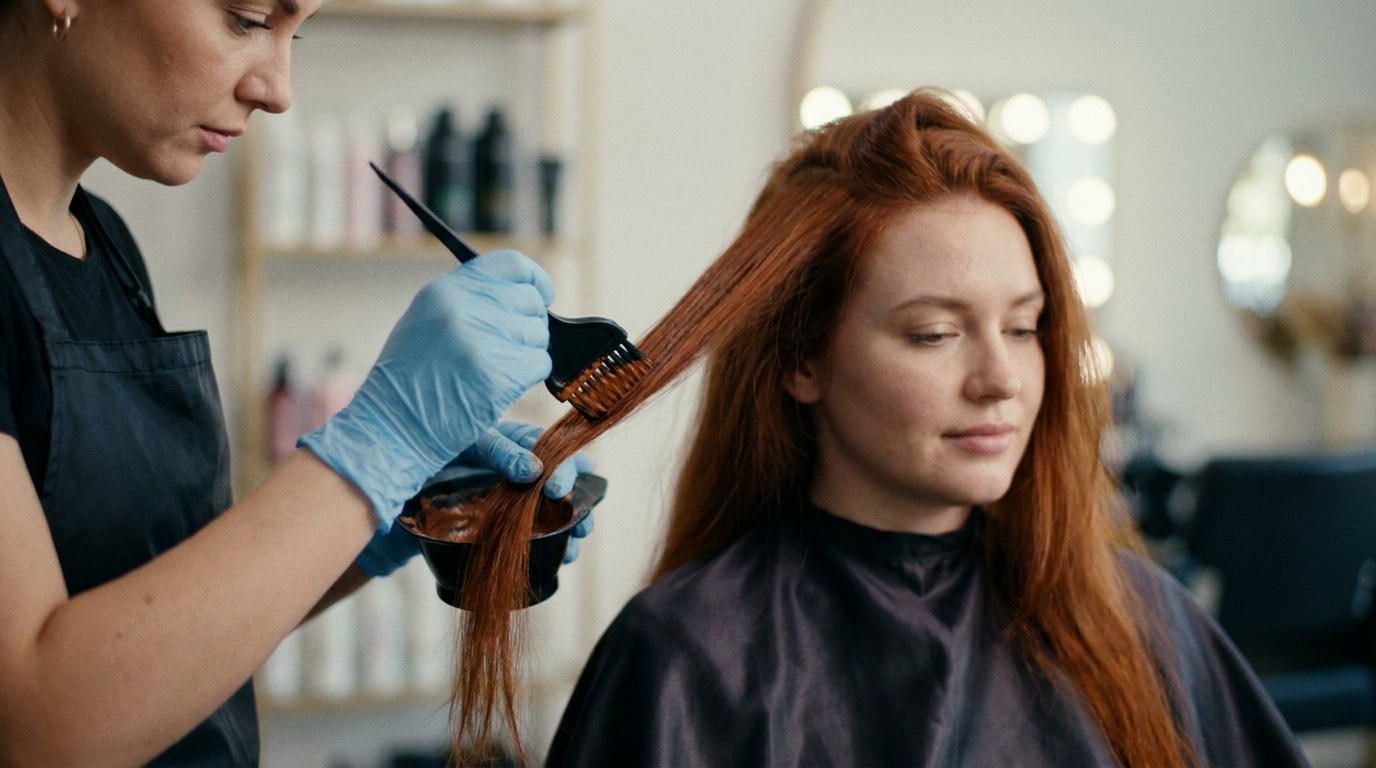
– Hair coloring — including highlights, balayage, corrective color, and gray coverage
– Chemical services — relaxers, keratin treatments, perms
– Blow-dry styling, thermal styling, and finishing techniques
– Natural hair and textured hair techniques across Type 1 through Type 4 curl patterns
Skin and Scalp
– Scalp analysis and treatments
– Basic facial and skin care services as they intersect with cosmetology scope of practice
Nail Services (Foundational)
– Basic manicure and nail care as required within cosmetology licensing scope
Science and Business
– Anatomy, physiology, and chemistry as they apply to cosmetology
– Infection control, sanitation, and Virginia State Board regulations
– Salon business fundamentals — client management, retail, professional communication
Inclusive Techniques
AVI’s training intentionally spans the full diversity of hair textures and skin tones you will encounter in a Northern Virginia salon. You won’t graduate having only practiced on one hair type. That matters here.
How Long Cosmetology School Takes in Virginia
Full-time students at AVI can typically complete the 1,500-hour requirement in approximately 12–14 months. The exact timeline depends on your schedule track and any breaks in attendance.
Important: Confirm current schedule options and exact timelines directly with AVI admissions, as program schedules can be updated. You can reach AVI’s admissions team here or call (703) 943-9841.
A Real Student’s Path: From Career Change to Licensed Cosmetologist
Consider someone like Maya — a 30-year-old former office manager in Fairfax who had always done hair for friends and family but never pursued it professionally. She enrolled in AVI’s Cosmetology program after researching accredited cosmetology schools in Northern Virginia and wanting something close to home with a strong inclusive curriculum.
By her 12th month, she had completed her 1,500 hours, passed both the written and practical Virginia State Board exams on her first attempt, and accepted a position at a Fairfax County salon specializing in natural and textured hair. The inclusive training she received at AVI meant she could serve her clients confidently from day one — not after months of learning on the job.
Cosmetologist Career Paths and Earning Potential in Virginia
A Virginia cosmetology license doesn’t lock you into one career path. It opens several.
What Cosmetologists Can Do with a Virginia License
Salon Stylist
The most common starting point. Work at an independent salon, a franchise location, or a boutique studio in one of Northern Virginia’s dense suburban markets — Arlington, Tysons, Reston, Fairfax, Alexandria.
Salon Owner / Independent Booth Renter
Licensure is the legal prerequisite for operating as an independent cosmetologist in Virginia. Booth rental and salon ownership are realistic mid-career moves, and both represent significant income ceiling increases over employment.
Platform Artist / Educator
Experienced cosmetologists with strong technical skills move into brand representation — demonstrating products and techniques at trade shows, education events, and training sessions for product lines.
Session Stylist / Editorial Work
The DC, Maryland, and Northern Virginia market has an active film, television, political, and media presence. Session stylists who work on shoots, productions, and editorial projects build careers that look very different from traditional salon work.
Freelance and Mobile Services
Wedding and event styling is a significant market in the DC metro area, where weddings routinely include large bridal parties. Many licensed cosmetologists build profitable freelance businesses around event work.
Cosmetologist Salary in Virginia
According to the U.S. Bureau of Labor Statistics (BLS), Virginia cosmetologists earn a mean annual wage that reflects both the state’s overall cost of living and the premium of established metropolitan markets like Northern Virginia and the DC suburbs.
Cosmetologists working in the DC/Northern Virginia metro area consistently trend above the state mean — reflecting the higher service prices, denser clientele, and affluent consumer base in this market.
A few honest notes on cosmetologist income:
- Tips are real income. Most salary data captures base wages only. In a busy Northern Virginia salon, tips meaningfully increase total take-home pay.
- Specialization drives earnings. Colorists, natural hair specialists, and bridal stylists typically out-earn generalist stylists.
- Self-employment raises the ceiling. Booth renters and salon owners bear more financial responsibility but have no wage cap.
Cosmetology is not a path to overnight wealth. It is a path to a sustainable, licensure-protected career in a growing, recession-resilient industry — in one of the highest-income markets in the United States.
A Second Story: Veteran to Cosmetologist
Consider someone like Darnell — a 28-year-old Army veteran from Woodbridge who separated after six years of service and used the Post-9/11 GI Bill® to enroll in AVI’s Cosmetology program. He had always had an eye for style and spent years cutting hair informally for fellow soldiers. At AVI, he applied that instinct to structured, board-prep training.
Darnell completed his 1,500 hours, passed his Virginia State Board exams, and opened a booth rental space in Manassas within 18 months of starting school. His GI Bill® benefits covered his tuition, which meant he graduated debt-free and could put his early earnings directly into building his client base. His specialty in fade cuts and textured men’s styling positioned him well in a market underserved by stylists with that specific skill set.
Paying for Cosmetology School: Financial Aid and GI Bill® at AVI
Cost is a real consideration — and it shouldn’t be the reason you don’t pursue a career you want. Here’s what’s available at AVI.
Federal Financial Aid
AVI Career Training is accredited by the Council on Occupational Education (COE), which means eligible students can access federal Title IV financial aid — including the Pell Grant and federal student loans. Pell Grants don’t need to be repaid, which makes them the most valuable form of aid for students who qualify.
To determine your eligibility, complete the Free Application for Federal Student Aid (FAFSA) at studentaid.gov. AVI’s admissions team can walk you through the process.
GI Bill® Benefits
AVI Career Training accepts the GI Bill®, including the Post-9/11 GI Bill®. If you’re a veteran or active-duty service member, your GI Bill® benefits may cover tuition and fees for cosmetology training at AVI. This is a significant advantage — and one of the reasons AVI’s student population includes a notable number of veterans transitioning into beauty and wellness careers.
Speak with AVI’s admissions team to confirm current benefit calculations and ensure your enrollment is structured to maximize your GI Bill® coverage.
What Cosmetology School Costs in Virginia
Tuition costs vary by school, program length, and what’s included (kit fees, exam prep materials, etc.). Contact AVI directly for current tuition figures. What you should evaluate alongside the sticker price:
- What financial aid is available and what you’re likely to qualify for
- Whether kit and materials costs are bundled or separate
- The licensing exam fees charged by PSI Services (these are paid to the state, not the school)
- The income you’ll start generating once you’re licensed — which directly offsets the investment
Talk to AVI admissions about tuition and financial aid options.
Is Cosmetology School Worth It in 2025?
The honest answer: yes — if you choose the right program, understand what the career actually looks like, and go in prepared.
Here’s the case for it:
The DC/Northern Virginia market is strong. Cosmetologists in this market have access to one of the densest, highest-income client bases in the country. Salons in this area charge premium prices, which means stylists earn more per service than they would in most other markets.
The industry is stable. Hair and beauty services are not easily outsourced or automated. Demand for licensed cosmetologists remains consistent even during economic downturns, because personal care is considered essential by most consumers.
Licensure protects your career. A Virginia cosmetology license isn’t just a credential — it’s a legally protected professional designation. You have something specific and verifiable to offer any employer or client.
The timeline is fast. In roughly a year of full-time training, you can be licensed and working. Compare that to a four-year degree with an uncertain job market on the other side.
The ceiling is high. Stylists who specialize, build clientele, and eventually move into ownership or education can build higher careers. It takes time and skill-building, but the path is real and clear.
What it requires from you: consistency, commitment to mastering your craft, and the willingness to build relationships with clients over time. That’s not a small ask — but it’s a learnable, achievable one.
Start Your Cosmetology Career at AVI Career Training in Vienna, VA
AVI Career Training is located at 1595 Spring Hill Rd #720, Vienna, VA 22182 — in the heart of Northern Virginia’s DC metro corridor, accessible from Fairfax, Tysons, Reston, Arlington, and beyond.
Our Cosmetology program is:
– COE Accredited and SCHEV Certified
– Built to prepare you for Virginia State Board written and practical exams
– Designed around inclusive techniques that work across all hair textures and skin tones
– Eligible for federal financial aid and GI Bill® benefits
Whether you’re starting fresh, changing careers, or returning to a passion you set aside — AVI gives you the training, the credentials, and the community to do it right.
Apply to AVI’s Cosmetology program now or call (703) 943-9841 to speak with an admissions advisor.
Your license. Your career. Your timeline. Let’s start.