Virginia has no state-mandated laser technician license — which means the certification and training you earn matters more than almost anywhere else in the country.
That’s both an opportunity and a responsibility. Medspas, dermatology clinics, and cosmetic surgery centers across Northern Virginia and the DC metro are actively hiring skilled laser technicians. But they’re not hiring just anyone. They want candidates who can demonstrate hands-on competency, understand laser-skin science, and work safely and effectively on every skin tone that walks through the door.
If you’re exploring this career path, this guide covers everything you need to know: what the job actually looks like day-to-day, what Virginia’s regulatory landscape means for you, what you can expect to earn, and how to find a training program that gives you a real competitive edge.
AVI Career Training offers a Cosmetic Laser Technician program in Vienna, VA — built around inclusive techniques, hands-on practice, and industry-recognized certification. If you’re ready to take the first step, you can apply now or keep reading to learn exactly what this career involves.
—
Key Takeaways
- Virginia has no state laser license requirement — certification from an accredited program is your primary credential and your competitive differentiator
- Cosmetic laser technicians in the DC metro area can earn $40,000–$70,000+ annually, with experienced techs in high-volume medspas earning more
- AVI’s Cosmetic Laser Technician program is COE-accredited, taught by licensed professionals, and includes inclusive skin tone training
- The medspa industry is growing fast — the U.S. medical aesthetics market is projected to exceed $15 billion by 2027, driven by demand for laser services
- Training programs vary widely — COE accreditation and hands-on clinical hours are the markers that separate serious programs from low-quality alternatives
—
What a Cosmetic Laser Technician Actually Does
Before you commit to any training program, it helps to know what this job looks like in practice — not just the glossy version, but the real day-to-day.
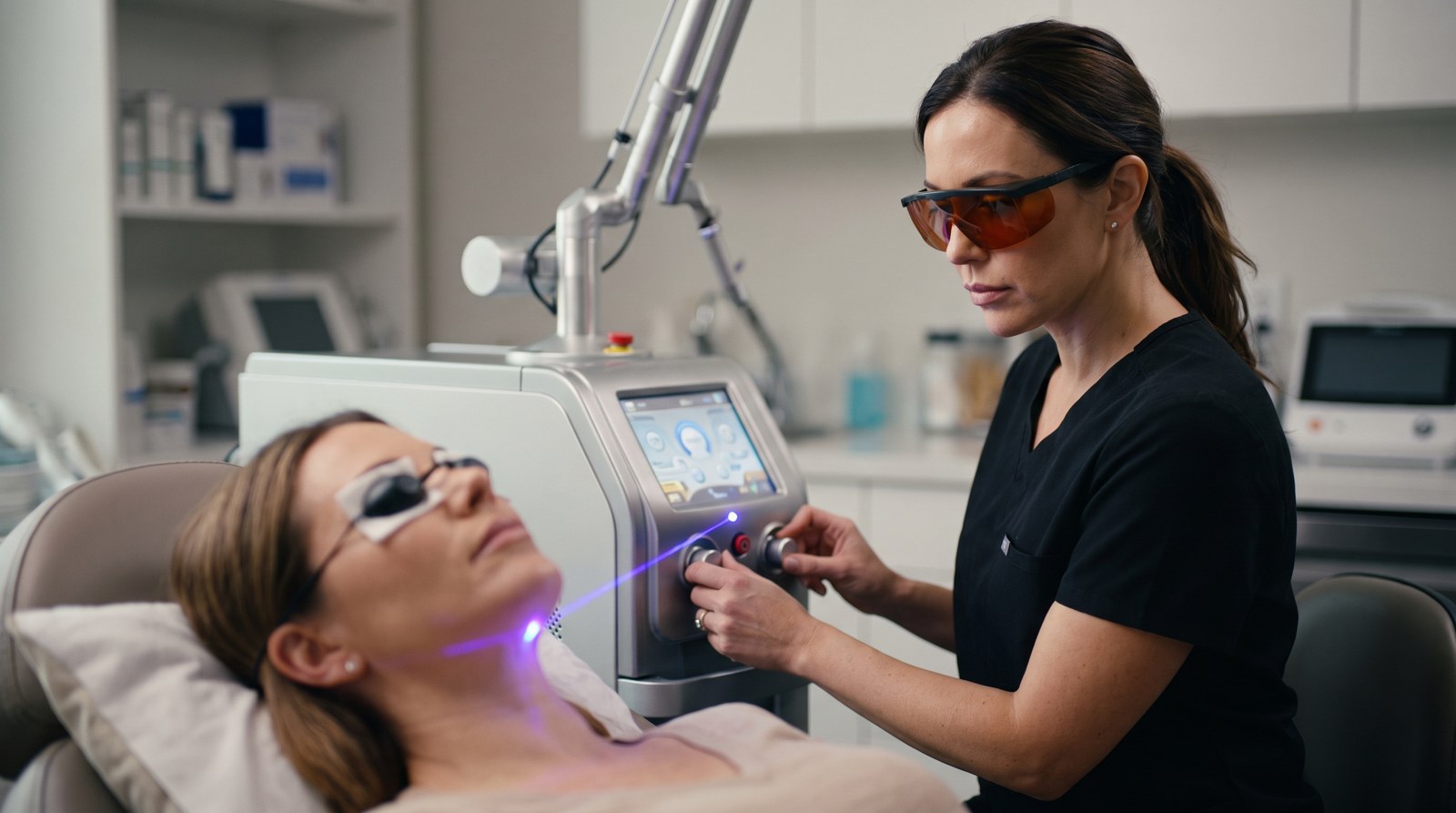
Cosmetic laser technicians operate laser and light-based devices to perform aesthetic treatments. These include laser hair removal, photofacials (IPL treatments), laser skin resurfacing, pigmentation correction, and non-invasive body contouring. In some settings, laser techs also operate radiofrequency and ultrasound-based devices.
A typical day might include:
- Reviewing client intake forms and medical history for contraindications
- Performing patch tests and skin assessments before treatment
- Calibrating equipment settings based on skin type, hair color, and treatment area
- Delivering treatments with precision and monitoring client comfort
- Documenting outcomes and scheduling follow-up appointments
- Educating clients on aftercare and setting expectations for results
The Science Behind the Job
Laser technology is grounded in a principle called selective photothermolysis — the idea that specific wavelengths of light can target particular chromophores (melanin, oxyhemoglobin, water) in skin tissue without damaging surrounding structures. This isn’t just trivia. Understanding these principles is what separates a technician who can adjust confidently when something doesn’t go as expected from one who’s just following a script.
Good training covers this science in depth. It’s also what makes this career intellectually engaging for people who want more than a routine service job.
Who You’ll Work With
Cosmetic laser technicians work across a range of settings in Northern Virginia and the broader DC metro:
- Medspas: The most common employer, ranging from boutique owner-operated practices to multi-location chains
- Dermatology clinics: Often handle more complex cases including acne scarring, rosacea, and post-surgical skin
- Plastic surgery centers: May assist with pre- and post-procedure laser treatments
- Cosmetic surgery practices: Similar to plastic surgery, with a focus on aesthetic outcomes
- Day spas and wellness centers: Expanding into laser services as consumer demand grows
In some settings, a cosmetic laser technician works under the supervision of a licensed physician or nurse practitioner. In others — particularly for non-ablative treatments like laser hair removal — technicians have more independent client-facing responsibility.
—
Virginia’s Regulatory Landscape for Laser Technicians
This is the part that surprises most people exploring this career in Virginia.
Unlike cosmetology and esthetics, which are regulated by the Virginia Department of Professional and Occupational Regulation (DPOR), cosmetic laser technology does not have a dedicated state licensing category in Virginia. There is no “Virginia laser license” to obtain.
What That Means in Practice
Without a state license requirement, the credential that defines you as a qualified laser technician is the certification you earn through your training program — and the reputation of the institution that issued it.
This creates a market where two technicians can both say they’re “certified” while having very different levels of actual competency. One may have completed a rigorous, COE-accredited program with 100+ hours of hands-on clinical training. Another may have completed a weekend course from a vendor with no accreditation.
Employers in the DC metro area know the difference. When a medspa medical director is reviewing applications, they’re looking at:
- Where you trained and whether the program is accredited
- How many clinical hours you logged
- Whether your training covered a full range of skin types and tones
- What devices you’re trained to operate
- Any additional credentials (such as NCEA or CIDESCO certification)
Why Accreditation Matters So Much Here
COE accreditation — the standard held by AVI Career Training — signals that a program meets nationally recognized standards for curriculum quality, faculty credentials, student outcomes, and institutional integrity. For laser technician training specifically, this matters because state licensure doesn’t exist to serve as a quality filter. Accreditation fills that gap.
When you train at an accredited school, you’re not just earning a certificate. You’re earning a credential backed by an independent quality standard — one that employers recognize and trust.
—
Cosmetic Laser Technician Salary in Virginia
Salary data for cosmetic laser technicians specifically can be difficult to pin down because the Bureau of Labor Statistics groups this role under broader categories. The most relevant BLS category is Skincare Specialists (SOC 39-5094), which includes estheticians and related practitioners.
Earning Ranges in Northern Virginia
In the DC metro area — which consistently ranks among the highest-paying markets for skincare and aesthetics professionals — cosmetic laser technicians can expect:
- Entry-level (0–2 years): $38,000–$50,000 annually
- Mid-career (3–5 years): $50,000–$65,000 annually
- Experienced / specialized (5+ years): $65,000–$85,000+ annually, particularly in high-volume medspas or specialized clinics
Hourly rates typically range from $18 to $35, depending on setting and experience. Many medspa positions also include commission structures tied to treatment volume or retail sales, which can significantly increase total compensation.
Factors That Influence Your Earning Potential
Your salary as a cosmetic laser technician in Virginia isn’t fixed — it moves based on several variables you can influence directly:
Device specialization: Technicians trained on a wider range of devices (Nd:YAG, diode, IPL, fractional CO2, radiofrequency) command higher rates because they can generate more revenue for their employer.
Skin tone competency: Medspas serving diverse clientele — and Northern Virginia’s population is exceptionally diverse — actively seek technicians who can safely and confidently treat deeper skin tones. This is a skill that not all programs teach well.
Client retention: In commission-based positions, your ability to build a loyal client base directly affects your income. This comes from technical skill, communication, and client education.
Location within Northern Virginia: Tysons Corner, McLean, Arlington, and Fairfax typically offer higher compensation than more suburban markets.
—
Choosing a Cosmetic Laser Technician Program in Virginia
The program you choose shapes your career trajectory from day one. Here’s what to evaluate before you enroll anywhere.
Accreditation and Institutional Credentials
As covered above, accreditation matters enormously in a field without state licensure. Look for programs offered by COE-accredited or ACCSC-accredited schools. These designations indicate that an independent body has reviewed the school’s curriculum, faculty, facilities, and student outcomes.
AVI Career Training is COE-accredited and SCHEV-certified, making it one of the credentialed options for cosmetic laser technician training in Northern Virginia.
Curriculum Depth: What Should Be Covered
A rigorous laser technician program should cover:
- Laser physics and the principles of selective photothermolysis
- Laser safety protocols (ANSI standards, optical hazards, protective equipment)
- Skin anatomy and physiology, with emphasis on melanin science
- Fitzpatrick skin type classification and its clinical applications
- Contraindications: medical conditions, medications, and lifestyle factors
- Hands-on device operation across multiple laser and light-based platforms
- Treatment protocols for laser hair removal, photofacials, skin resurfacing, and pigmentation
- Client consultation, documentation, and informed consent
- Adverse event recognition and management
- Business and professional practice skills
Inclusive Training: A Non-Negotiable
If a program’s marketing materials show only one skin tone — or if their faculty can’t speak specifically to treating Fitzpatrick types IV–VI — that’s a meaningful gap.
AVI’s curriculum is built around inclusive techniques by design. In the Northern Virginia and DC metro market, where clients represent an extraordinary range of ethnicities and skin tones, this isn’t optional. It’s core competency.
Hands-On Clinical Hours
Theory is necessary. But technique is built through repetition on real clients under supervised conditions. Ask any program you’re considering: How many clinical hours are included? Do students work on live models? What devices will you actually operate — not just observe?
Financial Aid Eligibility
Programs offered by accredited schools are typically eligible for federal financial aid, including Pell Grants. AVI also accepts the GI Bill® for eligible veterans and military-affiliated students. If a program is not offered through an accredited institution, it likely won’t be eligible for federal aid — which matters significantly when comparing program costs.
—
Two Students Who Made This Work
From Medical Records to the Treatment Room
Priya had spent seven years working in healthcare administration at a hospital in Fairfax. She was good at her job, but she wanted something client-facing — something where she could see the direct impact of her work. She’d always been interested in skincare, and after researching careers that combined technical skills with client interaction, she landed on cosmetic laser technology.
She enrolled in AVI’s Cosmetic Laser Technician program while continuing to work part-time. The program’s schedule was manageable, and the hands-on clinical component gave her confidence she hadn’t expected to build so quickly. Within three months of completing her certification, Priya was hired at a medspa in Tysons Corner. Within her first year, she had built a consistent client base and was earning more than she had in her previous role — while genuinely looking forward to going to work.
A Career Pivot After the Military
Marcus separated from the Army after eight years and wasn’t sure what came next. He knew he wanted a career in a growing field, something with real earning potential and a clear path forward — but he wasn’t interested in a four-year degree. A friend mentioned the cosmetic laser program at AVI, and when Marcus learned that the GI Bill® covered the cost, the decision became straightforward.
What he didn’t expect was how much the science component would engage him. The precision required in laser calibration, the logic of treatment protocols, the importance of safety procedures — it mapped onto skills he’d developed in the military. He graduated, earned his certification, and accepted a position at a dermatology-affiliated medspa in Arlington. His technical background made him stand out from the start.
—
How to Launch Your Cosmetic Laser Technician Career in Northern Virginia
If you’ve read this far, you have a clear picture of what this career involves, what it pays, and what the path looks like. Here’s how to take concrete next steps.
Step 1: Research Your Program Options Carefully
Don’t enroll in the first program you find. Evaluate accreditation, curriculum depth, clinical hours, inclusive training, and financial aid eligibility. Ask schools directly: What devices will I operate? How many clients will I treat during training? What does job placement look like for graduates?
Step 2: Understand Your Financial Aid Options
If cost is a factor — and for most students, it is — find out whether the program qualifies for federal financial aid. COE-accredited schools like AVI are eligible. Veterans should ask specifically about GI Bill® benefits and whether the school has a dedicated point of contact for military-affiliated students.
Step 3: Get Hands-On Early
If possible, shadow a cosmetic laser technician at a local medspa before you start a program. Even one afternoon observing a treatment session will give you a realistic picture of the work and confirm that it’s the right fit for you.
Step 4: Build Your Professional Network During Training
The Northern Virginia and DC metro aesthetics community is active and connected. Your instructors, your clinical supervisors, and your fellow students are the beginning of your professional network. Don’t wait until graduation to start building those relationships.
Step 5: Apply to AVI Career Training
AVI’s Cosmetic Laser Technician program is designed for working adults who are serious about building a career. The program covers the full scope of laser and light-based aesthetics, trains students on inclusive techniques for all skin tones, and is backed by COE accreditation that employers in this market recognize.
If you’re ready to take the first step, apply now or call (703) 943-9841 to speak with an admissions advisor. You can also learn more about AVI Career Training and explore the full program catalog.
AVI Career Training is located at 1595 Spring Hill Rd #720, Vienna, VA 22182 — in the heart of Northern Virginia, easily accessible from Tysons, Fairfax, Arlington, and the broader DC metro area.
—
The cosmetic laser technician field rewards people who combine technical precision with genuine care for their clients. If that sounds like you, the career is there. The training is available. The next step is yours to take.