
The Post-9/11 GI Bill, officially known as Chapter 33, is a federal education benefit that covers tuition, fees, housing, and supplies for eligible veterans attending VA-approved vocational programs, including beauty and cosmetology schools. If you’ve served at least 90 days of active duty after september 10, 2001, this benefit can fund your entire path into the beauty industry. What most veterans don’t realize is that Chapter 33 applies to hands-on trade programs, not just four-year colleges. Avi Career Training in Fairfax County, VA, accepts Chapter 33 benefits and helps veterans navigate every step from application to graduation.
What is Chapter 33 beauty school coverage and who qualifies?
Chapter 33 beauty school benefits are defined as VA-funded education payments applied to VA-approved cosmetology, esthetics, massage therapy, and related vocational programs. The Post-9/11 GI Bill covers up to 36 months of benefits, including tuition and fees paid directly to the school, a monthly housing allowance, and an annual book and supplies stipend of up to $1,000. That 36-month ceiling is enough to complete most full-time cosmetology or esthetics programs with room to spare.
Eligibility is based on your total active-duty service time after september 10, 2001. The VA assigns a benefit percentage tier, ranging from 40% for 90 days of service up to 100% for 36 months or more. Your tier directly controls how much of your tuition the VA pays. A veteran at 100% eligibility attending a public in-state school pays nothing out of pocket for tuition. A veteran at 60% eligibility receives 60% of the maximum benefit rate, and must cover the remaining balance.
The monthly housing allowance is calculated using the Basic Allowance for Housing (BAH) rate for an E-5 with dependents at the school’s zip code. This is not a flat national number. A veteran attending a beauty school in Northern Virginia receives a higher housing allowance than one attending in a rural area, simply because local BAH rates are higher. That geographic factor makes location a real financial variable when choosing your school.
How to find and verify VA-approved beauty schools
Not every beauty school accepts Chapter 33 funds. Verifying VA approval before enrollment is the single most important step you can take. Veterans who skip this step risk enrolling in a program that cannot certify their benefits, which means no tuition payment and no housing allowance.
The VA’s GI Bill Comparison Tool, available at va.gov, lets you search any school by name or location and confirm its approval status. Use it before you visit a campus, not after. Here is the verification process in order:
- Search the school in the VA’s GI Bill Comparison Tool and confirm it appears as an approved institution.
- Contact the school’s VA certifying official directly to confirm the specific program you want is approved, not just the school overall.
- Request your Certificate of Eligibility (COE) from the VA through VA.gov or by calling 1-888-GIBILL-1.
- Gather your required documents: high school diploma or GED, government-issued photo ID, and your COE.
- Schedule a campus tour and admissions interview before signing any enrollment contract.
Beauty schools must meet VA accreditation and program standards to receive approval. That process involves state licensing board oversight and VA program review. A school that recently gained approval may not yet appear in the Comparison Tool, so always call the school’s certifying official to double-check.
Pro Tip: Ask the school’s admissions team for the full name and contact information of their VA certifying official before your campus visit. That one contact will be your most important relationship throughout your enrollment.

Avi’s esthetician school in Fairfax County provides dedicated admissions staff who walk veterans through the approval verification process before any paperwork is signed.
What does the enrollment process look like for veterans?
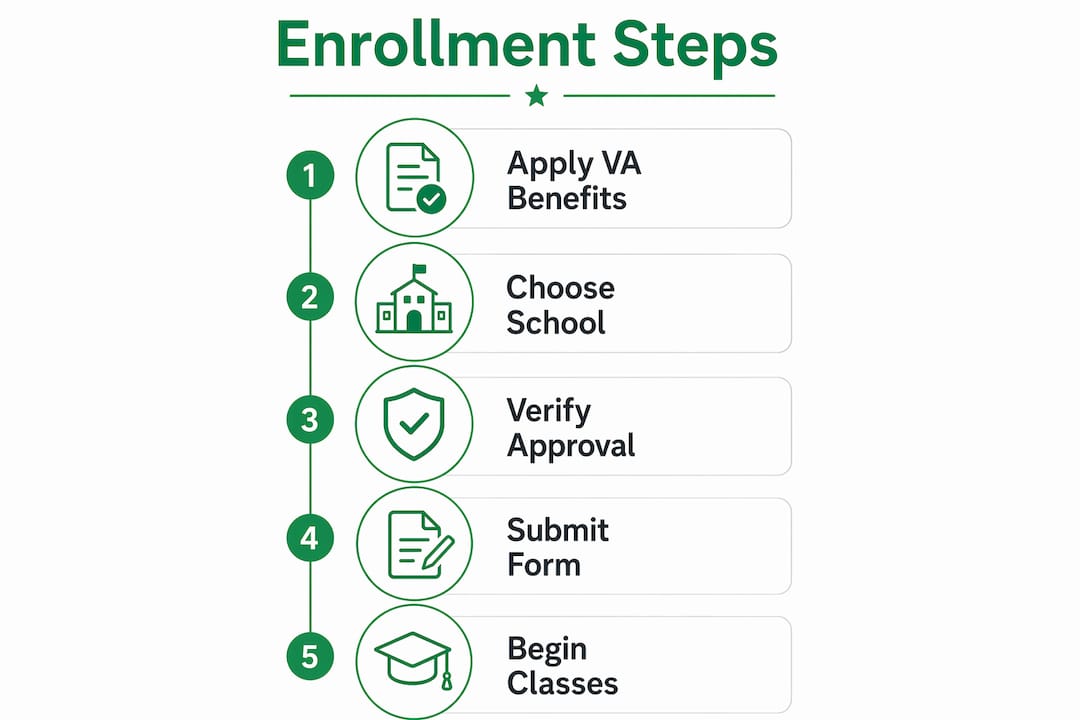
The enrollment process for veterans using Chapter 33 at beauty schools follows a clear sequence. Admissions interviews confirm veteran readiness for the physical and scheduling demands of cosmetology training. This is not a formality. Beauty school programs involve long hours on your feet, hands-on client work, and strict attendance requirements. The interview exists to make sure you understand what you’re committing to.
The full enrollment sequence looks like this:
- Schedule your campus tour. Walk the floor, observe students in training, and ask about daily schedules and program length.
- Attend your admissions interview. Discuss your career goals and confirm the program aligns with your timeline and physical expectations.
- Submit your documents. Provide your high school diploma or GED, photo ID, and Certificate of Eligibility.
- Complete enrollment paperwork. Sign your enrollment agreement and complete any state-required forms.
- VA certification submission. The school’s certifying official submits Form 22-1999 to the VA, which triggers your benefit payments.
That last step is where many veterans experience delays. VA certifying officials manage Form 22-1999 to trigger benefit payments, and processing times vary. Build a relationship with your certifying official from day one. Knowing their name and checking in regularly prevents small paperwork errors from becoming month-long payment delays.
Avi’s cosmetology program near Fairfax, VA includes a structured admissions process designed specifically to help veterans align their career goals with the right program before they commit.
How to maximize Chapter 33 benefits and avoid common pitfalls
The most common mistake veterans make is enrolling before confirming their school’s VA approval status. Many veterans assume all beauty schools are VA-eligible, but approval is program-specific, not just institution-wide. Confirming approval at the program level, not just the school level, protects your benefits from the start.
Housing allowance is the benefit most veterans underestimate and most easily lose. Full housing allowance requires enrollment above half-time, with at least one class taken on campus. Fully online programs or schedules certified below half-time result in a reduced or eliminated monthly housing payment. If your program allows any online coursework, confirm with your certifying official exactly how your hours will be certified before you register.
Pro Tip: Never drop below half-time enrollment without first calling your VA certifying official. A single schedule change can cut your housing allowance immediately, and reinstating it requires a new certification cycle.
If you receive less than 100% of your Chapter 33 benefit, partial benefits require out-of-pocket payment by the school’s tuition deadline or your classes may be dropped. Ask the school’s financial aid office whether a payment plan is available for the remaining balance. Many VA-approved beauty schools offer this option specifically for veterans at lower eligibility tiers.
VA law under Title 38 U.S. Code 3679 prohibits approved schools from charging late fees or removing veterans from classes due to delayed VA tuition payments, provided the COE was submitted on time. This protection is real and enforceable. If a school threatens to drop you for a VA payment delay, cite this statute directly to the financial aid office.
Here is a quick checklist to protect your benefits throughout enrollment:
- Confirm program-level VA approval, not just school-level approval.
- Submit your COE before the semester payment deadline.
- Stay enrolled above half-time and attend at least one on-campus class.
- Know your certifying official’s name and check in at the start of each term.
- Ask about payment plans if your benefit tier is below 100%.
Avi’s financial aid team helps veterans understand both Chapter 33 coverage and supplemental aid options when benefits don’t cover the full program cost.
Key Takeaways
Chapter 33 beauty school benefits cover tuition, housing, and supplies at VA-approved programs, but maximizing them requires confirming program-level approval, maintaining above half-time enrollment, and building a direct relationship with your school’s VA certifying official.
| Point | Details |
|---|---|
| Confirm program approval | Use the VA’s GI Bill Comparison Tool to verify the specific beauty program, not just the school. |
| Know your eligibility tier | Your benefit percentage determines how much tuition the VA pays; tiers range from 40% to 100%. |
| Protect your housing allowance | Stay enrolled above half-time and attend at least one on-campus class to retain full monthly payments. |
| Submit your COE on time | Timely COE submission triggers VA payment and protects you from late fees under Title 38 U.S. Code 3679. |
| Build rapport with your certifying official | Your school’s VA certifying official processes Form 22-1999 and directly controls the speed of your benefit payments. |
Why veterans belong in the beauty industry
Veterans bring something most beauty school students don’t: discipline, precision under pressure, and the ability to follow complex procedures without cutting corners. I’ve seen this play out repeatedly. The same attention to detail that keeps a soldier’s equipment mission-ready translates directly into the technical demands of cosmetology and esthetics work.
The mindset shift is real, though. Military culture rewards hierarchy and uniformity. Beauty school rewards creativity and individual expression. That transition feels uncomfortable at first, and that’s normal. The veterans who thrive are the ones who treat the adjustment as a new mission, not a loss of identity.
The biggest mistake I see veterans make is waiting too long to start because the process feels bureaucratic. Yes, the VA certification paperwork takes time. Yes, you need to verify approval before you sign anything. But none of that is harder than what you’ve already done. The GI Bill exists precisely because your service earned it. Using it for a hands-on career in beauty is not a lesser choice. For many veterans, it’s the most satisfying career move they ever make.
My honest advice: call the VA certifying official at your target school before your campus tour. Ask them directly how many veterans they currently have enrolled and how smoothly the certification process runs. That one conversation tells you more about a school’s veteran-friendliness than any brochure.
— krishna
Avi Career Training and Chapter 33 benefits
Avi Career Training in Fairfax County, VA, is a VA-approved beauty school with programs in cosmetology, esthetics, and massage therapy, all eligible for Chapter 33 funding. Avi’s admissions team includes staff experienced in VA benefit navigation, helping veterans confirm eligibility, submit documentation, and connect with the school’s certifying official from day one.
Veterans attending Avi benefit from hands-on training, partnerships with leading Northern Virginia spas and salons, and a structured path from enrollment to licensure. Whether you’re exploring beauty school options in Belle Haven or want to understand how your GI Bill applies to a specific program, Avi’s admissions team is ready to walk you through every step. Contact Avi today to schedule your campus tour and start putting your Chapter 33 benefits to work.
FAQ
What is Chapter 33 in the context of beauty school?
Chapter 33, the Post-9/11 GI Bill, is a VA education benefit that covers tuition, fees, a monthly housing allowance, and an annual supplies stipend of up to $1,000 at VA-approved beauty and cosmetology programs.
How do I know if a beauty school accepts Chapter 33?
Search the school in the VA’s GI Bill Comparison Tool at va.gov and confirm the specific program is approved. Always verify at the program level, not just the institution level, before signing any enrollment agreement.
Does Chapter 33 cover the full cost of beauty school?
Veterans at 100% eligibility attending an in-state public school pay nothing out of pocket for tuition. Veterans at lower eligibility tiers receive a proportional benefit and are responsible for the remaining balance, which some schools cover through payment plans.
What documents do I need to enroll in beauty school using Chapter 33?
You need a Certificate of Eligibility from the VA, a high school diploma or GED, and a government-issued photo ID. Submit these before your enrollment deadline to trigger timely benefit payments.
Can a beauty school drop me if the VA is slow to pay?
No. Under Title 38 U.S. Code 3679, VA-approved schools cannot penalize veterans or remove them from classes due to delayed VA tuition payments, as long as the Certificate of Eligibility was submitted on time.