Beauty School for ESL Students in Northern Virginia
Yes — you can attend beauty school and build a rewarding career in the beauty industry even if English is not your first language. At AVI Career Training in Vienna, Virginia, students from dozens of countries and language backgrounds have earned their Virginia licenses and launched professional careers in cosmetology, esthetics, nail technology, and massage therapy. Language does not have to be a barrier. In fact, in Northern Virginia’s diverse, multilingual communities, it can be one of your greatest professional strengths.
This guide walks you through everything you need to know as an ESL student exploring beauty school — from what to look for in a program, to how the Virginia State Board licensing exam works, to what you report earning once you’re licensed.
—
Key Takeaways
—
Can You Attend Beauty School If English Isn’t Your First Language?
Absolutely. Beauty and wellness training is fundamentally a hands-on profession. The core skills — cutting, coloring, applying skincare treatments, performing massages, shaping nails — are learned through doing, not through reading textbooks. You watch a technique demonstrated. You practice it. You refine it. That learning process does not require fluency in English.
This is one of the most important things to understand before letting language anxiety hold you back. The vast majority of your hours in beauty school are spent on the clinic floor, working on real clients under instructor supervision. You are building muscle memory, technical precision, and professional confidence — all of which transfer across languages.
That said, there is a written theory component to your Virginia State Board licensing exam. It covers topics like sanitation, safety, state regulations, and program-specific knowledge. This is where preparation matters, and where choosing the right school — one that supports ESL students intentionally — makes a real difference.
If you are ready to explore your options, start your application at AVI Career Training or call (703) 943-9841 to speak with an admissions advisor today.
—
What to Look for in a Beauty School as an ESL Student
Not every beauty school is equally prepared to support students who are still building their English skills. When you are evaluating schools, here are the key factors to look for — and what AVI Career Training offers in each area.
Hands-On, Skills-Based Curriculum
The more a school’s program relies on doing rather than just listening, the more accessible it is for ESL students. Look for schools where students spend the majority of their time on the clinic floor practicing real services. At AVI, hands-on training is at the core of every program — from cosmetology to nail technology to massage therapy.
Accreditation You Can Trust
COE accreditation (Council on Occupational Education) is a nationally recognized standard of quality. It means the school has been independently evaluated for its curriculum, its instructors, its facilities, and its student outcomes. AVI Career Training is COE Accredited and SCHEV Certified through the State Council of Higher Education for Virginia.
Accreditation also matters for financial aid eligibility. If you need help paying for school, an accredited institution can connect you with federal Pell Grants and other funding — making training more financially accessible regardless of your background.
Diverse, Inclusive Student Community
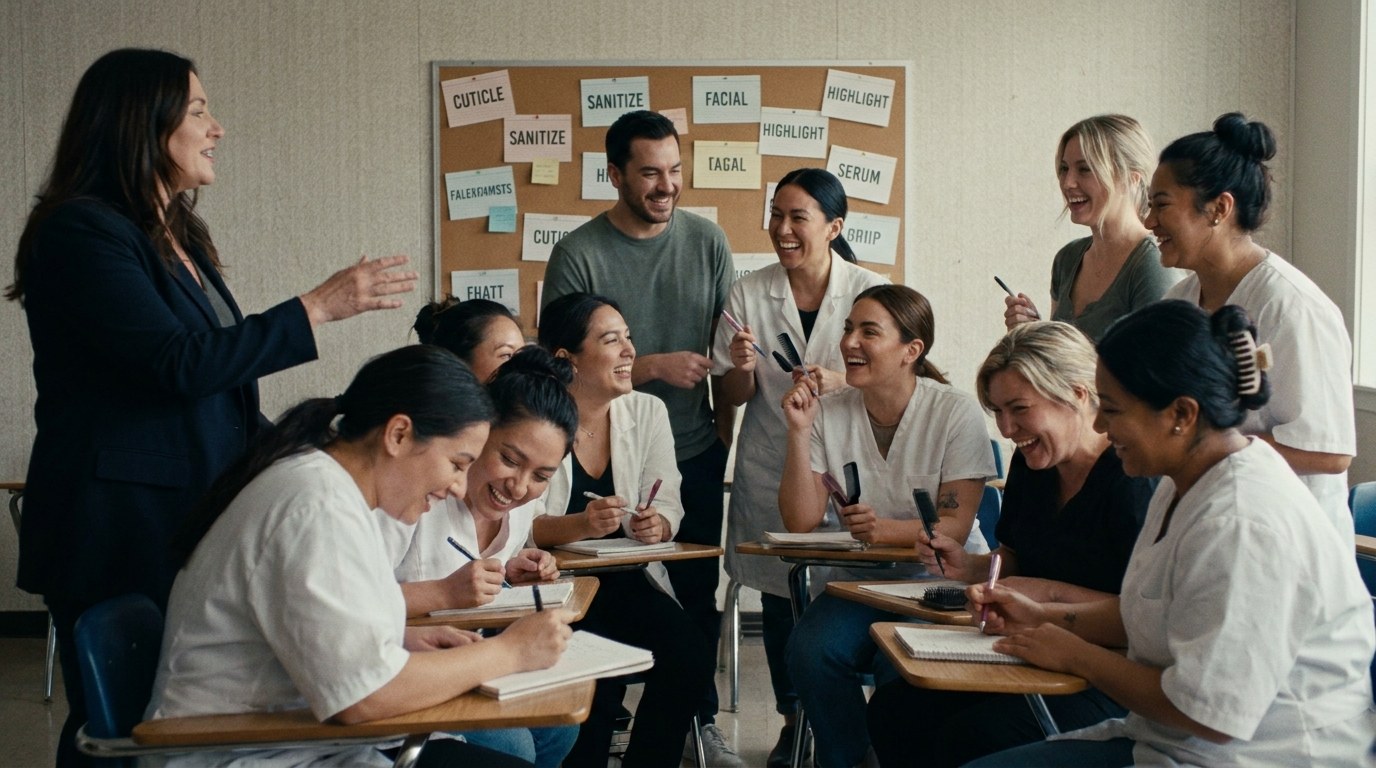
You should feel welcome from your first day. A school that draws students from many cultural backgrounds will naturally develop instructors and staff who are skilled at communicating across language differences — using demonstration, visual aids, and patience rather than assuming everyone learns the same way.
Flexible Scheduling
Many ESL students are also balancing work, family responsibilities, or other commitments. Schools that offer flexible schedule options — including part-time tracks — make it more realistic to complete your training without putting your life on hold.
Financial Aid Access
Tuition costs are a real concern. Look for schools that accept federal financial aid, including Pell Grants. AVI Career Training also accepts the GI Bill® for eligible veterans and military-connected students.
—
Virginia State Board Licensing: What ESL Students Need to Know
Understanding how licensing works in Virginia — before you start school — removes one of the biggest sources of anxiety for ESL students. Here is what the path to licensure actually looks like.
Clock Hours Required by Program
Virginia sets specific training hour requirements for each license type, regulated by the Virginia Department of Professional and Occupational Regulation (DPOR):
These are training hours completed at your school. Once you finish your program hours and meet other requirements, you are eligible to sit for the Virginia State Board exam.
The Two-Part Exam: Written and Practical
The Virginia State Board licensing exam has two components:
The Written (Theory) Exam covers your knowledge of safety, sanitation, state regulations, and program-specific theory. This is administered by PSI Exams. For ESL students, this is the part that requires the most preparation — not because the content is impossible, but because it involves reading and answering questions in English.
Here is a genuinely useful detail that most beauty school websites never mention: PSI Exams has an accommodation request process. ESL students and students with language-related needs can explore what accommodations may be available by contacting PSI directly before their exam date. Requesting accommodations in advance is a legitimate, supported option — not a workaround.
The Practical (Hands-On) Exam is almost entirely language-minimal. You demonstrate specific techniques on a mannequin or model, following timed instructions. Your hands do the talking. For many ESL students, this portion of the exam is actually the strongest part of their performance — because it tests exactly what they have been practicing every day.
How AVI Prepares You for Both Parts
AVI’s curriculum is designed to prepare you for the full licensing exam, not just the practical component. Theory is taught in ways that use visual demonstration, repetition, and clear written materials — instructional approaches that support learners at all English proficiency levels. As your exam date approaches, your instructors work with you on both the hands-on skills and the written content you need to know.
—
How AVI Career Training Supports a Diverse, Multilingual Student Body
AVI Career Training’s student body reflects the extraordinary diversity of Northern Virginia itself. Students from Latin America, East Africa, Southeast Asia, the Middle East, and Eastern Europe have all trained at AVI — and gone on to build successful careers in the DC metro beauty market.
This is not accidental. It reflects something fundamental about how AVI approaches beauty education.
Inclusive by Design, Not by Default
Most beauty schools train students primarily on one skin tone and one hair type. AVI’s curriculum is built to train you on every skin tone and every hair texture. That is not just a philosophical statement — it is a practical training decision that prepares you for the real clientele you will serve in Northern Virginia.
When you graduate from AVI, you are not guessing how to work on a client whose skin tone or hair texture looks different from what you practiced on in school. You have already done it, under professional instruction, dozens of times.
A Real Story: From Hesitation to Licensed Professional
Consider a student — we’ll call her Mei — who came to AVI speaking limited English after moving to Northern Virginia from Southeast Asia. She had worked in a nail salon in her home country for years, but she had no U.S. license and was uncertain whether language would prevent her from earning one.
She enrolled in AVI’s Nail Technician program. The 150-hour curriculum was challenging, but the hands-on format suited her learning style. Her instructors used demonstration, one-on-one coaching, and repetition to make sure she understood every technique. When it came time to prepare for the written exam, AVI helped her study the theory content methodically, in plain language, without unnecessary complexity.
Mei passed both parts of the Virginia State Board exam. She now works in a salon in Fairfax County — where her language skills are not a liability but a direct asset with a loyal client base.
Another Story: A Fresh Start After Years in a Different Career
Luis moved to the DC area from South America and spent several years working in construction. He had strong technical hands, a sharp eye for detail, and a desire to build something more stable for his family. A friend told him about AVI’s Cosmetology program.
His English was conversational but not fluent. He worried the theory work would be too much. What he found instead was an environment where practical skill was respected from day one, where instructors took time to explain concepts clearly, and where his cultural background and Spanish language skills became a professional advantage in a community with a large Spanish-speaking clientele.
He completed AVI’s 1,000-hour Cosmetology program and is now working toward building his own clientele — with a license, a career, and a community of clients who trust him.
—
Your Path from Student to Licensed Professional in Northern Virginia
The path from enrolling in beauty school to working as a licensed professional in Northern Virginia is more direct than many people expect. Here is what the timeline and the opportunity actually look like.
Program Timelines at AVI
These are full-time estimates. Part-time scheduling will extend your timeline but gives you flexibility to balance other responsibilities while you train.
What You Can Earn as a Licensed Professional
According to the U.S. Bureau of Labor Statistics, licensed beauty professionals in Virginia earn competitive wages — and in the DC metro market, that earning potential is higher than many parts of the country:
These are careers that do not require a four-year degree. They do not require perfect English at the start. They require skill, licensure, and the willingness to build a clientele — all of which are fully within reach.
Why Northern Virginia Is a Strong Market for Multilingual Beauty Professionals
The communities around AVI’s Vienna, Virginia campus — Annandale, Falls Church, Herndon, Tysons, and the broader Fairfax County area — include some of the most linguistically and culturally diverse populations on the East Coast. There is active, sustained demand for beauty professionals who speak Spanish, Korean, Vietnamese, Amharic, Arabic, and dozens of other languages.
Your multilingual skills are not just a personal attribute. In this market, they are a career differentiator that sets you apart from monolingual competitors and builds the kind of client loyalty that creates long-term income.
The Concrete Next Step
If you are ready to take the first step toward a beauty license in Virginia, here is what to do:
1. Contact AVI at (703) 943-9841 to speak with an admissions advisor about your specific situation and program goals
2. Schedule a campus visit to see the clinic floor, meet instructors, and ask your questions in person
3. Apply now to start your enrollment process at AVI Career Training
You do not need to have everything figured out before you reach out. Admissions advisors at AVI are here to walk you through financial aid options, program schedules, and what to expect — in plain language, with patience.
—
Frequently Asked Questions
Can I go to beauty school if I don’t speak English fluently?
Yes. Beauty training is primarily hands-on. The written theory component of the Virginia State Board exam requires preparation, but AVI’s curriculum supports students at all English proficiency levels — and PSI Exams offers an accommodation request process for the written portion.
Is the Virginia State Board cosmetology exam available in other languages?
The standard written exam is administered in English. However, PSI Exams has an accommodation request process that students can explore before their exam date. Contact PSI directly well in advance to ask about available options.
What beauty school programs are good for ESL students in Virginia?
Programs with the fewest clock hours — like Nail Technician (150 hours) and Basic Esthetics (600 hours) — allow ESL students to reach licensure relatively quickly while managing the theory workload. Cosmetology (1,000 hours) is also fully achievable with the right school support.
How long does it take to get a cosmetology license in Virginia as an ESL student?
The training timeline is the same for all students: approximately 12–14 months full-time for cosmetology (1,000 hours). The licensing exam preparation may take a bit more time for ESL students, but that is entirely manageable with dedicated study and instructor support.
Does AVI Career Training offer support for non-English speaking students?
AVI’s diverse student body and hands-on instructional approach make it a welcoming environment for ESL students. Contact AVI directly at (703) 943-9841 or apply online to discuss your specific needs with an admissions advisor.
—
AVI Career Training is located at 1595 Spring Hill Rd #720, Vienna, VA 22182. Programs are COE Accredited and SCHEV Certified. Financial aid is available for those who qualify. GI Bill® benefits accepted.