Beauty School for ESL Students in Northern Virginia
Yes — you can attend beauty school and earn a Virginia cosmetology or esthetics license even if English is not your first language. At AVI Career Training in Vienna, Virginia, students from all language backgrounds learn professional beauty skills through hands-on technique, not lecture-heavy coursework. If you’re looking for a beauty school for ESL students in Northern Virginia, AVI is built for you.
Northern Virginia is one of the most linguistically diverse regions in the United States. Fairfax County alone is home to speakers of over 100 languages. AVI reflects that community — and our programs are specifically designed to teach through demonstration, practice, and results rather than dense textbook reading or written academic assignments.
—
> ### Key Takeaways
> – Virginia requires 1,500 clock hours for Cosmetology, 600 hours for Basic Esthetics, and 150 hours for Nail Technology
> – Nail Technology can be completed in as few as 8 weeks, making it one of the fastest paths to Virginia licensure
> – The Virginia State Board licensing exam includes a hands-on practical component, which significantly reduces the language barrier compared to written-only tests
> – AVI Career Training is COE-accredited and SCHEV-certified, making students eligible for Title IV federal financial aid
> – The GI Bill® is accepted at AVI — relevant for immigrant veterans and military-connected ESL students
—
Can You Attend Beauty School If English Is Not Your First Language?
Absolutely. There is no English proficiency requirement to enroll in a Virginia-licensed cosmetology, esthetics, or nail technology program. What matters is your commitment to learning the craft and completing the required clock hours set by the Virginia Department of Professional and Occupational Regulation (DPOR).
Beauty education is different from a traditional academic program. You are not writing essays or sitting through two-hour lectures in English. You are learning how to cut hair, apply skincare treatments, shape nails, and care for clients — skills that are demonstrated with your hands and evaluated through what you actually do, not what you write.
That structural difference matters enormously for ESL students. When success is measured by results — a clean blowout, a flawless facial, a precise nail set — language proficiency takes a back seat to technique and practice. At AVI Career Training, the curriculum is built around exactly that: learning by doing.
Ready to take the first step? Apply to AVI Career Training today.
—
How AVI Career Training Supports ESL Students
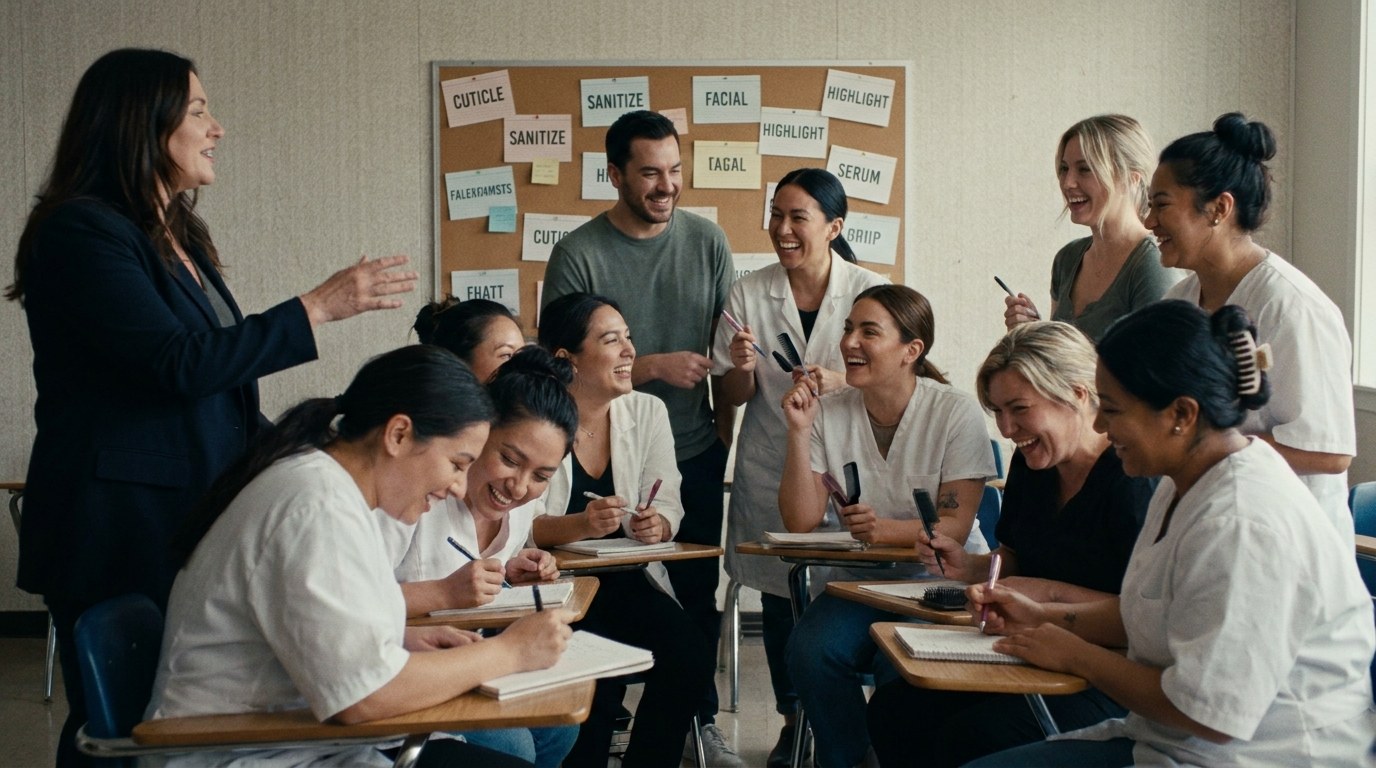
AVI Career Training serves a genuinely diverse student body — the kind of diversity that reflects Northern Virginia itself. Students come from across Latin America, West Africa, Southeast Asia, the Middle East, and beyond. Many are immigrants. Many are learning English while building a new career. That is not a barrier at AVI. It is part of who we are.
Hands-On Learning Reduces the Language Gap
The AVI curriculum is technique-driven by design. Instructors demonstrate skills visually. Students observe, practice, and receive real-time feedback through guided hands-on work — not through reading comprehension quizzes or vocabulary tests. This approach mirrors how professional beauty skills are actually used in a salon or spa: through touch, observation, and repetition.
For ESL students, this means your ability to master a skill is not capped by your current English level. A student who is still building conversational English can still execute a perfect eyebrow shaping, a thorough scalp treatment, or a precise gel manicure. The work speaks for itself.
An Inclusive Curriculum Built for a Diverse World
AVI trains students to work beautifully on every skin tone and every hair texture. This is a core value, not a footnote. Many beauty programs still teach primarily to one skin type or hair type, which leaves students unprepared for the full range of clients they will actually serve.
At AVI, you learn inclusive techniques from day one. That matters especially for ESL students who often come from — and will serve — communities that have historically been underserved by mainstream beauty education. Your background is an asset in this industry.
A Community That Reflects Yours
When you walk into AVI’s Vienna, VA campus, you are walking into a learning environment that looks like Northern Virginia. Students share similar backgrounds, speak multiple languages, and support one another through the program. That kind of community makes a real difference when you are navigating a new country, a new career, and a new language all at once.
—
Meet Maria: A Real Path From Immigrant to Licensed Esthetician
Maria came to Northern Virginia from El Salvador seven years ago. Her English was functional but not fluent when she enrolled in AVI’s Basic Esthetics program. She had worked in customer service and retail, but she wanted a career she could build on her own terms — something where her skill, not someone else’s opinion of her accent, determined her income.
She was nervous about the written portion of the State Board exam. But her AVI instructors helped her focus on the core concepts, practice the terminology she would need, and prepare strategically for the exam. More importantly, she excelled in the hands-on practical portion — the part that showed exactly what she could do.
Maria passed the Virginia State Board exam on her first attempt. She now works as a licensed esthetician at a medical spa in Tysons Corner, earning a steady income with a schedule that works around her family. She is also building a private clientele on weekends.
Her story is not unusual at AVI. It is the goal.
—
Virginia State Board Licensing: What ESL Students Need to Know
Earning a Virginia cosmetology or esthetics license follows the same process for every student — regardless of language background. Here is what that path looks like.
Required Clock Hours by Program
The Virginia DPOR sets the following clock hour minimums to qualify for the State Board exam:
| Program | Required Hours | Estimated Full-Time Timeline |
|—|—|—|
| Nail Technology | 150 hours | ~8 weeks |
| Basic Esthetics | 600 hours | ~4–6 months |
| Cosmetology | 1,000 hours | ~12–14 months |
| Massage Therapy | 625 hours | ~5–6 months |
All hours are completed through hands-on training at a licensed school like AVI. You cannot substitute work experience for clock hours.
The Licensing Exam Structure
Virginia uses the National Interstate Council (NIC) written examination for cosmetology and esthetics licensing. The exam tests your knowledge of theory, safety, sanitation, and Virginia-specific regulations.
Here is the key point for ESL students: the licensing exam also includes a practical (hands-on) component. In the practical exam, you demonstrate skills on a live model or mannequin. You are evaluated on technique and execution — not on how you explain what you are doing.
This two-part structure significantly reduces the overall language barrier compared to a purely written exam. Many ESL students find that consistent preparation and focused study of the written content — combined with strong practical performance — puts them in a strong position to pass.
Language Accommodations and Exam Support
The Virginia DPOR and NIC do have processes for requesting accommodations for students with specific needs. If you require language support or other accommodations for the written exam, contact DPOR directly before your exam date to understand your options.
Virginia DPOR Contact Information:
AVI’s admissions and student support team can also help you understand the process and prepare effectively for both exam components. Reach out to AVI to start that conversation.
—
Which AVI Programs Are the Best Fit for ESL Students?
Every AVI program is accessible to ESL students. But depending on your timeline, budget, and long-term goals, some programs may be a better starting point than others.
Nail Technology: The Fastest Path to Licensure
At only 150 required clock hours, Nail Technology is the fastest route to a Virginia license. Full-time students can complete the program in approximately 8 weeks and become eligible to sit for the State Board exam shortly after.
For ESL students who want to enter the workforce quickly, establish income, and build confidence in a professional beauty setting, Nail Technician is an excellent entry point. Virginia nail technicians earn approximately $25,000–$40,000 per year, with booth rental arrangements offering additional income potential as you build your clientele.
Basic Esthetics: A Strong Balance of Speed and Earning Power
The Basic Esthetics program requires 600 clock hours and takes approximately four to six months to complete full-time. Licensed estheticians in Virginia earn a median of approximately $36,000–$50,000 per year, with strong demand in medical spas, wellness centers, and high-end skincare studios across the DC metro area.
Esthetics training is highly tactile and technique-driven, making it a natural fit for hands-on learners. You will master facials, waxing, chemical exfoliation, and skincare consultation — all skills that translate directly to income the day you receive your license.
AVI also offers a Master Esthetics track for students who want to go deeper into advanced skincare, including laser and light therapies.
Cosmetology: The Broadest Long-Term Career
Cosmetology requires 1,500 clock hours — a 12 to 14-month commitment for full-time students — and it opens the widest range of career options. Licensed cosmetologists in Virginia earn approximately $32,000–$42,000 per year as employees, with significantly higher earning potential for those who build strong clientele or move into booth rental or salon ownership.
If your goal is to run your own business, specialize in natural hair, or serve a broad range of clients across haircare, skincare, and nail services, Cosmetology is the most comprehensive foundation you can build.
For ESL students willing to invest the time, Cosmetology pays dividends for decades.
Massage Therapy and Cosmetic Laser Technology
AVI also offers Massage Therapy (625 clock hours) and Cosmetic Laser Technician programs for students interested in wellness and medical aesthetics. These are competitive, growing fields with strong demand in the DC metro area. Both programs are hands-on by nature and accessible to ESL learners.
—
Meet James: From Army Service to Licensed Massage Therapist
James immigrated from Nigeria in his early twenties and served eight years in the U.S. Army before transitioning to civilian life in Northern Virginia. His English was strong, but he had never considered a beauty or wellness career until a friend suggested Massage Therapy.
He was skeptical at first. He had assumed beauty school was not for him — either because of his background or his gender. But James discovered that AVI’s Massage Therapy program was grounded in anatomy, technique, and client care — exactly the kind of structured, skill-based training he had thrived in during his military career.
James used the GI Bill® to cover a significant portion of his program costs at AVI. He graduated, passed his Virginia licensing exam, and now works full-time at a sports medicine clinic in Arlington — earning more than he made in his last Army assignment, with full control of his schedule.
His advice to other veterans and immigrants considering beauty school: “The skills are real. The license is real. The income is real. Stop waiting.”
—
Financial Aid, GI Bill®, and Next Steps for ESL Students
The cost of beauty school is a real consideration — especially for immigrant and ESL students who may be managing other financial obligations while building a new life in the United States. AVI has multiple funding pathways available.
Title IV Federal Financial Aid
AVI Career Training is COE-accredited and SCHEV-certified, which means the school is approved to participate in federal Title IV financial aid programs. Eligible students may qualify for:
To apply for federal financial aid, you will complete the FAFSA (Free Application for Federal Student Aid). Eligibility is based on financial need and enrollment status — not on English proficiency or immigration status in most cases. AVI’s admissions team can walk you through the process step by step.
GI Bill® Benefits
AVI accepts the GI Bill® for eligible veterans and active-duty service members. This includes the Post-9/11 GI Bill, which can cover tuition, fees, and a monthly housing allowance for qualifying students. If you served in the U.S. military and are now pursuing a new career, your education benefits can make AVI’s programs fully or substantially covered.
What Beauty Careers Pay in Virginia
Understanding earning potential helps you make a clear-eyed decision about the investment. Here are current ranges for licensed beauty professionals in Virginia, based on Bureau of Labor Statistics data:
These figures reflect licensed, working professionals — not students. Licensure is the milestone that unlocks this earning potential, and AVI’s programs are specifically designed to get you there.
For current wage data by occupation and region, the Bureau of Labor Statistics Occupational Outlook Handbook is a reliable reference.
Your Next Step
If you are an ESL student in Northern Virginia considering a beauty or wellness career, the best thing you can do right now is start a conversation. Talk to someone at AVI who can answer your specific questions — about programs, about language support, about financial aid, about what your path to licensure actually looks like.
AVI’s admissions team works with students from every background. They are not here to pressure you. They are here to help you figure out whether AVI is the right fit — and if it is, to help you get started.
Apply to AVI Career Training today or call (703) 943-9841 to speak with an admissions advisor directly. You can also visit our Vienna, VA campus to see the learning environment for yourself.
Your language background is not a barrier to a beauty career in Virginia. At AVI, it never has been.
—
AVI Career Training is located at 1595 Spring Hill Rd #720, Vienna, VA 22182. Programs are COE-accredited and SCHEV-certified. GI Bill® is a registered trademark of the U.S. Department of Veterans Affairs. Financial aid availability is subject to eligibility requirements.