

Summary:
Most people researching beauty schools focus on tuition, location, and program length. Those things matter. But there’s one factor that quietly shapes your entire experience — and it barely shows up on the brochure: how many students are sharing your instructor.
At a school where one teacher is managing 25 or 30 students at once, you get what you get. At a school where that same instructor is working with 15, the whole dynamic changes. You get corrected faster, you get more hands-on time, and you actually build a relationship with the person teaching you.
That’s the real argument for a small cosmetology school. And it’s worth understanding before you commit.
Beauty School Class Size: Why the Number on the Wall Matters
There’s a version of beauty school where you spend months watching demonstrations from the back of a crowded room, waiting your turn on a mannequin while the instructor works their way through a packed class. That’s not a worst-case scenario — it’s just what happens when enrollment outpaces instruction capacity.
Class size isn’t a minor logistical detail. It determines how much real feedback you get, how quickly you can correct bad habits before they stick, and whether your instructor even knows your name by the end of the program. Those aren’t soft benefits. They directly affect whether you pass your board exam and whether you walk into your first job actually ready to work.
What Does a Good Student-to-Teacher Ratio Actually Look Like?
The phrase “small class sizes” gets used so often in beauty school marketing that it’s stopped meaning much. Every school says it. Very few publish the actual number.
We publish our student-to-teacher ratio at 1:15. That’s one instructor for every fifteen students — a figure that shapes the entire structure of how training happens here. When you’re one of fifteen rather than one of thirty, you’re not waiting as long for hands-on correction. You’re not watching from a distance while someone else gets the feedback you needed. You’re in it.
This matters more as you move through the program. Early on, you’re learning foundational techniques — and getting those right the first time is easier when an instructor can actually watch you work and step in immediately. Later, when you’re building speed and consistency for the board exam, having that ratio means your instructor knows where your weak spots are. They’ve seen your work enough times to know what you need to practice, not just what the curriculum says to cover next.
There’s also something less quantifiable but genuinely important: when a school is small enough that instructors know students individually, the culture changes. Students who feel known tend to ask more questions. They’re less likely to quietly struggle through something they don’t understand. That dynamic — where it’s safe to not know something yet — is actually one of the better predictors of whether someone finishes the program.
Our 96% graduation rate reflects that. Nationally, graduation rates at cosmetology schools vary widely, and many fall well below that mark. A high rate isn’t just a feel-good statistic. It means the school is structured in a way that helps students get through — not just get in.

How Class Size Affects Hands-On Training Hours
Virginia recently updated its cosmetology training requirements. Students who enrolled on or after September 1, 2024 need to complete a minimum of 1,000 hours — down from the previous 1,500-hour requirement. That change makes cosmetology school faster and more accessible than it’s been in years. But it also raises the stakes on how those hours are used.
If you’re completing 1,000 hours in a school where clinic time is stretched thin across a large student body, you may finish your hours without the depth of practice that actually prepares you for licensure. Hours on paper and hours of meaningful, supervised, hands-on training are not the same thing.
In a smaller program, those 1,000 hours go further. You’re spending more of that time actually working — on real clients, under real supervision, with an instructor close enough to course-correct in the moment. That’s not a minor distinction. The Virginia board exam tests practical skills, and practical skills come from practice that’s been watched and refined, not just logged.
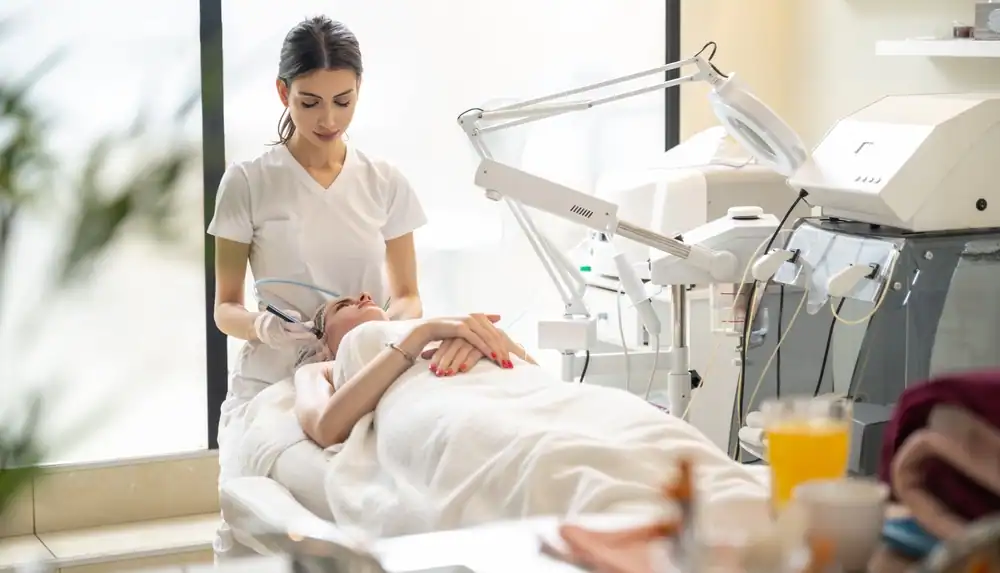
Fairfax County’s population is one of the most ethnically diverse in the country, which means the clients you’ll work with after graduation will represent an enormous range of skin tones, hair textures, and beauty needs. Our esthetics curriculum covers all six Fitzpatrick Skin Types — not because it’s a nice thing to say, but because it prepares you for the actual clientele you’ll encounter working in Fairfax County and the broader Northern Virginia region. A smaller program makes it easier to ensure every student gets meaningful exposure to that full range, rather than moving on before everyone has had adequate hands-on time.
Personalized Beauty School Training: What It Looks Like in Practice
“Personalized training” is another phrase that gets thrown around a lot without much behind it. In practice, it means a few specific things — and they’re worth naming plainly.
It means your instructor knows where you are in the curriculum and where you’re struggling, not just where the class is as a whole. It means when you’re preparing for your board exam, the feedback you’re getting is specific to your technique, not generic advice aimed at a room of thirty. And it means the people running the school are invested in your outcome — because in a smaller program, your outcome is visible. There’s nowhere for it to hide.
Financial Aid at a Small Cosmetology School: What You Should Know
One of the most persistent misconceptions about small beauty schools is that they can’t offer financial aid. The assumption seems to be that only large institutions have access to federal programs. That’s not how it works.
What determines financial aid eligibility is accreditation — specifically, whether a school holds accreditation from an agency recognized by the U.S. Department of Education. We hold accreditation from the Council on Occupational Education, or COE, which is a nationally recognized accrediting agency and one of the pathways that unlocks Title IV federal financial aid. That means Pell Grants — up to $7,395 for qualifying students — as well as subsidized and unsubsidized federal loans are available here, at a school with a 1:15 student-to-teacher ratio and rolling monthly enrollment.
We’re also approved by the U.S. Department of Veterans Affairs for GI Bill and VR&E benefits. Northern Virginia has one of the largest veteran and active-duty military populations in the country, given the proximity to the Pentagon, Fort Belvoir, and other federal installations. If you’ve served and you’re weighing your education options, those benefits work here.
Beyond the credentials, we do something that makes a practical difference for a lot of students: our staff personally walks you through the entire FAFSA process at no cost. Not a referral to a website. An actual person helping you complete the forms and understand what you qualify for. For career changers, first-generation college students, and anyone who hasn’t navigated federal financial aid before, that kind of support can be the difference between enrolling and walking away because the process felt too complicated.
There’s no application fee here, either. So if you’re at the stage of exploring whether this is the right move, there’s no financial risk to finding out.
Accredited Cosmetology Schools: How to Read the Credentials and Why It Matters
When a school says it’s “accredited,” that word is doing a lot of work — and it’s worth understanding what’s actually behind it.
There are different accrediting bodies for cosmetology schools, and they’re not interchangeable. NACCAS — the National Accrediting Commission of Career Arts and Sciences — is the most widely recognized in the beauty school industry and accredits more than 1,500 schools nationally. COE, the Council on Occupational Education, accredits career and technical schools across a broader range of fields. Both are recognized by the U.S. Department of Education, meaning both unlock federal financial aid eligibility. They’re parallel pathways, not a hierarchy.
What matters for you as a prospective student is that the school you choose holds accreditation from a DOE-recognized agency — and that you can verify it. If a school claims to be accredited but won’t tell you by whom, or names an organization you can’t find listed on the Department of Education’s website, that’s a problem worth taking seriously. Your financial aid eligibility, your ability to sit for the Virginia board exam from an approved institution, and the legitimacy of your credential all depend on this.
We hold COE accreditation, SCHEV certification from the State Council of Higher Education for Virginia, and a license from Virginia’s Department of Professional and Occupational Regulation. We’re also licensed by the Maryland and DC Boards of Cosmetology. That combination matters practically: it means graduates are prepared to work across the entire DMV region, not just within Virginia’s borders. And with Virginia among the states that have enacted legislation to join the Cosmetology Licensure Compact — which is expected to activate for licensees in early 2026 — a Virginia license is becoming more portable than ever.
For students in Fairfax County, VA weighing their options, that portability is worth factoring in. The DMV job market for licensed beauty professionals is strong, and a credential that works across Virginia, Maryland, and DC — and potentially more states through the compact — is a meaningfully more valuable one.
Is a Small Cosmetology School the Right Choice for You?
The honest answer is: it depends on what you need from the experience. If you learn best with individual attention, if you want instructors who know your work and can give you specific feedback, and if you want a program where the people around you are genuinely invested in whether you finish — then yes, a smaller school is almost certainly the better fit.
The data points toward that conclusion, too. A 96% graduation rate doesn’t happen by accident. It reflects a program structure where students are supported closely enough to actually get through.
If you’re in Fairfax County or the broader Northern Virginia area and you’re seriously considering cosmetology or esthetics training, AVI Career Training is worth a closer look. Classes start the first Monday of every month, there’s no application fee, and someone on our team will sit down with you to walk through the financial aid process before you commit to anything.