
Esthetician training is a structured program that combines skin science education with supervised practical experience to prepare students for professional skincare services. If you’re considering a beauty career, understanding what the curriculum actually includes helps you choose the right program and set realistic expectations. Esthetician programs typically split training evenly between classroom theory and hands-on clinical work. That balance is not accidental. It reflects what state licensing boards require and what employers actually need from a working esthetician.
What does esthetician training cover in the classroom?
The classroom portion of esthetics training covers the science that makes every treatment work. You cannot safely perform a chemical peel or recommend a product without understanding what is happening at the cellular level. This is where esthetics education earns its credibility as a professional discipline, not just a trade skill.
The core theory subjects include:
- Skin anatomy and physiology. You study the epidermis, dermis, and subcutaneous layers, along with how each layer functions and ages. This knowledge directly informs how you assess a client’s skin before any service.
- Product chemistry and ingredients. You learn how active ingredients like retinoids, AHAs, and hyaluronic acid interact with skin pH. Understanding formulation basics helps you recommend products without causing reactions.
- Sanitation and infection control. Proper disinfection of tools, surfaces, and hands is not optional. Rigorous sanitation routines are taught throughout clinical training because violations can result in health citations or lawsuits.
- Contraindications. You learn which conditions, such as active rosacea, open wounds, or certain medications, make specific treatments unsafe. Recognizing contraindications protects both you and your clients.
- Legal scope of practice. Understanding the legal scope of what an esthetician can and cannot do is the most vital part of the curriculum for safe, compliant practice.
- State board exam preparation. Written exams test infection control, skin science, product chemistry, anatomy, and legal regulations. Classroom instruction is structured to align directly with these exam categories.
Pro Tip: Take sanitation protocols as seriously as technique practice. State board examiners consistently flag sanitation errors as a primary reason for first-attempt failures.
What practical skills do esthetician programs teach?
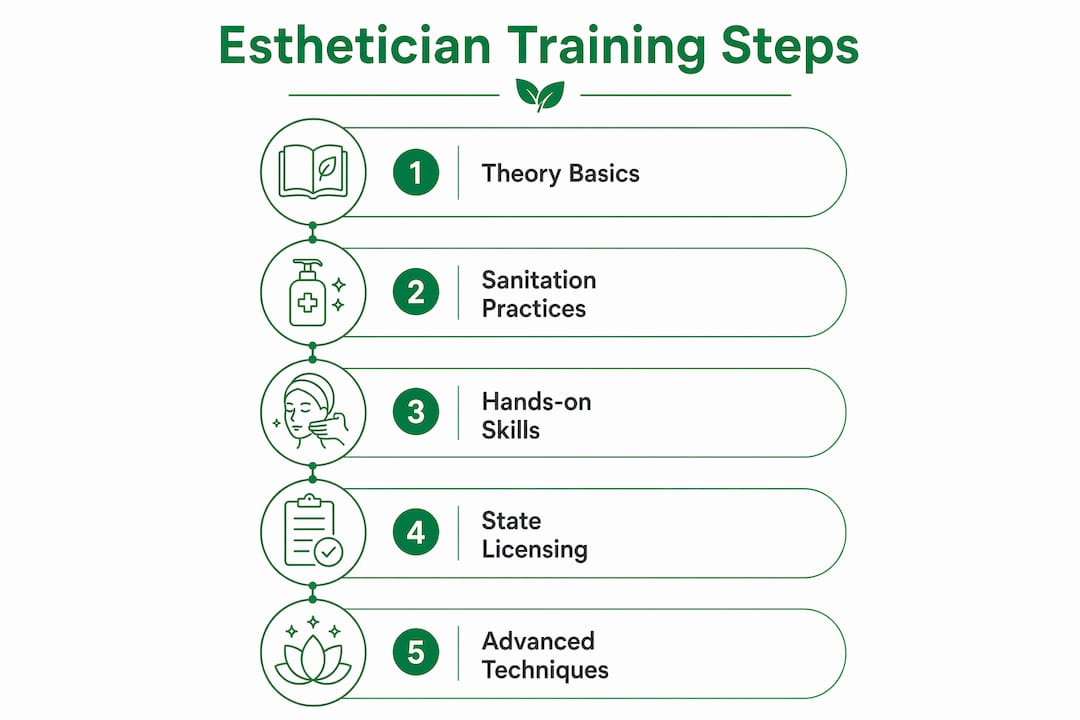
The hands-on portion of training is where theory becomes technique. You practice on fellow students, volunteer models, and eventually real clients under instructor supervision. This is also where most students discover the gap between reading about a facial and actually performing one on a person with sensitive skin.
The practical curriculum follows a clear progression:
- Facial services. You master the full facial sequence: cleansing, toning, skin analysis, steam, extractions, massage, mask application, and moisturizing. Each step has a specific purpose and a correct order.
- Exfoliation methods. Manual exfoliation with scrubs and mechanical tools comes first. Chemical exfoliation using enzyme treatments and mild acids follows once you understand contraindications.
- Hair removal. Waxing is the primary technique taught, covering face, brows, lip, chin, and body areas. Some programs also introduce threading basics as an alternative method.
- Brow and lash services. Brow shaping, tinting, and basic lash tinting are standard curriculum items in most programs.
- Makeup application. You learn color theory, skin prep, and application techniques for both everyday and corrective makeup. This rounds out your service menu for client-facing work.
- Client consultations. Client communication skills are taught alongside technical skills because managing expectations and identifying contraindications both happen during the intake conversation.
- Supervised clinic hours. You complete a required number of supervised hours working on actual clients. These hours count toward your state licensing requirement and are non-negotiable.
Pro Tip: Use every clinic session to practice your consultation script. Knowing how to ask about medications, allergies, and skin history becomes automatic only through repetition.
Practical experience also reveals something textbooks cannot fully prepare you for. Applying techniques on real clients with sensitivities is fundamentally different from practicing on a classmate with normal skin. That gap is exactly why supervised clinic hours matter so much.
How do state licensing hours affect your training?
State licensing requirements directly shape how long your training takes and what your program must include. State esthetician training hour requirements vary dramatically, from 260 hours in Florida to more than 1,500 hours in Alabama. That range means a student in one state could complete training in a few months, while a student in another spends over a year in school.
Every state requires you to attend a state-approved program. State approval is mandatory for licensure eligibility. National accreditation is separate and voluntary, but it affects whether you can access federal financial aid. Choosing an accredited esthetics program gives you both licensing eligibility and financial aid access.
The licensing exam itself has two parts. Written and practical exams test theory, sanitation, safety protocols, and service skills. The practical portion typically requires you to demonstrate a facial, a waxing service, and proper sanitation procedures in real time.
Some programs now offer hybrid formats. Hybrid programs move 30–50% of coursework online through recorded lectures and quizzes, while keeping all supervised practical hours in person. This format works well for students who need scheduling flexibility without sacrificing hands-on training quality.
When you choose an accredited esthetics program, verify that it meets your specific state’s hour requirements. A program that qualifies in one state may not satisfy the requirements in another. This matters especially if you plan to practice in a different state after graduation, since cosmetology license reciprocity between states is not guaranteed and varies significantly.
What advanced skills can esthetician training include?
Entry-level esthetics training covers the foundation. Advanced and master-level programs go significantly further. Master esthetics programs range from 1,200 to 1,600 hours and include clinical procedures that entry-level graduates are not licensed to perform.
Advanced training areas include:
- Chemical peels. Medium-depth and deeper peels require precise knowledge of acids, concentrations, and client skin typing. These are high-risk services with real consequences if performed incorrectly.
- Microcurrent therapy. This electrical modality uses low-level current to stimulate facial muscles and improve tone. It requires understanding of contraindications including pacemakers and pregnancy.
- Lymphatic drainage. Manual lymphatic drainage techniques reduce puffiness and support post-procedure healing. This skill is increasingly requested in medical spa settings.
- Laser and light treatments. Some advanced programs include supervised laser training, though full laser operation often requires additional state-specific certification beyond esthetics licensure.
- Business and client management. Advanced programs frequently incorporate retail sales training, appointment management, and basic business operations. These skills directly affect your earning potential as a solo practitioner or suite renter.
The career case for advanced training is straightforward. Medical spas and clinical skincare practices pay significantly more than day spas, and they hire estheticians with documented advanced credentials. Starting with a solid foundation and building toward specialty certifications is the most direct path to higher-end positions in the field.
Key Takeaways
Esthetician training covers skin science, sanitation, hands-on clinical techniques, and state licensing requirements, making program selection and accreditation status the two most consequential decisions you will make before enrolling.
| Point | Details |
|---|---|
| Theory and practice split evenly | Programs divide training roughly 50/50 between classroom science and supervised clinical work. |
| State hours vary widely | Required training hours range from 260 to 1,500+, so verify your state’s minimum before choosing a program. |
| Accreditation affects financial aid | State approval is required for licensure; national accreditation determines federal financial aid eligibility. |
| Licensing exams test both theory and skill | Written exams cover science and law; practical exams require live demonstrations of facials, waxing, and sanitation. |
| Advanced training opens higher-paying roles | Master esthetics programs add chemical peels, microcurrent, and lymphatic drainage for medical spa careers. |
What I’ve learned about training quality that most articles skip
Most articles about esthetician training focus on the curriculum checklist. The checklist matters, but it misses the harder truth: the quality of your supervised hours determines your readiness far more than the total number of hours logged.
I’ve seen students complete the minimum required hours and struggle at their first job because their clinic sessions were rushed or poorly supervised. The opposite is also true. Students who treat every clinic client like a paying customer, ask instructors for feedback after every service, and practice their consultation scripts until they feel natural, those students pass their boards and land jobs faster.
Physical stamina and ergonomics are also critical for estheticians to avoid repetitive strain injuries during long work hours. Almost no one talks about this before enrollment. Standing at a treatment table for six to eight hours, repeatedly performing massage strokes and waxing movements, takes a real physical toll. Programs that teach proper body mechanics and posture from day one are doing their students a genuine service.
The other skill that separates good estheticians from great ones is knowing when to say no. Declining services outside your legal scope is a professionally high-stakes skill that takes practice to execute confidently. A client who insists on a service you are not licensed to perform is a liability, not an opportunity. The best programs build this into client consultation training from the start, not as an afterthought.
— krishna
Avi Career Training: where esthetics education meets real results
Avi Career Training in Fairfax County, VA, offers a state-approved esthetics program built around the same balance of theory and clinical practice that state-approved programs use to achieve first-attempt licensure pass rates between 85% and 95%.
Students at Avi receive personalized mentorship from enrollment through graduation, with access to externship placements at leading spas and salons across Northern Virginia. The program prepares you for both the written and practical components of your state board exam. Financial aid options are available for eligible students, making the program accessible without requiring you to take on unmanageable debt. If you are ready to build a career in skincare, the esthetics program at Avi gives you the foundation, the clinical hours, and the career support to get there.
FAQ
What subjects does esthetician training cover?
Esthetician training covers skin anatomy, product chemistry, sanitation, infection control, legal scope of practice, and hands-on techniques including facials, waxing, and makeup application. Programs also prepare students for state board written and practical exams.
How many hours does esthetician training require?
Training hour requirements vary by state, ranging from 260 hours in Florida to more than 1,500 hours in Alabama. Always verify your specific state’s minimum before enrolling.
Does esthetician training include business skills?
Many programs, especially advanced or master-level ones, incorporate retail sales, client management, and basic business operations into the curriculum. These skills are particularly valuable for estheticians who plan to work independently or rent a suite.
What is the difference between state approval and national accreditation?
State approval is required for your program to qualify you for a state esthetics license. National accreditation is voluntary but determines whether you can access federal financial aid to fund your training.
Can I complete esthetician training online?
Some programs offer hybrid formats where 30–50% of coursework is completed online, but all supervised practical hours must be completed in person. No state currently allows fully online esthetician training because hands-on clinical skill is a licensing requirement.