Nail Technology: A Complete Healthcare Career Guide for the DMV
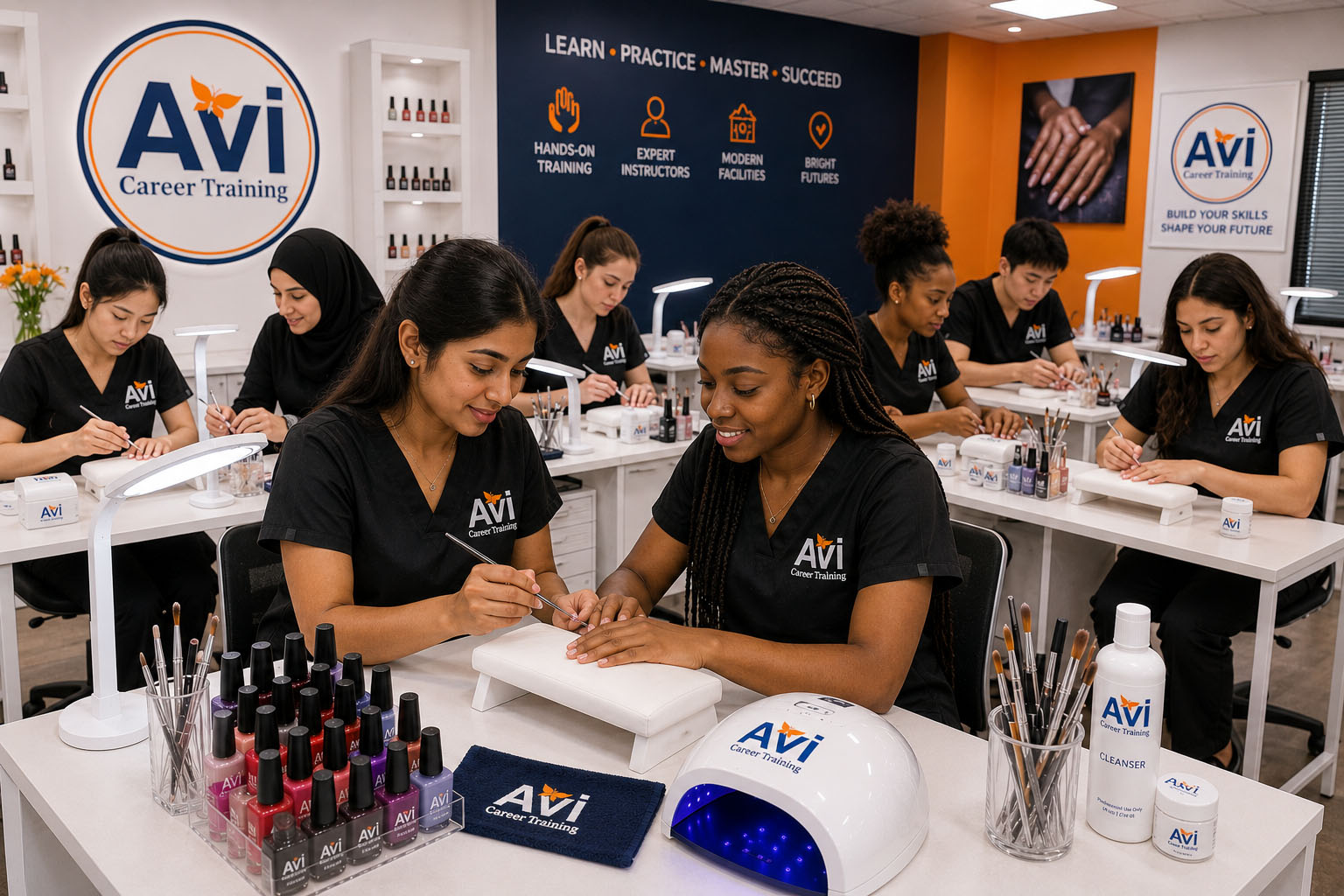
A nail technology career in the DMV area is a legitimate, licensed healthcare-adjacent profession that pays real wages, requires state board certification, and puts you in direct contact with clients who depend on your trained eye for more than just aesthetics.
If you’ve been Googling “nail tech school Virginia” or wondering whether this is a serious career or just a side hustle, this guide answers that question directly — with licensing requirements, DMV-specific salary data, and a clear picture of what training actually looks like at a COE-accredited school in Northern Virginia.
- Virginia requires 150 clock hours of nail technician training to sit for the state board exam
- AVI Career Training’s Nail Technician program (NO FINANCIAL AID FOR THIS PROGRAM) can be completed in approximately 8–10 weeks
- Nail technicians in the Northern Virginia/DC metro area earn significantly above national median wages due to cost-of-living premiums and tipping culture
- Virginia issues two separate credentials — a Nail Technician license and a Manicurist license — and they are not the same
- COE accreditation and SCHEV certification are the two quality benchmarks every prospective student should verify before enrolling in any Virginia beauty school
Ready to take the first step? Apply to AVI Career Training’s Nail Technician program today.
—
Is Nail Technology Really a Healthcare Career?
Yes — nail technology is a healthcare-adjacent profession, not just a cosmetic service. Trained nail technicians are often the first professionals to spot signs of serious health conditions before a client ever sees a doctor.
Here’s why that matters: your nails and the skin around them are windows into your overall health. Discoloration, texture changes, pitting, and unusual growth patterns can all signal underlying conditions — some of them serious.
What Nail Technicians Are Trained to Observe
A qualified nail technician learns to recognize and respond to conditions including:
None of this means a nail technician diagnoses medical conditions — that’s outside their scope of practice, and good training makes that boundary clear. What it means is that nail technology requires a level of anatomical knowledge, sanitation discipline, and client assessment that puts it firmly in the wellness professional category.
—
Virginia Nail Technician Licensing Requirements Explained
Virginia’s licensing process for nail technicians is managed by the Virginia Board for Barbers and Cosmetology under the Virginia Department of Professional and Occupational Regulation (DPOR). Here’s exactly what the path looks like.
Training Hours Required
Virginia requires 150 clock hours of nail technician training at a state-approved school. These hours must be completed at an accredited institution — not through self-study or online-only programs. Every hour counts toward specific competency areas including nail theory, sanitation, and practical skills.
The State Board Examination
After completing your 150 hours, you’re eligible to sit for the Virginia State Board examination. The exam has two components:
1. Written (theory) examination: Tests knowledge of nail anatomy, skin conditions, chemical safety, sanitation protocols, and Virginia state law
2. Practical (hands-on) examination: Demonstrates your ability to perform actual nail services safely and correctly
Passing both components earns you your Virginia nail technician license. You cannot legally practice as a nail technician in Virginia without it.
Nail Technician License vs. Manicurist License: What’s the Difference?
This is one of the most common points of confusion — and it matters. Virginia issues two separate credentials:
| Credential | Scope |
|—|—|
| Manicurist License | Nail care for hands only — manicures, nail enhancements on the hands |
| Nail Technician License | Full scope — hands AND feet, including pedicures and foot care services |
If you want to offer pedicures and foot services (which is standard in most salons and spas), you need the Nail Technician license — not just the Manicurist license. Most comprehensive nail technology programs prepare students for the full Nail Technician credential.
License Renewal
Virginia nail technician licenses must be renewed every two years. Renewal requirements include continuing education, keeping your contact information updated with DPOR, and paying the renewal fee. Letting your license lapse can result in fines and the inability to work legally.
No college degree is required. A high school diploma or GED is the only academic prerequisite to enroll in a nail technology program and pursue licensure in Virginia.
—
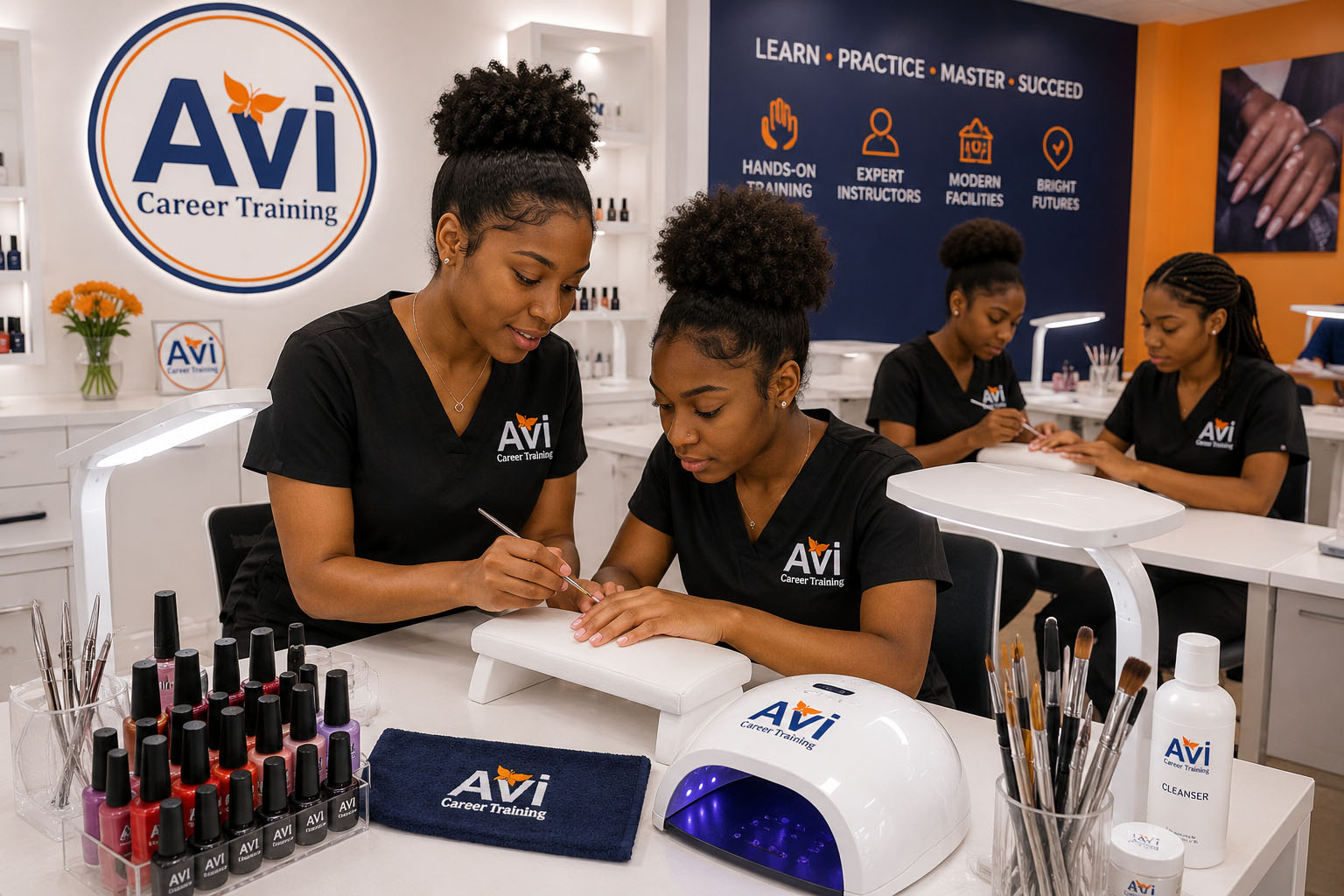
What You’ll Actually Learn in a Nail Technology Program
A quality nail technology program is more than a course in polishing technique. At AVI Career Training, the Nail Technician program (NO FINANCIAL AID FOR THIS PROGRAM) covers a comprehensive curriculum designed to produce safe, skilled, and client-ready professionals.
Nail Anatomy and Physiology
You’ll learn the structure of the nail — the nail plate, nail bed, matrix, lunula, cuticle, and surrounding skin. Understanding what’s beneath the surface is what separates a trained nail technician from someone who learned from YouTube.
This knowledge directly informs how you service clients safely — knowing, for example, that cutting too deep into the lateral nail fold creates an entry point for bacteria, or that over-filing the nail plate thins it and compromises its structural integrity.
Sanitation and Infection Control
Sanitation is where nail technology becomes unambiguously clinical. You’ll learn:
These aren’t suggestions — they’re legal requirements under Virginia state board standards. Failure to follow proper sanitation protocols can result in client injury, license suspension, or legal liability.
Nail Services and Application Techniques
You’ll develop hands-on proficiency in:
Instruction covers technique across diverse nail types and conditions — because clients walk through the door with natural nails that vary in thickness, texture, curvature, and health status.
Inclusive Techniques for All Skin Tones and Nail Types
AVI Career Training is built on a specific commitment: training students to work beautifully on every client, regardless of skin tone, background, or nail type. That means instruction in color theory as it applies across the full spectrum of skin tones — so you can recommend and apply colors that look right on every hand, not just one standard.
This is a professional differentiator that directly expands your client base when you’re working in a diverse market like the DMV.
Chemical Safety
Nail technology involves working with acrylic monomers, gel UV/LED systems, acetone, and other chemicals daily. You’ll learn how to handle these safely — proper ventilation requirements, skin protection, correct storage, and what to do if a client has a chemical sensitivity or allergic reaction.
This isn’t optional knowledge. It’s what protects you, your clients, and your license.
> Real Student Story: Marissa came to AVI Career Training after ten years in office administration. She’d always done her own nails and assumed nail tech school would be “mostly the fun stuff.” What surprised her — in the best way — was the depth of the sanitation and nail health curriculum. “I didn’t expect to learn about nail diseases and how to recognize infections,” she said. “But that’s what made me feel like a real professional when I graduated, not just someone who can do a nice set.”
—
Nail Technician Salary and Career Outlook in the DC Metro Area

Nail technicians in Northern Virginia and the broader DC metro area earn more than the national median — and the gap is significant.
According to the U.S. Bureau of Labor Statistics (BLS), the national median annual wage for manicurists and pedicurists is approximately $31,000–$34,000. But that national figure doesn’t reflect what’s happening in the DMV market, where cost-of-living premiums, a high-income client base, and strong demand for premium nail services drive compensation meaningfully higher.
Employment Models and Income Structure
Your income as a nail tech depends heavily on how you work — and there are several models to understand:
Salon Employee
You’re on the salon’s payroll. You receive an hourly wage or commission on services, with tips on top. Benefits may include health insurance, paid time off, and guaranteed hours. This is the most common starting point for new graduates.
Booth Rental
You pay a weekly or monthly fee to rent a station in an existing salon. You keep 100% of your service revenue and tips — but you’re responsible for your own supplies, marketing, and business management. Booth rental rewards established nail techs with a client following.
Suite Rental / Independent Operator
You rent your own private suite in a shared beauty complex (think Sola Salons or similar). Maximum independence and earning potential — with corresponding business overhead.
Tipping Culture in the DMV
This is a critical piece of the income picture that BLS data doesn’t capture. In the DC metro area, standard tips for nail services run 20–25%. On a full book of services at premium DMV pricing, tips can meaningfully increase a nail tech’s take-home pay — often adding hundreds of dollars per week to base income.
Realistic Income Trajectory
| Stage | Approximate Annual Income (DMV Market) |
|—|—|
| Entry-Level (first 1–2 years) | $32,000–$42,000 |
| Established Salon Employee (3–5 years) | $42,000–$58,000 |
| Booth Rental with Client Base | $50,000–$75,000+ |
| Independent Suite / Specialty Nail Artist | $65,000–$90,000+ |
These figures include tips and are approximate. Individual results vary based on hours worked, service menu, pricing, clientele, and business development skills.
> Real Student Story: Devon left a retail management job in Fairfax to pursue nail technology full-time. After completing the Nail Technician program at AVI and passing his Virginia State Board exam, he took a commission position at a nail salon in Tysons Corner. Within 18 months, he’d built a loyal client list, transitioned to booth rental, and was bringing in more than he’d earned managing a retail team of 15. “I had no idea the earning potential was this real,” he said. “I thought I was just following a passion. Turns out it’s an actual career.”
Start Your Nail Technology Career — Apply to AVI Today
—
How to Choose a Nail Tech School in Northern Virginia (and Why Accreditation Matters)
Not all nail technology programs are equal — and in Virginia, the school you choose directly affects your licensing eligibility, the quality of your training, and your financial options.
Here’s the decision framework every prospective student should use.
What COE Accreditation Means
COE stands for the Council on Occupational Education — the national accrediting body recognized by the U.S. Department of Education for career and technical schools. COE accreditation signals that a school meets rigorous standards for:
When a school is COE Accredited, it has passed an external review process that most unaccredited schools never attempt. AVI Career Training is COE Accredited — one of a relatively small number of beauty and wellness schools in Northern Virginia to hold this credential.
What SCHEV Certification Means
SCHEV is the State Council of Higher Education for Virginia. SCHEV certification is required for a Virginia school to operate legally and offer state-approved programs. Without SCHEV certification, a school cannot offer programs that lead to Virginia state board licensure.
Always verify that any nail tech school you consider is both COE Accredited and SCHEV Certified before enrolling.
Tuition, Costs, and Financial Aid for the Nail Technician Program
Because AVI’s Nail Technician program is under 600 clock hours, federal financial aid (Title IV / FAFSA) is NOT available for this program. This is a regulatory threshold — programs under 600 hours are not eligible for Pell Grants or federal student loans, regardless of the school’s accreditation status.
AVI does not misrepresent this. What is available:
Contact AVI directly at (703) 943-9841 to discuss current tuition rates and payment options for the Nail Technician program.
Questions to Ask Any Nail Tech School Before You Enroll
1. Is the school COE Accredited and SCHEV Certified?
2. Is the program state-approved to prepare students for the Virginia State Board exam?
3. What is the pass rate for students on the state board exam?
4. What does tuition include — supplies, kits, exam fees?
5. Are instructors actively licensed professionals with industry experience?
6. What is the student-to-instructor ratio in hands-on lab sessions?
7. Is federal financial aid available for this specific program (and if yes, is the program over 600 hours)?
AVI Career Training answers all of these questions directly. Learn more about AVI’s accreditations, instructors, and mission — or start your application today.
Why AVI Career Training in Vienna, VA
AVI Career Training is located at 1595 Spring Hill Rd #720, Vienna, VA 22182 — in the heart of Northern Virginia, minutes from the Tysons Corner corridor and easily accessible from across the DMV.
What sets AVI apart:
—

—
Frequently Asked Questions: Nail Technology Career in the DMV
Q: How many hours do you need to become a nail technician in Virginia?
A: Virginia requires 150 clock hours of nail technician training at a state-approved school. After completing those hours, you’re eligible to sit for the Virginia State Board examination — which includes both a written theory test and a practical hands-on component.
—
Q: Is nail technology considered a healthcare career?
A: Nail technology is a healthcare-adjacent profession. Licensed nail technicians are trained to recognize signs of nail fungus, diabetic foot complications, psoriasis, bacterial infections, and other conditions that may require medical attention. While nail techs don’t diagnose or treat medical conditions, their trained observation skills put them directly in the wellness professional category — regulated by the same Virginia Board for Barbers and Cosmetology that oversees other licensed beauty and wellness professionals.
—
Q: How much do nail technicians make in the Washington DC area?
A: Nail technicians in the Northern Virginia and DC metro area typically earn above the national median, which the Bureau of Labor Statistics places around $31,000–$34,000 annually. In the DMV market, entry-level nail techs in salon employment commonly earn $32,000–$42,000, while experienced booth renters and independent operators can earn $50,000–$90,000 or more annually — with tips factoring significantly into take-home pay.
—
Q: What is the difference between a nail technician and a manicurist license in Virginia?
A: Virginia issues two separate credentials. A Manicurist license covers nail services for the hands only. A Nail Technician license covers both hands and feet — including pedicures and foot care services. Most professional nail technology programs prepare students for the full Nail Technician license.