
Nail Technology: A Real Healthcare Career in Northern Virginia
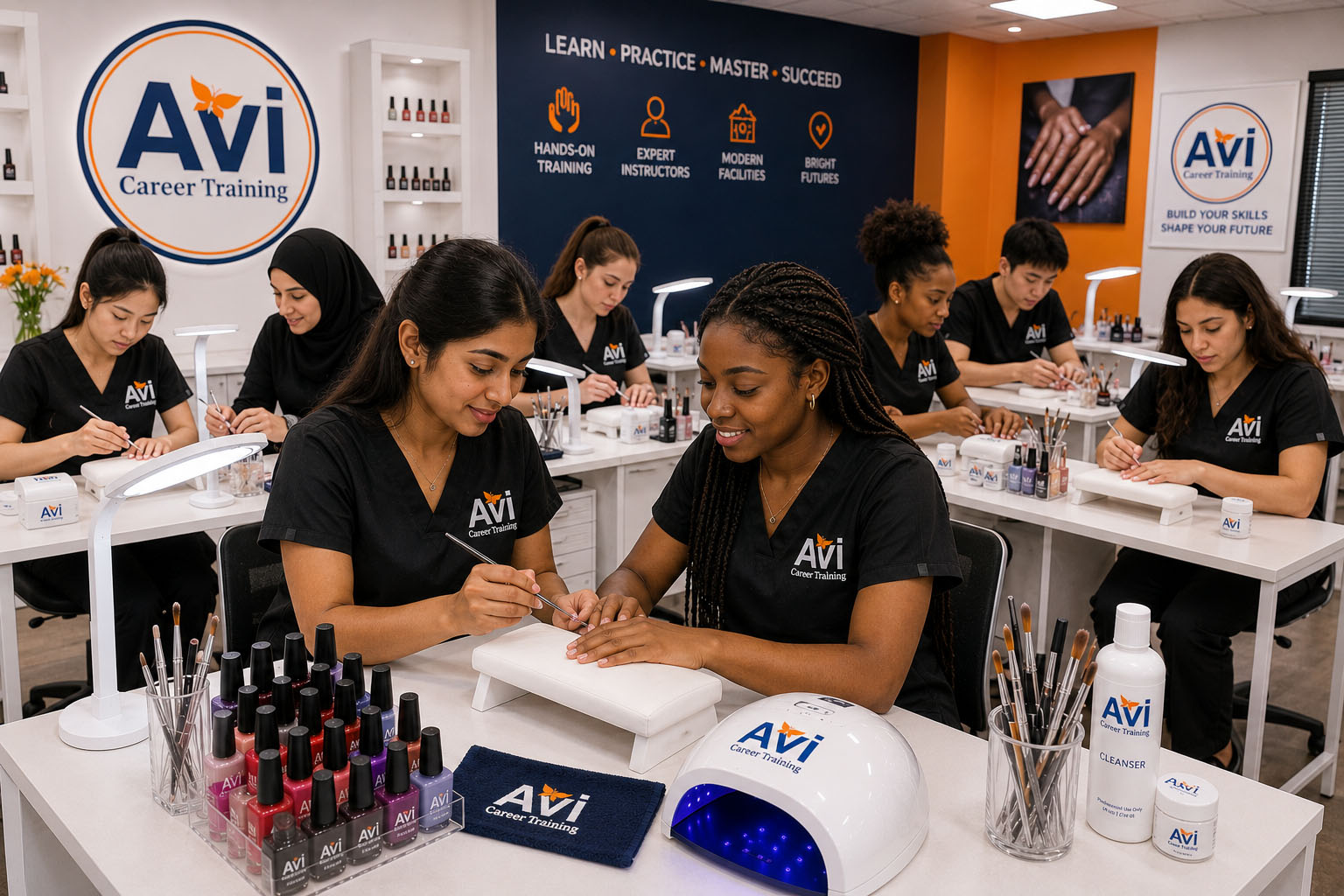
A nail technician career in Northern Virginia is one of the fastest paths to a licensed, client-facing healthcare-adjacent profession in the DMV market — and most people seriously underestimate its income potential, scope of practice, and long-term staying power. Apply Now at AVI Career Training to get started.
If you’ve been searching Reddit threads, asking friends, or Googling late at night whether nail tech is a “real” career — the answer is yes. And in a high-income market like Northern Virginia, the ceiling is higher than most people expect.
This guide covers everything you need to know: Virginia’s licensing requirements, realistic salary ranges, what separates a strong training program from a weak one, and how AVI Career Training in Vienna, VA prepares students to pass the board exam and build a career they’re proud of.
—
- Virginia requires 150 clock hours of nail technology training to sit for the state board exam
- Nail technicians in the DMV area can realistically earn $45,000–$65,000+ using booth rental or self-employment models
- Nail tech is regulated by the Virginia Department of Professional and Occupational Regulation (DPOR) under the Board for Barbers and Cosmetology
- AVI Career Training in Vienna, VA is COE-accredited and SCHEV-certified — two credentials that matter when evaluating any beauty school
- The Nail Technology program at AVI is under 600 hours and does not qualify for federal financial aid (Title IV / FAFSA) — payment plan and private financing options are available
—
Why Nail Technology Belongs in the Healthcare Conversation
Nail technology is a healthcare-adjacent profession — not just a beauty service. This distinction matters for your career, your credibility, and your clients.
Here’s what most people don’t realize: a skilled nail technician is often the first person to notice the early signs of a fungal infection, an ingrown nail condition, or skin changes that may indicate a more serious health issue. For diabetic clients, proper nail care isn’t a luxury — it’s a medical necessity. Poor nail and foot hygiene in diabetic patients can lead to serious complications, which is why nail technicians trained in health awareness are genuinely valuable to their clients’ wellbeing.
The Wellness Economy Is Reshaping the Industry
The U.S. wellness economy has grown dramatically in the past decade. Consumers aren’t just buying polish — they’re investing in self-care, stress relief, and preventive health maintenance. That shift has elevated nail services from a cosmetic category into a broader wellness context, one that increasingly overlaps with spa medicine, podiatric wellness, and integrative health.
Nail technicians who understand sanitation science, product chemistry, and nail disorder recognition are operating at a different professional level than technicians who only know how to apply gel. That depth of knowledge is exactly what a quality training program — and Virginia state board licensing — is designed to develop.
Sanitation Standards That Mirror Clinical Settings
Virginia’s DPOR standards for nail technicians include strict sanitation and disinfection protocols. The tools, processes, and product safety knowledge required to pass the Virginia State Board exam are serious — and they reflect the health-protective nature of the work. When you sterilize implements, avoid cross-contamination, and assess nail health before each service, you’re practicing infection control. That’s not cosmetic. That’s clinical-adjacent.
This healthcare framing also matters for building a sustainable clientele. Clients with medical concerns — diabetic foot care, nail conditions, sensitive skin — seek out technicians they trust. Being the professional who understands the health context of nail care gives you a competitive edge in any market, especially a high-income market like Northern Virginia.
—
Virginia Licensing Requirements for Nail Technicians (What DPOR Actually Requires)
Virginia requires a nail technician license before you can legally perform nail services for compensation — and the path to that license is clearly defined by the Virginia Department of Professional and Occupational Regulation (DPOR).
How Many Hours Do You Need to Become a Nail Tech in Virginia?
150 clock hours of approved nail technology training are required by Virginia DPOR. That’s the minimum to qualify for the state board exam. This is one of the lower hour requirements nationally, which means you can complete training and enter the workforce faster in Virginia than in many other states.
Those 150 hours cover a defined curriculum scope — not just application techniques. Expect training in:
Does Virginia Require a License to Do Nails?
Yes — performing nail services for pay without a license in Virginia is illegal. The Virginia Board for Barbers and Cosmetology, operating under DPOR, regulates nail technicians statewide. There are no exceptions for “just doing nails on friends” in exchange for money. If you’re charging, you need a license.
Step-by-Step: The Virginia Nail Tech Licensing Pathway
| Step | What You Do | Details |
|---|---|---|
| 1 | Complete 150 clock hours | At a DPOR-approved nail technology school in Virginia |
| 2 | Apply to take the state board exam | Submit application through DPOR; pay applicable exam fees |
| 3 | Pass written exam | Theory/knowledge component covering sanitation, nail science, regulations |
| 4 | Pass practical exam | Hands-on skill demonstration before a state board examiner |
| 5 | Receive your license | Now legally authorized to practice in Virginia |
| 6 | Renew every two years | Virginia nail technician licenses renew on a biennial cycle |
Always verify current fees and exam schedules directly at dpor.virginia.gov — requirements can be updated, and your school should help you navigate the current process.
—
—
Nail Tech Salary & Job Outlook in the DMV Market
Can you make a living as a nail technician in Northern Virginia? Yes — and in this market, you can make a very good one.
National Baseline vs. DMV Reality
According to the Bureau of Labor Statistics (BLS) Occupational Outlook Handbook, the national median annual wage for manicurists and pedicurists is approximately $30,000–$34,000. But that national figure tells only part of the story — and not the most relevant part if you’re building a career in Northern Virginia.
The DMV metro area (DC, Maryland, Virginia) is one of the highest-cost, highest-income regions in the country. Tysons Corner, McLean, Arlington, Alexandria, Reston — these communities have dense populations of professionals who spend regularly on self-care services and expect premium quality. That consumer base supports pricing structures that simply don’t exist in lower-cost markets.
(BLS, employed)
Realistic Range
Training Hours
Cycle (Virginia)
Three Income Models — And Which One Builds Wealth Fastest
Employed nail technician: You work at a salon or spa as a W-2 employee. You get a steady paycheck, sometimes benefits, and a predictable schedule. This is the lowest-risk entry point, ideal for new graduates building skill and confidence.
Booth rental: You rent a station at an established salon and keep everything you earn after paying booth rent. This is the model most experienced DMV nail techs use to maximize income. With a loyal clientele and specialty services (nail art, gel extensions, specialty pedicures), earning $45,000–$65,000+ per year is realistic in this market.
Self-employed / mobile: You work independently, traveling to clients or operating from a private studio. Overhead can be low, flexibility is high, and your income ceiling is limited mainly by your appointment book and service pricing.
Is Nail Technology a Good Career in 2025?
Yes — and the fundamentals favor continued growth. The BLS projects steady demand for nail technicians driven by two durable trends: the expanding wellness economy and the aging U.S. population’s growing need for foot care services. Nail services are also recession-resilient to a meaningful degree — consumers tend to maintain personal care spending even during economic contractions.
Specialization accelerates income in this field. Nail technicians who develop expertise in nail art, medical-adjacent services (diabetic-safe pedicures, nail restoration), or premium gel and acrylic techniques consistently command higher prices and attract repeat clients.
—
Maya came to AVI Career Training as a 34-year-old office manager who’d spent a decade behind a desk in the Tysons Corner area. She was good at her job — but she was exhausted by it. She’d done nails for friends for years and kept getting told she should do it professionally. After completing AVI’s Nail Technology program, she passed her Virginia State Board exam on the first attempt. Within six months of licensing, she had a booth rental at a salon in Vienna, a growing Instagram portfolio, and a waitlist of clients. By month nine, she was earning more than she had at her corporate job — and actually looking forward to Mondays.
—
—
What to Look for in a Nail Technology Program (And How to Evaluate Schools in the DMV)
Not all nail technology programs are equal — and choosing the wrong one can cost you time, money, and your first shot at the state board exam.
Here’s what actually separates a strong nail technology program from a subpar one.
Accreditation: The Non-Negotiable Starting Point
Look for schools accredited by the Council on Occupational Education (COE) and certified by the State Council of Higher Education for Virginia (SCHEV). These aren’t vanity credentials — they signal that the school meets defined standards for curriculum quality, instructor qualifications, and student outcomes. If a school can’t name its accrediting body, walk away.
Curriculum That Goes Beyond Application Techniques
A strong nail technology program covers:
If a school’s curriculum description sounds like it’s mostly about applying acrylics, that’s a red flag.
Program Evaluation Framework
| What to Evaluate | Green Flag | Red Flag |
|---|---|---|
| Accreditation | COE-accredited, SCHEV-certified | No named accrediting body |
| Instructor credentials | Licensed industry professionals with salon experience | Vague bios, no licensing info |
| Curriculum scope | Sanitation, nail disorders, product chemistry, board prep | Focuses only on application techniques |
| Hands-on clinic hours | Real clients in a supervised clinic setting | Primarily mannequin hands or theory-only |
| Financial transparency | Clear tuition, payment plans disclosed upfront | Vague costs, pressure to “enroll first” |
| State board pass rates | School can provide data on exam outcomes | No data available or topic is avoided |
What Is the Difference Between a Nail Tech and an Esthetician?
A nail technician’s scope of practice is focused on the hands, nails, and feet — manicures, pedicures, nail enhancements, and nail health assessment. An esthetician works on skin care: facials, waxing, chemical exfoliation, and skin analysis. The two professions have different licensing requirements in Virginia (nail tech: 150 hours; esthetics: significantly more hours). Some professionals hold both licenses. If you’re curious about the skin care path, AVI Career Training also offers a Basic Esthetics program — worth exploring if you want a broader wellness practice.
—
How to Start Your Nail Tech Career at AVI Career Training in Vienna, VA
AVI Career Training’s Nail Technology program is built around one outcome: getting you licensed and working in the DMV market as fast as possible — without cutting corners on the knowledge that makes you a trusted professional. Federal financial aid (Title IV / FAFSA) is not available for this program; payment plan and private financing options are available.
What AVI’s Nail Technology Program Includes
AVI Career Training is a COE-accredited, SCHEV-certified beauty and wellness school located at 1595 Spring Hill Rd #720, Vienna, VA 22182 — minutes from the