Medical Assistant vs. Esthetics: Which Career Wins?
Medical assisting and esthetics each offer stable employment, hands-on work, and a chance to genuinely help people — but they differ significantly in training time, licensing requirements, income ceiling, and long-term career flexibility, especially in the Northern Virginia and DC metro market.
If you’re weighing these two paths and wondering which one is right for you, this guide breaks down exactly what each role involves, what training costs in time and money, what the salary data actually says, and where the two fields overlap in a high-growth niche called medical esthetics.
Ready to skip ahead? Apply now at AVI Career Training or call (703) 943-9841 to speak with an admissions advisor about the esthetics and cosmetic laser technology programs designed for this market.
—
???? Key Takeaways
—
What Does a Medical Assistant Actually Do?
What Does a Medical Assistant Actually Do?
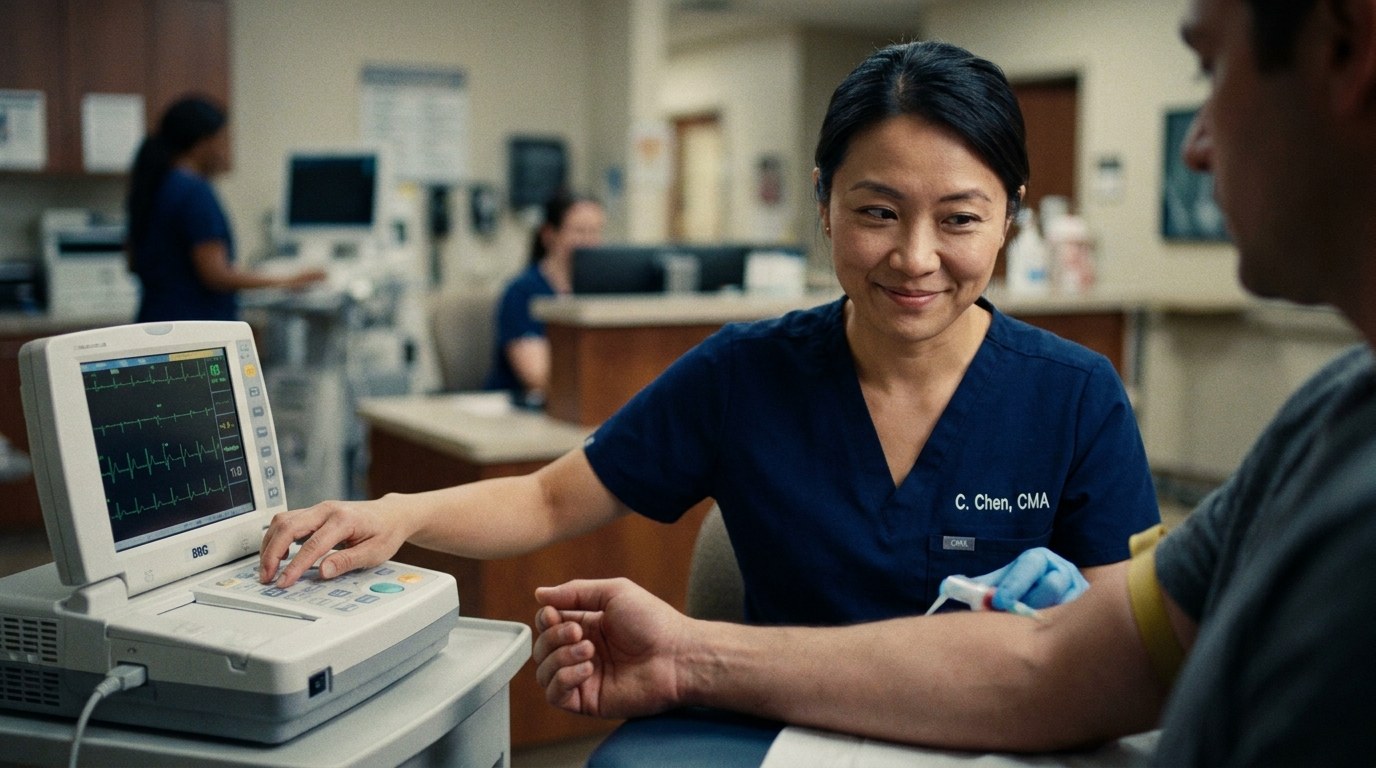
A medical assistant is a clinical support professional who works alongside physicians and other healthcare providers in outpatient settings.
The role sits at the intersection of administrative and clinical work. On any given day, a medical assistant might:
Most medical assistants work in physician offices, urgent care clinics, outpatient surgical centers, and specialty practices. It is a genuinely hands-on healthcare role — one that attracts people who want structured clinical work without the decade-long path to becoming a nurse or physician.
Why People Choose This Path
The appeal is real. Medical assisting offers a defined entry point into healthcare, relatively predictable hours compared to hospital-based roles, and strong job security. The U.S. Bureau of Labor Statistics projects 14% job growth for medical assistants through 2032 — significantly faster than the average for all occupations. (Source: BLS Occupational Outlook Handbook)
But here’s what many career explorers don’t factor in: the training timeline is longer than most people expect, certification is increasingly required for employment, and the income ceiling in Northern Virginia — while solid — is not dramatically higher than what a skilled esthetician or cosmetic laser technician earns in the same market.
More on that below.
—
What Is Medical Esthetics — and How Is It Different?
What Is Medical Esthetics — and How Is It Different?
Medical esthetics is the clinical side of skincare — and it’s one of the most overlooked career paths by people who think they have to choose between “healthcare” and “beauty.”
A medical esthetician or cosmetic laser technician doesn’t work at a day spa doing basic facials. They work in medical spas (medspas), dermatology offices, plastic surgery practices, and aesthetic clinics performing science-based treatments:
This is clinical-adjacent work. It requires an understanding of skin biology, wound healing, contraindications, and device operation — not just product knowledge. The clientele in Northern Virginia’s affluent communities (Tysons Corner, McLean, Great Falls, Reston) spend significantly more on these services than the national average, which directly translates into higher earning potential for providers.
The “Medical” Overlap You Didn’t Know Existed
Many medical estheticians work directly alongside plastic surgeons and dermatologists. Some complete both esthetician licensure and advanced training in laser and energy-based devices, positioning themselves squarely in the clinical workforce — without needing a nursing degree or four years of college.
That overlap — science-based, client-facing, hands-on clinical work — is exactly where a career in medical esthetics lives. And it’s precisely the space that programs like AVI Career Training’s Esthetics and Cosmetic Laser Technology tracks are designed to fill.
—
—
Salary, Demand, and Career Outlook: A Side-by-Side Look
Salary, Demand, and Career Outlook: A Side-by-Side Look
The salary comparison between medical assistants and estheticians is closer than most people expect — and in the right market, estheticians and cosmetic laser technicians can out-earn medical assistants significantly.
Medical Assistant Salary in Northern Virginia
According to the U.S. Bureau of Labor Statistics, the national median annual wage for medical assistants is approximately $42,000. The Northern Virginia and DC metro area, with its higher cost of living and concentration of specialty medical practices, typically pushes that figure to $48,000–$56,000 for experienced MAs in well-resourced practices.
Job growth is strong and real — 14% projected through 2032 is well above average, driven by an aging population and the expansion of outpatient care settings.
Esthetics and Cosmetic Laser Technician Salary in Northern Virginia
The national median for skincare specialists sits at approximately $40,000, but that figure is pulled down significantly by part-time workers and lower-cost markets. In Northern Virginia — home to some of the highest-income ZIP codes in the country — the picture looks very different.
Estheticians working in medspas, dermatology practices, or high-end day spas in the Tysons Corner and McLean corridor regularly earn $55,000–$80,000 when tips, retail commissions, and service commissions are factored in. Cosmetic laser technicians, who operate more advanced energy-based devices, often command $50,000–$90,000+ depending on their training credentials, the practice setting, and the volume of treatments they perform.
The BLS also projects 17% job growth for skincare specialists through 2032 — faster than medical assistants.
The Bottom Line on Salary
Neither career is a clear financial winner in isolation. What matters more is your market (Northern Virginia heavily favors esthetics), your specialization (advanced laser training pushes income higher), and your employment setting (medspas and plastic surgery practices pay more than day spas or physician offices for both roles).
—
Training Requirements and Time-to-Employment in Virginia
Training Requirements and Time-to-Employment in Virginia
This is where the two career paths diverge most sharply — and where the esthetics track has a meaningful advantage for people who want to start working sooner.
Medical Assistant Training in Virginia
Medical Assistant Training in Virginia
Virginia is one of the states that does not require medical assistants to hold a state license. The Virginia Department of Health Professions does not regulate the medical assistant profession at the licensure level. (Verify: Virginia Department of Health Professions)
However — and this is critical — most employers in the Northern Virginia market expect candidates to hold national certification through either:
Earning these certifications typically requires completing a formal medical assistant training program, most of which are offered as associate degree or diploma programs running 12–24 months. Community colleges and career schools in the Virginia/DC area offer both formats.
Estimated time to first job: 12–24 months, depending on program format.
Esthetician Licensing in Virginia
Esthetician Licensing in Virginia
Virginia does require estheticians to be licensed through the Virginia Board for Barbers and Cosmetology, administered by the Virginia Department of Professional and Occupational Regulation (DPOR). Licensure requires:
1. Completing an approved esthetics training program (verify current hour requirement with DPOR/VBBC)
2. Passing the Virginia State Board written and practical examinations
3. Submitting a licensure application to DPOR
The important point: approved esthetics programs in Virginia can be completed in significantly less time than a medical assistant associate degree — often in a matter of months, not years.
Estimated time to first job: As few as 5–8 months for graduates of intensive, full-time esthetics programs.
Cosmetic Laser Technician in Virginia
Cosmetic Laser Technician in Virginia
Cosmetic laser technician regulation in Virginia is more complex. Virginia law requires that certain laser procedures be performed under physician supervision, and the scope of what a laser technician can do independently versus under supervision depends on the specific treatment and the practice setting. If you’re exploring this career path, verify current requirements directly with the Virginia Board of Medicine before enrolling in any program.
That said, demand for trained laser technicians in Northern Virginia’s thriving medspa market is exceptionally high — and qualified candidates who hold both esthetics licensure and documented laser training are among the most sought-after professionals in the aesthetic industry.
—
—
Two Career Paths, One Honest Comparison
Meet Danielle. She was a pharmacy technician in her late 20s, living in Reston, Virginia. She loved working with people and wanted more hands-on clinical involvement — but she wasn’t ready to commit to a two-year associate degree program while working full-time. She started researching medical assistant programs, then stumbled onto the concept of medical esthetics while Googling one afternoon. Six months after enrolling in an esthetics program, she was licensed and working at a medspa in Tysons Corner, performing chemical peels and laser-assisted treatments under physician supervision, earning more per hour than she had as a pharmacy technician.
Meet Marcus. He was separating from the U.S. Air Force and exploring GI Bill®-eligible programs in Northern Virginia. He initially assumed healthcare meant nursing or medical assisting. A career counselor at his base pointed him toward cosmetic laser technology training as a high-demand, clinical-adjacent field that would qualify him for medspa and dermatology work in one of the wealthiest markets in the country. He enrolled, completed his training, and entered the aesthetic workforce months before his peers who had enrolled in longer degree programs.
Neither Danielle nor Marcus chose the “beauty school” path they’d imagined as teenagers. They chose science-based, client-facing clinical careers — and they got there faster than a traditional medical assistant route would have allowed.
—
If You Want a Clinical-Adjacent Beauty Career in Northern Virginia, Here’s Where to Start
If You Want a Clinical-Adjacent Beauty Career in Northern Virginia, Here’s Where to Start
AVI Career Training in Vienna, Virginia does not train medical assistants — but if what attracted you to medical assisting was the hands-on clinical work, the science, and the chance to genuinely help people, AVI’s programs may get you to a very similar destination, faster.
AVI Career Training is a COE-accredited (Council on Occupational Education), SCHEV-certified beauty and wellness career school located at 1595 Spring Hill Rd #720, Vienna, VA 22182 — minutes from the Tysons Corner corridor where Northern Virginia’s medspa and aesthetic clinic industry is concentrated.
Esthetics Programs at AVI
Esthetics Programs at AVI
AVI offers Basic Esthetics and Master Esthetics programs designed to prepare students for Virginia State Board licensure and immediate employment in spas, medspas, dermatology practices, and aesthetic clinics.
The curriculum is built around skin science, treatment protocols, advanced skincare techniques, and inclusive practice — training students to work effectively and confidently on every skin tone, not just a narrow demographic.
> ⚠️ Financial Aid Note: AVI’s Esthetics programs are under 600 hours and do not qualify for federal financial aid (Title IV / FAFSA). Payment plans and private financing options may be available. Contact AVI directly at (703) 943-9841 or apply here to discuss your options.
Cosmetic Laser Technology at AVI
Cosmetic Laser Technology at AVI
AVI’s Cosmetic Laser Technology program is the bridge between esthetics and clinical practice that most beauty schools don’t offer. Students learn to operate laser and energy-based devices used in medspas and physician-supervised aesthetic practices — the same technology driving some of the highest per-service revenue in the Northern Virginia market.
This program is particularly well-suited for:
> GI Bill® Note: AVI accepts GI Bill® benefits. If you’re a veteran or active-duty service member exploring your options, reach out to AVI admissions to verify eligibility for specific programs.
> ⚠️ Financial Aid Note: AVI’s Cosmetic Laser Technology program (NO FINANCIAL AID FOR THIS PROGRAM) is under 600 hours and does not qualify for federal financial aid (Title IV / FAFSA). Federal student aid is not available for this program. Contact AVI to discuss payment plan and private financing options.
Why AVI for This Career Path?
Why AVI for This Career Path?
Ready to explore your options? Apply now at AVI Career Training or call (703) 943-9841 to speak with an admissions advisor.
—
—
Frequently Asked Questions
Frequently Asked Questions
Q: How long does it take to become a medical assistant in Virginia?
A: Most medical assistant programs in Virginia run 12–24 months. Associate degree programs typically take two years; diploma or certificate programs can be completed in 12–15 months. Employers generally expect national certification (CMA through AAMA or RMA through AMT) in addition to completing a formal program.
—
Q: What is the difference between a medical assistant and an esthetician?
A: A medical assistant works in physician offices and clinical settings performing tasks like taking vitals, drawing blood, and assisting with patient intake — general clinical support under physician supervision. An esthetician is a licensed skincare professional who performs skin treatments such as facials, chemical peels, and (with additional training) laser and energy-based procedures. Medical estheticians work in clinical settings including medspas and dermatology practices, making the two roles more adjacent than most people realize.
—
Q: Do medical assistants or estheticians make more money?
A: Nationally, the median salaries are close — approximately $42,000 for medical assistants and $40,000 for estheticians (BLS). In the Northern Virginia and DC metro market, top-earning estheticians and cosmetic laser technicians working in medspas and high-end aesthetic practices often out-earn medical assistants — particularly when commissions, tips, and advanced laser service fees are factored in. Earning potential in both fields depends heavily on employer, specialization, and experience.
—
Q: What certifications do you need to work in medical esthetics?
A: In Virginia, the foundational requirement for most medical esthetics roles is an esthetician license from the Virginia Board for Barbers and Cosmetology (administered by DPOR). Many medical esthetics employers also require or strongly prefer documented training in laser and energy-based devices — such as the training offered in AVI Career Training’s Cosmetic Laser Technology program. Some positions in physician-supervised settings may have additional requirements; always verify with the relevant licensing board before enrolling in any program.