
Medical Assistant vs. Esthetics: Which Career Fits You?
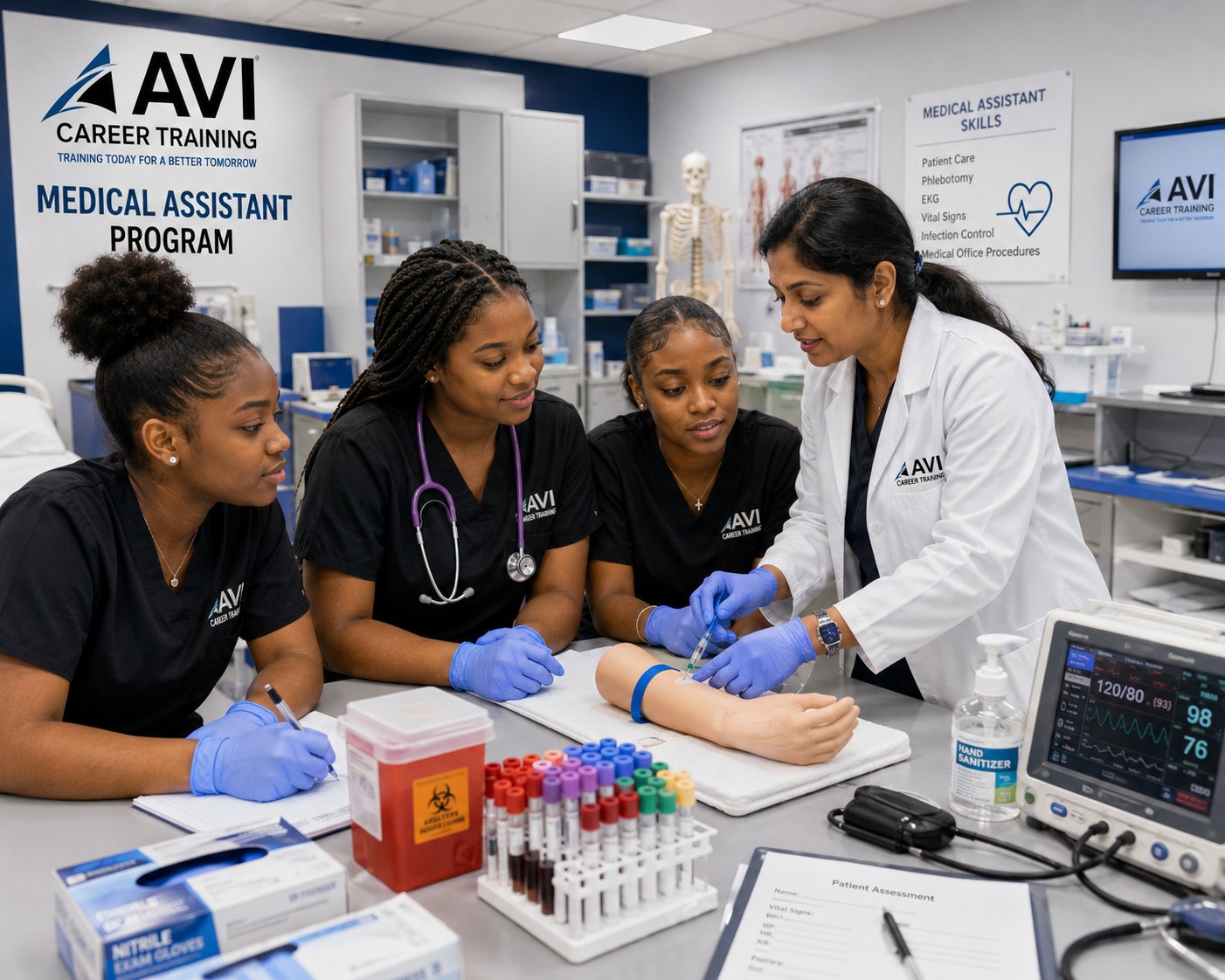
Medical assisting suits people who want to work in traditional clinical healthcare alongside doctors and nurses; esthetics and cosmetic laser careers suit people drawn to appearance-focused, outcomes-driven work in med spas and cosmetic clinics. The right choice depends on how you want to spend your days, how fast you need to start earning, and which work environment excites you most.
Both paths offer real, stable employment in the Northern Virginia and DC metro area. Both can lead to clinical or medical-adjacent settings. But they differ significantly in training format, licensing, daily duties, and long-term earning potential — especially in a market like Tysons Corner and Vienna, VA, where med spas and cosmetic clinics are growing fast.
This guide breaks down both careers side by side so you can make a confident, informed choice.
Apply Now at AVI Career Training →
—
Key Takeaways
- Medical assistant programs in Virginia typically run 9–24 months; AVI’s esthetics and cosmetic laser programs are designed for faster entry into the workforce.
- Virginia medical assistants earn approximately $38,000–$46,000 per year (BLS); med spa estheticians and laser technicians in Northern Virginia can earn competitively, with top earners exceeding that range in high-demand clinical settings.
- The medical spa industry is one of the fastest-growing segments of the U.S. healthcare-adjacent economy, with the American Med Spa Association (AmSpa) tracking consistent year-over-year growth through 2030.
- Estheticians in Virginia are licensed through the Virginia Department of Professional and Occupational Regulation (DPOR) — a recognized professional credential, not a certificate of completion.
- AVI Career Training in Vienna, Virginia is COE-accredited and offers both Basic Esthetics and Cosmetic Laser Technician programs in the heart of the Northern Virginia market.
—
What Does a Medical Assistant Actually Do?
A Direct Answer First
A medical assistant (MA) works in clinical healthcare settings — typically physician offices, urgent care centers, or outpatient clinics — handling both patient-facing clinical tasks and back-office administrative duties.
On the clinical side, MAs take vital signs, prepare patients for exams, draw blood, administer injections, and assist physicians during procedures. On the administrative side, they schedule appointments, manage medical records, handle insurance authorizations, and process billing.
It’s a role that keeps healthcare operations running. If you’re drawn to traditional medicine, want to work alongside doctors and nurses, and don’t mind a structured, fast-paced clinical environment — medical assisting is a legitimate and respected path.
Virginia-Specific Training Requirements
Unlike estheticians or cosmetologists, medical assistants in Virginia are not state-licensed through DPOR. Most employers prefer or require a formal certificate or associate degree, and some require national certification (such as the Certified Medical Assistant credential through the AAMA, or the RMA through AMT).
Training programs in Virginia typically run 9 to 24 months, depending on whether you pursue a certificate or an associate’s degree through a community college or private career school. Virginia’s community college system (VCCS) offers MA programs at multiple campuses throughout Northern Virginia.
—
What Is Medical Esthetics — and How Is It Different?
Not Just “Beauty School”
Medical esthetics is a specialized career lane within the licensed esthetics profession — one that focuses on clinical skin treatments, advanced technology, and outcomes-driven care rather than relaxation services alone.
A medical esthetician might work in a dermatology office, a plastic surgery practice, or — most commonly in Northern Virginia — a medical spa (med spa). Their scope of work includes chemical peels, microdermabrasion, medical-grade facials, pre- and post-surgical skin care, and increasingly, cosmetic laser treatments under appropriate supervision.
This is meaningfully different from a traditional esthetician working in a day spa. The environment is more clinical. The client base is treatment-focused. And the income ceiling is generally higher.
The Cosmetic Laser Technician Lane
One of the fastest-growing roles in the medical esthetics space is the Cosmetic Laser Technician — a professional trained to operate laser and light-based devices for hair removal, skin rejuvenation, pigmentation correction, and other aesthetic treatments.
In Virginia, laser technicians work under the supervision of a licensed physician or medical director. This is a medical-adjacent career that puts you squarely inside a clinical setting — without the length or cost of a traditional healthcare degree program.
AVI Career Training in Vienna, Virginia offers a Cosmetic Laser Technician program designed to train students for exactly this environment — in the heart of the Northern Virginia market where demand for these services is growing. (NO FINANCIAL AID FOR THIS PROGRAM — see Tuition section below for payment options.)
> “I wanted to work in a medical setting, but I wasn’t sure I wanted to be a nurse or MA,” says a former student who completed AVI’s cosmetic laser training. “Learning laser treatments put me in a clinical environment doing real aesthetic work — and I was working at a med spa in Tysons within months of graduating.”
If you’re drawn to the clinical world but also want creative, appearance-focused work, the medical esthetics lane — and specifically cosmetic laser — may be a better fit than a traditional medical assistant role.
—
Training Time, Cost, and Path to Licensing — Side by Side
The Comparison Most Decision-Makers Need
This is where the two paths diverge most clearly. Here’s an honest, side-by-side look:
| Factor | Medical Assistant (VA) | Esthetics / Cosmetic Laser (AVI) |
|---|---|---|
| Program Length | 9–24 months | Months (contact AVI for current program schedule) |
| State License Required? | No (employer certification preferred) | Yes — Virginia DPOR license for esthetics |
| Licensing Exam | Optional national cert (AAMA, AMT) | Virginia State Board exam (administered through DPOR) |
| Work Settings | Physician offices, urgent care, clinics | Med spas, dermatology, cosmetic clinics, salons |
| Federal Financial Aid | Often available (FAFSA-eligible programs) | ⚠️ NOT available for AVI’s Cosmetic Laser program (under 600 hours) |
| Hands-On Training Focus | Clinical procedures + administrative skills | Skin treatments, laser technology, client consultation |
⚠️ Important: Tuition & Financial Aid for AVI’s Cosmetic Laser Program
AVI Career Training’s Cosmetic Laser Technician program is under 600 hours in length. As a result, federal financial aid (Title IV / FAFSA) is NOT available for this program.
AVI’s Basic Esthetics program may qualify for financial aid — contact AVI directly to confirm eligibility based on current program hours.
For the Cosmetic Laser program, AVI works with students on payment plans and private financing options. Call (703) 943-9841 to discuss what works for your budget, or apply online and an admissions advisor will walk you through your options.
A note on AVI’s Esthetics program: Virginia requires 600 hours of training for a standard esthetics license through DPOR. AVI’s Basic Esthetics program meets this requirement. The Cosmetic Laser Technician program (NO FINANCIAL AID FOR THIS PROGRAM) is a separate, shorter-format program focused specifically on laser and energy-based device operation. Contact AVI Career Training directly for current program hours, schedule, and tuition — admissions advisors can clarify which path fits your goals.
—
Salary and Job Outlook in Northern Virginia
What the Numbers Actually Say
Northern Virginia and the DC metro area consistently rank among the highest-paying markets in the Southeast for both healthcare-adjacent and beauty/wellness careers. That matters when you’re evaluating earning potential.
(Source: U.S. Bureau of Labor Statistics — verify at BLS.gov before publishing)
(Source: American Med Spa Association / AmSpa — verify current projection)
(Source: Virginia Employment Commission / BLS metro data)
Medical Assistant Earning Potential
Virginia medical assistants earn approximately $38,000–$46,000 per year at the median, according to Bureau of Labor Statistics data (verify current figures at BLS.gov before publishing). In Northern Virginia and the DC metro area, that range tends to run higher given the regional cost of living and concentration of large healthcare systems like Inova Health System and Kaiser Permanente.
Advancement in the MA field typically requires additional certifications or further education — often moving toward medical coding, phlebotomy specialization, or eventually an LPN or RN path if clinical advancement is the goal.
Esthetician and Laser Technician Earning Potential
Licensed estheticians working in med spas or clinical settings — particularly those with cosmetic laser skills — often earn significantly more than their counterparts in traditional day spas. Commission-based and tip-inclusive compensation structures in med spas can push total annual income well above the base salary range, especially in high-traffic Northern Virginia markets like Tysons Corner, McLean, and Reston.
Cosmetic laser technicians are in particularly high demand as med spa services expand. The skill set is specialized, the equipment is expensive, and trained operators are not abundant. That supply-demand gap creates real negotiating power for qualified technicians in the DC metro market.
Here’s a career story that makes this concrete:
Tamara had been working as a front-desk coordinator at an urgent care clinic in Fairfax for three years. She liked healthcare but wanted to do something more hands-on — something where she could see visible results for her clients. She looked at medical assistant programs but didn’t want another year and a half of school. After researching med spa careers, she enrolled in AVI Career Training’s Cosmetic Laser Technician program (NO FINANCIAL AID FOR THIS PROGRAM) in Vienna. Within months of completing the program, she was working at a med spa near Tysons Corner performing laser hair removal and skin treatments — earning more than she had at the clinic, with a schedule she actually enjoyed.
—
How to Choose the Right Path for Your Goals
Four Questions to Help You Self-Select
You don’t need to guess which path fits you. Answer these four questions honestly, and the right direction will become clearer.
1. Do you want to work in traditional clinical medicine?
If your goal is to eventually become a nurse, physician assistant, or other licensed healthcare provider — and you want experience that counts toward that trajectory — a medical assistant role makes sense as a stepping stone. It puts you inside hospitals and physician offices, building clinical vocabulary and patient care experience that transfers.
If that’s not your goal, the structured medical pathway may be longer and more constrained than you need.
2. Do you care deeply about aesthetics, appearance, and skin?
If what actually excites you is helping people look and feel better — improving skin texture, reducing unwanted hair, correcting pigmentation, delivering visible cosmetic results — then medical esthetics and cosmetic laser are a natural fit. You’ll be in a clinical-feeling environment, but your work is focused on transformation, not treatment of illness.
3. How fast do you need to start earning?
Medical assistant programs require 9–24 months before you’re job-ready. AVI’s esthetics and cosmetic laser programs are designed for faster entry into the workforce. If you need to be earning within months, not years, the shorter program format matters — especially if you’re a career changer with existing financial commitments.
4. Do you want a state license or employer certification?
Virginia estheticians hold a state license issued by DPOR — a portable, recognized professional credential that goes with you everywhere you work. Medical assistants in Virginia are not state-licensed; their credentials are employer- or certification-body driven. For some people, holding an actual state professional license matters. For others, it doesn’t. Know which camp you’re in.
If You’re Drawn to the Aesthetics/Clinical-Beauty Lane
AVI Career Training in Vienna, Virginia is built for exactly this path. As a COE-accredited school, AVI offers:
AVI’s campus is in Vienna, VA — minutes from Tysons Corner and the broader Northern Virginia med spa market where you’ll be building your career. The instructors are licensed industry professionals. The training is hands-on from day one.
Apply Now at AVI Career Training →
—
Frequently Asked Questions
Q: Is a medical assistant career worth it compared to esthetics?
A: It depends on your goals. Medical assisting offers a clear path into traditional clinical healthcare, but training takes 9–24 months and median Virginia salaries range from $38,000–$46,000. Esthetics and cosmetic laser careers in Northern Virginia med spas can be competitive in pay — often with commission upside — and require shorter training timelines. If you want to stay in clinical healthcare long-term, MA may be the better fit. If you’re drawn to aesthetics and want faster entry into the workforce, esthetics or cosmetic laser is worth serious consideration.
—
Q: How long does it take to become a medical assistant in Virginia?
A: Medical assistant programs in Virginia typically run 9 to 24 months depending on whether you pursue a certificate (shorter) or an associate degree (longer) through a community college or private career school. Virginia does not require state licensure for MAs, but most employers prefer formal training and some require national certification through bodies like the AAMA or AMT.
—
Q: What is the difference between a medical esthetician and a medical assistant?
A: A medical esthetician is a state-licensed esthetics professional (licensed through Virginia DPOR) who specializes in clinical skin treatments — often in med spas, dermatology offices, or plastic surgery practices. A medical assistant handles both clinical tasks (vital signs, blood draws, patient prep) and administrative duties in traditional medical settings. Medical estheticians focus entirely on skin health and cosmetic outcomes; MAs support broader patient care across medical specialties.
—
Q: Can estheticians work in medical offices or med spas in Virginia?
A: Yes. Licensed Virginia estheticians — credentialed through DPOR — can work in med spas, dermatology offices, plastic surgery practices, and other clinical-adjacent settings. Cosmetic laser technicians work specifically with laser and energy-based devices under physician supervision. Northern Virginia has a strong and growing med spa market in areas like Tysons Corner, McLean, Reston, and Fairfax, creating consistent demand for trained esthetics professionals.
—
Q: What beauty school programs lead to medical spa careers?
A: Programs that lead most directly to med spa careers include Basic Esthetics (which qualifies you for Virginia DPOR licensure), Master Esthetics (advanced skin treatments), and Cosmetic Laser Technician training. AVI Career Training in Vienna, Virginia offers all three in the Council on Occupational Education (COE) accredited format — making it one of the most recognized beauty and wellness schools for medical-